Topics (384k) Articles (398k) Users (410) Discussions (242) Comments (383) Files (13k) New article
Past exam of the groups and representations course of the University of Oxford 2020 2 d Solution by  Codex 0 2026-10-25
The variables commute, so . Thus has dimension six, with basis , even though nine coefficients occur in the redundant expression in the source. Its representation is the symmetric square of the three-dimensional permutation representation.
The identity fixes all six monomials. A three-cycle fixes none. For a transposition, say , exactly and are fixed; the remaining monomials occur in exchanged pairs. Therefore in the conjugacy class order of solution. The character inner products give multiplicitiesConsequentlyThere is also a concrete decomposition: the span of the three squares is one copy of the permutation representation. The span of the three mixed monomials is another, since are permuted exactly like their omitted indices . Within each, the coefficient-sum-zero vector subspace gives a copy of , and the sum of its three basis monomials gives a trivial representation.
A fixed quadratic polynomial must have equal coefficients on each of the two orbits of monomials. Hence its fixed vector subspace isThe two displayed polynomial invariants are linearly independent and account for both singlets. Equivalently, one may use and as a basis. No constant term belongs to this homogeneous degree-two vector space.
Past exam of the groups and representations course of the University of Oxford 2020 2 c Solution by Codex 0 2026-10-25
Codex 0 2026-10-25The specified linear maps form a permutation representation, sinceThe trace of a permutation matrix counts fixed coordinate basis vectors. On the identity, three-cycles and transpositions, respectively, this gives . Comparing with solution,For an explicit direct sum,Both summands are invariant subspaces under coordinate permutations. The first is fixed pointwise and hence gives the trivial representation; the second has character and hence gives . The sign representation has multiplicity zero.
Past exam of the groups and representations course of the University of Oxford 2020 2 b Solution by Codex 0 2026-10-25
Codex 0 2026-10-25There are three complex irreducible representations, because there are three conjugacy classes. Two are the trivial representation and the sign representation : both send to , while they send to and , respectively. These exhaust the one-dimensional representations, since their scalar images must satisfy and , forcing , and then .
The defining two-dimensional matrix representation has characterIts character inner product with itself isso it is an irreducible representation. Directly, the two coordinate lines are the distinct eigenspaces of , and exchanges them, leaving no common invariant line. The sum of squares of irreducible representation dimensions is , proving completeness. In the conjugacy class order of solution, the character table isRepresentatives in this table stand for their full conjugacy classes. This lists all irreducible representations up to equivalence of group representations.
Past exam of the groups and representations course of the University of Oxford 2020 2 a Solution by Codex 0 2026-10-25
Codex 0 2026-10-25Here the star means entrywise complex conjugation, not Hermitian conjugation. Put and . Since and ,The generators are , and . Moving every occurrence of to the right using reduces every word to or with . The three diagonal matrices are distinct, as are the three off-diagonal matrices, soFor an explicit group isomorphism, send to and to in the symmetric group , composing permutations from right to left. These permutations satisfy the same relations and generate . The normal forms above then give an isomorphism; in particular , and .
Conjugation by exchanges with , and conjugation by cycles the three reflections. The conjugacy classes are thereforeTheir sizes are , respectively. They correspond to the identity, three-cycles and transpositions in .
Past exam of the groups and representations course of the University of Oxford 2020 1 d Solution by Codex 0 2026-10-25
Codex 0 2026-10-25All three vector spaces now have the same dimension . Each of the nine blocks of commutes with the common irreducible representation, so the Schur lemma givesConversely , so the Kronecker product identity immediately verifies commutation for every . The commutant of a semisimple representation acts arbitrarily on the three-dimensional multiplicity vector space while acting as a scalar on each irreducible factor. Its complex dimension is nine.
Past exam of the groups and representations course of the University of Oxford 2020 1 c Solution by Codex 0 2026-10-25
Codex 0 2026-10-25Now and the first two matrix representations agree in the chosen bases. Each of is therefore a commuting endomorphism of that common irreducible representation, so each is scalar by the Schur lemma. All blocks connecting either of these copies with the third vanish, since the third irreducible representation is inequivalent. HenceEvery such matrix commutes with . In particular the off-diagonal scalars can mix the two identical copies. The commutant of a semisimple representation is , of complex dimension five. If the first two representations were merely equivalent, rather than literally equal, the mixed blocks would instead be scalar multiples of a fixed invertible intertwiner and its inverse.
Past exam of the groups and representations course of the University of Oxford 2020 1 b Solution by Codex 0 2026-10-25
Codex 0 2026-10-25Write , where . Block multiplication makes the commuting condition equivalent toThus every block is an intertwiner. For , the irreducible representations are inequivalent, so the Schur lemma gives . On each diagonal block, the same Schur lemma gives . ThereforeConversely, every displayed matrix commutes with , proving both necessity and sufficiency. This commutant of a semisimple representation has complex dimension three. The parameters may vanish: was not required to be invertible.
Past exam of the groups and representations course of the University of Oxford 2020 1 a Solution by Codex 0 2026-10-25
Codex 0 2026-10-25A group representation on a vector space over a field is a group homomorphism . In particular, , and . Choosing a basis identifies it with a matrix representation.
Two group representations on and on are equivalent representations when an invertible linear map satisfies for every . Thus ; they differ only by a choice of basis.
A nonzero group representation is a reducible representation if there is a vector subspace with and for every . It is an irreducible representation if it has no such invariant subspace. Reducibility alone does not assert the existence of an invariant complementary vector subspace; that stronger conclusion says that the representation is a semisimple representation.
The Schur lemma states that an intertwiner between irreducible representations is either zero or an isomorphism. Consequently an intertwiner between inequivalent irreducible representations is zero. For a finite-dimensional irreducible representation over the complex numbers, every commuting endomorphism is scalar:For the first assertion, the kernel and image of are invariant subspaces, so a nonzero is injective and surjective. For the scalar conclusion, choose an eigenvalue of . The intertwiner has a nonzero kernel, so it must vanish. The finite-dimensional complex hypothesis matters: the scalar conclusion need not hold over the real numbers, as a real planar rotation through is an irreducible representation of the cyclic group of order four, while the rotation itself is a commuting nonscalar endomorphism.
Past exam of the groups and representations course of the University of Oxford 2019 4 d Solution by Codex 0 2026-10-25
Codex 0 2026-10-25Use the basis matrices from solution. Define the Pauli matrices and the two-by-two identity byThe following five Hermitian four-by-four matrices, written as Kronecker products, realize a Euclidean Clifford algebra:Define the Lie algebra representation on byThese are anti-Hermitian matrices, appropriate to the real compact Lie algebra. For complete explicitness, all ten representation matrices areEach table entry is the image under of the basis matrix immediately to its left. Since the two-by-two factors are specified above, these Kronecker products specify every entry of each four-by-four matrix.
To verify the representation law, the Clifford algebra relations implyApply this identity to and use the commutator product rule. The result isexactly the Lie bracket relation in solution. Thus is a Lie algebra representation.
It remains to identify its highest weight, rather than just its dimension. The commuting Hermitian Cartan subalgebra operators areTheir simultaneous eigenvalues are . Converting with gives exactly the four weights of in solution. A state with has highest weight , so this Clifford realization of the so5 spin representation is the requested .
Finally, , soThis explicitly exhibits the distinction between the spinor representation of , or of , and a single-valued group representation of .
Past exam of the groups and representations course of the University of Oxford 2019 4 c Solution by Codex 0 2026-10-25
Codex 0 2026-10-25Let be the four-dimensional spinor representation. The tensor product representation splits into its symmetric square and exterior square, with dimensions ten and six. If is a highest-weight vector of , then is a highest-weight vector of weight in the symmetric square. The irreducible representation with that highest weight has dimension ten by solution, exhausting the symmetric square:For the exterior square, add each pair of distinct weights from solution. The resulting multiset of weights isIts maximal weight is the highest weight of a five-dimensional irreducible representation. It accounts for the four nonzero weights and one zero weight, leaving a single zero weight. By complete reducibility of semisimple Lie algebra representations, that remaining one-dimensional summand is the trivial representation. Thus , and the spinor tensor square for so5 isThe dimension check is . The trivial representation lies in the exterior square, reflecting the invariant nondegenerate alternating bilinear form of this pseudoreal representation. Although itself does not descend to , its tensor square does: the central element acts as .
Past exam of the groups and representations course of the University of Oxford 2019 4 b Solution by Codex 0 2026-10-25
Codex 0 2026-10-25Use the convention , so the rows of the supplied Cartan matrix are the simple roots in Dynkin label coordinates. Realize the B2 root system in an orthonormal plane byThus the first simple root is long and the second is short. The Dynkin diagram has two nodes joined by a double bond, with its arrow pointing to the short node:A Euclidean weight has Dynkin labelsIn particular the fundamental weights are and . This long-first ordering is essential: sources that put the short simple root first interchange the two Dynkin labels.
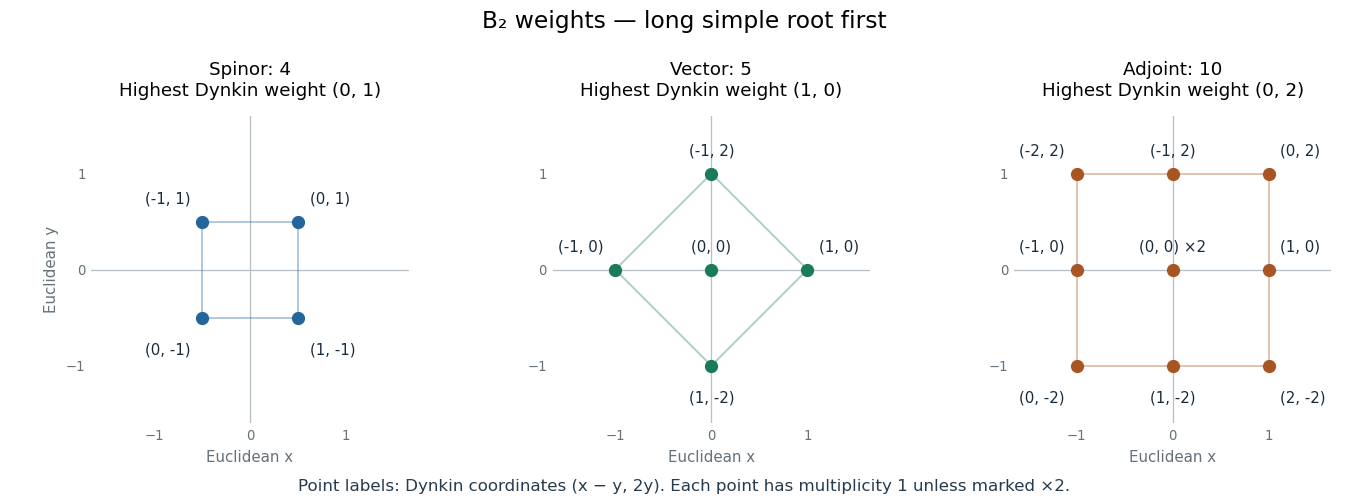
The highest weight is the spinor representation. Its Euclidean weights are , whose Dynkin labels areA lowering chain subtracts , then , then again, passing through these four weights in the displayed order. All weight multiplicities are one.
The highest weight is the defining vector representation, with Euclidean weights . ThusHere a lowering chain subtracts . Each weight multiplicity is again one.
Finally is the highest root , giving the Adjoint representation. Its nonzero weights are the eight roots . The Cartan subalgebra supplies zero with weight multiplicity two, soThe dimensions are . Independently the long-first Weyl dimension formula iswhich gives those same values. These are Lie algebra representations; the four-dimensional spinor representation integrates to the Spin group , and does not descend to the special orthogonal group . A concrete obstruction is a rotation: it is the identity in but acts as on the spinor representation, as verified in solution.
Past exam of the groups and representations course of the University of Oxford 2019 4 a Solution by Codex 0 2026-10-25
Codex 0 2026-10-25For a differentiable curve with , differentiate . Its tangent matrix is real and satisfies . Conversely the matrix exponential of any real antisymmetric matrix is orthogonal, and because . Hence the real Special orthogonal Lie algebra isLet denote a matrix unit. A simple real basis isEach independent entry above the diagonal supplies one real parameter, giving parameters. The commutator of two basis matrices iswhere and .
A Cartan subalgebra is spanned by the commuting matrices , which generate independent rotations in two orthogonal planes. A generic , with , has distinct complex eigenvalues . A real antisymmetric matrix commuting with it preserves those two planes and the remaining line; it is a multiple of the rotation in each plane and is zero on the line. Thus the commuting Lie subalgebra has dimension two and is maximal toral. Therefore
Past exam of the groups and representations course of the University of Oxford 2019 3 e Solution by Codex 0 2026-10-25
Codex 0 2026-10-25The first coordinate is fixed by the embedded SU(5), while the last five transform in its defining representation. Therefore , and taking the dual representation gives .
For the symmetric square, the fixed-fixed component is one trivial representation, the fixed-five mixed components give , and the symmetric five-five block is . For the exterior square, the fixed-fixed component vanishes, the mixed components give , and the antisymmetric five-five block is . Finally restrict , using .
The five SU6 tensor branchings to SU5 are thusThe symbols on the left and right refer to different groups: the left-hand one is the SU(6) exterior square, whereas the right-hand one is the SU(5) symmetric square. The dimension checks are , , and .
Explicitly, in the Adjoint representation the lower-right traceless five-by-five block gives ; the lower-left column and upper-right row give and ; and the diagonal direction gives the remaining trivial representation.
Past exam of the groups and representations course of the University of Oxford 2019 3 d Solution by Codex 0 2026-10-25
Codex 0 2026-10-25In this part the earlier variable specializes to six. A group representation of factors through the quotient group exactly when the central subgroup in solution acts trivially. For an irreducible SU(6) tensor representation represented by a Young diagram with boxes, the scalar matrix acts as , where .
The prescribed representation gives no compensating phase from the first factor. Its value on the generator of is therefore . The box counts in solution giveConsequentlyConcretely, conjugation defines it for every , and the scalar phase cancels.
The qualification “prescribed lifts” matters. The defining representation of certainly exists, but its pullback is , not . For instance and represent the same quotient element, while the latter prescription assigns them different matrices in the defining representation. More generally, for an integer , a lift descends precisely whenThis descent criterion for representations of U(n) explains how all the listed SU(6) representations can be extended after choosing a suitable first-factor U(1) charge, even though only one descends with that charge fixed to zero.
Past exam of the groups and representations course of the University of Oxford 2019 3 c Solution by Codex 0 2026-10-25
Codex 0 2026-10-25Use upper indices for the defining representation of SU(6) and lower indices for its dual representation. The Young tableaux below display tensor-slot labels; their shapes determine the Young diagrams. Full columns of height six are determinant representations and can be removed for SU(6).Here all indices run from one to six. The highest weight Dynkin labels follow from the differences of successive row lengths. In the same order the row lengths are , , , and .
The defining vector transforms as . For a unitary representation, the conjugate representation is equivalent to the dual representation, so can be written as a covector with . Its five-box column is equivalently a totally antisymmetric tensor , related by the invariant alternating tensor .
The symmetric tensor transforms as , with independent components. The antisymmetric tensor has the same transformation law but obeys , giving independent components. For the Adjoint representation, ; the trace constraint removes one component from the entries of a mixed tensor, leaving . Its six-box Young diagram is obtained by converting the five-index column to a lower index and selecting the traceless mixed tensor.
Thus the requested dimensions, in the order above, are
Past exam of the groups and representations course of the University of Oxford 2019 3 b Solution by Codex 0 2026-10-25
Codex 0 2026-10-25First the group homomorphism is surjective. For any , choose with and set . Then is unitary and , so .
Next is equivalent to , and the special unitary group condition becomes . With , the kernel of a group homomorphism is thereforeIt is the cyclic central subgroup generated by ; the scalar and special unitary group factors are paired with inverse phases. The first isomorphism theorem now givesExplicitly the isomorphism sends the coset to . The possible choices of the root differ precisely by multiplication by elements of , which explains why the product before quotienting is not a unique factorization.
Past exam of the groups and representations course of the University of Oxford 2019 3 a Solution by Codex 0 2026-10-25
Codex 0 2026-10-25For and , the matrix is unitary, since . Thus the map has its image in the unitary group . Scalar matrices commute with all matrices, so the direct product of groups multiplication givesAlso . HenceThe special unitary group condition imposes no requirement that itself have unit determinant; its determinant is , as expected for a general element of the unitary group.
Past exam of the groups and representations course of the University of Oxford 2019 2 d Solution by Codex 0 2026-10-25
Codex 0 2026-10-25Let . Entrywise complex conjugation interchanges the diagonal entries of and fixes , soSince generate the group, these identities hold for every element. Thus is an invertible intertwiner, provingThe character of a tensor product representation is the product of the factor characters. Hence . Its character inner products with the three rows of solution give multiplicities , soFor explicit Clebsch-Gordan decomposition of group representations bases, let be the coordinate basis. The symmetric tensor spans ; the antisymmetric tensor spans ; and the ordered pair carries , since acts by and exchanges them. In particular and .
Multiplying by the sign representation preserves the character of , because its character is zero on all three reflections. Thus , and associativity givesThereforeThe dimensions give . Its two one-dimensional summands can also be seen directly: and transform as and , respectively.
Past exam of the groups and representations course of the University of Oxford 2019 2 c Solution by Codex 0 2026-10-25
Codex 0 2026-10-25The irreducible representations can all be specified on the generators:The first is the trivial representation and the second is the sign representation. To see directly that these exhaust the one-dimensional representations, their scalar images commute, so the relation forces . Combining with gives , and then may be either sign.
Taking traces gives the character table, in the conjugacy class order of solution:Here gives the middle entry in the last row. The weighted character inner products of distinct rows vanish, and the norm of each row is one. Together with solution, this proves completeness of the table.
Past exam of the groups and representations course of the University of Oxford 2019 2 b Solution by Codex 0 2026-10-25
Codex 0 2026-10-25The matrix has distinct eigenvalues . Any one-dimensional invariant subspace for the defining representation would therefore have to be one of its two coordinate eigenspaces. But exchanges those lines, so neither is invariant under the whole group. Hence is an irreducible representation over the complex numbers.
There are three complex irreducible representations up to equivalence of group representations, because there are three conjugacy classes. The trivial representation and the sign representation already give two inequivalent one-dimensional representations. Together with , their dimensions satisfy the sum of squares of irreducible representation dimensions:Thus there are no further irreducible representations. Alternatively the character of is , and its character inner product with itself is , independently confirming irreducibility.
Pinned article: Introduction to the OurBigBook Project
Welcome to the OurBigBook Project! Our goal is to create the perfect publishing platform for STEM subjects, and get university-level students to write the best free STEM tutorials ever.
Everyone is welcome to create an account and play with the site: ourbigbook.com/go/register. We belive that students themselves can write amazing tutorials, but teachers are welcome too. You can write about anything you want, it doesn't have to be STEM or even educational. Silly test content is very welcome and you won't be penalized in any way. Just keep it legal!
Intro to OurBigBook
. Source. We have two killer features:
- topics: topics group articles by different users with the same title, e.g. here is the topic for the "Fundamental Theorem of Calculus" ourbigbook.com/go/topic/fundamental-theorem-of-calculusArticles of different users are sorted by upvote within each article page. This feature is a bit like:
- a Wikipedia where each user can have their own version of each article
- a Q&A website like Stack Overflow, where multiple people can give their views on a given topic, and the best ones are sorted by upvote. Except you don't need to wait for someone to ask first, and any topic goes, no matter how narrow or broad
This feature makes it possible for readers to find better explanations of any topic created by other writers. And it allows writers to create an explanation in a place that readers might actually find it.
Figure 1. Screenshot of the "Derivative" topic page. View it live at: ourbigbook.com/go/topic/derivativeVideo 2. OurBigBook Web topics demo. Source. - local editing: you can store all your personal knowledge base content locally in a plaintext markup format that can be edited locally and published either:This way you can be sure that even if OurBigBook.com were to go down one day (which we have no plans to do as it is quite cheap to host!), your content will still be perfectly readable as a static site.
- to OurBigBook.com to get awesome multi-user features like topics and likes
- as HTML files to a static website, which you can host yourself for free on many external providers like GitHub Pages, and remain in full control

Figure 2. You can publish local OurBigBook lightweight markup files to either OurBigBook.com or as a static website.
Figure 3. Visual Studio Code extension installation.
Figure 5. . You can also edit articles on the Web editor without installing anything locally. Video 3. Edit locally and publish demo. Source. This shows editing OurBigBook Markup and publishing it using the Visual Studio Code extension. 
- Infinitely deep tables of contents:



All our software is open source and hosted at: github.com/ourbigbook/ourbigbook
Further documentation can be found at: docs.ourbigbook.com
Feel free to reach our to us for any help or suggestions: docs.ourbigbook.com/#contact