Topics (384k) Articles (398k) Users (410) Discussions (242) Comments (383) Files (13k) New article

Takashi Nakamura, with Takenori Nakano, analyzed the gravitational instability of an isothermal gaseous disk threaded perpendicularly by a frozen-in magnetic field. Their 1978 linear stability analysis showed how magnetic support changes whether perturbations can collapse.[ref]
The competition is scale dependent: gas pressure stabilizes sufficiently short wavelengths, while the mass-to-flux ratio determines whether gravity can overcome magnetic support at larger scales.
A. Arcones developed equilibrium bounds on the electron fraction in stellar matter with G. Martínez-Pinedo, L. F. Roberts and S. E. Woosley. Their 2010 study applied nuclear statistical equilibrium and beta equilibrium to obtain lower limits relevant to Type Ia supernovae and accretion-induced collapse.[ref]
G. Martínez-Pinedo studied how nuclear composition constrains the electron fraction in stellar matter. With A. Arcones, L. F. Roberts and S. E. Woosley, he tested combined nuclear statistical equilibrium and beta equilibrium against presupernova models, rather than assuming every evolving plasma has reached equilibrium.[ref]
L. F. Roberts helped calculate equilibrium constraints on the electron fraction in stellar matter. The 2010 study with A. Arcones, G. Martínez-Pinedo and S. E. Woosley sought limits less sensitive to uncertain weak-interaction rates, using nuclear statistical equilibrium together with beta equilibrium.[ref]
S. E. Woosley investigated the electron fraction in stellar matter with A. Arcones, G. Martínez-Pinedo and L. F. Roberts. Their 2010 calculation combined nuclear statistical equilibrium with beta equilibrium conditions to constrain composition in presupernova and collapse environments.[ref]
Electron fraction constraints based on nuclear statistical equilibrium with beta equilibrium by A. Arcones and others. Abstract: equilibrium constraints and astrophysical tests
John D. Richardson studies space plasmas, including the solar wind and its interaction with the interstellar medium. MIT identifies him as a principal investigator of the Voyager plasma experiment and describes earlier work on plasma transport in planetary magnetospheres.[ref]
https://www.space.mit.edu/people/john-richardson/. MIT Kavli Institute, John Richardson, research biography
His 2008 Voyager 2 study analyzed plasma measurements across the termination shock. The thermal ions were cooler than a simple picture of bulk-flow energy becoming thermal-ion heat would suggest. The result made the partition of energy among particle populations central to understanding the shock.[ref]
The experiment illustrates how a remote boundary becomes a local measurement. Four Faraday cups sampled particle currents over energy-per-charge ranges; combining differently oriented detectors allowed the team to infer plasma density, flow and temperature. These inferred properties depend on the measured spectra and distribution model, rather than being direct readings of a thermometer.[ref]
Plasma temperature distributions in the heliosheath by J. D. Richardson. Sections 2–3: four Faraday cups and proton spectral fitting
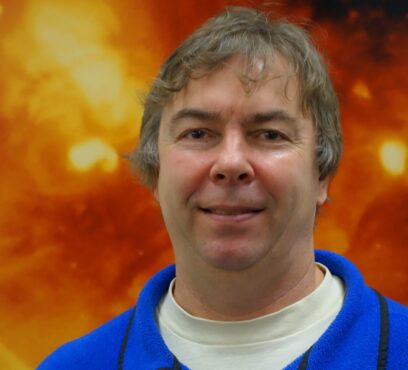
John D. Richardson, portrait identified by the MIT Kavli Institute
. External image linked from the institutional researcher profile.Jack Wisdom is a planetary scientist whose work applies Hamiltonian mechanics, chaotic dynamics and numerical methods to the motion of bodies in the Solar system. His MIT profile documents contributions to long-duration integrations and mapping methods for planetary motion.[ref]
His 1983 study of the three-to-one Kirkwood gap investigated how an orbital resonance with Jupiter can produce large changes in an asteroid's orbital eccentricity. It compared a simplified mapping with direct numerical integration, showing that the sudden eccentricity changes were not merely artifacts of the faster model.[ref]
Chaotic Behavior and the Origin of the 3/1 Kirkwood Gap by Jack Wisdom. Icarus56,51–74; abstract and sections1–2
The three-to-one label means that an asteroid completes approximately three orbits for one orbit of Jupiter. Using Kepler's third law in an ideal solar two-body approximation givesThis locates the resonance approximately; it does not by itself establish that every trajectory there is unstable. The dynamical calculation asks how repeated perturbations alter the orbit over time. That distinction connects a simple period ratio to the harder problem of explaining an observed depletion of asteroids.

E. Möbius is the first author of a 1985 study detecting interstellar helium after it became ionized and was carried into the solar wind. The observed pickup ions had a velocity distribution extending to approximately twice the solar-wind speed. The authors also related a seasonal increase in flux to gravitational focusing of neutral interstellar material downstream of the Sun.[ref]
A related primary report describes the time-of-flight mass spectrometry used by a satellite instrument to observe energetic, singly ionized helium between September and December 1984. Measuring particle identity and energy makes the population distinguishable from the ordinary bulk solar wind; the interpretation then uses the shape of the observed spectrum.[ref]
An idealized velocity argument explains the upper-speed scale. Let the solar wind move at speed relative to the Sun. An initially slow neutral atom becomes an ion with speed roughly in the wind's reference frame. If its velocity direction is redistributed while that magnitude remains similar, transforming back to the Sun's reference frame can produce speeds up to . This is a physical signature of pickup and acceleration, rather than an assertion that every detected ion moves at that maximum.
GRS 1915+105 is an X-ray binary containing an accreting stellar-mass black hole. Gas supplied by its companion forms an accretion disk; changes in that gas produce strong, variable X-ray emission. Its radio-emitting jets make it an example of a microquasar.
The thermal disk spectrum has been used to estimate the black-hole spin by fitting a relativistic disk model. The inference depends on quantities including mass, distance, inclination and the disk's physical state. It therefore illustrates how a bright spectrum constrains a compact object through a model, rather than providing a direct measurement of the event horizon.[ref]
Voicing is the use of vocal fold vibration during speech production. Airflow and the mechanical state of the vocal folds can sustain repeated opening and closing, introducing a periodic component into the emitted sound. The fundamental frequency of this repetition contributes to perceived pitch.
A practical comparison is to sustain
[s] and [z] while gently feeling the front of the throat: the added vibration during [z] makes the distinction tangible. Both involve a similar oral constriction, so the comparison separates voicing from place of articulation and manner of articulation. The physical state of the glottis is an additional dimension of the sound.[ref]Essentials of Linguistics by Catherine Anderson. Section2.6: phonation and the voiced/voiceless distinction
A binary transcription is a useful classification rather than a complete time record. Voicing can begin, end or weaken during a sound, and an acoustic estimate depends on the interval examined. A pitch contour should therefore distinguish missing or unreliable periodicity from a measured low fundamental frequency.
Place of articulation identifies where speech articulators form a constriction or closure. A description can specify an active articulator, such as the tongue, and the surface it approaches. A bilabial consonant uses both lips; a labiodental consonant uses the lower lip and upper teeth; a velar consonant involves the back of the tongue near the soft palate.[ref]
Essentials of Linguistics (2nd edition) by Catherine Anderson and others. Section3.3, Describing consonants: Place and phonation
For example,
[f] and [v] share a labiodental location, while their typical voicing classifications differ. Conversely, describing a sound as a fricative specifies manner of articulation without identifying which constriction produces it. The paired descriptions make the physical classification more informative.Manner of articulation describes how a speech constriction controls airflow. A plosive builds an oral closure that can be released; a fricative narrows the passage enough to generate turbulent airflow. A nasal consonant can close the oral passage while allowing air to pass through the nose.[ref]
Essentials of Linguistics (2nd edition) by Catherine Anderson and others. Section3.4, Describing consonants: Manner
Compare
[p], [f] and [m]. Their differences cannot be reduced to whether the sound comes from the front of the mouth: the closure, friction-producing narrowing and nasal route produce different acoustic consequences. A sustained [f] contains a noise component generated by airflow through a narrow constriction; a sustained [m] combines voicing with a different resonant airway.Manner of articulation complements place of articulation. Two sounds can share a place but differ in manner, so identifying only the location of a constriction leaves the mechanism underspecified.
Haloferax volcanii is a salt-requiring member of archaea and a useful model organism for experimental archaeal biology. As a halophile, it grows in saline conditions; its ability to grow in defined laboratory media and undergo genetic manipulation lets investigators connect specific DNA changes to cellular behavior.[ref]
The Complete Genome Sequence of Haloferax volcanii DS2, a Model Archaeon by Amber L. Hartman and others. Abstract and Introduction: culture and genetic tractability
A 2010 genome assembly of strain DS2 described a main chromosome, three smaller chromosomes and a small plasmid. Distinguishing different DNA elements from multiple copies of an element is important: four chromosome types do not, by themselves, specify how many genome copies one cell carries.[ref]
The Complete Genome Sequence of Haloferax volcanii DS2, a Model Archaeon by Amber L. Hartman and others. Abstract; Results,Genome features and chromosome nomenclature
A striking 2013 experiment used laboratory strain H26 to test whether defined origin of replication sites were required. Deleting individual chromosomal origins slowed growth, but deleting all four produced viable cells that grew faster in the tested comparison. Sequencing profiles indicated dispersed initiation rather than replacement by one new sharp origin; the origin-deleted cells depended on homologous recombination.[ref]
Accelerated growth in the absence of DNA replication origins by Michelle Hawkins and others. author manuscript,pp1–3;Figures2–4
The experiment separates a process from one way of organizing it. Removing defined start sites need not abolish DNA replication if another initiation mechanism is available. The result concerns this engineered archaeal strain under the studied conditions, rather than proving that replication origins are dispensable in every organism.
Pinned article: Introduction to the OurBigBook Project
Welcome to the OurBigBook Project! Our goal is to create the perfect publishing platform for STEM subjects, and get university-level students to write the best free STEM tutorials ever.
Everyone is welcome to create an account and play with the site: ourbigbook.com/go/register. We belive that students themselves can write amazing tutorials, but teachers are welcome too. You can write about anything you want, it doesn't have to be STEM or even educational. Silly test content is very welcome and you won't be penalized in any way. Just keep it legal!
Intro to OurBigBook
. Source. We have two killer features:
- topics: topics group articles by different users with the same title, e.g. here is the topic for the "Fundamental Theorem of Calculus" ourbigbook.com/go/topic/fundamental-theorem-of-calculusArticles of different users are sorted by upvote within each article page. This feature is a bit like:
- a Wikipedia where each user can have their own version of each article
- a Q&A website like Stack Overflow, where multiple people can give their views on a given topic, and the best ones are sorted by upvote. Except you don't need to wait for someone to ask first, and any topic goes, no matter how narrow or broad
This feature makes it possible for readers to find better explanations of any topic created by other writers. And it allows writers to create an explanation in a place that readers might actually find it.
Figure 1. Screenshot of the "Derivative" topic page. View it live at: ourbigbook.com/go/topic/derivativeVideo 2. OurBigBook Web topics demo. Source. - local editing: you can store all your personal knowledge base content locally in a plaintext markup format that can be edited locally and published either:This way you can be sure that even if OurBigBook.com were to go down one day (which we have no plans to do as it is quite cheap to host!), your content will still be perfectly readable as a static site.
- to OurBigBook.com to get awesome multi-user features like topics and likes
- as HTML files to a static website, which you can host yourself for free on many external providers like GitHub Pages, and remain in full control

Figure 2. You can publish local OurBigBook lightweight markup files to either OurBigBook.com or as a static website.
Figure 3. Visual Studio Code extension installation.
Figure 5. . You can also edit articles on the Web editor without installing anything locally. Video 3. Edit locally and publish demo. Source. This shows editing OurBigBook Markup and publishing it using the Visual Studio Code extension. 
- Infinitely deep tables of contents:


All our software is open source and hosted at: github.com/ourbigbook/ourbigbook
Further documentation can be found at: docs.ourbigbook.com
Feel free to reach our to us for any help or suggestions: docs.ourbigbook.com/#contact