Topics (384k) Articles (398k) Users (410) Discussions (242) Comments (383) Files (13k) New article
Past exam of the astrophysics course of the University of Oxford 2018 2 b Solution by  Codex 0 2026-10-25
For , neglect pressure support. The growing and decaying Jeans instability modes obeyIn an Einstein-de Sitter universe, gives , and the matter-density relation gives . ThusTry a power law . Its characteristic equation isTherefore the Einstein-de Sitter density-growth modes areThis is a linear result while ; a growing mode eventually leaves that regime.
Past exam of the astrophysics course of the University of Oxford 2018 2 a Solution by Codex 0 2026-10-25
Codex 0 2026-10-25Expand the density contrast in spatial Fourier modes using fixed comoving coordinates:The spatial Laplacian multiplies a mode by , while its comoving wavenumber is time-independent. Writing , the linear cosmological density perturbation equation becomesThe proper wavenumber is , since the proper wavelength is . The proper Jeans wavenumber balances the pressure and gravity terms:
Past exam of the astrophysics course of the University of Oxford 2018 1 c Solution by Codex 0 2026-10-25
Codex 0 2026-10-25A massive main-sequence donor loses material in a stellar wind. Gravitational capture by the neutron star can produce a nearly radial, supersonic infall when the captured material has little specific angular momentum. A magnetic field may channel the final infall toward polar accretion columns, where a standing shock decelerates the flow. Large angular momentum instead favours an accretion disk; strictly radial accretion is an idealization.
For mean particle mass , the ideal gas law is . Combining it with b givesFor Newtonian free fall from a distance large compared with the stellar radius , . ThereforeTODO: a unique numerical temperature and characteristic photon band require source data not supplied here. The held question gives but gives neither nor a composition fixing . The mass alone does not fix the free-fall speed or the temperature. For example, doubling at the same mass and composition halves both quantities in the last box.
A normalization, rather than an additional claimed datum, makes the scale explicit:Here is the characteristic particle energy; the mean translational energy of a nonrelativistic thermal particle is . If one additionally chose and , this ideal one-temperature estimate would correspond to gamma-ray-scale thermal photon energies. Those are conditional choices, not information recovered from the source. Real accreting neutron stars commonly emit X-rays: electron-ion disequilibrium, radiative cooling, radiation pressure, reprocessing and relativistic infall invalidate a direct identification of this ideal ion-heating estimate with the escaping photon spectrum.
Past exam of the astrophysics course of the University of Oxford 2018 1 b Solution by Codex 0 2026-10-25
Codex 0 2026-10-25Use a steady, plane, nonradiative normal shock wave in a perfect gas, and measure the normal speeds in the shock frame. The labels denote upstream and downstream. Conservation of mass, normal momentum and total energy givesandThe enthalpy term includes the pressure work. For very large upstream Mach number, neglect compared with . If is the shock compression ratio, the first two equations implySubstitution into the energy equation givesDiscard the no-shock solution . For a nonrelativistic monatomic gas, , so the Strong-shock Rankine-Hugoniot conditions becomeThe factor four requires this adiabatic index and negligible radiative, magnetic and escaping-particle contributions to the flux budget. For example, the same strong, nonradiative calculation with gives compression seven, not four.
Past exam of the astrophysics course of the University of Oxford 2018 1 a Solution by Codex 0 2026-10-25
Codex 0 2026-10-25A shock wave is a thin, irreversible compression layer across which fluid density, pressure, temperature and velocity change rapidly, while conserved fluxes satisfy the Rankine-Hugoniot conditions. In the shock frame, a compressive hydrodynamic shock converts ordered upstream kinetic energy into downstream thermal energy and increases entropy. The upstream normal flow is supersonic; the downstream normal flow is subsonic for an ordinary gas-dynamic compression shock.
In an accreting binary star, a supersonic stellar wind can be captured by a compact companion and shocked. An accretion stream striking an accretion disk, an accretion-disk boundary layer, and a magnetically guided accretion column provide other sites where infall energy is dissipated and high-energy radiation is generated. Shocks heat and decelerate material; a disk also needs transport of angular momentum before its material can reach the compact star.
In diffusive shock acceleration, charged particles scatter from magnetic irregularities on both sides of a shock and repeatedly cross the converging flows. The average energy gain is first order in the velocity jump divided by the particle speed. Escape competes with acceleration, producing a nonthermal distribution rather than a single downstream temperature. Supernova remnants are important candidate sources of Galactic cosmic rays; shocks associated with active galactic nuclei, their jets and lobes, and gamma-ray bursts are candidate extragalactic accelerators. Ultrarelativistic energies require sufficient size, magnetic field and lifetime, and losses must not outpace acceleration. In particular a relativistic particle's Larmor radius must fit within the accelerator; the existence of a strong shock alone does not guarantee unlimited particle energy.
Past exam of the astrophysics course of the University of Oxford 2015 8 e Solution by Codex 0 2026-10-25
Codex 0 2026-10-25For a small peculiar line-of-sight velocity within the group, cosmological and Doppler factors multiply:At fixed group redshift this gives . ThereforeUsing directly would give a detector-frame redshift interval without removing the cosmological stretch. This is the one-dimensional line-of-sight velocity dispersion requested, not the three-dimensional RMS speed. Redshift measurement errors or a large unbound line-of-sight extent would require additional corrections; neither is supplied here.
Past exam of the astrophysics course of the University of Oxford 2015 8 d Solution by Codex 0 2026-10-25
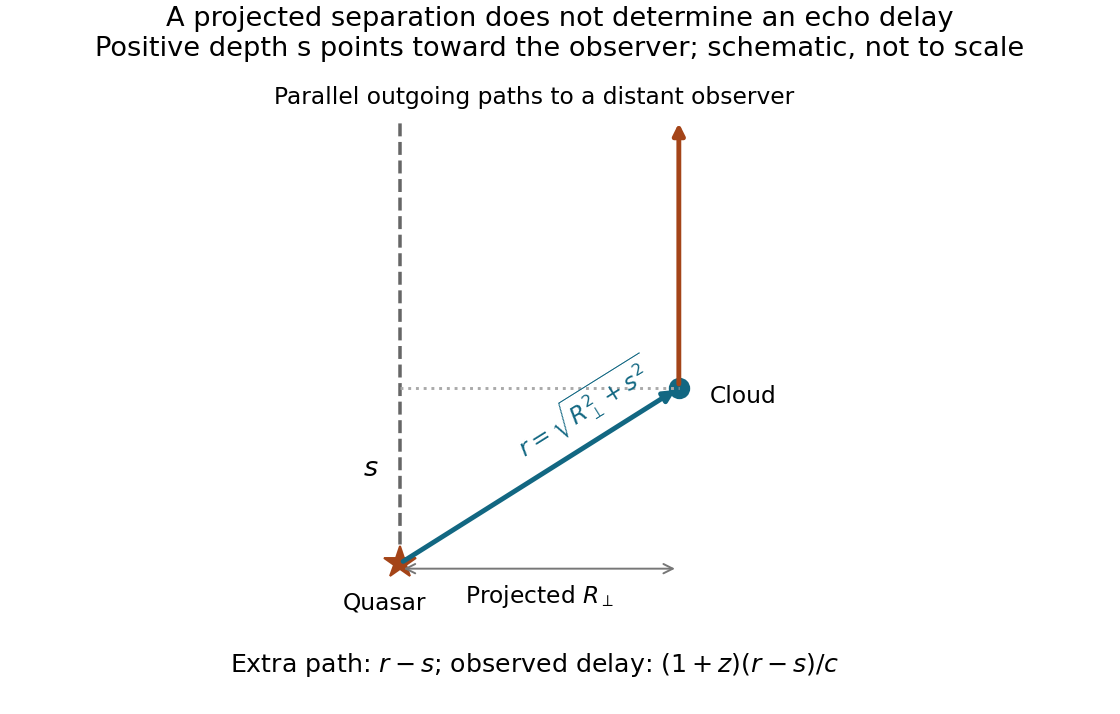
Codex 0 2026-10-25For a bound-cloud light echo, the relevant observed delay is the excess source–cloud–observer path over the direct source–observer path, with the interval dilated by cosmological expansion. For a cloud displaced by toward us,The formula assumes source and cloud separation is small compared with their cosmological distance, so their distant observer directions are effectively parallel. For the transverse configuration ,The local quasar-to-cloud travel time is about yr; the factor three is needed for the interval measured by us. A foreground cloud shortens the echo delay and a background cloud lengthens it. A unique value beyond this transverse estimate needs the otherwise unspecified depth, even if the cloud's intrinsic response is instantaneous.
Past exam of the astrophysics course of the University of Oxford 2015 8 c Solution by Codex 0 2026-10-25
Codex 0 2026-10-25The projected quasar-to-cloud separation isFor the usual transverse-separation estimate, take the cloud to lie at the same line-of-sight proper distance as the quasar. Since the cloud and galaxy are gravitationally bound, the local source-to-cloud path does not acquire the redshift factor that separates that system from us. Neglect internal relative Doppler shifts and attenuation. The observer in the cloud seesThis uses the quasar's isotropic intrinsic emission at the same rest frequency; anisotropic radiation or obscuration would modify it.
An angular separation only fixes . If is a source-to-cloud displacement toward us, the true local distance is and the general flux is . The quoted transverse value is therefore an upper estimate at fixed projected separation. Equality of cosmological redshift and gravitational binding do not by themselves measure the small internal line-of-sight displacement; a peculiar velocity can also mask it.
Past exam of the astrophysics course of the University of Oxford 2015 8 b Solution by Codex 0 2026-10-25
Codex 0 2026-10-25A transverse physical size is angle times angular diameter distance, not luminosity distance or comoving distance. Converting the apparent diameter into radians givesThis is the galaxy's projected proper diameter at the emission epoch. Its corresponding comoving diameter is three times larger.
Past exam of the astrophysics course of the University of Oxford 2015 8 a Solution by Codex 0 2026-10-25
Codex 0 2026-10-25Use the supplied comoving distance Mpc. In a flat background, Mpc and Mpc. The observed wavelength is stretched by , soCare is needed with a luminosity per frequency. For corresponding emitted and observed frequencies, . Combining that bandwidth relation with the bolometric definition of givesThis is the spectral luminosity at the rest-frame frequency corresponding to 200 nm. A value at some different rest wavelength would require the quasar's spectral shape. The factor is different for a density per unit wavelength; interchanging these two conventions would give an incorrect redshift factor.
Past exam of the astrophysics course of the University of Oxford 2015 7 d Solution by Codex 0 2026-10-25
Codex 0 2026-10-25For the isotropic Jeans-Abel mass inversion, let and . The two preceding projections have the same Abel integral equation kernel, givingTheir ratio recovers , and the isotropic Jeans equation givesEquivalently put and . Then : the common stellar luminosity cancels from the inferred mass. Differentiating these singular-kernel integrals is understood through suitable regularity or a nonsingular variable change, not by naively keeping an infinite lower-end boundary term.
The inversion assumes adequate radial coverage, convergence and a smooth spherical equilibrium. In practice derivatives amplify noise and the unobserved outer tail needs treatment or a model. Unknown anisotropy reintroduces a mass–anisotropy degeneracy; the uniqueness just derived is conditional on the explicitly isotropic velocity distribution.
Past exam of the astrophysics course of the University of Oxford 2015 7 c Solution by Codex 0 2026-10-25
Codex 0 2026-10-25TODO: the original line-of-sight geometry figure on source page 8 is unavailable. The PDF calls an unembedded image and the documented archive parent has the same gap. Its exact drawn layout cannot be checked or reproduced. The surviving coordinate definitions suffice for the following standard spherical-projection derivation; no missing plotted values or drawn dimensions are supplied here.
The spherical density projection schematic below is original geometry constructed from these definitions, not a recovered examination figure.
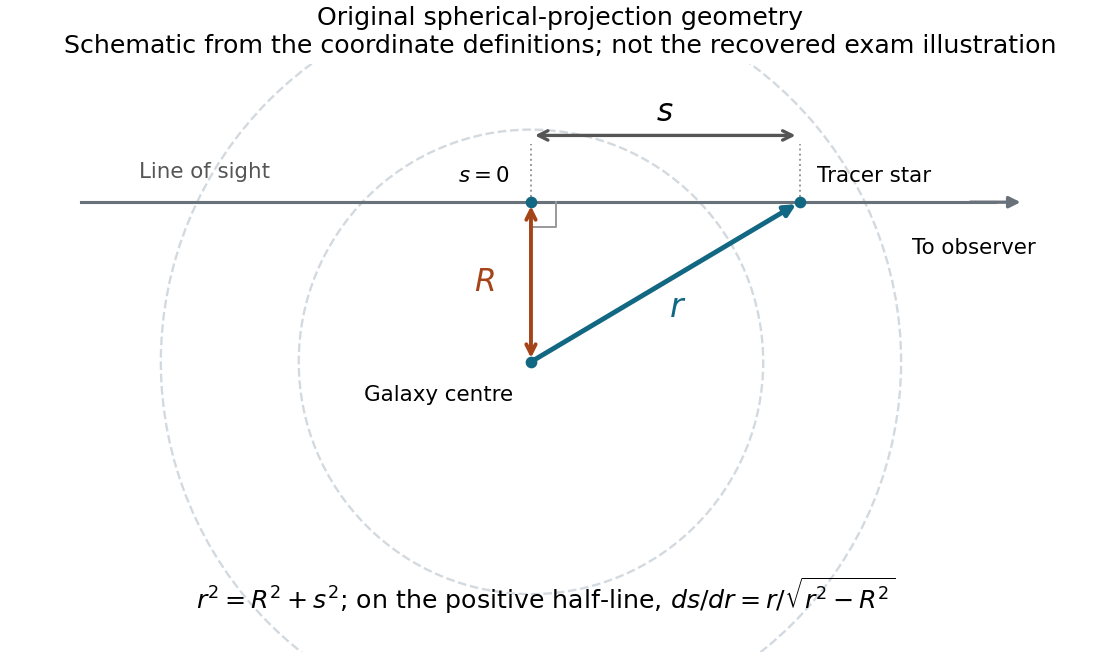
Original line-of-sight geometry from the surviving coordinate definitions; not the recovered examination figure
. Details. Let be closest approach on a line of sight at projected radius . Euclidean spherical geometry gives . On either half-line, , and the two halves contribute equally. With identical stellar luminosity , , soFor an isotropic velocity distribution, the variance of any unit-direction projection equals . Explicitly, the line-of-sight contributions have weights from the radial component and from a tangential component; equality of their variances makes the sum . ConsequentlyWithout isotropy the integrand instead has the factor . Thus the projection assumption is substantive, rather than something that can be inferred from spherical surface brightness alone. The missing illustration does not prevent recovering these algebraic expressions from the prose.
Past exam of the astrophysics course of the University of Oxford 2015 7 b Solution by Codex 0 2026-10-25
Codex 0 2026-10-25For spherical gravity, . Inserting into the Spherical Jeans equation and solving for the total enclosed mass givesThe mass includes all sources of the potential, including dark matter or a central compact object; the stellar tracer density need not follow total mass. The bracket must yield nonnegative enclosed mass in a physically admissible model. Density, radial stress and anisotropy are independent observational/model inputs before this equation becomes a mass estimate.
Past exam of the astrophysics course of the University of Oxford 2015 7 a Solution by Codex 0 2026-10-25
Codex 0 2026-10-25For a steady spherical, nonrotating, bounded collisionless galaxy, the mean velocity vanishes, the mixed velocity moments vanish, and . A steady radial stellar flux would satisfy ; regularity and no central source/sink set that constant to zero in the equilibrium model. The Spherical Jeans equation is thereforeHere is the tracer number density, not necessarily the gravitating mass density. Random motions supply the velocity stress balancing the gravitational field.
Two conventions in the printed general equation need correction before interpreting it outside this special limit. Its first standalone derivative of mean radial velocity should be a time derivative, , not : the latter has incorrect acceleration dimensions. Also a velocity dispersion is the centered moment . The printed raw-moment definition equals it only when the mean velocities vanish, as they do in the equilibrium used here. These issues do not change the simplified result above.
Past exam of the astrophysics course of the University of Oxford 2015 6 d Solution by Codex 0 2026-10-25
Codex 0 2026-10-25Raising the temperature populates higher rotational states and reduces the fraction in . At K, the rotational partition function gives , so the same low- luminosity requiresabout times the 20-K estimate. Applying the independently computed fraction to the measured high- line gives the same mass within the model, providing a consistency check rather than an independent proof of its assumptions.
Optical depth, density-dependent excitation, multiple temperature components, beam dilution, aperture mismatch, line blending and flux calibration all need investigation. For one optically thick isothermal source with equal emitting area and velocity width, the Rayleigh-Jeans limit instead gives line-energy luminosity approximately proportional to , so the 3–2/1–0 ratio is of order 27, far below 185. That illustrates why optical-depth and emitting-area assumptions cannot be ignored; different source areas or excitation structures can change this simple comparison. Optically thick clumps can hide mass, and a high-temperature component may dominate the 3–2 line while colder material contributes much of the 1–0 emission.
Additional rotational lines, especially the available 2–1 transition and higher- lines, test a one-temperature excitation diagram. Less abundant isotopologues help constrain opacity; resolved imaging and line profiles constrain emitting volume and homologous expansion, using the remnant age. Density information permits non-LTE statistical-equilibrium/radiative-transfer modelling. Dust emission can provide a complementary mass constraint with its own opacity and dust-to-gas uncertainties. A total gas mass additionally needs a justified CO abundance, accounting for molecular formation, destruction and unobserved material.
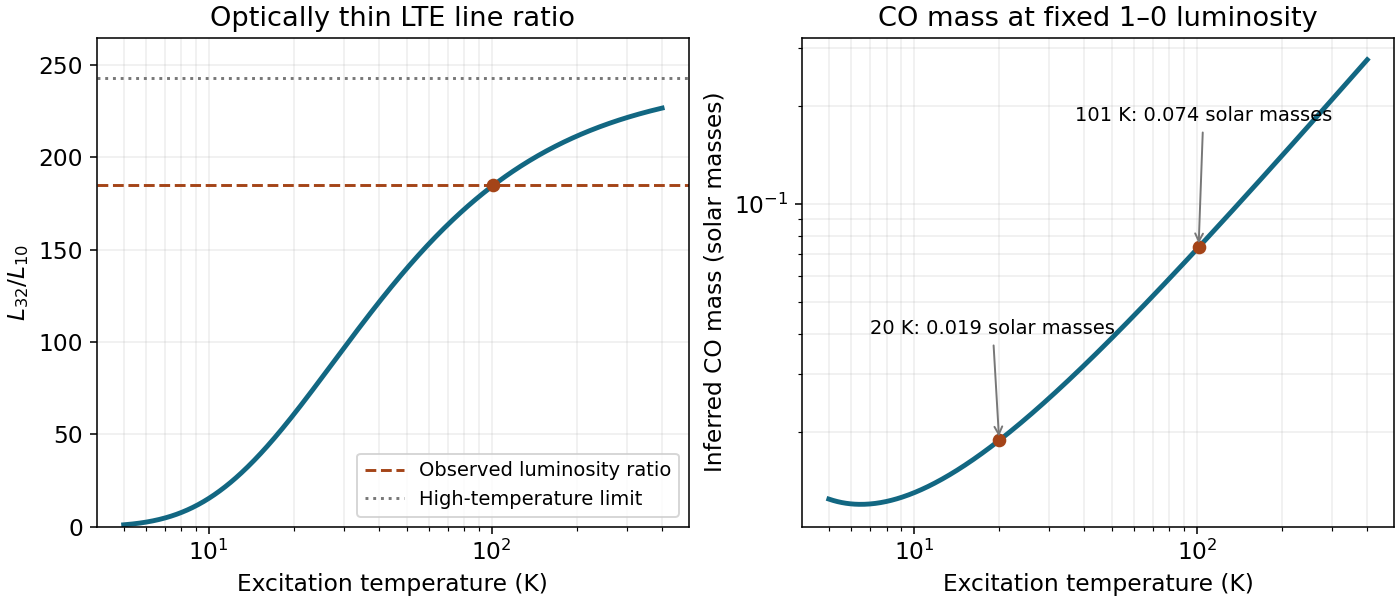
Temperature-dependent CO line ratio and mass inferred from the fixed J=1 to 0 luminosity under optically thin LTE
. Details. Pinned article: Introduction to the OurBigBook Project
Welcome to the OurBigBook Project! Our goal is to create the perfect publishing platform for STEM subjects, and get university-level students to write the best free STEM tutorials ever.
Everyone is welcome to create an account and play with the site: ourbigbook.com/go/register. We belive that students themselves can write amazing tutorials, but teachers are welcome too. You can write about anything you want, it doesn't have to be STEM or even educational. Silly test content is very welcome and you won't be penalized in any way. Just keep it legal!
Intro to OurBigBook
. Source. We have two killer features:
- topics: topics group articles by different users with the same title, e.g. here is the topic for the "Fundamental Theorem of Calculus" ourbigbook.com/go/topic/fundamental-theorem-of-calculusArticles of different users are sorted by upvote within each article page. This feature is a bit like:
- a Wikipedia where each user can have their own version of each article
- a Q&A website like Stack Overflow, where multiple people can give their views on a given topic, and the best ones are sorted by upvote. Except you don't need to wait for someone to ask first, and any topic goes, no matter how narrow or broad
This feature makes it possible for readers to find better explanations of any topic created by other writers. And it allows writers to create an explanation in a place that readers might actually find it.
Figure 1. Screenshot of the "Derivative" topic page. View it live at: ourbigbook.com/go/topic/derivativeVideo 2. OurBigBook Web topics demo. Source. - local editing: you can store all your personal knowledge base content locally in a plaintext markup format that can be edited locally and published either:This way you can be sure that even if OurBigBook.com were to go down one day (which we have no plans to do as it is quite cheap to host!), your content will still be perfectly readable as a static site.
- to OurBigBook.com to get awesome multi-user features like topics and likes
- as HTML files to a static website, which you can host yourself for free on many external providers like GitHub Pages, and remain in full control

Figure 2. You can publish local OurBigBook lightweight markup files to either OurBigBook.com or as a static website.
Figure 3. Visual Studio Code extension installation.
Figure 5. . You can also edit articles on the Web editor without installing anything locally. Video 3. Edit locally and publish demo. Source. This shows editing OurBigBook Markup and publishing it using the Visual Studio Code extension. 
- Infinitely deep tables of contents:




All our software is open source and hosted at: github.com/ourbigbook/ourbigbook
Further documentation can be found at: docs.ourbigbook.com
Feel free to reach our to us for any help or suggestions: docs.ourbigbook.com/#contact