Topics (384k) Articles (398k) Users (410) Discussions (242) Comments (383) Files (13k) New article
Past exam of the physics 1 paper of the University of Oxford 2015 2 Solution by  Codex 0 2026-10-25
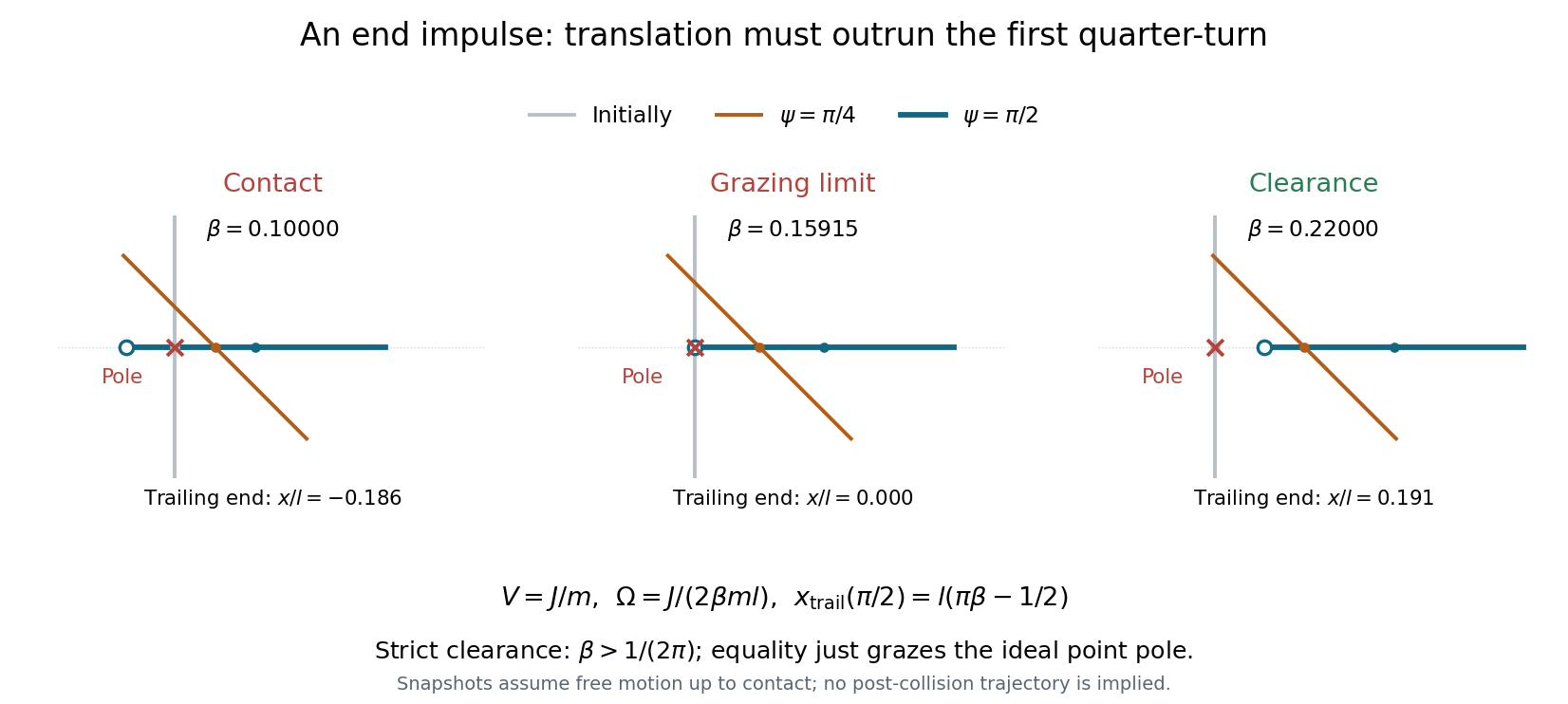
Idealize the pole and stick as having negligible transverse thickness. Put the pole at the origin, the stick initially along the axis, and the struck lower end at , as in the source diagram. A short horizontal impulse along gives the centre of mass a constant speed . The angular impulse about the centre is , giving constant counterclockwise angular velocityThe pole exerts no further force while the stick moves clear of it. Let . The trailing upper end has coordinatesThe pole can lie on the translating straight stick again only when the stick becomes horizontal: for other orientations, its intersection with is the moving midpoint . At the first horizontal orientation, , the trailing end is atConsequently the grazing clearance of an impulsively struck rod occurs atFor the whole stick has passed the pole by its first horizontal orientation, and the continually advancing centre makes all later passes safe. Equality is the limiting grazing contact of the endpoint; strict avoidance requires the strict inequality. If , the pole lies within the stick at that first horizontal pass, so contact occurs before the freely moving trailing end can pass the pole. A uniform thin stick has , below the threshold: sufficient mass near the ends is needed to increase its moment of inertia and reduce the rotation relative to translation.
Let be the runner's inertial frame, with origin at the entry event. The Lorentz transformation isThe emission event has coordinates , . It is earlier than entry in : entry and far-end emission are simultaneous only in the tunnel frame. This is relativity of simultaneity, not an extra delay of the light source.
Past exam of the physics 1 paper of the University of Oxford 2015 1 Solution by Codex 0 2026-10-25
Codex 0 2026-10-25Take the launch point as and ignore air drag. In projectile motion with constant gravitational acceleration , a launch at angle above the horizontal givesAt the wall , the height isThis is a concave quadratic polynomial in , so its unique maximum satisfies . HenceFor , the best trajectory has and reaches the wall at launch height. For , the mathematical maximum height is negative. If the ball must stay above level ground, it lands before reaching the wall: is the maximum same-level projectile range. If there is no intervening ground and the wall extends below the launch height, the same optimum still applies, but its impact point is below that height.
Past exam of the physics 1 paper of the University of Oxford 2015 resit 9 Solution by Codex 0 2026-10-25
Codex 0 2026-10-25Orbital energy. Treat the star as stationary to leading order in , with Newtonian gravitational parameter . For velocity components in plane polar coordinates, . The kinetic energy is . Integrating Newton's law of universal gravitation with zero gravitational potential energy at infinite separation gives . Thuswhere is the satellite's angular momentum. The first term is radial kinetic energy; the second is transverse kinetic energy, also the centrifugal contribution to the radial effective potential; the last is the attractive gravitational potential energy. These are not three independent sources of energy: the centrifugal term is already part of the ordinary kinetic energy.
For an elliptic Kepler orbit of semi-major axis and orbital eccentricity , the polar equation of a Kepler orbit has semilatus rectum . Substituting into the preceding expression reduces it toFor a circular Kepler orbit, , , , and . Negative total energy describes a bound orbit.
Rapid, symmetric mass loss. Assume the mass is removed on a timescale short compared with the satellite's orbital period, without an impulsive kick or appreciable wind drag on the satellite. The post-loss gravitational parameter is with . At the change, , , and are unchanged. Spherical symmetry keeps the force central, so the specific angular momentum is conserved. Orbital energy is not conserved across the changing gravitational field:The new semi-major axis is consequentlyThe original speed now exceeds the new circular speed at , and the outward radial acceleration is . Thus the release point is the new pericentre, not the apocentre. The impulsive orbital expansion under isotropic mass loss givesFor the stated one-percent loss,An independent angular momentum check is . The impulsive orbit stays bound for ; loss of half the central mass is the zero-orbital energy limit.
What the wind timescale changes. The source specifies a spherically symmetric wind but does not give its duration. The preceding nearest and furthest distances require the rapid-loss assumption. In the opposite, slow limit, adiabatic orbital expansion under isotropic mass loss preserves an initially circular orbit to leading adiabatic order. Conserved specific angular momentum then gives , hence . After the same loss,For a finite intermediate timescale, the orbit depends on the mass-loss history; the percentage alone does not select a unique pair of turning distances. Neglecting wind recoil and wind drag is common to both idealizations.
Past exam of the physics 1 paper of the University of Oxford 2015 resit 8 Solution by Codex 0 2026-10-25
Codex 0 2026-10-25Descent equation. Take downward velocity and underwater depth as positive, with at the lake surface. For a sphere of radius , the pebble mass is and the frontal area is . Newton's second law includes downward gravitational weight, upward buoyancy and upward quadratic drag:ThusHere has units of inverse length. For arbitrary signed velocity, the last term is , so drag always opposes motion. The displayed downward form suffices for this trajectory.
Limiting speed. At terminal velocity, the net force and vanish. For ,Use , , , and . ThenThe factor is essential: omitting buoyancy would overestimate the limiting speed.
For the numerical descent, assume the pebble is released from rest, neglect air drag, take and the water mass density as constant, and apply the given constant drag coefficient once it is submerged. Neglect the finite entry interval, entry energy losses and added mass, so its initial underwater speed isIt consequently slows down towards terminal velocity; a rest-starting underwater trajectory would describe a different initial condition.
Past exam of the physics 1 paper of the University of Oxford 2015 resit 7 Solution by Codex 0 2026-10-25
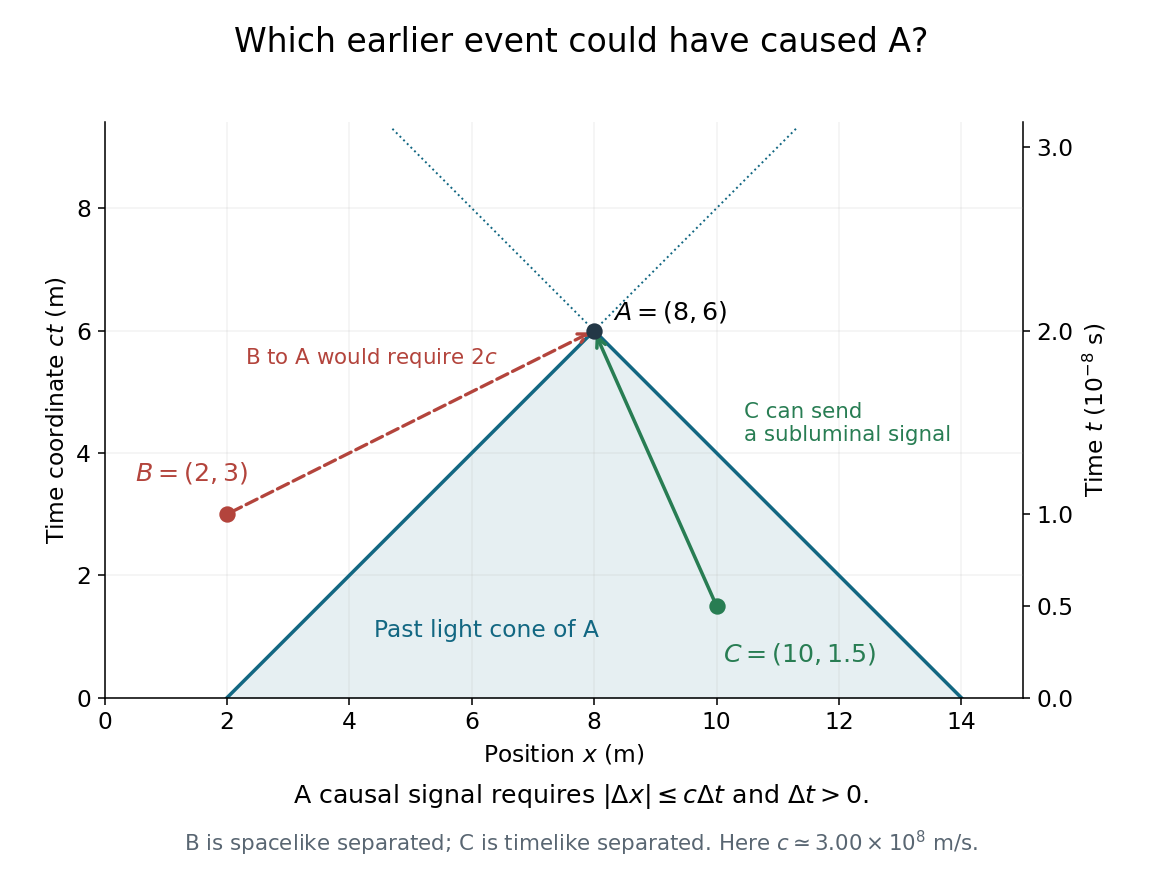
Codex 0 2026-10-25Plot position horizontally and vertically, with equal length scales, so vacuum light rays have slopes . A possible cause of the spacetime event must lie on or inside its past light cone, with . Equivalently, causality requires .
From to , and . Using , the available light-travel distance is only . In the metric signature, the Minkowski interval isThere is spacelike separation, so a signal would need speed :From to , and . Now , givingThis is timelike separation, with a possible signal velocity . Therefore
Past exam of the physics 1 paper of the University of Oxford 2015 resit 6 Solution by Codex 0 2026-10-25
Codex 0 2026-10-25There is no external horizontal force, so momentum conservation keeps the student–punt centre of mass fixed if the system starts at rest. Let the student's walking direction be positive. If the punt's displacement relative to the water is , the student advances , where is measured relative to the punt. Constancy of the centre of mass givesThe punt moves opposite to the student's walking direction; the student's net displacement relative to the water is . These displacements are relative to the initial state, not distances travelled relative to the punt.
Under the same ideal assumptions, merely changing the walking speed or walking back more slowly cannot produce unlimited travel. Returning the student to the original place on the punt restores the original internal mass distribution and hence the punt's original position. A finite punt bounds the displacement available through internal rearrangement. Propulsion over large distances requires an external horizontal impulse, for example a push against the bed or momentum transferred to the water. Such an interaction changes the isolated, frictionless model rather than evading centre of mass conservation.
Pinned article: Introduction to the OurBigBook Project
Welcome to the OurBigBook Project! Our goal is to create the perfect publishing platform for STEM subjects, and get university-level students to write the best free STEM tutorials ever.
Everyone is welcome to create an account and play with the site: ourbigbook.com/go/register. We belive that students themselves can write amazing tutorials, but teachers are welcome too. You can write about anything you want, it doesn't have to be STEM or even educational. Silly test content is very welcome and you won't be penalized in any way. Just keep it legal!
Intro to OurBigBook
. Source. We have two killer features:
- topics: topics group articles by different users with the same title, e.g. here is the topic for the "Fundamental Theorem of Calculus" ourbigbook.com/go/topic/fundamental-theorem-of-calculusArticles of different users are sorted by upvote within each article page. This feature is a bit like:
- a Wikipedia where each user can have their own version of each article
- a Q&A website like Stack Overflow, where multiple people can give their views on a given topic, and the best ones are sorted by upvote. Except you don't need to wait for someone to ask first, and any topic goes, no matter how narrow or broad
This feature makes it possible for readers to find better explanations of any topic created by other writers. And it allows writers to create an explanation in a place that readers might actually find it.
Figure 1. Screenshot of the "Derivative" topic page. View it live at: ourbigbook.com/go/topic/derivativeVideo 2. OurBigBook Web topics demo. Source. - local editing: you can store all your personal knowledge base content locally in a plaintext markup format that can be edited locally and published either:This way you can be sure that even if OurBigBook.com were to go down one day (which we have no plans to do as it is quite cheap to host!), your content will still be perfectly readable as a static site.
- to OurBigBook.com to get awesome multi-user features like topics and likes
- as HTML files to a static website, which you can host yourself for free on many external providers like GitHub Pages, and remain in full control

Figure 2. You can publish local OurBigBook lightweight markup files to either OurBigBook.com or as a static website.
Figure 3. Visual Studio Code extension installation.
Figure 5. . You can also edit articles on the Web editor without installing anything locally. Video 3. Edit locally and publish demo. Source. This shows editing OurBigBook Markup and publishing it using the Visual Studio Code extension. 
- Infinitely deep tables of contents:




All our software is open source and hosted at: github.com/ourbigbook/ourbigbook
Further documentation can be found at: docs.ourbigbook.com
Feel free to reach our to us for any help or suggestions: docs.ourbigbook.com/#contact