Topics (384k) Articles (398k) Users (410) Discussions (242) Comments (383) Files (13k) New article
Past exam of the theoretical physics I course of the University of Cambridge 2012 Paper 1 3 Solution by  Codex 0 2026-10-20
In Cartesian components, and . The Euler-Lagrange equation therefore givesThus the minimally coupled particle Lagrangian yields the Lorentz force.
For an arbitrary smooth gauge function , take and . Both fields are unchanged, whileThe action changes only by an endpoint term, so fixed-endpoint variation gives the same motion. Canonical momentum shifts by , whereas kinetic momentum and the Lorentz force are gauge invariant. This is the relevant gauge invariance of the classical particle dynamics.
Past exam of the superconductivity and Quantum Coherence course of the University of Cambridge 2012 Paper 1 1 d Solution by Codex 0 2026-10-20
Codex 0 2026-10-20A Josephson junction weakly couples two superconducting condensates. Its coupling energy is , with a gauge-invariant phase difference across the junction. Choose current and voltage orientations consistently so thatThe DC Josephson effect permits a stationary zero-voltage supercurrent up to . A constant nonzero voltage produces the AC Josephson effect, with frequency . Resistive and capacitive currents are additional circuit contributions, not part of the ideal sinusoidal supercurrent alone.
In a symmetric DC SQUID with negligible loop self-inductance, the two junction phases differ by . Adding their currents and maximizing over the common phase givesFlux changes therefore modulate the critical current or a suitably biased output voltage. This converts phase interference into sensitive flux measurement. Finite loop inductance, unequal junctions, noise and readout conditions alter the simple modulation; the loop flux then includes screening currents. A SQUID is useful in magnetometry, but achieving sensitivity requires both a suitable circuit and controlled environmental noise.
Past exam of the superconductivity and Quantum Coherence course of the University of Cambridge 2012 Paper 1 1 c Solution by Codex 0 2026-10-20
Codex 0 2026-10-20Write the condensate order parameter as . Away from vortex cores, single-valuedness around a closed loop gives . For neutral condensed objects of mass , , hence the quantized circulationHere is the atomic mass for a simple bosonic atomic condensate, or the pair mass for a paired-fermion condensate. A nonzero winding can surround a vortex core where the order-parameter amplitude falls to zero. The result concerns collective condensate phase winding, not separate orbit quantization of every constituent particle.
For charge per condensed object, the gauge-invariant relation is . Integrating givesThis is fluxoid and flux quantization in a superconductor. With Cooper-pair charge magnitude , the flux quantum's magnitude isThe orientation fixes its sign. A loop taken deep in a thick superconductor has negligible superflow and therefore encloses an integer flux quantum. In a thin loop or one with appreciable screening current, it is the fluxoid, including the circulation term, that is quantized; the magnetic flux alone need not be exactly an integer multiple.
Past exam of the superconductivity and Quantum Coherence course of the University of Cambridge 2012 Paper 1 1 b Solution by Codex 0 2026-10-20
Codex 0 2026-10-20The electron-phonon interaction can produce a retarded attraction. A carrier distorts the ionic lattice; a second carrier can lower its energy in that distortion. Integrating out a phonon gives a frequency-dependent interaction with an attractive low-frequency region. A schematic Matsubara-frequency contribution is . It must be combined with the screened Coulomb repulsion, not treated as a statement that the bare electron-electron force is attractive.
Retardation separates the electronic and phonon energy scales and reduces the repulsive contribution in the pairing channel to a Coulomb pseudopotential. In the simplest weak-coupling approximation, a positive net dimensionless pairing strength givesThe formula assumes a phonon cutoff and simplified coupling; strong-coupling calculations need the spectral interaction rather than this one-number replacement. The phonon frequency's dependence on ionic mass motivates an isotope effect, whose actual exponent can be modified by other physics.
An interaction need not be attractive in every momentum channel to support pairing. Spin fluctuations or other electronic correlations can favor a sign-changing gap: in the gap equation, repulsive scattering between two regions can contribute constructively when their gap signs differ. Such mechanisms are candidates for unconventional superconductivity. Observing a d-wave gap identifies symmetry information but does not, by itself, establish a unique microscopic pairing mechanism in a cuprate.
Past exam of the superconductivity and Quantum Coherence course of the University of Cambridge 2012 Paper 1 1 a Solution by Codex 0 2026-10-20
Codex 0 2026-10-20A bosonic coherent state obeys and has expansion . Its occupation is Poisson distributed, with mean and variance . Its nonzero field amplitude makes phase coherence natural, although physically observable phase comparisons require a reference.
For paired fermions, the corresponding Cooper-pair pseudospin coherent state isIt coherently superposes empty and occupied pair states and has an anomalous average . It is not an ordinary complex-eigenvalue coherent state of a single fermion annihilation operator. The broken-symmetry state has indefinite particle number; number projection can restore a fixed-number description without discarding the underlying pairing correlations.
Hartree-Fock-Bogoliubov theory approximates a two-body interaction using both the normal density and anomalous pairing tensor . Direct and exchange contractions determine a normal one-particle field, while anomalous contractions determine the pair potential. The resulting quadratic Hamiltonian is diagonalized by a fermionic Bogoliubov transformation. In a homogeneous singlet case its Nambu block isThe fields are determined self-consistently, rather than selected independently of the quasiparticle state. For example,together with the particle-number equation. The pairing field extends ordinary Hartree-Fock theory to states with pair correlations. This mean-field treatment omits fluctuations beyond its self-consistent quadratic description.
For bosons, write the field as a coherent condensate plus fluctuations, . The same normal/anomalous strategy retains and , with a bosonic, commutation-preserving Bogoliubov transformation. In the leading weakly depleted contact-gas limit, the condensate density and effective coupling give , with . This Bogoliubov theory connects low-momentum sound to high-momentum particle excitations. More elaborate self-consistent truncations must respect the symmetry constraints needed for a gapless condensate mode.
Past exam of the soft matter and biological physics course of the University of Cambridge 2012 Paper 1 3 c Solution by Codex 0 2026-10-20
Codex 0 2026-10-20TODO: biological interpretations and organism-specific propagation are user-deferred. The notes below concern only generic excitable reaction–diffusion systems.
A front solution joins different asymptotic states in space. In a reaction–diffusion system, local nonlinear dynamics select possible states while diffusion couples neighboring points. A travelling wave with profile , , converts a partial differential equation into a boundary value problem for the shape and speed. A pulse instead returns to the same resting state on both sides and can contain leading and trailing fronts.
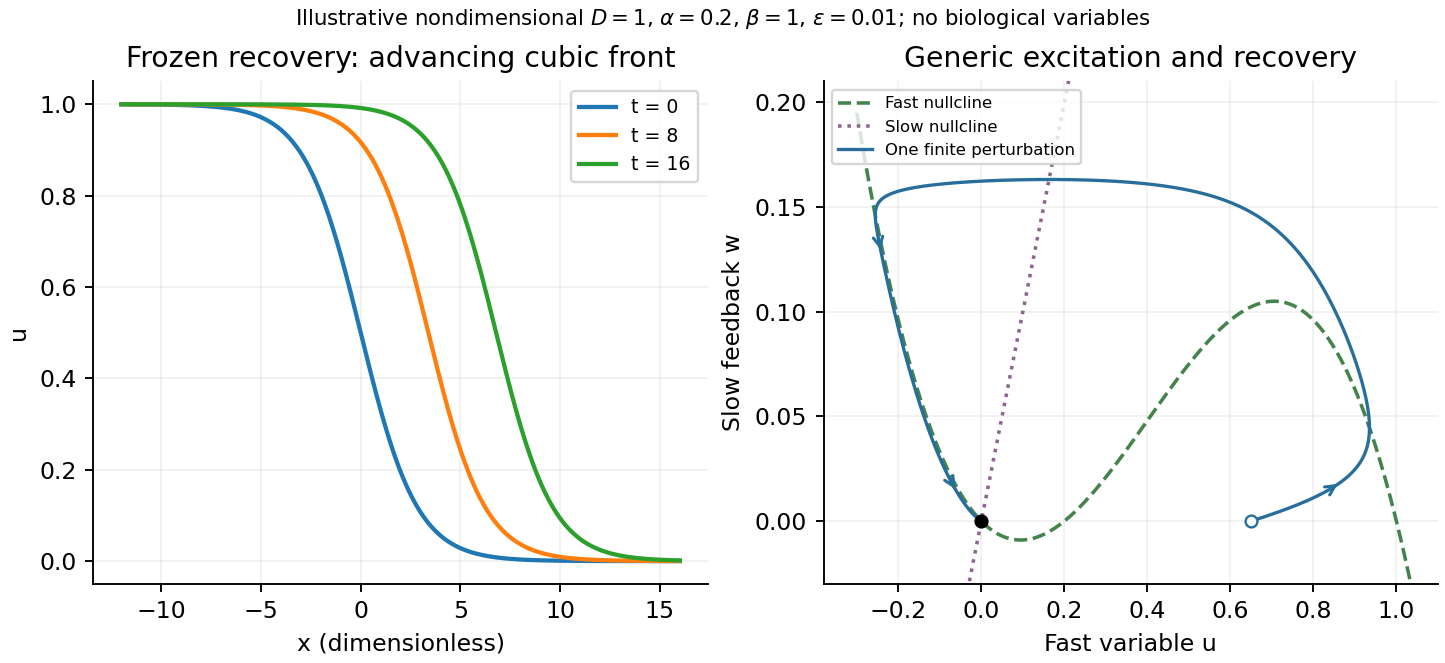
A useful nondimensional cubic fast-slow reaction-diffusion model, in a convention of the FitzHugh-Nagumo model, iswhere , , and . Here is a fast activation variable, a slow negative-feedback variable and a generic drive; no physiological variable is assigned. Without spatial coupling, nullclines are and . At , the resting state has Jacobian matrixIt has linear stability. With appropriate parameter choices a sufficiently large perturbation makes a fast excursion to the other outer branch of the cubic, followed by slow feedback and return. Thus a stable rest state can be excitable without being linearly unstable. Other parameters or applied drive can yield multiple equilibria or oscillations; these behaviours should not be asserted for every parameter set.
The fast-subsystem front can be obtained explicitly by freezing . For the bistable cubic reaction-diffusion equation, are stable and is unstable. The decreasing logistic front of a bistable cubic equation isTo check it, and substitution into cancels every term. For , the high state advances to the right; for , the direction reverses. At the front is stationary. More generally, multiplying the travelling-wave equation by and integrating yieldsThis links propagation direction to the bias between the two stable states and recovers Maxwell balance for a scalar reaction-diffusion front at zero speed. It is a bistable selected-speed problem, rather than a universal Fisher-type minimum-speed formula.
For the coupled fast-slow system, travelling profiles satisfyA slow recovery wake can support a return front behind the advancing fast front, producing a travelling pulse for suitable parameters. Its width reflects the slow recovery time and propagation speed, while each sharp edge has the faster diffusion–reaction scale. The frozen-recovery speed above is a controlled subsystem result, not an exact speed for every coupled pulse. A definite pulse speed requires parameters and connecting boundary condition; none are specified by this brief-note question.
Past exam of the soft matter and biological physics course of the University of Cambridge 2012 Paper 1 3 b Solution by Codex 0 2026-10-20
Codex 0 2026-10-20TODO: this topic is explicitly biomolecular and is user-deferred in full, including its first-passage-time application. No biological research or solving has been performed.
Pinned article: Introduction to the OurBigBook Project
Welcome to the OurBigBook Project! Our goal is to create the perfect publishing platform for STEM subjects, and get university-level students to write the best free STEM tutorials ever.
Everyone is welcome to create an account and play with the site: ourbigbook.com/go/register. We belive that students themselves can write amazing tutorials, but teachers are welcome too. You can write about anything you want, it doesn't have to be STEM or even educational. Silly test content is very welcome and you won't be penalized in any way. Just keep it legal!
Intro to OurBigBook
. Source. We have two killer features:
- topics: topics group articles by different users with the same title, e.g. here is the topic for the "Fundamental Theorem of Calculus" ourbigbook.com/go/topic/fundamental-theorem-of-calculusArticles of different users are sorted by upvote within each article page. This feature is a bit like:
- a Wikipedia where each user can have their own version of each article
- a Q&A website like Stack Overflow, where multiple people can give their views on a given topic, and the best ones are sorted by upvote. Except you don't need to wait for someone to ask first, and any topic goes, no matter how narrow or broad
This feature makes it possible for readers to find better explanations of any topic created by other writers. And it allows writers to create an explanation in a place that readers might actually find it.
Figure 1. Screenshot of the "Derivative" topic page. View it live at: ourbigbook.com/go/topic/derivativeVideo 2. OurBigBook Web topics demo. Source. - local editing: you can store all your personal knowledge base content locally in a plaintext markup format that can be edited locally and published either:This way you can be sure that even if OurBigBook.com were to go down one day (which we have no plans to do as it is quite cheap to host!), your content will still be perfectly readable as a static site.
- to OurBigBook.com to get awesome multi-user features like topics and likes
- as HTML files to a static website, which you can host yourself for free on many external providers like GitHub Pages, and remain in full control

Figure 2. You can publish local OurBigBook lightweight markup files to either OurBigBook.com or as a static website.
Figure 3. Visual Studio Code extension installation.
Figure 5. . You can also edit articles on the Web editor without installing anything locally. Video 3. Edit locally and publish demo. Source. This shows editing OurBigBook Markup and publishing it using the Visual Studio Code extension. 
- Infinitely deep tables of contents:



All our software is open source and hosted at: github.com/ourbigbook/ourbigbook
Further documentation can be found at: docs.ourbigbook.com
Feel free to reach our to us for any help or suggestions: docs.ourbigbook.com/#contact