Topics (384k) Articles (398k) Users (410) Discussions (242) Comments (383) Files (13k) New article
Past exam of the physics of Nanoelectronic Systems course of the University of Cambridge 2012 Paper 1 3 a Solution by  Codex 0 2026-10-20
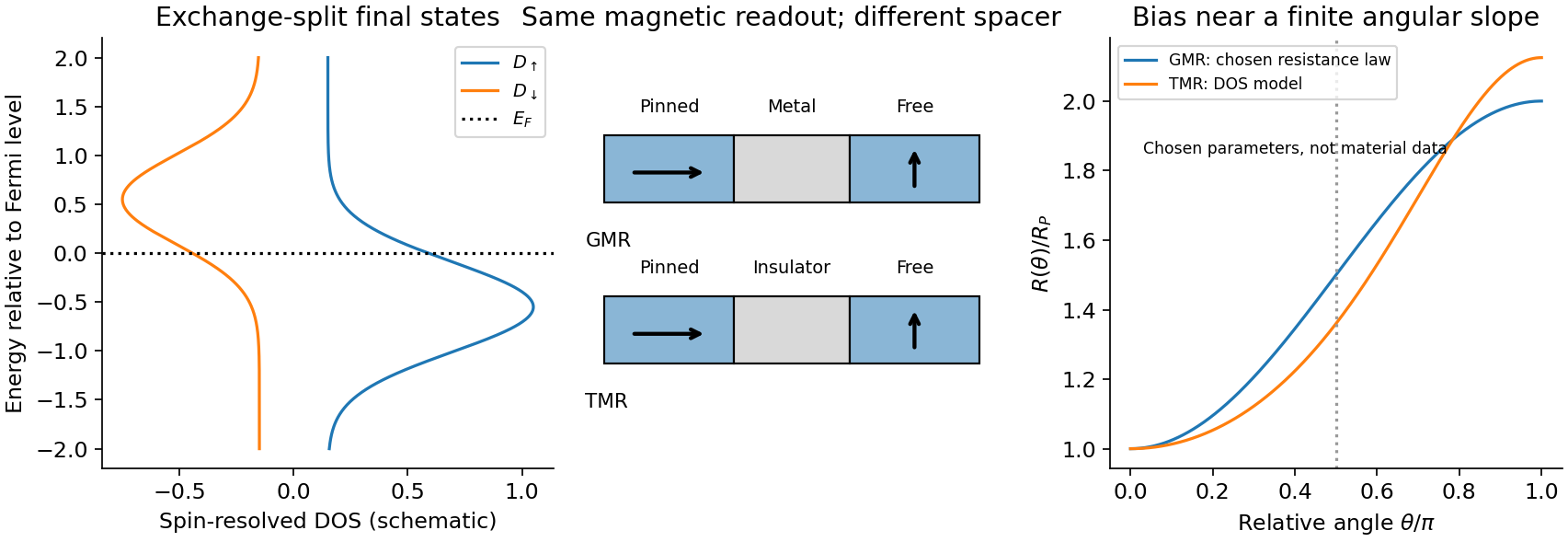
Exchange-split bands in a ferromagnet generally give a different spin-resolved density of states for each spin branch, and . If spin is approximately conserved across a multilayer, its two spin channels conduct in parallel. A spin valve combines a comparatively fixed reference-layer magnetization with a soft free layer that rotates in a small applied field. Its readout depends on the relative angle, not simply the absolute spin population. Biasing the layers near a perpendicular alignment gives a useful linear response instead of operating at the flat parallel/antiparallel extrema.
In giant magnetoresistance, a metallic spacer separates ferromagnetic layers. Spin-dependent bulk and interface scattering make their channel resistances unequal. The density of available final states influences scattering of more mobile states; however, a large total density of states does not by itself guarantee a large conductivity. The scattering-weighted spin-channel asymmetry also involves velocity and scattering matrix elements. In the elementary identical-layer two-current resistor model, let each magnetic layer have resistances in the two spin channels and neglect spacer resistance. Parallel moments give channels and , while antiparallel moments give in each channel. ThereforeOne favorable spin channel traverses both aligned layers efficiently; reversal removes that common easy path. A conducting spacer adds resistance, and spin mixing weakens the separate-channel approximation. The channel asymmetry is material/interface dependent, so positive magnetoresistance is not a theorem for every pair of different ferromagnets.[ref]
Spin dependent transport: GMR & TMR by Alain Schuhl and Daniel Lacour. §§2.1–2.2, pp.947–948, spin-dependent scattering and two-current construction
In tunnelling magnetoresistance, the spacer is an ultrathin insulator and current flows across a magnetic tunnel junction. In the simple spin-conserving density-of-states tunnelling magnetoresistance model, assume spin-independent matrix elements and low voltage. Available initial and final states giveWriting and , these become and . ThusThe effective tunnelling polarization can depend on the barrier and orbital symmetry, not just a bulk density-of-states sketch. Crystalline MgO junctions exploit symmetry-selective transmission, so the elementary product model is not a quantitative universal formula for them.[ref]
Giant room-temperature magnetoresistance in Fe-MgO-Fe junctions by Shinji Yuasa and others. 2004 publisher abstract, crystalline MgO junctions and large room-temperature response
Both devices convert a free-layer rotation into an electrical change. A useful approximate GMR interpolation is ; the elementary tunnelling model instead gives . The spin-valve small-field sensitivity is a chain rule,magnetic anisotropy, biasing and pinning set the rotation susceptibility. Conducting-spacer GMR usually offers low resistance and supports current-in-plane or current-perpendicular geometries. TMR uses perpendicular tunnelling, often offers a larger fractional signal and a larger resistance-area product, but demands uniform, stable barriers and has bias dependence and breakdown limits. Neither is automatically the better small-field sensor: heating, Johnson and low-frequency noise, domain switching, hysteresis and stability set the detectable field. Reverse sweep direction, vary current and temperature, and independently test reference-layer pinning to distinguish a reproducible magnetic signal from drift or heating.
Past exam of the physics course of the year 4 of the natural sciences course of the University of Cambridge 2012 Paper 1 Section B B1 b Solution by Codex 0 2026-10-20
Codex 0 2026-10-20The transverse stiffness of a stretched spring follows because a spring of length develops transverse force to first order. Its extension changes only at second order, so the leading transverse stiffness comes from its existing tension, not from that extension change. Here , givingThe mode vectors are again and . Treating the springs as unstretched would incorrectly remove this linear restoring force.
Past exam of the physics course of the year 4 of the natural sciences course of the University of Cambridge 2012 Paper 1 Section B B1 a Solution by Codex 0 2026-10-20
Codex 0 2026-10-20Let be longitudinal displacements. Hooke's law givesThe symmetric and antisymmetric eigenvectors are respectively and , soOrdinary frequencies are these values divided by .
Past exam of the physics course of the year 4 of the natural sciences course of the University of Cambridge 2012 Paper 1 Section A A1 b Solution by Codex 0 2026-10-20
Codex 0 2026-10-20Wavefunction normalization cancels in the ratio of integrals:A normalized version of the specified wavefunction is on its support.
Past exam of the physics course of the year 4 of the natural sciences course of the University of Cambridge 2012 Paper 1 Section A A1 a Solution by Codex 0 2026-10-20
Codex 0 2026-10-20The probability density is proportional to , not to the complex amplitude itself. For equal small intervals approached from inside the support,
Past exam of the physics course of the year 1 of the natural sciences course of the University of Cambridge 2011 Paper 1 Section E E15 iii Solution by Codex 0 2026-10-20
Codex 0 2026-10-20The orbit is unbound for : parabolic at equality and hyperbolic above it. The pericentre speed has reached or exceeded the local escape velocity.
Past exam of the physics course of the year 1 of the natural sciences course of the University of Cambridge 2011 Paper 1 Section E E15 ii Solution by Codex 0 2026-10-20
Codex 0 2026-10-20 Past exam of the physics course of the year 1 of the natural sciences course of the University of Cambridge 2011 Paper 1 Section E E15 i Solution by Codex 0 2026-10-20
Codex 0 2026-10-20The orbit is circular for . The speed equals and radial acceleration balances the changing direction of the velocity.
Past exam of the physics course of the year 1 of the natural sciences course of the University of Cambridge 2011 Paper 1 Section E E14 d Solution by Codex 0 2026-10-20
Codex 0 2026-10-20A conservative force has work depending only on the endpoints, so it can be writtenThe arbitrary additive constant in potential energy has no effect on force. A smooth curl-free force is conservative on a simply connected domain; a hole or excluded singularity requires checking global circulation as well.
Uniform gravity has , central gravity has with zero at infinity, and a linear spring has relative to equilibrium. If the potential is time independent and no other force does work, is conserved by the work-energy theorem. A time-dependent potential or nonconservative work can change mechanical energy; having an instantaneous gradient force alone is not sufficient for energy conservation. [ref]
University Physics Volume 1 by William Moebs and others. Chapter8, conservative forces, potential energy and mechanical-energy conservation
Past exam of the physics course of the year 1 of the natural sciences course of the University of Cambridge 2011 Paper 1 Section E E14 c Solution by Codex 0 2026-10-20
Codex 0 2026-10-20For a stationary closed circuit, Faraday's law of induction isThe loop orientation and magnetic-flux normal obey the right-hand convention. For a moving material circuit, the emf is instead , with the same negative derivative of the flux through the moving circuit. The additional magnetic force term accounts for motional emf.
Lenz's law expresses the minus sign physically: an induced current opposes the change in flux that produces it. It does not always oppose the field itself. Increasing positive flux drives a current producing negative flux; decreasing it reverses that response. A straight conducting rod of length l moving across a perpendicular uniform field has emf magnitude Blv. A resistive return circuit then develops a magnetic braking force, and the supplied mechanical power equals Joule heating in the ideal steady limit. This connects induction with conservation of energy. [ref]
University Physics Volume 2 by Samuel J. Ling and others. Chapter13, Faraday induction, Lenz direction and motional emf
Past exam of the physics course of the year 1 of the natural sciences course of the University of Cambridge 2011 Paper 1 Section E E14 b Solution by Codex 0 2026-10-20
Codex 0 2026-10-20For a steady thin-wire current in vacuum, the Biot-Savart law isThe line element follows conventional current direction. More generally replace with . The cross product gives the circulating field direction and superposition allows contributions from separate wire segments to be added.
Integration gives around a long straight wire. On the axis of a circular loop of radius a, , including the centre value . Coil turns multiply the field when their geometries coincide; distributed coils and solenoids follow by integration. This is a magnetostatic or quasistatic calculation: rapidly changing currents require retarded electrodynamics and appropriate displacement-current effects, not an instantaneous wire formula. [ref]
University Physics Volume 2 by Samuel J. Ling and others. Chapter12, steady-current fields and Biot–Savart applications
Past exam of the physics course of the year 1 of the natural sciences course of the University of Cambridge 2011 Paper 1 Section E E14 a Solution by Codex 0 2026-10-20
Codex 0 2026-10-20Gauss's law statesThe surface is closed and oriented outward, and includes all enclosed charge. The integral law follows from the local form through the divergence theorem. It is universally valid in classical electromagnetism, but calculating the field directly from the flux requires enough symmetry.
For spherical charge symmetry, . A uniform infinite line gives from a coaxial cylinder. An infinite sheet gives on either side from a pillbox, with the direction set by charge sign. The normal field jump is ; the electrostatic field inside a conductor is zero. Zero enclosed charge implies zero net flux, not generally zero field. [ref]
University Physics Volume 2 by Samuel J. Ling and others. Chapter6, Gaussian surfaces and symmetry applications
Past exam of the physics course of the year 1 of the natural sciences course of the University of Cambridge 2011 Paper 1 Section B B7 iv Solution by Codex 0 2026-10-20
Codex 0 2026-10-20Power is the rate of energy transfer:Net mechanical power equals the rate of kinetic-energy change in the work–energy description.
Past exam of the physics course of the year 1 of the natural sciences course of the University of Cambridge 2011 Paper 1 Section B B7 ii Solution by Codex 0 2026-10-20
Codex 0 2026-10-20The work-energy theorem gives for a point particle. For a conservative force, and its work is . Force is not generally a scalar derivative of total energy without specifying the displacement and the relevant energy.
Past exam of the physics course of the year 1 of the natural sciences course of the University of Cambridge 2011 Paper 1 Section B B7 i Solution by Codex 0 2026-10-20
Codex 0 2026-10-20 Past exam of the physics B course of the University of Cambridge 2012 Paper 1 Section C C13 Solution by Codex 0 2026-10-20
Codex 0 2026-10-20Use the Euler-Bernoulli beam equation for a uniform slender elastic beam, small deflection and small slope, neglecting axial tension, shear deformation, rotational inertia of a cross-section and damping. Let be Young's modulus, the second moment of area about the neutral axis, and the mass per unit length. If density instead denotes mass per volume, replace this by . The bending stiffness is ; the small-slope curvature is . The bending and kinetic energies areTwice integrating the variation of by parts gives the restoring load per unit length. Newton's second law therefore givesAt a pivot, displacement is fixed but slope is free; zero end bending moment gives . This also follows from the natural boundary term in the variation.
With separation of variables, givesChoose the time normalization . Initial rest removes the sine time term, so . The spatial characteristic roots are , givingThe two conditions at give and , hence . At , addition and subtraction of give and . Nontrivial positive-frequency modes therefore have and . Thus the simply supported beam normal modes areThe zero-frequency cubic solution also vanishes under these four endpoint conditions, so is not an additional mode.
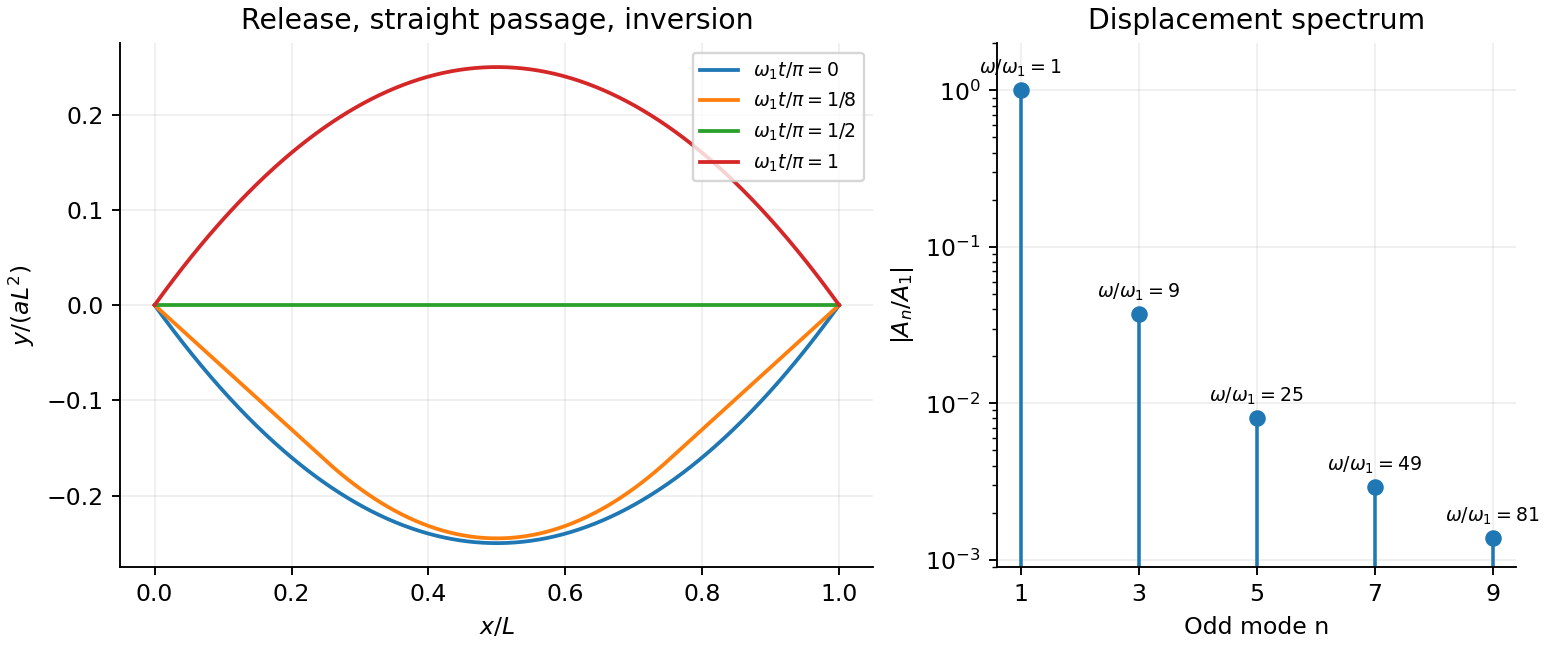
For the specified release, small slope requires . Expand the initial deflection in the Fourier sine series. Its coefficients areWriting , the resulting motion isOnly odd normal modes occur because the initial profile is symmetric about the midpoint, and their amplitudes decrease as . The frequencies grow as , so the motion is dispersive and is not a single shape multiplied by one cosine. Nevertheless the ideal undamped solution is exactly periodic with period . At all odd-mode cosines vanish, so the bar is instantaneously straight; at it has the opposite initial deflection. The first mode dominates displacement, with third-mode amplitude only of the first.
There is initial curvature incompatibility at a moment-free beam end: the prescribed parabola has , whereas a moment-free pivot requires zero curvature at an endpoint. Therefore the data do not define a classical solution with curvature continuous through the two end-time corners. They do define a finite-energy weak solution after release of the forces or end moments that prepared the initial shape. The sine expansion represents that solution: its displacement reproduces the initial parabola, each mode satisfies the released endpoint conditions, and gives finite bending energy. One must not differentiate the initial series twice at its endpoints and assign the interior parabola's curvature there. This qualification leaves the modal displacement prediction intact.
Past exam of the physics B course of the University of Cambridge 2012 Paper 1 Section C C12 Solution by Codex 0 2026-10-20
Codex 0 2026-10-20Measure from the upward vertical, let point from the support along the symmetry axis, and use the support as the reference point for all moments of inertia. Choose and . These form an instantaneous principal-axis frame; its transverse axes need not spin with marks painted on the body. The three infinitesimal Euler angles rotations add as vectors:Resolving the vertical direction givesA convention matters here: in genuinely material-fixed transverse axes, the first two components are rotated by the spin angle . For one conventional choice they are and . Since , that rotation changes neither kinetic energy nor the axial and vertical conserved momenta. The simplified displayed components use the instantaneous transverse frame just defined.[ref]
The Motion of Rigid Bodies. §3.5.2, angular-velocity decomposition and body-frame components; §3.6, symmetric-top conserved momenta
For a frictionless fixed support, the support does no work and gravity is conservative, so the total energy is constant. The heavy symmetric top Lagrangian isThe two cyclic coordinates giveEquivalently, gravitational torque has no component along the vertical or symmetry axis. Eliminate and the axial spin from :This is the heavy symmetric top reduction at fixed . A constant inclination must satisfy the reduced equation of motion , not merely have zero instantaneous velocity. Differentiation at fixed conserved momenta gives, for and ,Therefore uniform precession of a heavy symmetric top requiresFor a prescribed upward inclination , real precession rates exist only if the quadratic discriminant is nonnegative:For positive spin the absolute-value sign can be dropped. The two roots are the slow and fast branches and coalesce at the threshold. The familiar upright-limit critical magnitude is ; strict inequality gives gyroscopic stabilization of an inverted symmetric top. This limiting stability condition should not be confused with a positive minimum over every possible inclination. As approaches from below, the fixed-inclination threshold approaches zero. At the horizontal angle for ; below the horizontal the quadratic admits real solutions even at . The stated minimum therefore needs the inclination convention made explicit.
Past exam of the physics B course of the University of Cambridge 2012 Paper 1 Section C C11 Solution by Codex 0 2026-10-20
Codex 0 2026-10-20For the scattering calculation, take the heavy target as fixed and define . The incoming kinetic energy and angular momentum are and . In the original sketch, the horizontal dashed incoming asymptote has perpendicular distance from the nucleus, while is the radius from the nucleus to the point where .
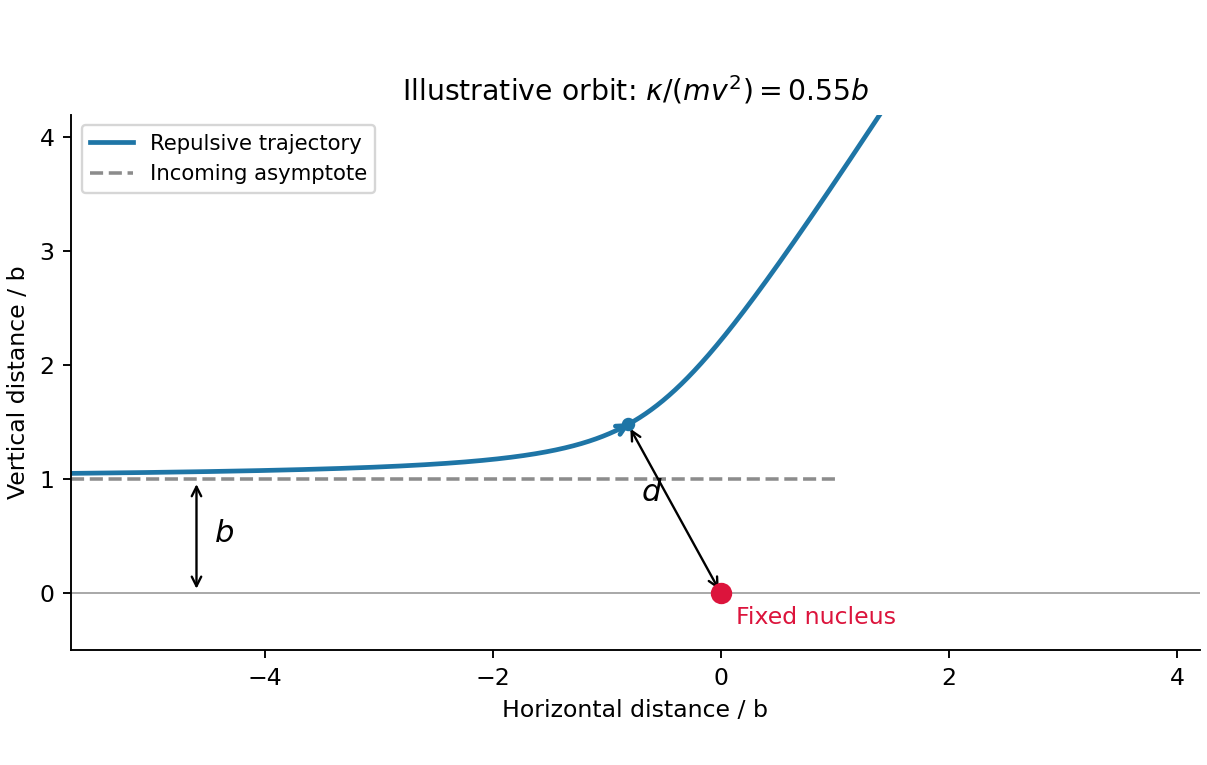
At closest approach, the velocity is tangential and . conservation of energy givesChoose the positive root and put :Head-on incidence gives , and repulsion always gives . With an attractive Coulomb force, change the sign of the potential term:For , the attractive and repulsive inverse-square closest approaches obey . For attraction causes a collision with the point centre, so is a singular endpoint, not a regular scattering turning point. Finite nuclear size is excluded by the stated point-force model.
For the repulsive inverse-cube central force , the torque vanishes, , and angular momentum is still conserved. Its potential energy is , since . ThusThe new coefficient is denoted because its units are , unlike the units of the inverse-square coefficient. Conserving angular momentum depends on centrality, not on a particular radial power law.
Pinned article: Introduction to the OurBigBook Project
Welcome to the OurBigBook Project! Our goal is to create the perfect publishing platform for STEM subjects, and get university-level students to write the best free STEM tutorials ever.
Everyone is welcome to create an account and play with the site: ourbigbook.com/go/register. We belive that students themselves can write amazing tutorials, but teachers are welcome too. You can write about anything you want, it doesn't have to be STEM or even educational. Silly test content is very welcome and you won't be penalized in any way. Just keep it legal!
Intro to OurBigBook
. Source. We have two killer features:
- topics: topics group articles by different users with the same title, e.g. here is the topic for the "Fundamental Theorem of Calculus" ourbigbook.com/go/topic/fundamental-theorem-of-calculusArticles of different users are sorted by upvote within each article page. This feature is a bit like:
- a Wikipedia where each user can have their own version of each article
- a Q&A website like Stack Overflow, where multiple people can give their views on a given topic, and the best ones are sorted by upvote. Except you don't need to wait for someone to ask first, and any topic goes, no matter how narrow or broad
This feature makes it possible for readers to find better explanations of any topic created by other writers. And it allows writers to create an explanation in a place that readers might actually find it.
Figure 1. Screenshot of the "Derivative" topic page. View it live at: ourbigbook.com/go/topic/derivativeVideo 2. OurBigBook Web topics demo. Source. - local editing: you can store all your personal knowledge base content locally in a plaintext markup format that can be edited locally and published either:This way you can be sure that even if OurBigBook.com were to go down one day (which we have no plans to do as it is quite cheap to host!), your content will still be perfectly readable as a static site.
- to OurBigBook.com to get awesome multi-user features like topics and likes
- as HTML files to a static website, which you can host yourself for free on many external providers like GitHub Pages, and remain in full control

Figure 2. You can publish local OurBigBook lightweight markup files to either OurBigBook.com or as a static website.
Figure 3. Visual Studio Code extension installation.
Figure 5. . You can also edit articles on the Web editor without installing anything locally. Video 3. Edit locally and publish demo. Source. This shows editing OurBigBook Markup and publishing it using the Visual Studio Code extension. 
- Infinitely deep tables of contents:




All our software is open source and hosted at: github.com/ourbigbook/ourbigbook
Further documentation can be found at: docs.ourbigbook.com
Feel free to reach our to us for any help or suggestions: docs.ourbigbook.com/#contact