Topics (384k) Articles (398k) Users (410) Discussions (242) Comments (383) Files (13k) New article
Past exam of the physics A course of the University of Cambridge 2010 Paper 1 Section B B7 b Solution by  Codex 0 2026-10-20
At25kHz, the n=1 and n=2 modes can propagate, withThey have different phase and group speeds, so a launch exciting both produces multimode propagation and possible beating. Actual mode amplitudes depend on the transverse launch profile; their existence does not guarantee both are excited. Modes n≥3 remain evanescent.
Past exam of the physics A course of the University of Cambridge 2010 Paper 1 Section B B7 a Solution by Codex 0 2026-10-20
Codex 0 2026-10-20At5kHz every transverse mode is below cutoff, so no propagating guided mode exists. A driven boundary can produce an evanescent near field. For n=1 the decay coefficient is , an e-folding distance of18.4mm. This is decay along the guide, not attenuation of an otherwise propagating lossless wave.
Past exam of the physics A course of the University of Cambridge 2010 Paper 1 Section A 3 b Solution by Codex 0 2026-10-20
Codex 0 2026-10-20At1000nm the first-zero radius is , slightly larger than the separation. The images therefore overlap strongly and just fail the conventional Rayleigh criterion, rather than forming two clean isolated peaks.
The summed Airy profile can still have a shallow central dip and two local maxima: Rayleigh's criterion is a resolution convention, not the exact condition for a profile to become single-peaked. The two-panel original plot in part(a) shows the correct intensity sums at both wavelengths. [ref]
University Physics Volume 3 by Samuel J. Ling and others. §4.5, resolution criterion for equal point sources
Past exam of the physics A course of the University of Cambridge 2010 Paper 1 Section A 3 a Solution by Codex 0 2026-10-20
Codex 0 2026-10-20The angular separation is . Each star's angular diameter is below , so treating it as a point source is justified at these diffraction scales.
At300nm the Airy disk first-zero radius is . The separation is3.28 times this radius: two well-separated bright peaks occur. The stars are mutually incoherent, so their point spread functions add as intensities, not amplitudes:The value at u=0 is defined by continuity. Faint diffraction rings remain on either side of each principal peak. [ref]
University Physics Volume 3 by Samuel J. Ling and others. §4.5, circular-aperture diffraction and Rayleigh angular scale
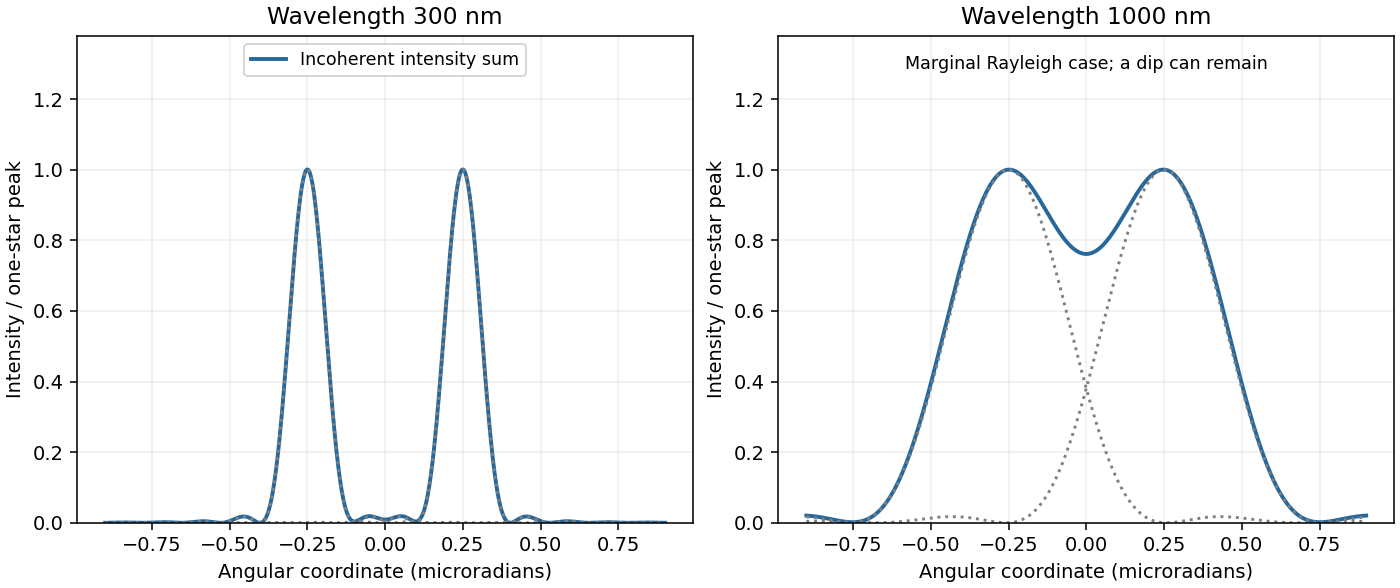
Two-star profiles
. Summed Airy intensities for equal incoherent point sources at the two specified wavelengths. Source. Details. Past exam of the thermal and statistical physics course of the University of Cambridge 2012 Paper 1 2 c Solution by Codex 0 2026-10-20
Codex 0 2026-10-20Bose-Einstein condensation is macroscopic occupation of a single lowest-energy one-particle state. For a homogeneous three-dimensional ideal gas of conserved massive bosons, set that energy to zero. The excited-state population isHere . As , the excited states can hold only particles. Additional particles occupy the ground state. ThusThe isolated ground state must be counted separately from the continuum density of states; otherwise one misses the condensate. A dilute atomic gas is a physical realization of the quantum-degeneracy regime, but trapping geometry and interactions modify the homogeneous ideal-gas formulas.[ref]
Statistical Physics by David Tong. §3.5.3: saturation of excited states, separate ground-state occupation and ideal-gas condensation temperature
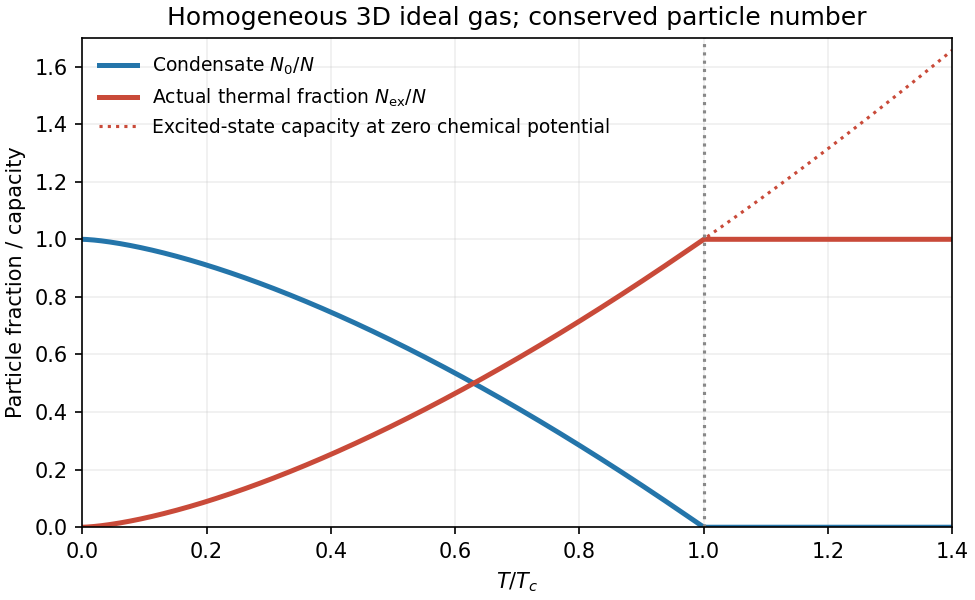
Ideal Bose condensate fraction
. Original homogeneous three-dimensional ideal-gas condensate fraction and maximum thermal population, normalized to the critical temperature. No trapped-gas or experimental data are implied. Details.In the homogeneous ideal gas, one and two dimensions do not have finite-temperature condensation in the thermodynamic limit because the low-energy population integral diverges. Finite size or a trap changes that conclusion's assumptions. Condensation and superfluidity are distinct: the ideal quadratic gas has zero Landau critical velocity, while interactions can support a sound mode and superfluid flow. Neither zero viscosity nor phase-rigid flow follows from the occupation formula alone.
Past exam of the thermal and statistical physics course of the University of Cambridge 2012 Paper 1 2 b Solution by Codex 0 2026-10-20
Codex 0 2026-10-20Brownian motion arises from many microscopic collisions. A one-dimensional Langevin description isThe fluctuation-dissipation relation ties random forcing to drag, ensuring thermal equilibrium. For a free particle set . With initially thermal velocities, its mean-square displacement isIt is ballistic, , at short times and diffusive, , for . In three dimensions the corresponding long-time result is . At diffusive times, the position propagator from a specified origin is Gaussian with variance per coordinate. A small sphere in a viscous liquid supplies a physical example; in the slow unbounded-fluid limit its drag is .
For a harmonic trap, overdamped relaxation has time , equilibrium variance and stationary correlationConsequently stationary trapped Brownian displacement obeysConfinement makes this displacement saturate, unlike free diffusion. A trajectory initialized exactly at the centre instead has variance ; confusing that conditional variance with the stationary displacement gives an erroneous factor of two. The equilibrium position distribution is proportional to . More general finite confinement has a geometry-dependent equilibrium distribution and bounded displacement, not necessarily a Gaussian one.
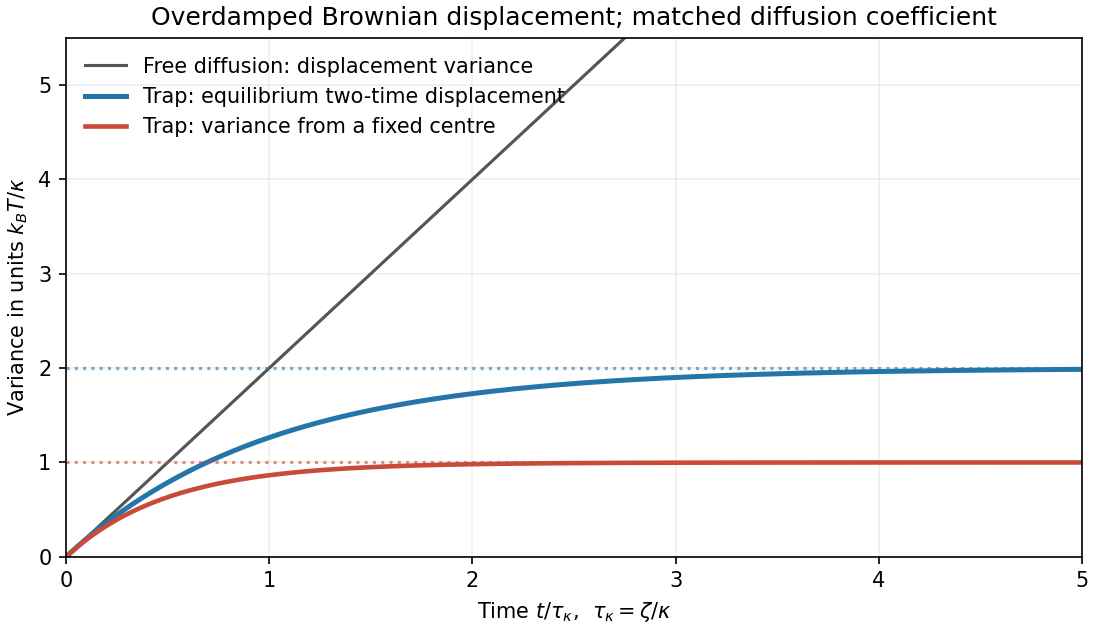
Free and trapped Brownian motion
. Original analytic mean-square-displacement curves compare free overdamped diffusion, a stationary harmonic trap and a fixed-origin harmonic-trap variance. The last two have different initial ensembles. Details. Past exam of the thermal and statistical physics course of the University of Cambridge 2012 Paper 1 2 a Solution by Codex 0 2026-10-20
Codex 0 2026-10-20Landau theory expands a thermodynamic potential in an order parameter, constrained by symmetry. For a scalar with sign-reversal symmetry, a useful free-energy density isHere is the conjugate field. At , minimizing rather than merely finding stationary points givesThe symmetry-related minima represent spontaneous symmetry breaking, as for a simple uniaxial ferromagnet with magnetization as order parameter. An infinitesimal field selects one sign. Above , the susceptibility is ; below it the stable-branch susceptibility is . Minimization lowers by below , producing a heat-capacity density jump with continuous entropy.
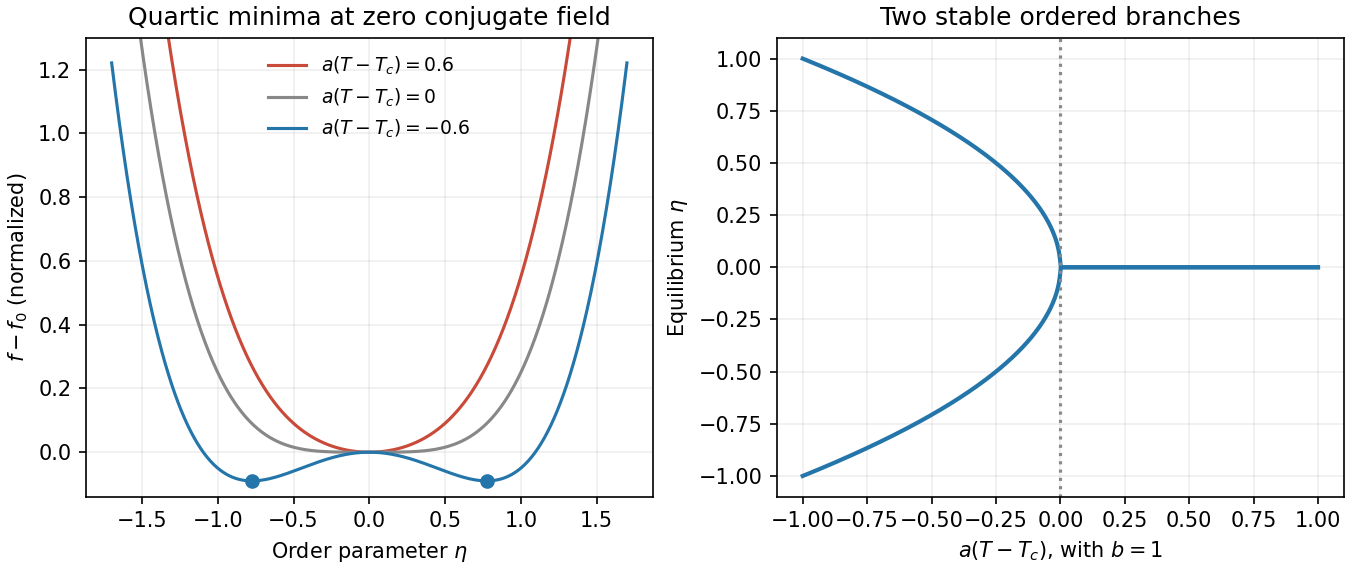
Landau minima
. Original normalized quartic free-energy curves above, at and below a continuous transition, with the two symmetry-related equilibrium order-parameter branches. Details.A negative quartic coefficient requires a stabilizing with . It can produce a first-order transition before the quadratic coefficient changes sign: coexistence occurs at and . Odd terms are allowed when the assumed symmetry is absent. Landau theory predicts mean-field exponents; spatial fluctuations can change critical behaviour, especially close to a critical point in low dimensions. A gradient term extends the model to nonuniform order parameters but does not by itself supply dynamical equations.
Past exam of the thermal and statistical physics course of the University of Cambridge 2012 Paper 1 1 c Solution by Codex 0 2026-10-20
Codex 0 2026-10-20For either phase, the entropy differential at fixed composition isThe pressure derivative uses the Maxwell relation from . Differentiating the equality of entropies along coexistence gives the general relationFor a differentiable coexistence curve with pressure varying, equality of Gibbs free energies also implies . Since , the two phases then share . Thus, with ,This is the Ehrenfest entropy-continuity relation. Entropy equality alone would give without the shared-volume condition; a constant-pressure boundary or vanishing discontinuities needs separate limiting analysis.
Past exam of the thermal and statistical physics course of the University of Cambridge 2012 Paper 1 1 b Solution by Codex 0 2026-10-20
Codex 0 2026-10-20Assume three-dimensional isotropic gapless excitations, zero chemical potential and one independent branch. Momentum-state counting givesSubstituting into the Bose energy integral shows and . The observed exponent therefore gives .
For the quadratic-boson heat-capacity coefficient, the required Bose integral isThe equality follows by expanding and integrating term by term. HenceThe supplied units make its a heat capacity per volume. Equating its coefficient to givesEquivalently has . For identical branches, the measured coefficient fixes , so instead . The one-branch convention is necessary for the quoted numerical value. The supplied integral with is not the moment arising for the exponent determined here.
Past exam of the thermal and statistical physics course of the University of Cambridge 2012 Paper 1 1 a Solution by Codex 0 2026-10-20
Codex 0 2026-10-20Use thermal de Broglie wavelength and spacing . Degeneracy onset from thermal wavelength occurs atThe numerical factor depends on the convention for a typical momentum, but the scale does not. For fermions the Fermi temperature gives a comparable scale for spin degeneracy two.
Representative estimates, with the assumed densities stated explicitly, are:
| System | Assumed number density | Assumed particle mass | |
|---|---|---|---|
| Conduction electrons | |||
| Dilute heavy atomic cloud | |||
| Neutrons at nuclear-scale density |
Here is the atomic mass constant. Thus the characteristic orders are for electrons, sub-microkelvin for a dilute heavy atomic gas, and for neutrons. There is no density-independent quantum-degeneracy temperature for atomic gases: for example, taking and mass instead gives about . These are illustrative input estimates, not values supplied by the paper. Denser neutron-star cores require relativistic and interaction corrections; the estimate identifies the degeneracy scale rather than a precise stellar temperature.
Pinned article: Introduction to the OurBigBook Project
Welcome to the OurBigBook Project! Our goal is to create the perfect publishing platform for STEM subjects, and get university-level students to write the best free STEM tutorials ever.
Everyone is welcome to create an account and play with the site: ourbigbook.com/go/register. We belive that students themselves can write amazing tutorials, but teachers are welcome too. You can write about anything you want, it doesn't have to be STEM or even educational. Silly test content is very welcome and you won't be penalized in any way. Just keep it legal!
Intro to OurBigBook
. Source. We have two killer features:
- topics: topics group articles by different users with the same title, e.g. here is the topic for the "Fundamental Theorem of Calculus" ourbigbook.com/go/topic/fundamental-theorem-of-calculusArticles of different users are sorted by upvote within each article page. This feature is a bit like:
- a Wikipedia where each user can have their own version of each article
- a Q&A website like Stack Overflow, where multiple people can give their views on a given topic, and the best ones are sorted by upvote. Except you don't need to wait for someone to ask first, and any topic goes, no matter how narrow or broad
This feature makes it possible for readers to find better explanations of any topic created by other writers. And it allows writers to create an explanation in a place that readers might actually find it.
Figure 1. Screenshot of the "Derivative" topic page. View it live at: ourbigbook.com/go/topic/derivativeVideo 2. OurBigBook Web topics demo. Source. - local editing: you can store all your personal knowledge base content locally in a plaintext markup format that can be edited locally and published either:This way you can be sure that even if OurBigBook.com were to go down one day (which we have no plans to do as it is quite cheap to host!), your content will still be perfectly readable as a static site.
- to OurBigBook.com to get awesome multi-user features like topics and likes
- as HTML files to a static website, which you can host yourself for free on many external providers like GitHub Pages, and remain in full control

Figure 2. You can publish local OurBigBook lightweight markup files to either OurBigBook.com or as a static website.
Figure 3. Visual Studio Code extension installation.
Figure 5. . You can also edit articles on the Web editor without installing anything locally. Video 3. Edit locally and publish demo. Source. This shows editing OurBigBook Markup and publishing it using the Visual Studio Code extension. 
- Infinitely deep tables of contents:




All our software is open source and hosted at: github.com/ourbigbook/ourbigbook
Further documentation can be found at: docs.ourbigbook.com
Feel free to reach our to us for any help or suggestions: docs.ourbigbook.com/#contact