Topics (384k) Articles (398k) Users (410) Discussions (242) Comments (383) Files (13k) New article
Past exam of the physics A course of the University of Cambridge 2011 Paper 2 Section B B8 b Solution by  Codex 0 2026-10-20
The populations giveTogether with , this describes Larmor precession of a spin initially perpendicular to the field. The positive angular frequency is ; the sign specifies the rotation sense through . The factor of two between the spinor amplitudes and the measured spin is essential. The model with quantum coherence predicts no decay; spin relaxation or dephasing in a real solid can damp the oscillation.
Past exam of the physics A course of the University of Cambridge 2011 Paper 2 Section B B8 a Solution by Codex 0 2026-10-20
Codex 0 2026-10-20Put , . The real part of the off-diagonal coherence vanishes:This also follows from and its zero initial expectation. Individual measurements still give , each with probability .
Past exam of the physics A course of the University of Cambridge 2011 Paper 1 Section D D13 c Solution by Codex 0 2026-10-20
Codex 0 2026-10-20Absorption of photons with creates electron-hole pairs, the upward band-diagram arrow. In the depletion region the built-in field drives electrons towards n material and holes towards p material; diffusion also delivers carriers generated within a diffusion length outside that region. Selective contacts collect the two signs. Illumination maintains a nonequilibrium quasi-Fermi-level splitting, allowing a voltage and useful current through an external load; it is the light, rather than the equilibrium barrier, that supplies the energy.
Taking forward diode current as positive, an ideal illuminated junction haspower is delivered where in this convention. Reflection, below-gap transmission, carrier thermalization, recombination and resistive losses limit real conversion; even an ideal single junction has radiative detailed-balance limits.[ref]
Detailed Balance Limit of Efficiency of p-n Junction Solar Cells by William Shockley and Hans-Joachim Queisser. 1961, Journal of Applied Physics 32, pp.510–519: radiative detailed-balance limit
Past exam of the physics A course of the University of Cambridge 2011 Paper 1 Section D D13 b Solution by Codex 0 2026-10-20
Codex 0 2026-10-20forward bias injects electrons and holes into a common active region. Their electron-hole recombination can emit a photon as an electron falls from a conduction-band state into an empty valence-band state, with approximately the band gap near the band edges. A direct band gap makes this radiative transition much more probable than an indirect gap requiring simultaneous phonon participation. Carrier confinement improves their overlap; nonradiative recombination and photon trapping reduce the external efficiency. This is spontaneous electroluminescence and does not require population inversion. The biased carriers have separate quasi-Fermi levels, rather than one global equilibrium Fermi level. The band-diagram downward arrow shows photon emission. As a concrete implementation, an InGaN/AlGaN double heterostructure was used for a bright blue junction LED.[ref]
Past exam of the physics A course of the University of Cambridge 2011 Paper 1 Section D D13 a Solution by Codex 0 2026-10-20
Codex 0 2026-10-20Joining p-type and n-type regions initially allows majority carriers to diffuse across and recombine. Exposed negative acceptor charge on the p side and positive donor charge on the n side form a depletion region. Its electric field points from n to p and balances diffusion at equilibrium. The Fermi level is then spatially constant, while the conduction and valence band edges bend across the built-in potential; this equilibrium barrier cannot supply continuous power to a load.
forward bias makes p positive relative to n, reducing the barrier from to . electrons enter p material and holes enter n material, becoming minority carriers whose diffusion and recombination sustain the current. reverse bias enlarges the barrier and leaves a much smaller minority-carrier current until breakdown. The ideal diffusion model gives , the Shockley diode equation; depletion-region recombination, series resistance and breakdown limit this approximation. Minority-carrier injection on both sides is essential to the junction theory.[ref]
The Theory of p-n Junctions in Semiconductors and p-n Junction Transistors by William Shockley. 1949, pp.435–436: rectification, electron and hole currents, and injection
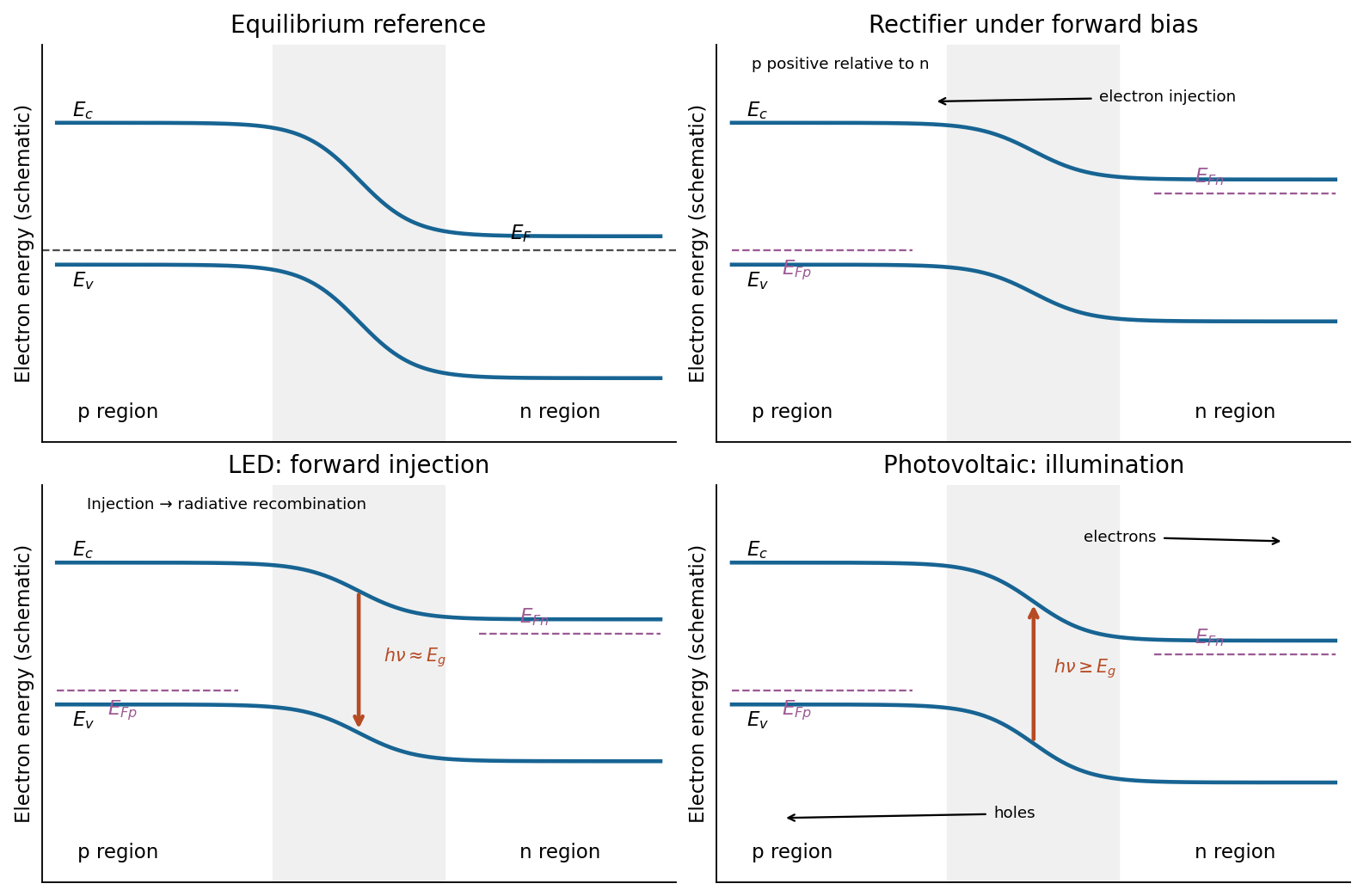
Junction band bending and three device functions
. Original schematic electron-energy diagrams, not quantitative band solutions. Equilibrium has one flat Fermi level; biased and illuminated panels indicate separate carrier quasi-Fermi levels. The photon arrows distinguish LED emission from solar-cell absorption. Details. Past exam of the physics A course of the University of Cambridge 2011 Paper 1 Section D D12 c Solution by Codex 0 2026-10-20
Codex 0 2026-10-20Boundary conditions quantize the transverse wavevector of an electromagnetic waveguide. For an ideal hollow rectangular conducting guide of sides , filled with a nondispersive medium of wave speed , a transverse electric mode of a rectangular waveguide or transverse magnetic mode of a rectangular waveguide obeysThe allowed integer pairs differ: TE permits one zero index, but not both; TM requires both positive. Here is the longitudinal propagation constant. Below cutoff is imaginary, so the mode is evanescent. Above cutoff,The positive branch approaches the straight line far above cutoff, while near cutoff its slope tends to zero. Different frequencies acquire different group delays and a pulse can spread. A wave phase speed above does not convey superluminal information; in this ideal guide energy transport follows the group velocity. A single hollow conductor cannot support a TEM mode; two-conductor guides can have a zero-cutoff TEM branch. Material dispersion, dielectric fibres and lossy boundaries require their actual dispersion relation and need not preserve the product rule.
Past exam of the physics A course of the University of Cambridge 2011 Paper 1 Section D D12 b Solution by Codex 0 2026-10-20
Codex 0 2026-10-20A finite optical pupil spreads a point into a point spread function. In incoherent imaging an extended intensity distribution is convolved with that function; its Fourier transform is the optical transfer function, which attenuates and ultimately removes high spatial frequencies. For an ideal circular pupil the point response is an Airy disk. The Rayleigh criterion for two equally bright incoherent points isA microscope's object-space scale is of order , with the numerical factor depending on illumination and the criterion; measures the accepted ray cone. A larger pupil or shorter wavelength improves the diffraction scale. Aberrations, defocus, detector pixel sampling, motion, background and photon noise can worsen practical performance. Merely magnifying the same blurred image adds no information. Coherent sources require amplitude superposition instead of the incoherent intensity rule. Rayleigh resolution is a convention for separating a pair, distinct from the precision of localizing one isolated point; information does not abruptly vanish below it.
Past exam of the physics A course of the University of Cambridge 2011 Paper 1 Section D D12 a Solution by Codex 0 2026-10-20
Codex 0 2026-10-20In Fourier transform spectroscopy, a scanning Michelson interferometer measures intensity against optical path difference rather than selecting one narrow wavelength at a time. After subtraction of the constant background, an ideal stationary source gives an interferogramA cosine Fourier transform recovers the spectral power density after instrumental calibration. A mirror displacement changes the round-trip path by ; the zero-path-difference burst aligns the scan, and a reference laser can calibrate the displacement.
Finite maximum path difference multiplies the interferogram by a window and convolves the recovered radiation spectrum with that window's Fourier transform. Thus is of order ; precise factors depend on scan range and resolution convention. Uniform path samples of separation need to avoid aliasing without bandpass information. interferogram apodization reduces sidelobes at the price of broader lines. The broad accepted optical throughput can be advantageous; the multiplex signal-to-noise advantage depends on detector noise and is not universal in photon-noise-limited measurements. Source drift during a scan, finite beam divergence, imperfect sampling and wave phase errors require control. The finite-window reasoning is the delay-range resolution in Fourier transform spectroscopy.[ref]
Introduction to Fourier Transform Spectroscopy by Julius Cohen. NBSIR 86-3339, chapters 13–16, printed pp.51–80: basic equation, apodization, resolution and sampling
Past exam of the physics A course of the University of Cambridge 2011 Paper 1 Section C C11 b Solution by Codex 0 2026-10-20
Codex 0 2026-10-20In the harmonic approximation, sum over wavevector and phonon branch :The occupation factor is the Bose-Einstein distribution with zero phonon chemical potential; is the zero-point energy. A temperature-independent zero-point term does not contribute to the heat capacity in this fixed-frequency approximation.
Past exam of the physics A course of the University of Cambridge 2011 Paper 1 Section C C11 b Solution by Codex 0 2026-10-20
Codex 0 2026-10-20For three-dimensional acoustic modes, and the mode count in a spherical shell is proportional to , giving phonon DOS proportional to . Thermally occupied modes have of order , so . Differentiation gives . At , all harmonic modes are classically populated; each has mean energy by equipartition. Thus the molar heat capacity tends to , the Dulong-Petit law. Anharmonic expansion and electronic contributions are not included in that lattice limit.
Past exam of the physics A course of the University of Cambridge 2011 Paper 1 Section C C11 a Solution by Codex 0 2026-10-20
Codex 0 2026-10-20For independent conduction-electron states labelled by band, wavevector and spin, combine those labels into . ThenHere counts the same spin and band states as the sum, and is fixed by the number constraint . The energy zero is a fixed band reference. Use the total DOS for total internal energy or the molar DOS for molar internal energy; these conventions must not be mixed.
Past exam of the physics A course of the University of Cambridge 2011 Paper 1 Section C C11 a Solution by Codex 0 2026-10-20
Codex 0 2026-10-20Only states within an energy shell of width roughly around appreciably change occupation at low temperature. There are roughly such states and each excitation costs energy of order . Thus , giving . This is the thermal-shell estimate of electronic heat capacity; filled states far below are blocked by the Pauli exclusion principle. A smooth DOS and fixed particle number give the more precise Sommerfeld result to leading order.
Past exam of the physics A course of the University of Cambridge 2011 Paper 1 Section C C10 b Solution by Codex 0 2026-10-20
Codex 0 2026-10-20For annihilation of a phonon ,For phonon creation,The signs follow whether the neutron gains or loses the phonon's energy and crystal momentum. These are one-phonon coherent inelastic neutron scattering conditions, with accounting for lattice periodicity.
Past exam of the physics A course of the University of Cambridge 2011 Paper 1 Section C C10 a Solution by Codex 0 2026-10-20
Codex 0 2026-10-20For elastic scattering, and , where is a reciprocal lattice vector. In the ideal static crystal, coherent scattering obeys this lattice selection rule; the crystal as a whole can take the mechanical recoil with negligible energy. crystal momentum is defined modulo , not as unconstrained free-particle momentum.
Past exam of the physics A course of the University of Cambridge 2011 Paper 1 Section B B8 b Solution by Codex 0 2026-10-20
Codex 0 2026-10-20 Past exam of the physics A course of the University of Cambridge 2011 Paper 1 Section B B8 b Solution by Codex 0 2026-10-20
Codex 0 2026-10-20A beam illuminates only slits, giving and . The two main lobes broaden by compared with the wider beam. Their separation is slightly below the stated Rayleigh threshold: marginally unresolved by that criterion. This is not an assertion that the profile has only one maximum: the ideal equal-line sum still has two maxima and a modest central dip, as plotted. Inference from real data also requires adequate signal-to-noise ratio and a known instrumental profile.
Past exam of the physics A course of the University of Cambridge 2011 Paper 1 Section B B8 a Solution by Codex 0 2026-10-20
Codex 0 2026-10-20With the order positions are unchanged from the grating equation, and the envelope's first zeros satisfy . Equivalently the first missing integer orders are . The third-order peaks remain appreciable. The displayed order-coordinate places all principal maxima at integers.
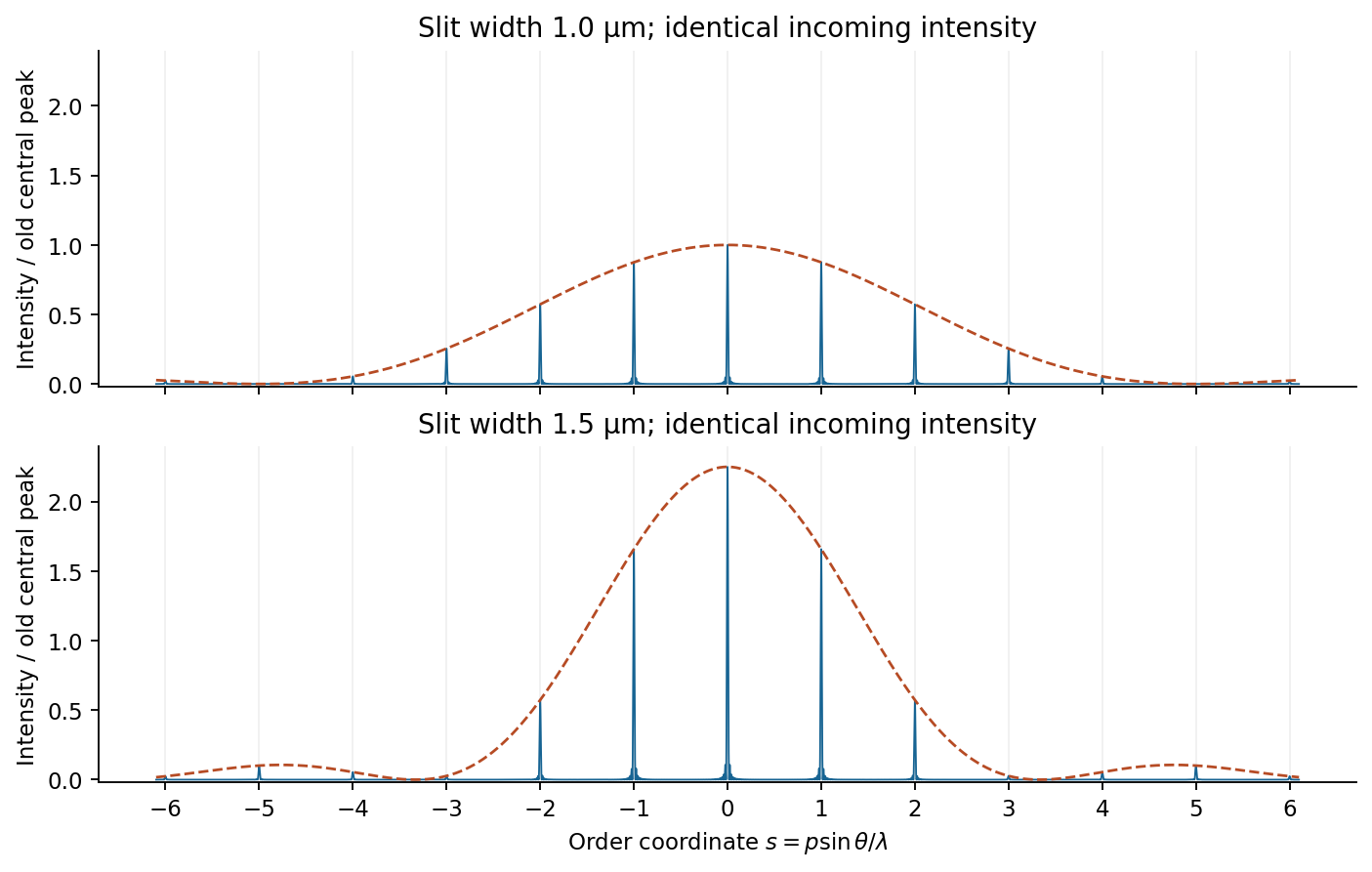
Slit-width envelopes on a common incident-intensity scale
. Original finite-array model with an illustrative 60 illuminated slits to make the peaks visible. Dashed lines show single-slit envelopes; the supplied slit pitch and widths set the peak ratios independently of this illustrative slit count. Details. Past exam of the physics A course of the University of Cambridge 2011 Paper 1 Section B B8 a Solution by Codex 0 2026-10-20
Codex 0 2026-10-20A beam illuminates slits. The resolving power of a diffraction grating in order is , corresponding to a Rayleigh criterion separation . The separation therefore gives two well separated main peaks. The finite-grating incoherent doublet profile adds the mutually incoherent lamp intensities, not their amplitudes.
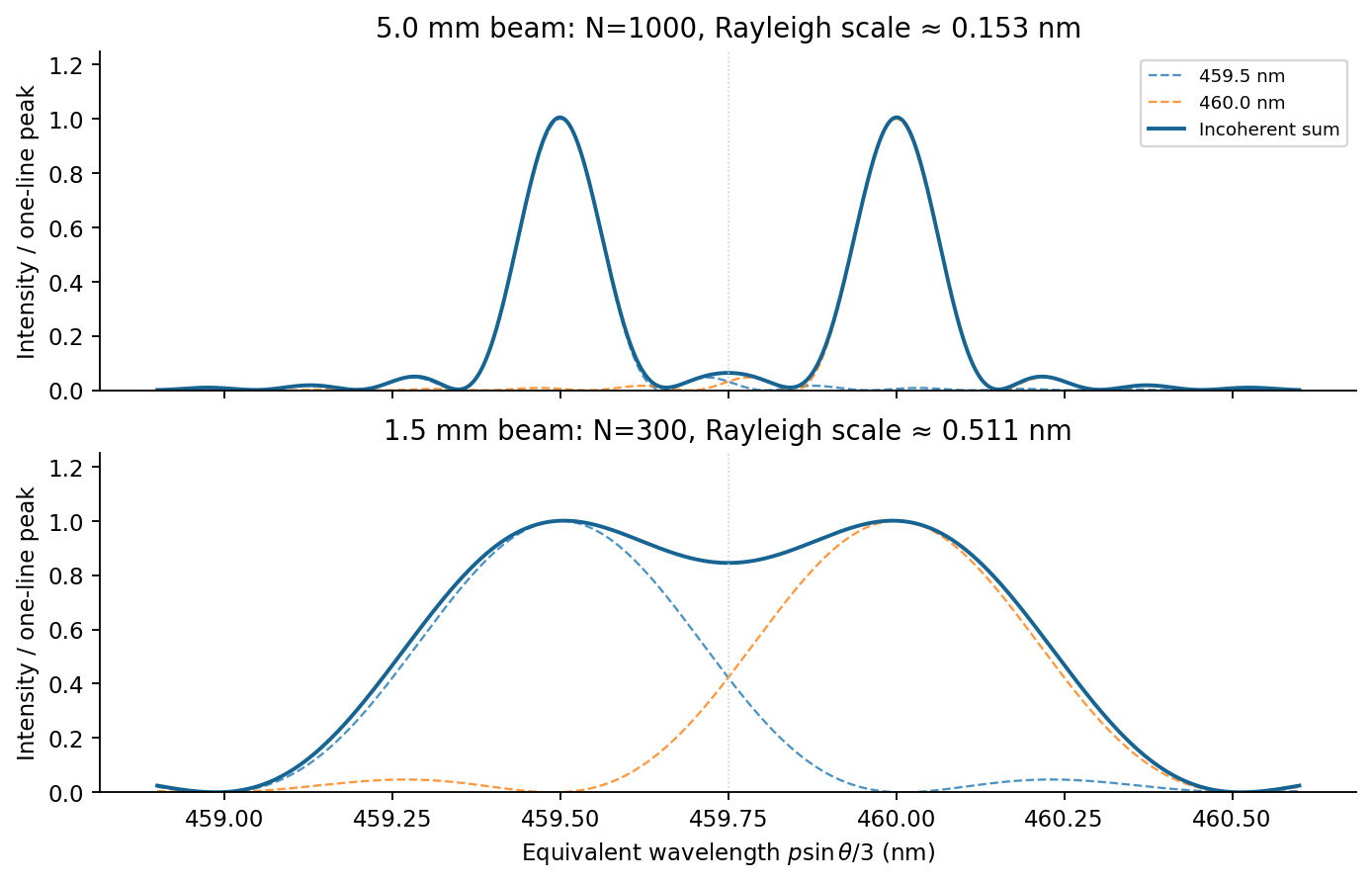
Third-order doublet for two illuminated grating widths
. Original finite-N intensity sums, with equal line strengths and narrow slits. The horizontal coordinate is the wavelength inferred from the third-order grating equation. Each component is dashed and their incoherent sum is solid. Details. Past exam of the physics A course of the University of Cambridge 2011 Paper 1 Section A 5 b Solution by Codex 0 2026-10-20
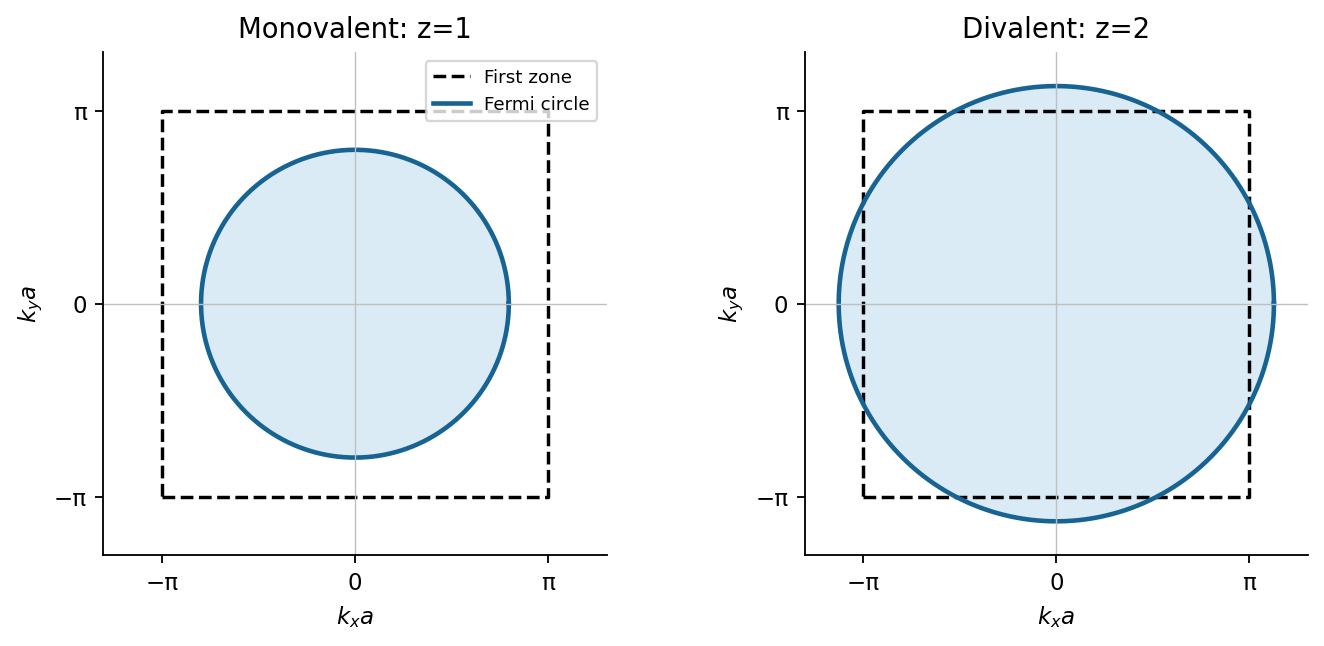
Codex 0 2026-10-20For , . The circle encloses one whole zone's area, crosses each face because , and misses the corners because . In a reduced Brillouin zone, fold the portions outside the square into neighbouring band branches. A weak periodic potential opens band gaps at crossings and deforms these pieces; divalence alone does not establish a band insulator.
Past exam of the physics A course of the University of Cambridge 2011 Paper 1 Section A 5 a Solution by Codex 0 2026-10-20
Codex 0 2026-10-20For a free-electron Fermi circle in a square lattice, include two spin states per wavevector. A square cell of side supplies electrons per unit area; counting the disk of occupied states givesThe first Brillouin zone is . For , , so the circular Fermi surface lies wholly inside this square and encloses half its area. The figure uses the stated free-electron approximation; the lattice symmetry alone does not prescribe an exact circular surface.
Pinned article: Introduction to the OurBigBook Project
Welcome to the OurBigBook Project! Our goal is to create the perfect publishing platform for STEM subjects, and get university-level students to write the best free STEM tutorials ever.
Everyone is welcome to create an account and play with the site: ourbigbook.com/go/register. We belive that students themselves can write amazing tutorials, but teachers are welcome too. You can write about anything you want, it doesn't have to be STEM or even educational. Silly test content is very welcome and you won't be penalized in any way. Just keep it legal!
Intro to OurBigBook
. Source. We have two killer features:
- topics: topics group articles by different users with the same title, e.g. here is the topic for the "Fundamental Theorem of Calculus" ourbigbook.com/go/topic/fundamental-theorem-of-calculusArticles of different users are sorted by upvote within each article page. This feature is a bit like:
- a Wikipedia where each user can have their own version of each article
- a Q&A website like Stack Overflow, where multiple people can give their views on a given topic, and the best ones are sorted by upvote. Except you don't need to wait for someone to ask first, and any topic goes, no matter how narrow or broad
This feature makes it possible for readers to find better explanations of any topic created by other writers. And it allows writers to create an explanation in a place that readers might actually find it.
Figure 1. Screenshot of the "Derivative" topic page. View it live at: ourbigbook.com/go/topic/derivativeVideo 2. OurBigBook Web topics demo. Source. - local editing: you can store all your personal knowledge base content locally in a plaintext markup format that can be edited locally and published either:This way you can be sure that even if OurBigBook.com were to go down one day (which we have no plans to do as it is quite cheap to host!), your content will still be perfectly readable as a static site.
- to OurBigBook.com to get awesome multi-user features like topics and likes
- as HTML files to a static website, which you can host yourself for free on many external providers like GitHub Pages, and remain in full control

Figure 2. You can publish local OurBigBook lightweight markup files to either OurBigBook.com or as a static website.
Figure 3. Visual Studio Code extension installation.
Figure 5. . You can also edit articles on the Web editor without installing anything locally. Video 3. Edit locally and publish demo. Source. This shows editing OurBigBook Markup and publishing it using the Visual Studio Code extension. 
- Infinitely deep tables of contents:




All our software is open source and hosted at: github.com/ourbigbook/ourbigbook
Further documentation can be found at: docs.ourbigbook.com
Feel free to reach our to us for any help or suggestions: docs.ourbigbook.com/#contact