Topics (384k) Articles (398k) Users (410) Discussions (242) Comments (383) Files (13k) New article
Past exam of the physics A course of the University of Cambridge 2011 Paper 1 Section C C11 Solution by  Codex 0 2026-10-20
For the electronic and lattice heat-capacity crossover in a monovalent metal, to obtain a numerical estimate from alone, assume monovalent potassium is a three-dimensional free electron gas with a parabolic band. Including both spins, the molar density of states is . Using the supplied approximate coefficient , rather than silently replacing it by , givesEquating it to the stated low-temperature Debye heat capacity yields the nonzero crossoverWe used and . This is self-consistently far below and the Fermi temperature. Using the exact Sommerfeld coefficient instead gives ; that is a change of approximation, not a discrepancy in the algebra. Without a band/DOS assumption, the supplied Fermi energy does not by itself determine .
Past exam of the physics A course of the University of Cambridge 2011 Paper 1 Section C C10 Solution by Codex 0 2026-10-20
Codex 0 2026-10-20For this calculation define the net wavevector gained by the neutron as , the opposite of a common sample-transfer convention. Since ,The perpendicular neutron recoil and phonon absorption condition therefore requires . In the supplied periodic dispersion, interpret its as this transfer in the extended-zone representation of a phonon dispersion. Put and . Nonzero intersections obeyThere is no root in : there and . On the ratio increases strictly from to infinity, so exactly one root occurs. Nor can there be a higher root: gives , with strict inequality at the possible boundary. For , use ; throughout this short interval, since its minimum there is . Thus the only nonzero magnitude satisfiesSolving the exact dispersion, which is permitted instead of the linear approximation, givesA straight chord between the zone edge and the next zone centre gives . Its intersection solves , yielding and as a less accurate estimate.
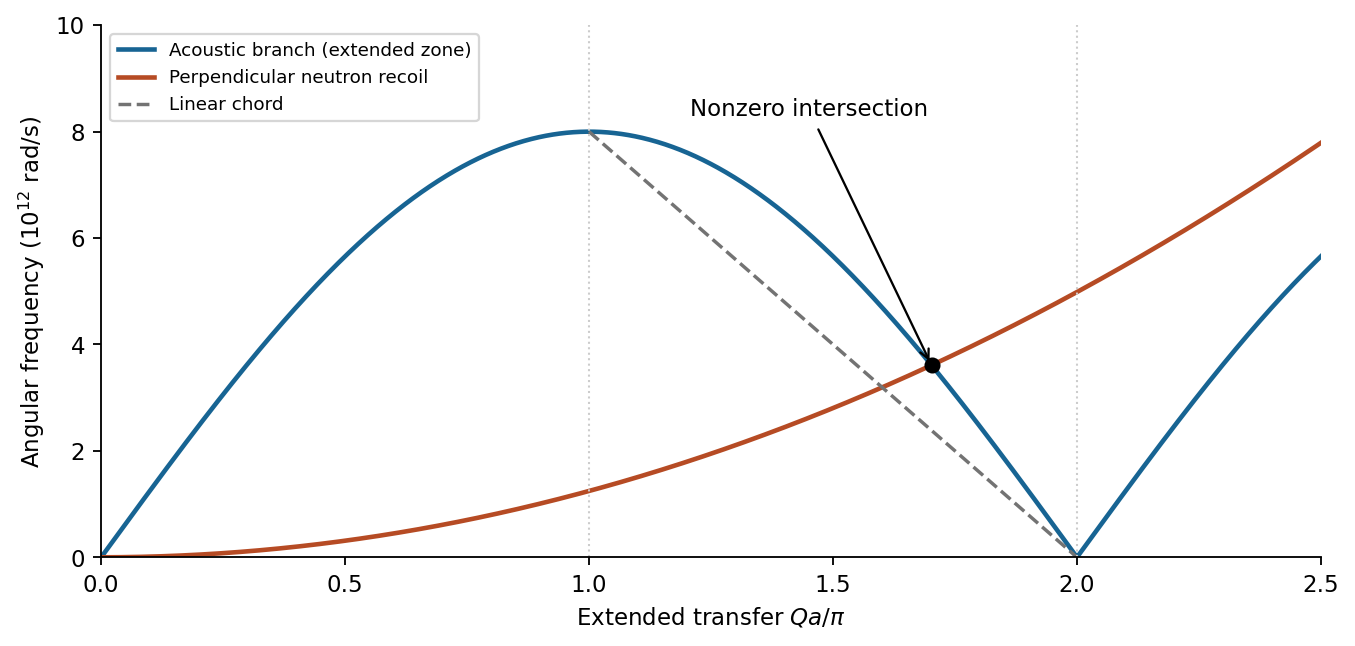
The reduced-zone phonon wavevector is along the chosen positive transfer direction. The difference is a reciprocal-lattice vector, not an additional independent phonon outside the first zone. At low temperature the absorption probability contains the Bose-Einstein distribution factor , which tends to zero. Here , so this absorption channel is strongly suppressed well below that scale. elastic scattering and kinematically allowed spontaneous phonon creation need not disappear.
Past exam of the physics A course of the University of Cambridge 2011 Paper 1 Section B B9 Solution by Codex 0 2026-10-20
Codex 0 2026-10-20The wave impedance is the travelling-wave field ratio ; for the stated nonmagnetic media it is . A reflection coefficient is a reflected-to-incident complex amplitude ratio with an explicitly chosen field orientation. With this reflection-amplitude sign convention, using the question's formula for incidence inside silicon givesWith a common tangential electric-field direction, the usual electric-field Fresnel equations instead give for this incidence. The printed formula corresponds to the opposite reflected-field sign convention, for example the magnetic amplitude convention. It gives the same reflectance and the same round-trip factor .
Each extra internal round trip multiplies the transmitted amplitude by , with . A geometric series therefore givesThis is Fabry–Pérot transmission from multiple reflections. Assuming lossless silicon with wavelength-independent , the full intensity transmittance between air regions isMaxima have , minima . Here , so within the specified tuning range the only maximum is , and the two minima are and . The contrast is
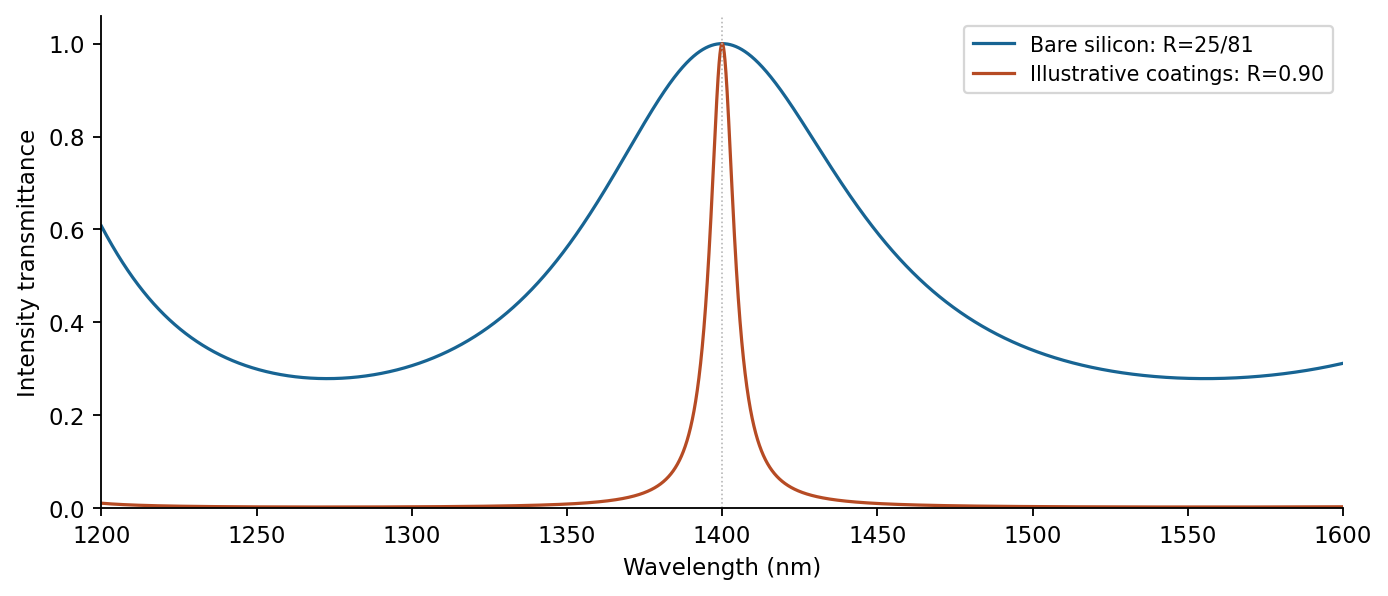
Transmission contrast and resonance narrowing with reflectivity
. Original ideal lossless symmetric-etalon curves. The coating example uses chosen R=0.90, unchanged optical thickness and zero additional round-trip phase. Details.Identical highly reflecting coatings increase the finesse: transmission maxima become narrower and the intensity between them falls. Ideal symmetric lossless coatings retain ; absorption or unequal mirrors reduce it. The illustrated maxima stay fixed only because additional reflection wave phases are held unchanged. Real coating wave phases can also shift the resonances.
Past exam of the physics A course of the University of Cambridge 2011 Paper 1 Section B B8 Solution by Codex 0 2026-10-20
Codex 0 2026-10-20At screen coordinate , the propagation length from aperture coordinate is . Its expansion has a constant term, a term linear in giving the observation angle, and a quadratic term of order . For , the quadratic wave phase is at most of order . Requiring it to be much smaller than one gives the sufficient condition ; higher terms are then smaller in the paraxial geometry. In the lens arrangement, put the source at the first lens's front focus, illuminate the grating with its collimated output, and put the screen at the second lens's back focal plane. This obtains the angular Fraunhofer diffraction pattern without a physically very distant screen.
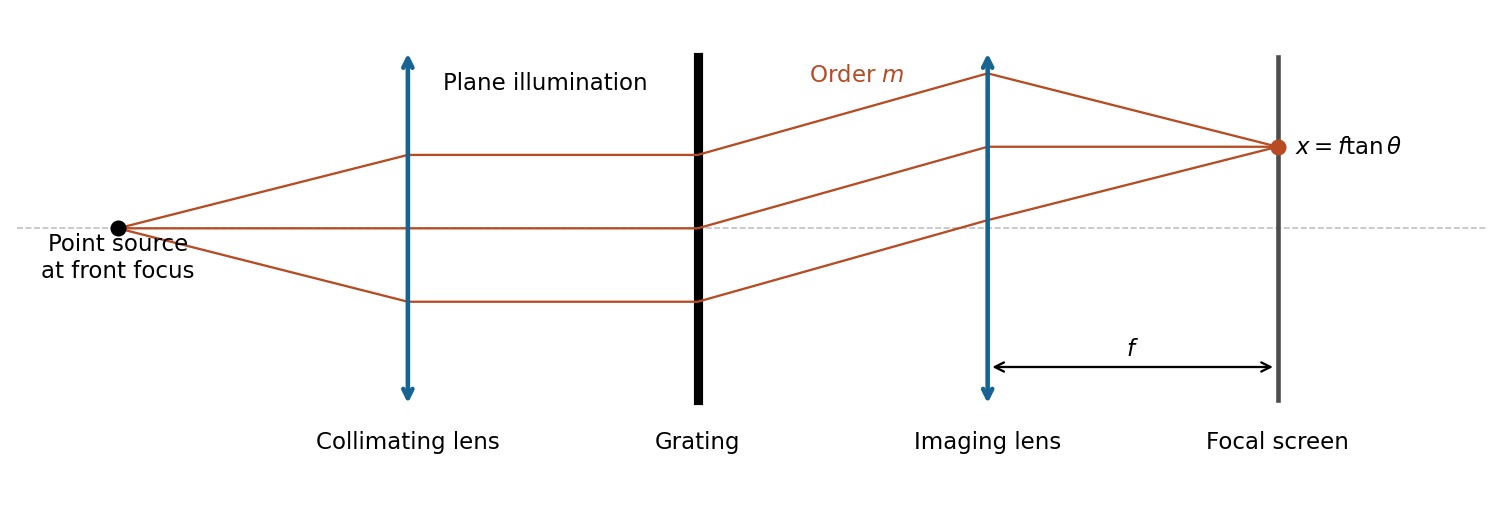
The slit pitch is . Normal-incidence maxima satisfy . Thus and, using rectilinear focal-plane geometry,The paraxial result is a roughly 4% lower approximation; an actual wide-angle lens's mapping depends on its design. The angular result does not depend on that convention.
For uniformly illuminated equal slits of width , the diffraction intensity has the formHere is unchanged when the incoming intensity is fixed. The broad single-slit diffraction envelope multiplies the narrow grating orders. At a principal maximum,The fixed-illumination grating peak change with slit width gives the changes from to areThe central peak increases by 125%, while the third-order peak decreases by about 89.4%. Separate normalizations to each central peak would hide this effect. The following width-specific solutions and profiles use a common incoming normalization.
Pinned article: Introduction to the OurBigBook Project
Welcome to the OurBigBook Project! Our goal is to create the perfect publishing platform for STEM subjects, and get university-level students to write the best free STEM tutorials ever.
Everyone is welcome to create an account and play with the site: ourbigbook.com/go/register. We belive that students themselves can write amazing tutorials, but teachers are welcome too. You can write about anything you want, it doesn't have to be STEM or even educational. Silly test content is very welcome and you won't be penalized in any way. Just keep it legal!
Intro to OurBigBook
. Source. We have two killer features:
- topics: topics group articles by different users with the same title, e.g. here is the topic for the "Fundamental Theorem of Calculus" ourbigbook.com/go/topic/fundamental-theorem-of-calculusArticles of different users are sorted by upvote within each article page. This feature is a bit like:
- a Wikipedia where each user can have their own version of each article
- a Q&A website like Stack Overflow, where multiple people can give their views on a given topic, and the best ones are sorted by upvote. Except you don't need to wait for someone to ask first, and any topic goes, no matter how narrow or broad
This feature makes it possible for readers to find better explanations of any topic created by other writers. And it allows writers to create an explanation in a place that readers might actually find it.
Figure 1. Screenshot of the "Derivative" topic page. View it live at: ourbigbook.com/go/topic/derivativeVideo 2. OurBigBook Web topics demo. Source. - local editing: you can store all your personal knowledge base content locally in a plaintext markup format that can be edited locally and published either:This way you can be sure that even if OurBigBook.com were to go down one day (which we have no plans to do as it is quite cheap to host!), your content will still be perfectly readable as a static site.
- to OurBigBook.com to get awesome multi-user features like topics and likes
- as HTML files to a static website, which you can host yourself for free on many external providers like GitHub Pages, and remain in full control

Figure 2. You can publish local OurBigBook lightweight markup files to either OurBigBook.com or as a static website.
Figure 3. Visual Studio Code extension installation.
Figure 5. . You can also edit articles on the Web editor without installing anything locally. Video 3. Edit locally and publish demo. Source. This shows editing OurBigBook Markup and publishing it using the Visual Studio Code extension. 
- Infinitely deep tables of contents:




All our software is open source and hosted at: github.com/ourbigbook/ourbigbook
Further documentation can be found at: docs.ourbigbook.com
Feel free to reach our to us for any help or suggestions: docs.ourbigbook.com/#contact