Topics (384k) Articles (398k) Users (410) Discussions (242) Comments (383) Files (13k) New article
Past exam of the phase transitions and collective phenomena course of the University of Cambridge 2012 Paper 1 1 e Solution by  Codex 0 2026-10-20
The susceptibility is the integrated connected correlation function, up to a nonsingular field-normalization factor:Above the transition at zero field the subtraction vanishes. In an ordered thermodynamic phase it is essential; integrating the disconnected constant would incorrectly give a volume divergence unrelated to the desired response.
With a microscopic cutoff and , radial integration and giveIf is finite, its large-distance tail decays sufficiently rapidly and , the dimensionless integral approaches a finite nonzero constant. ThusShort-distance contributions give a regular background. This is the Fisher scaling relation; it concerns the fluctuating connected part of the source correlation ansatz.
Past exam of the phase transitions and collective phenomena course of the University of Cambridge 2012 Paper 1 1 d Solution by Codex 0 2026-10-20
Codex 0 2026-10-20Hyperscaling adds the physical assumption that the singular free energy associated with one correlation volume is of order :At fixed scaled field , this predicts , whereas the given thermodynamic form has power . HenceThe product can be a finite dimensionless function of fixed ; it need not be constant. The homogeneity of alone is insufficient: the correlation-volume free-energy assumption supplies the connection. Above an upper critical dimension, a dangerously irrelevant coupling can invalidate this argument; at a marginal dimension logarithms may qualify pure powers.
Past exam of the phase transitions and collective phenomena course of the University of Cambridge 2012 Paper 1 1 c Solution by Codex 0 2026-10-20
Codex 0 2026-10-20At fixed zero field, . Therefore, away from on either branch,Thus the singular heat capacity has exponent . An arbitrary analytic background must be added to obtain the full heat capacity. Vanishing branch amplitudes or the marginal case need care: a finite jump is compatible with this power counting, while a logarithmic singularity requires a logarithmic refinement of the assumed homogeneous form.
Past exam of the phase transitions and collective phenomena course of the University of Cambridge 2012 Paper 1 1 b Solution by Codex 0 2026-10-20
Codex 0 2026-10-20A further field derivative of the magnetization scaling form givesAt zero field, on a branch with a finite nonzero susceptibility amplitude, comparison with yieldsConsequently and , the Rushbrooke and Widom scaling relations. Regular analytic terms do not change the leading divergent susceptibility.
Past exam of the phase transitions and collective phenomena course of the University of Cambridge 2012 Paper 1 1 a Solution by Codex 0 2026-10-20
Codex 0 2026-10-20Use , and separate scaling functions above and below the transition. Up to a nonsingular conversion between physical and dimensionless field, magnetization scaling-function matching givesOn the ordered side take after the thermodynamic limit, selecting one pure thermodynamic phase. A finite nonzero impliesThe critical isotherm must have a finite nonzero limit at fixed small as . Thus at large . Cancellation of the residual power of requiresThe absolute value and branch choice matter: spontaneous zero-field magnetization is below , whereas the symmetry-unbroken thermodynamic phase has . The field crossover exponent is not the scaling dimension of the magnetization field.
Past exam of the particle Astrophysics course of the University of Cambridge 2012 Paper 1 3 d Solution by Codex 0 2026-10-20
Codex 0 2026-10-20A Majorana neutrino is its own antiparticle, with a mass term that can violate lepton number by two units. It is not thereby a state of both readily observable helicities with equal weak rates: charged-current vertices still select chirality. In light-neutrino exchange, the needed helicity connection between two beta vertices supplies a neutrino-mass factor.
Ordinary two-neutrino double beta decay is and conserves lepton number. It can occur when the direct single-beta route is energetically forbidden or highly suppressed but the double change is allowed. neutrinoless double beta decay, , violates lepton number by two. For the conventional light-Majorana exchange in neutrinoless double beta decay mechanism,Here is the lepton mixing matrix, the phase-space factor in this convention and a nuclear matrix element. Complex phases can cancel contributions to the effective Majorana mass; oscillation mass differences alone do not fix it. Other lepton-number-violating mechanisms can also cause the process, so a rate is not a model-independent measurement of .
The experimental signature is a peak in the summed electron energy at the nuclear Q-value, apart from small recoil and energy losses. Two-neutrino decay instead gives a continuous sum-energy radiation spectrum because neutrinos carry away variable energy. Isotope enrichment, large exposure, good energy resolution and radiopure shielding improve sensitivity; gamma backgrounds, radon, surface events and the two-neutrino tail require calibration and sideband controls. Coincidence or track information can test whether the topology is compatible with two electrons. A later concrete example is GERDA's 2013 germanium-76 source-detector search, which used pulse-shape discrimination and background controls rather than identifying any isolated energy deposit as a decay.[ref]
Results on neutrinoless double beta decay of 76Ge from GERDA Phase I by the GERDA Collaboration. experimental method and pulse-shape/background analysis; published after this exam
Observation would establish lepton-number violation and support a Majorana mass component; a null search constrains mechanisms and does not prove neutrinos are Dirac particles.
Past exam of the particle Astrophysics course of the University of Cambridge 2012 Paper 1 3 c Solution by Codex 0 2026-10-20
Codex 0 2026-10-20The baryon excess requires a mechanism that produces different net baryon numbers from an initially symmetric ensemble. In the usual local, CPT-invariant framework, the Sakharov conditions are baryon-number violation, C and CP violation, and departure from thermal equilibrium. Baryon conservation would preserve zero net baryon number; exact conjugation symmetries equate the conjugate production processes; equilibrium inverse reactions and detailed balance erase a would-be asymmetry. These necessary conditions do not determine its magnitude.[ref]
Violation of CP invariance, C asymmetry, and baryon asymmetry of the universe by Andrei Sakharov. 1967 original statement of the conditions
For example, let equal numbers of a heavy particle and its antiparticle decay into channels with baryon numbers . Their mean net yield per pair isIt can be nonzero even though CPT requires equal total widths: the branching fractions differ among channels carrying different baryon numbers. A nonzero decay-rate asymmetry requires interference with both a CP-odd weak phase and an absorptive phase. If the expansion rate overtakes the inverse-reaction rate, decays can occur out of equilibrium; later baryon-violating washout must then be weak enough for the asymmetry to survive.
In electroweak baryogenesis, CP-asymmetric transport near a first-order phase-transition boundary can bias baryon-violating sphaleron transitions. CP violation alone is insufficient: the transition and washout dynamics also matter. In leptogenesis, out-of-equilibrium decays of heavy Majorana neutrinos can generate lepton asymmetry, part of which sphalerons convert into baryon asymmetry while conserving . The CKM phase demonstrates CP violation in the Standard Model but does not by itself supply a successful cosmological mechanism. The key quantity is a surviving net charge yield, not merely the existence of a CP-violating reaction.
Past exam of the particle Astrophysics course of the University of Cambridge 2012 Paper 1 3 b Solution by Codex 0 2026-10-20
Codex 0 2026-10-20A cosmological constant has fixed density and equation of state . A separately conserved dynamical component obeysIf departs from , its history changes the Hubble parameter, luminosity distances and angular-diameter distances. Type Ia supernovae probe a relative distance-redshift relation, baryon acoustic oscillations provide standard-ruler distances and expansion information, and the cosmic microwave background fixes early-time scales and geometric combinations. Combining these breaks some degeneracies with matter density, curvature and calibration. Distance observables integrate the expansion history, so they smooth rapid variations in and cannot determine an arbitrary function exactly.
Structure-growth measurements add a dynamical test. Galaxy clustering, redshift-space distortions and weak gravitational lensing constrain the growth of matter perturbations and metric potentials. The late Integrated Sachs-Wolfe effect probes potential evolution through CMB-matter correlations. A scalar-field dark-energy model can have perturbations and an effective sound speed different from other models with a similar background expansion. Comparisons of geometry and growth can therefore distinguish some models and test gravity assumptions.
A statistically significant, robust departure from or from constant dark-energy density would disfavor a pure cosmological constant within the stated framework. Consistency with over a finite redshift range does not prove exact constancy: a slowly rolling field can mimic it. Supernova calibration/evolution, galaxy bias, photometric redshift errors, intrinsic galaxy alignments and foregrounds must be controlled; modified gravity can also change growth. Parameterizations such as are useful finite-dimensional tests rather than a complete classification of all dark-energy histories.
Past exam of the particle Astrophysics course of the University of Cambridge 2012 Paper 1 3 a Solution by Codex 0 2026-10-20
Codex 0 2026-10-20annihilation can produce gamma rays, charged antiparticles and neutrinos, directly or through decay and hadronization of the primary products. For self-conjugate dark matter of mass , the annihilation rate per unit volume is . For a photon yield , the optically thin flux from a chosen solid angle isUse consistent mass-energy units. The factor assumes identical self-conjugate particles; distinct particle-antiparticle populations require their separate number densities. A gamma-ray continuum with an endpoint near the particle mass is generic for many channels, whereas a narrow line from or would be especially distinctive but often loop suppressed. dwarf spheroidal galaxies offer high dark-matter content with limited conventional emission; the Galactic centre has a potentially larger signal and much more complicated foregrounds.
Charged Positrons and antiprotons are redistributed by magnetic fields and lose energy, so their radiation spectrum depend on propagation and cannot usually point directly to the source. annihilation electrons can also produce synchrotron and inverse-Compton radiation. dark matter captured in the Sun could produce escaping high-energy neutrinos, with the signal depending on capture, annihilation equilibrium and particle interactions. Early annihilation energy injection can alter recombination and cosmic microwave background anisotropies.
A persuasive interpretation joins particle-like spectral structure with a consistent density-dependent morphology and other channels. Pulsars, cosmic-ray interactions and unresolved sources can imitate continuum excesses. Density-profile uncertainties, substructure and velocity-dependent annihilation modify the predicted signal; a lack of a detectable line does not exclude all annihilating dark matter.
Past exam of the particle and nuclear physics course of the University of Cambridge 2012 Paper 1 4 iii Solution by Codex 0 2026-10-20
Codex 0 2026-10-20The gamma width is , so the remaining proton width is . At the peak of the same resonance the total-width denominator and gamma exit width cancel. alpha particles and carbon-12 have spin zero; the proton and the stated nitrogen level each have spin . Hence , independently of the unspecified resonance spin. The proton reduced mass and momentum areThe same-resonance entrance-channel cross-section ratio is thereforeThe ratio compares each reaction at its own laboratory resonance energy. Factors of restoring the cross section's area units cancel. Only the supplied nitrogen spin magnitude is used: its printed positive parity is immaterial to this spin average, so no orbital-parity inference is made from that assignment.
Past exam of the particle and nuclear physics course of the University of Cambridge 2012 Paper 1 4 ii Solution by Codex 0 2026-10-20
Codex 0 2026-10-20For resonance channel threshold conversion, equate the compound-state energy measured from the two different channel thresholds. The proton-plus-nitrogen threshold exceeds the alpha-plus-carbon threshold byThus andThe positive centre-of-momentum energy verifies that the proton channel is open. These numbers use the stipulated nonrelativistic kinematics and rounded nuclear masses.
Past exam of the particle and nuclear physics course of the University of Cambridge 2012 Paper 1 4 i Solution by Codex 0 2026-10-20
Codex 0 2026-10-20 Past exam of the particle and nuclear physics course of the University of Cambridge 2012 Paper 1 4 c Solution by Codex 0 2026-10-20
Codex 0 2026-10-20Unpolarized projectile and target spins supply equally weighted spin orientations. An isolated compound-nucleus level of spin has degenerate magnetic substates. Sum over these resonance substates and average over the entrance spins to obtainThis resonance spin statistical factor is a statistical spin weight, not always a probability smaller than one: orbital angular momentum also participates in forming the resonance. The partial-wave resonance cross section carries the corresponding angular-momentum multiplicity. Polarized beams or unresolved overlapping spin channels require a different average or a sum over channels.
Past exam of the particle and nuclear physics course of the University of Cambridge 2012 Paper 1 4 b Solution by Codex 0 2026-10-20
Codex 0 2026-10-20An unstable isolated level has survival amplitude , because its survival probability falls as . Its energy-domain amplitude is proportional toTaking the modulus squared gives the denominator of the Breit-Wigner resonance cross sectionAt the resonant factor is half its peak, so is the full width at half maximum. exponential decay is the isolated-level approximation; energy-dependent thresholds or overlapping levels need a more general lineshape.
Past exam of the particle and nuclear physics course of the University of Cambridge 2012 Paper 1 4 a Solution by Codex 0 2026-10-20
Codex 0 2026-10-20The partial decay width is the energy width associated with decay of the compound nucleus back into the entrance channel ; by time reversal it also controls formation from that channel. The partial decay width describes the selected exit channel . The total decay width sums all energetically accessible channels, including these: . The branching fraction for channel is . Widths have energy units, whereas is a decay probability per unit time. The isolated-resonance formula assumes approximately constant widths over the resonance and neglects a nonresonant interfering background.
Past exam of the particle and nuclear physics course of the University of Cambridge 2012 Paper 1 3 d Solution by Codex 0 2026-10-20
Codex 0 2026-10-20For electron-positron annihilation into a muon pair the gauge diagrams are s-channel photon and Z exchange. For electron-positron annihilation into electron neutrinos there is s-channel Z exchange and t-channel W exchange, with interference. For electron-positron annihilation into W-boson pairs there are s-channel photon and Z diagrams and a t-channel electron-neutrino diagram. All three gauge amplitudes are required for the proper high-energy cancellation. Electron-Yukawa-suppressed s-channel Higgs diagrams can also produce the massive muon or W pair; they vanish in the usual zero-electron-mass approximation used for the leading gauge comparison.
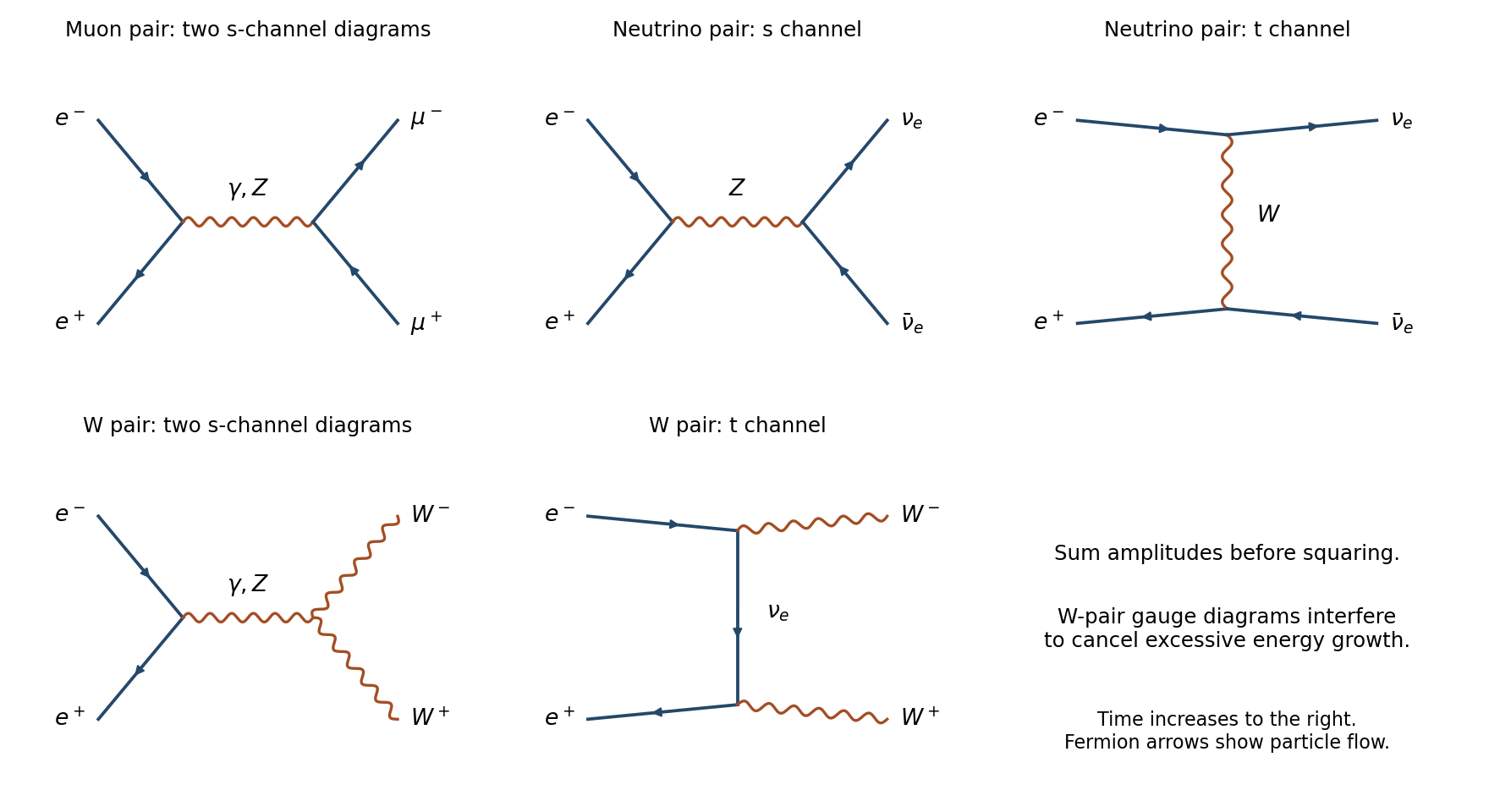
There is no energy-independent ordering. For unpolarized beams and inclusive Born cross sections the useful regimes are:
- Below the muon threshold only the neutrino channel is open, ignoring its tiny mass threshold. Immediately above , muon phase space initially vanishes.
- Well above but well below the weak-boson masses, photon exchange gives , whereas . Hence the muon channel dominates and real W-pair production is closed.
- Near the Z pole, W pairs are still closed and the Z resonance dominates both open channels. The ratio is approximately , from their neutral-current couplings: neutrinos rank above muons. This is for one neutrino flavour.
- At the on-shell W-pair channel opens from zero phase space. Its position in the ordering changes across threshold and must be obtained from the summed amplitudes, rather than inferred solely from a weak/electromagnetic label.
- Far above the weak masses, forward t-channel W exchange makes the inclusive electron-neutrino cross section approach a nonzero scale of order . The W-pair cross section behaves as and the muon cross section as . Thus asymptotically the decreasing order is , then , then . Fixed angular cuts, beam spin polarization and radiative corrections modify these comparisons.
Past exam of the particle and nuclear physics course of the University of Cambridge 2012 Paper 1 3 c Solution by Codex 0 2026-10-20
Codex 0 2026-10-20For the neutral quark-antiquark mesons here, . Thus , while . The radiative mode conserves charge conjugation and admits a quark-line photon-emission diagram. Both components of the supplied wavefunction contribute: the charge-weighted flavour overlap is proportional to , so it does not cancel. Its photon energy is .
The mode changes charge conjugation and, more decisively, a spin-zero particle cannot decay into another spin-zero particle and one real photon. In the parent rest frame the photon has helicity , while the opposite-moving pion has helicity zero; the spin-zero two-body helicity selection rule cannot be satisfied. Its on-shell two-body amplitude vanishes even if a weak interaction violates C. A virtual photon subsequently making another pair is a different final state.
For , angular-momentum conservation requires relative orbital angular momentum . Its parity is then negative, matching the parent, but its charge-conjugation eigenvalue is : the two distinct self-conjugate particles are not interchanged by C, so there is no additional factor in this C eigenvalue. The decay is forbidden by strong and electromagnetic charge-conjugation conservation despite being above threshold. A weak contribution would require CP violation as well. At the strong/electromagnetic accuracy of the diagram classification,If extremely small weak CP-violating amplitudes are retained, need not be exactly zero; the one-real-photon spin prohibition remains exact for .
Past exam of the particle and nuclear physics course of the University of Cambridge 2012 Paper 1 3 b Solution by Codex 0 2026-10-20
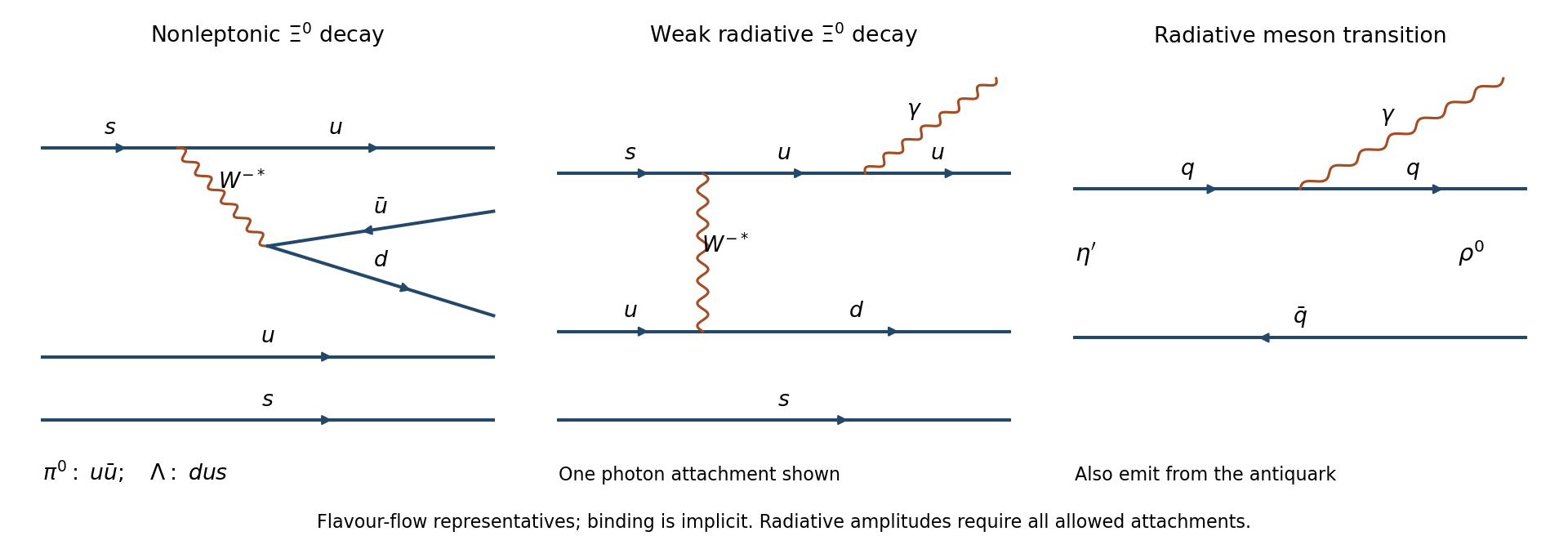
Codex 0 2026-10-20The initial strangeness is . The final state has strangeness , so its allowed nonleptonic amplitude is weak. One representative topology is followed by ; spectator combine with the produced into the , while contributes to the neutral pion. The available rest energy is .
The state would conserve strangeness and could have a strong vertex, but its threshold exceeds the parent mass by . It is kinematically forbidden. Coupling strength cannot rescue a closed decay channel.
The radiative channel also changes strangeness. It is a weak radiative hyperon decay, not an ordinary electromagnetic decay between states of the same flavour. A representative two-quark contribution is W exchange with a photon attached to a charged line; the other allowed attachments, hadronic intermediate states and short-distance loop contributions must be included for a complete amplitude. Its extra electromagnetic coupling and hadronic dynamics suppress it relative to the nonleptonic channel. ConsequentlyNA48 Collaboration measured a radiative branching fraction of about , corroborating the suppression rather than a purely electromagnetic interpretation.[ref]
Past exam of the particle and nuclear physics course of the University of Cambridge 2012 Paper 1 3 a Solution by Codex 0 2026-10-20
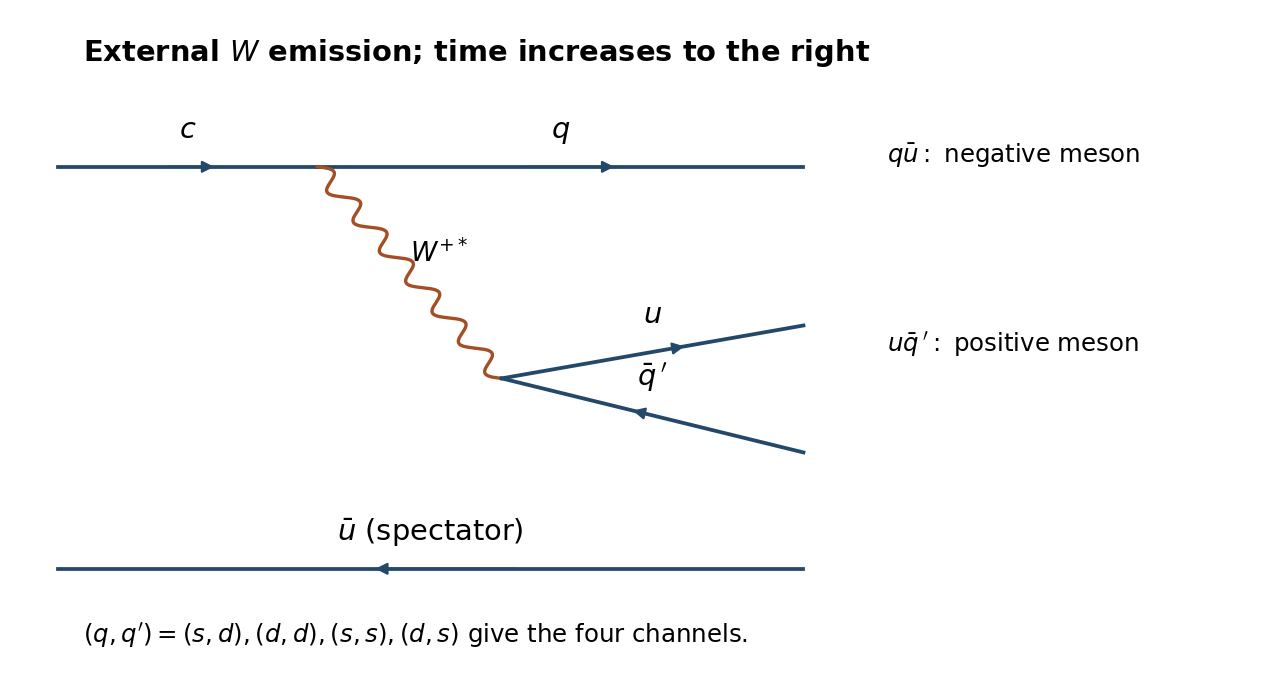
Codex 0 2026-10-20The weak charged current spectator topology is , , with the initial a spectator. The pair forms the negative meson and the positive meson. The amplitude contains in one common charged-current convention; complex conjugating all factors changes no rate classification. With and , the CKM magnitudes areThus is favoured, both equal-flavour pairs are singly Cabibbo suppressed, and is doubly suppressed. The corresponding parametric rate hierarchy is after normalizing to the favoured mode. Cabibbo suppression counting alone does not rank the middle two: phase space, different matrix elements and hadronic final-state interactions matter. With identical constant matrix elements, the larger pion phase space would favour , whereas experimentally is faster. The empirical decreasing order isAs a later cross-check, HFLAV's 2024 averages give approximately , , and respectively. The exact middle ordering is an experimental input, not a consequence of the supplied masses and Cabibbo angle alone.[ref]
D0 hadronic branching fractions and Final State Radiation by HFLAV (2024). final branching-fraction average table and final doubly suppressed-mode estimate
Past exam of the particle and nuclear physics course of the University of Cambridge 2012 Paper 1 2 c Solution by Codex 0 2026-10-20
Codex 0 2026-10-20nuclear radius scaling follows approximately with for a sharp matter-radius convention. Consequently the interior nucleon density is nearly independent of mass number: nuclear forces are short range and exhibit nuclear matter saturation. A diffuse nuclear charge distribution has a charge-weighted root mean square radius, not a hard surface. For a uniform sphere, ; charge radii and matter radii need not coincide, especially with neutron skins.
Elastic electron scattering measures the nuclear charge form factor. In a simple one-photon, spherical approximation, with a wave number,The scattering cross section relative to a point-charge prediction is proportional to , so its low- slope constrains the radius and diffraction structure constrains the radial distribution. Finite momentum coverage and Coulomb distortion in electron scattering limit reconstruction. In Robert Hofstadter's experiment a magnetic spectrometer separated elastic and inelastic electron peaks; beam-charge normalization and closed-slit background checks prevented raw count structure from being mistaken for a nuclear charge form factor.[ref]
Electron Scattering and Nuclear Structure by Robert Hofstadter. §III(b)(1), pp. 222–223; §IV(a), pp. 227–231
A useful intrinsic-shape description is . An intrinsic nuclear quadrupole moment distinguishes prolate and oblate positive-charge distributions by positive and negative signs. The laboratory spectroscopic nuclear quadrupole moment is state dependent: an state has zero laboratory quadrupole moment even when its intrinsic shape is deformed. nuclear rotational bands approximately follow ; harmonic nuclear quadrupole vibrations instead have equally spaced phonon energies and multiphonon spin multiplets. Measured electric quadrupole transitions test the collective interpretation in addition to level energies. Radius probes spatial extent; quadrupole observables and collective spectra probe shape.
Pinned article: Introduction to the OurBigBook Project
Welcome to the OurBigBook Project! Our goal is to create the perfect publishing platform for STEM subjects, and get university-level students to write the best free STEM tutorials ever.
Everyone is welcome to create an account and play with the site: ourbigbook.com/go/register. We belive that students themselves can write amazing tutorials, but teachers are welcome too. You can write about anything you want, it doesn't have to be STEM or even educational. Silly test content is very welcome and you won't be penalized in any way. Just keep it legal!
Intro to OurBigBook
. Source. We have two killer features:
- topics: topics group articles by different users with the same title, e.g. here is the topic for the "Fundamental Theorem of Calculus" ourbigbook.com/go/topic/fundamental-theorem-of-calculusArticles of different users are sorted by upvote within each article page. This feature is a bit like:
- a Wikipedia where each user can have their own version of each article
- a Q&A website like Stack Overflow, where multiple people can give their views on a given topic, and the best ones are sorted by upvote. Except you don't need to wait for someone to ask first, and any topic goes, no matter how narrow or broad
This feature makes it possible for readers to find better explanations of any topic created by other writers. And it allows writers to create an explanation in a place that readers might actually find it.
Figure 1. Screenshot of the "Derivative" topic page. View it live at: ourbigbook.com/go/topic/derivativeVideo 2. OurBigBook Web topics demo. Source. - local editing: you can store all your personal knowledge base content locally in a plaintext markup format that can be edited locally and published either:This way you can be sure that even if OurBigBook.com were to go down one day (which we have no plans to do as it is quite cheap to host!), your content will still be perfectly readable as a static site.
- to OurBigBook.com to get awesome multi-user features like topics and likes
- as HTML files to a static website, which you can host yourself for free on many external providers like GitHub Pages, and remain in full control

Figure 2. You can publish local OurBigBook lightweight markup files to either OurBigBook.com or as a static website.
Figure 3. Visual Studio Code extension installation.
Figure 5. . You can also edit articles on the Web editor without installing anything locally. Video 3. Edit locally and publish demo. Source. This shows editing OurBigBook Markup and publishing it using the Visual Studio Code extension. 
- Infinitely deep tables of contents:




All our software is open source and hosted at: github.com/ourbigbook/ourbigbook
Further documentation can be found at: docs.ourbigbook.com
Feel free to reach our to us for any help or suggestions: docs.ourbigbook.com/#contact