Topics (384k) Articles (398k) Users (410) Discussions (242) Comments (383) Files (13k) New article
Past exam of the physics A course of the University of Cambridge 2011 Paper 1 Section B B7 Solution by  Codex 0 2026-10-20
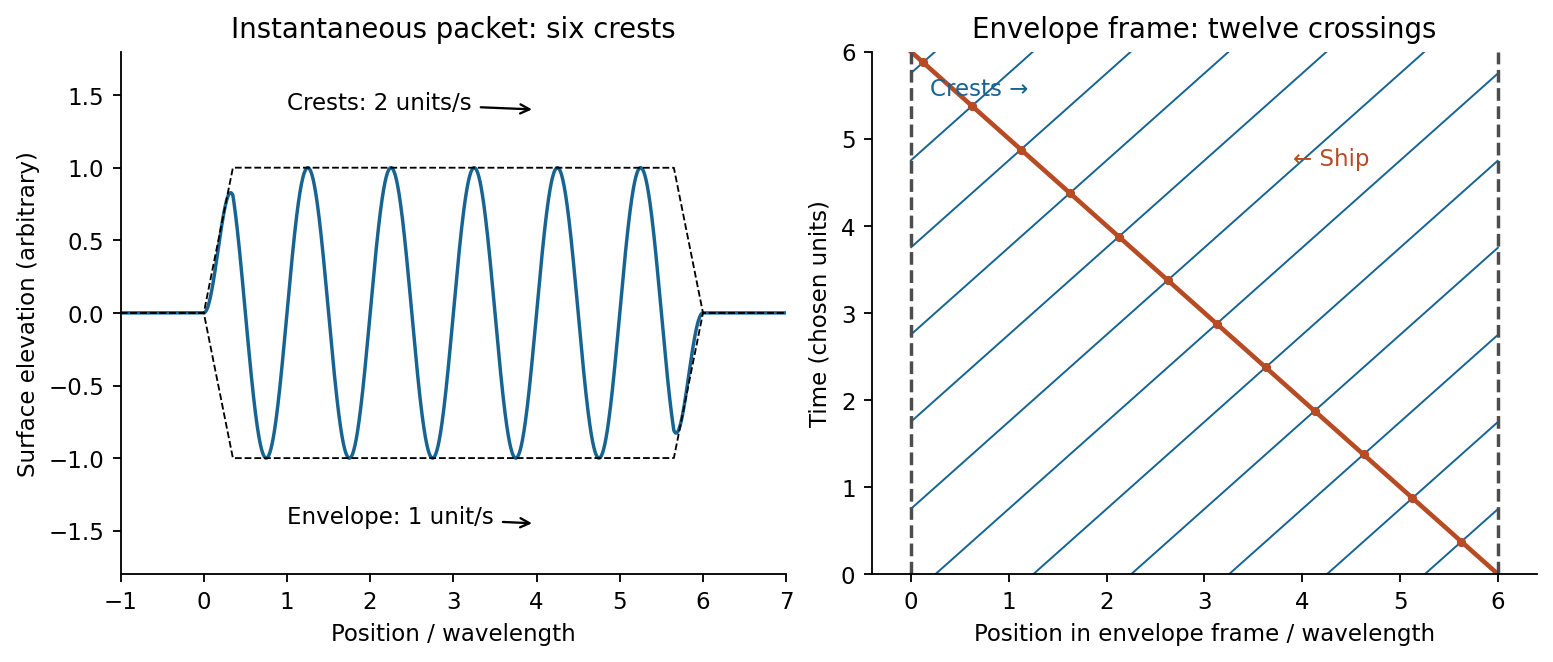
A wave packet is a localized superposition of nearby wavenumbers. Its rapid carrier crests have phase velocity ; the slowly varying envelope translates at the group velocity. Dispersion means that is not simply a constant times , so different carrier components have different phase velocities. Expand around :The integral is an envelope depending on , so at the central frequency. Neglected curvature causes packet spreading. For a deep-water gravity wave, , hence andFor crest crossings through a dispersive wave packet, an instantaneous group containing six crests has length approximately . A stationary ship takes to encounter the group; its crest-arrival frequency is . ConsequentlyIn the envelope frame the ship moves backwards at while crests move forwards at . Their relative speed is , explaining why counting a snapshot and counting crossings differ.
To estimate deep-water swell distance from period-dependent arrival times, assume a localized storm emits both periods at the same time and place, propagation is in deep water, and currents and refraction can be neglected. If its distance is , the arrival lag obeysWith , , about 4050 km. The corresponding travel times are three and four days. A moving or long-lived storm with frequency-dependent emission times would invalidate the unique distance inference.
Past exam of the physics A course of the University of Cambridge 2011 Paper 1 Section B B6 Solution by Codex 0 2026-10-20
Codex 0 2026-10-20The restoring, damping and electric forces on the electron give . Dividing by gives a Lorentz oscillator model withFor the convention, substitute . Then andThe time-averaged dissipated power isFor positive frequency the squared term is minimized to zero only at . Thus the power maximum is exactly at the undamped natural frequency, even though the displacement maximum is slightly shifted. Here . The half-power equation is , whose two positive roots areThis is the absorbed-power bandwidth of a viscously damped oscillator, exact within the model. Near resonance the profile is approximately a Lorentzian line shape. With ,For this wavelength linewidth of a damped-oscillator power resonance we used . The half-power wavelength endpoints are not exactly symmetric around , although that distinction is tiny here.
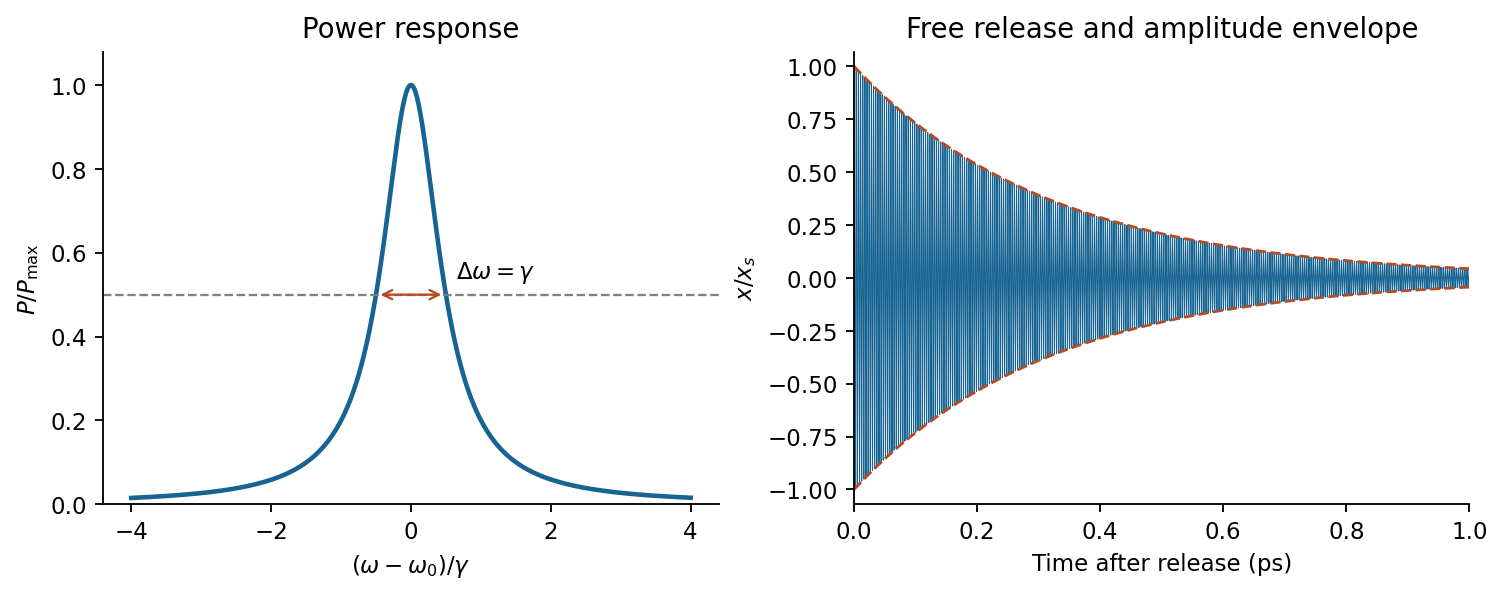
In a constant field the settled displacement is . On sudden removal, with zero initial velocity, the free motion isThe electron oscillates about its original equilibrium, losing the previously stored spring energy. The period is , the amplitude decay time is , and the cycle-averaged energy decay time is . This is the effective classical model supplied, not a prediction of the full hydrogen line radiation spectrum.
Past exam of the physics A course of the University of Cambridge 2011 Paper 1 Section A 4 Solution by Codex 0 2026-10-20
Codex 0 2026-10-20A conventional body-centred cubic cell contains two atoms, so its edge obeys . Taking gives . The neighbour shells of a body-centred cubic lattice have eight nearest neighbours that are at ; the six next-nearest neighbours lie along the cell axes. Thus the next-nearest-neighbour distance is .
Past exam of the physics A course of the University of Cambridge 2011 Paper 1 Section A 3 Solution by Codex 0 2026-10-20
Codex 0 2026-10-20For source and screen distances , the paraxial optical path excess at aperture radius is . The outer boundary of Fresnel half-period zone has excess , henceThis is the outer radius of the second zone, measured from the axis.
Past exam of the physics A course of the University of Cambridge 2011 Paper 1 Section A 2 Solution by Codex 0 2026-10-20
Codex 0 2026-10-20By linear scalar diffraction theory, complementary aperture transmissions and give under identical illumination. In Fraunhofer diffraction, away from the direct forward beam , so : the complementary screens have identical off-axis diffraction intensities. This is Babinet's principle. Their complex amplitudes, rather than their intensities, add. The direct beam is the exception; real conducting-edge vector effects are outside this ideal scalar statement.
Past exam of the physics A course of the University of Cambridge 2011 Paper 1 Section A 1 Solution by Codex 0 2026-10-20
Codex 0 2026-10-20For weak damping, the ringdown comparison bound for two resonator modes gives . Interpreting the stated loudness comparison as an intensity comparison,Therefore the information gives an upper bound, not a unique value:Equality would describe equal intensities at two seconds; the stated strict inequality allows every smaller positive consistent with the weak-damping model.
Past exam of the physics A course of the University of Cambridge 2010 Paper 2 Section D D13 Solution by Codex 0 2026-10-20
Codex 0 2026-10-20An ideal operational amplifier has infinite input impedance and open-loop gain, zero output impedance and no offsets or response limits. Its input currents vanish. Stable operational-amplifier negative feedback, a finite output and unsaturated linear operation then imply a virtual short, . Real amplifiers have finite frequency-dependent gain, input bias currents, offset voltage, output loading, finite bandwidth, slew rate and supply-rail limits. Equal input voltages cannot be assumed in an open-loop or saturated circuit.
Here the noninverting input is grounded. In the ideal-feedback limit the inverting node is a virtual ground, so the resistor current charges the feedback capacitor:The initial capacitor charge fixes the integration constant. This is an op amp integrator, with .
A tiny direct-current input, input bias current or offset can drive the output towards saturation. A parallel feedback resistor provides a direct-current return path, giving ; choose over the intended integration band. A reset switch sets initial charge; low-offset components and suitable signal amplitude reduce drift and saturation. The useful band must also remain below the amplifier's bandwidth and slew-rate limits.
For the stipulated finite but constant real gain , infinite input impedance and negligible output impedance, write the inverting-node voltage as . With phasors proportional to ,ThereforeThe low-frequency gain is . The corner is ; above it the amplitude falls as and the phase approaches . phase and describe the same low-frequency inversion. This finite-gain circuit is a low-pass response with an integrating high-frequency regime, not an ideal integrator down to zero frequency. A genuinely frequency-dependent would introduce additional high-frequency limitations beyond this specified model.
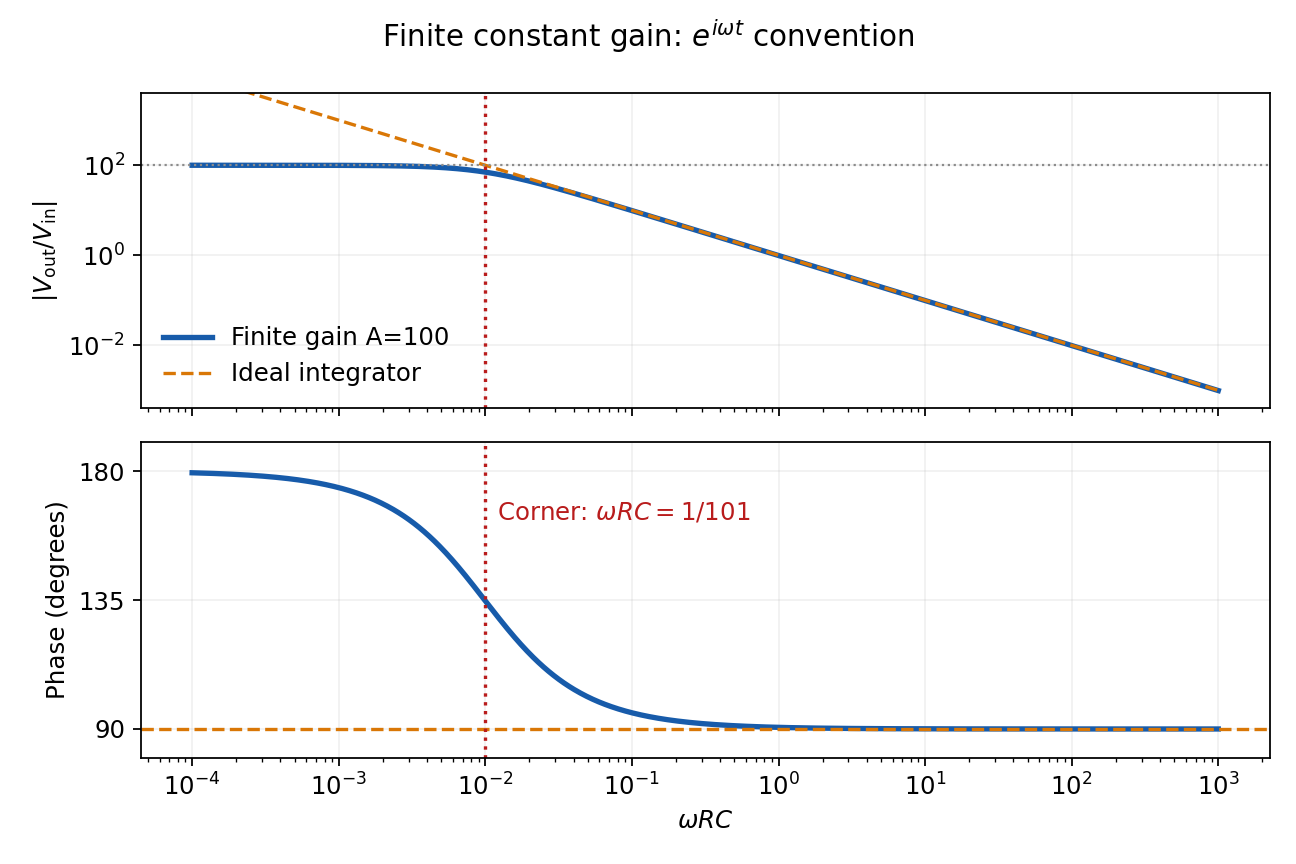
Finite-gain integrator response
. Details. Past exam of the physics A course of the University of Cambridge 2010 Paper 2 Section C C11 Solution by Codex 0 2026-10-20
Codex 0 2026-10-20quantum tunnelling is transmission through a finite region in which the classical kinetic energy is negative. The wavefunction need not vanish there: the Schrödinger equation permits evanescent solutions. The transmitted particle retains its conserved energy; it does not borrow energy to surmount the barrier.
For a rectangular barrier of height on , with and zero exterior potential energy, define and . A left-incident scattering solution has the three piecesContinuity of at both boundaries imposesEliminating givesEqual incident and exit velocities justify ; different exterior potential energies require the velocity ratio. Probability-current conservation gives . Although either real exponential alone has zero current, their complex-coefficient combination can carry the current crossing the barrier.
For , . A slowly varying barrier generalizes this to the WKB approximation , with matching prefactors and turning-point limitations. This exponential sensitivity explains why very small geometric or energy changes can produce large changes in a tunnelling rate.
In alpha decay, a quasibound alpha particle penetrates the nuclear Coulomb barrier; penetration probability, attempt frequency and nuclear preformation determine the rate. In a scanning tunnelling microscope, a bias between a conducting tip and sample gives current approximately proportional to . Piezoelectric positioning and constant-current feedback probe surfaces, while vibration isolation and electronic-state dependence limit a purely geometric interpretation. Atomic-scale steps and surface reconstruction were resolved in the original surface-imaging study.[ref]
Surface Studies by Scanning Tunneling Microscopy by Gerd Binnig and others. Abstract and pp. 57–61, atomic-scale surface images
In a Josephson junction, coherent tunnelling of Cooper pairs permits , a phase-dependent supercurrent through a weak link. Thus the same barrier physics explains natural decay and underpins sensitive surface and superconducting devices. Past exam of the physics A course of the University of Cambridge 2010 Paper 2 Section B B9 Solution by Codex 0 2026-10-20
Codex 0 2026-10-20With angular-coordinate measure , the normalized one-particle orbitals are . Single-valuedness requires integer . Their products obeyIf arc-length measure is used instead, each one-particle wavefunction normalization includes ; the physical energy is unchanged. For the following parts impose antisymmetry on the full spatial-and-spin state of the two fermions.
Pinned article: Introduction to the OurBigBook Project
Welcome to the OurBigBook Project! Our goal is to create the perfect publishing platform for STEM subjects, and get university-level students to write the best free STEM tutorials ever.
Everyone is welcome to create an account and play with the site: ourbigbook.com/go/register. We belive that students themselves can write amazing tutorials, but teachers are welcome too. You can write about anything you want, it doesn't have to be STEM or even educational. Silly test content is very welcome and you won't be penalized in any way. Just keep it legal!
Intro to OurBigBook
. Source. We have two killer features:
- topics: topics group articles by different users with the same title, e.g. here is the topic for the "Fundamental Theorem of Calculus" ourbigbook.com/go/topic/fundamental-theorem-of-calculusArticles of different users are sorted by upvote within each article page. This feature is a bit like:
- a Wikipedia where each user can have their own version of each article
- a Q&A website like Stack Overflow, where multiple people can give their views on a given topic, and the best ones are sorted by upvote. Except you don't need to wait for someone to ask first, and any topic goes, no matter how narrow or broad
This feature makes it possible for readers to find better explanations of any topic created by other writers. And it allows writers to create an explanation in a place that readers might actually find it.
Figure 1. Screenshot of the "Derivative" topic page. View it live at: ourbigbook.com/go/topic/derivativeVideo 2. OurBigBook Web topics demo. Source. - local editing: you can store all your personal knowledge base content locally in a plaintext markup format that can be edited locally and published either:This way you can be sure that even if OurBigBook.com were to go down one day (which we have no plans to do as it is quite cheap to host!), your content will still be perfectly readable as a static site.
- to OurBigBook.com to get awesome multi-user features like topics and likes
- as HTML files to a static website, which you can host yourself for free on many external providers like GitHub Pages, and remain in full control

Figure 2. You can publish local OurBigBook lightweight markup files to either OurBigBook.com or as a static website.
Figure 3. Visual Studio Code extension installation.
Figure 5. . You can also edit articles on the Web editor without installing anything locally. Video 3. Edit locally and publish demo. Source. This shows editing OurBigBook Markup and publishing it using the Visual Studio Code extension. 
- Infinitely deep tables of contents:




All our software is open source and hosted at: github.com/ourbigbook/ourbigbook
Further documentation can be found at: docs.ourbigbook.com
Feel free to reach our to us for any help or suggestions: docs.ourbigbook.com/#contact