Topics (384k) Articles (398k) Users (410) Discussions (242) Comments (383) Files (13k) New article
Past exam of the physics B course of the University of Cambridge 2010 Paper 2A Section D D16 Solution by  Codex 0 2026-10-20
Linearity means that the differential operator obeys . Therefore any linear combination of homogeneous solutions is again a solution; associated initial or boundary data must be combined by the same rule.
With characteristic coordinates and , the equation becomes . Integrating in these coordinates givesThe two profiles propagate without changing shape at speeds and . Equivalently write . At , the data imply and . Hence is constant; its two contributions cancel in , givingThe slope formula holds classically wherever the two derivatives exist, and as a weak derivative otherwise. Since the string tension is , here must be mass per unit length. These are two-sided string data with zero slope. The stipulated boundary data specify incoming as well as outgoing waves; this is not a pulse generated on an everywhere initially resting infinite string. For example, at a positive observation point its incoming signal can begin before the motion at begins.
For explicit profiles put , andThen and . At ordinary points, for and zero for . Because itself vanishes at both support edges, this first weak derivative has no delta-function term, although it has jumps.
At , the displacement isFor non-front times its slope isThis is displacement cancellation without slope cancellation in crossing pulses: displacement cancels throughout the overlap , but slope generally does not. Cancellation at one spatial position for an interval of time does not imply cancellation of the spatial derivative there. At , the classical slope is not defined; the adjacent pieces specify its one-sided limits.
At the two windows meet without an open overlap. Their displacements combine intowith slopeAt the classical slope is undefined. At the exceptional meeting time , oddness of gives for every , so the spatial derivative is exactly zero there. Its one-sided time limits at are and ; these do not determine its value at the meeting point.
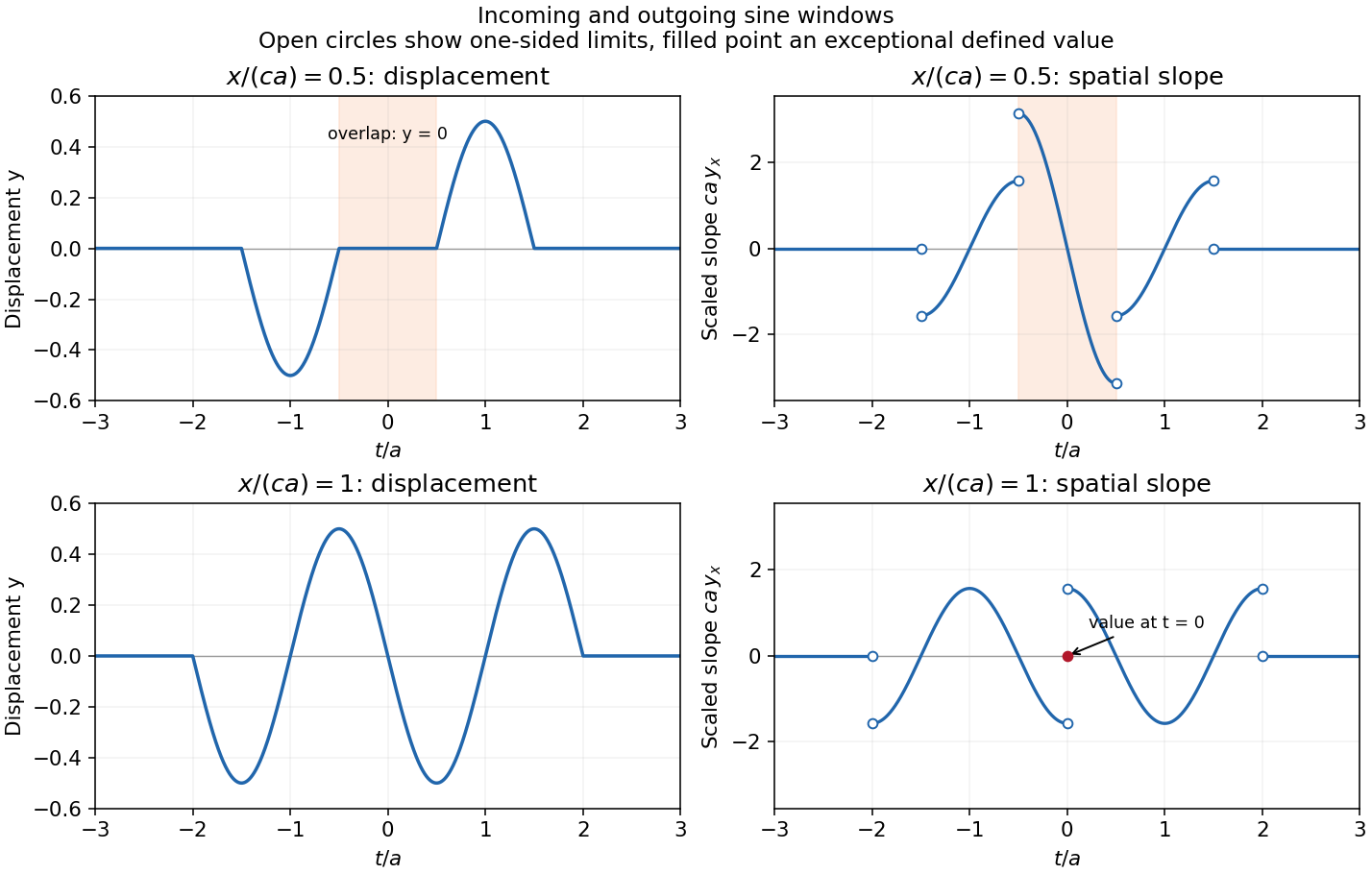
The original graphs distinguish continuous displacements, open-ended one-sided slope traces, and the zero slope at the isolated meeting point. The sharp temporal window is not differentiable at its endpoints, so the overall solution is piecewise classical and globally weak. In particular the literal boundary slope at is not a classical derivative: the even spatial profile has a cusp there. The zero-slope boundary prescription is satisfied at regular times and in its almost-everywhere trace sense; it cannot be read as a globally smooth classical condition for this nonsmooth .
Past exam of the physics B course of the University of Cambridge 2010 Paper 2A Section D D15 Solution by Codex 0 2026-10-20
Codex 0 2026-10-20A Fourier series separates a periodic physical signal into harmonics. For example, a periodic voltage applied to a linear circuit can be treated one frequency at a time; the harmonic responses then superpose to give the output waveform.
Write for the pulse width and for its duty cycle, with . The waveform is a train of positive rectangular pulses centred on , each with area one. It is even about , so every sine coefficient vanishes. Cosine orthogonality givesand, for ,This is the Fourier series of a periodic rectangular pulse:The actual constant term in the series is , not . As usual for a jump discontinuity, the series converges to the average of the one-sided values at each pulse edge, namely , irrespective of the value assigned at that isolated endpoint. Elsewhere it converges to the rectangular waveform.
Counting the constant as the first term, the first three terms areso their sum isIf “first three” instead means the first three nonconstant harmonics, add ; the original plot shows that alternative partial sum as well. The three-term approximation rounds the narrow peaks and ripples between them; many harmonics are needed to represent a sharp pulse.
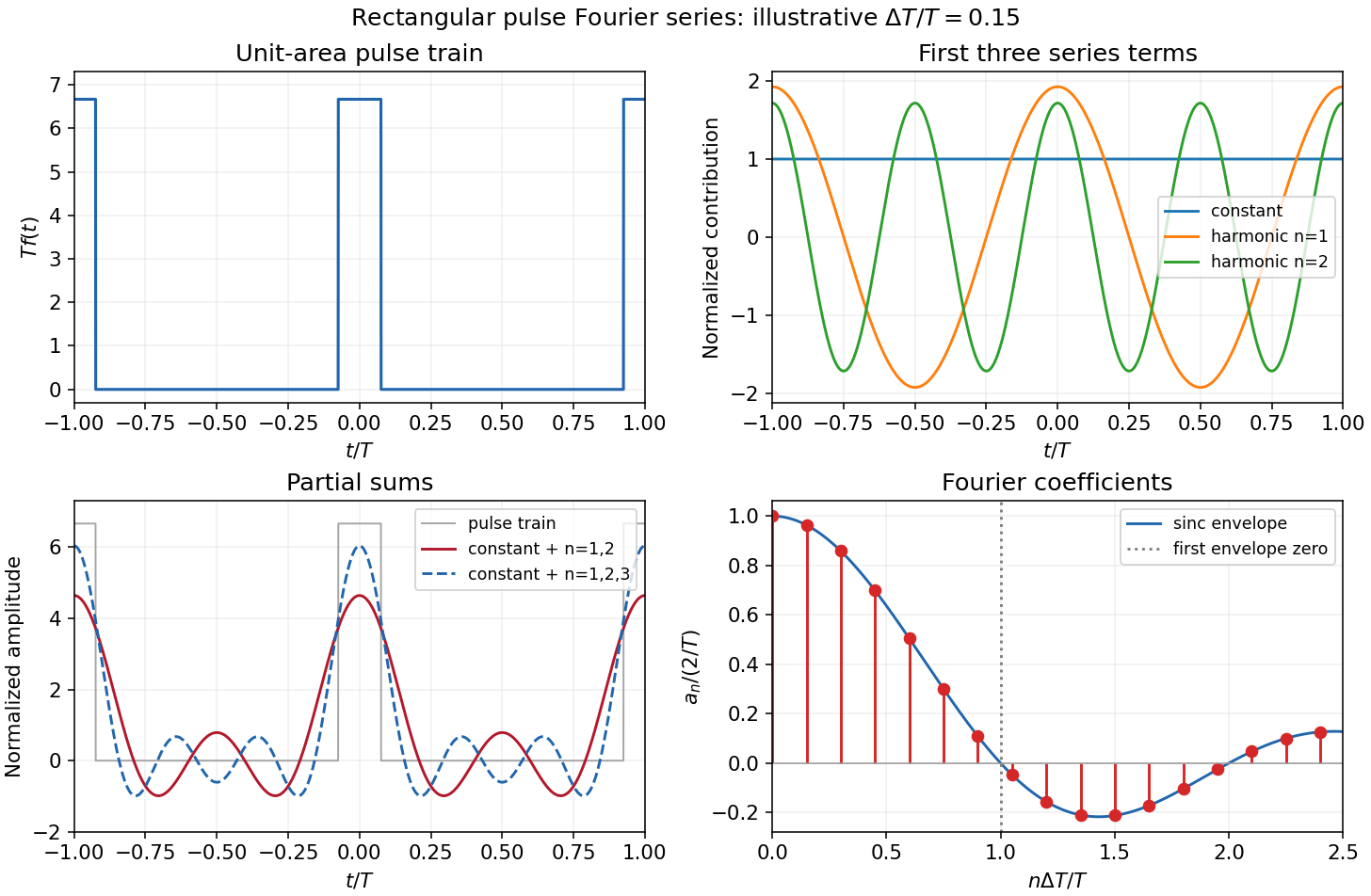
The original sketches use the illustrative duty cycle and cover . The coefficient panel also displays the first spectral zero.
For , expand the sinc function:Thus the low-index coefficients, including , have nearly equal values, although their constant-series contribution still has the factor . The first sinc zero occurs at , or . If this is not an integer, the closest integer coefficient is near zero rather than exactly zero: writing gives . This pulse-width scale of Fourier coefficients means that a narrower pulse requires significant harmonics extending to proportionally larger indices, the reciprocal time-width/frequency-width relation.
Past exam of the physics B course of the University of Cambridge 2010 Paper 2A Section D D14 Solution by Codex 0 2026-10-20
Codex 0 2026-10-20A normal mode has all displacement coordinates proportional to a common time dependence, with fixed relative amplitudes. For a nonzero frequency the time dependence is sinusoidal. A zero-frequency mode is a free displacement or uniform drift rather than an oscillation.
Use the printed mass ordering . Displacements are measured from the unstretched equilibrium positions, givingEquivalently,This is the generalized eigenvalue problem for normal modes of three masses connected by two equal springs. Substitute to obtain . Reflection symmetry gives an antisymmetric vector and symmetric vectors . The former has . For a symmetric vector, the end and centre equations give and . Their solutions are , , or , . HenceThese are all three eigenmodes. The last two keep the centre of mass fixed and are orthogonal in the mass-weighted inner product. The general zero-mode contribution is , accounting for both a centre-of-mass shift and a conserved total momentum. There are no fixed end springs in this system.
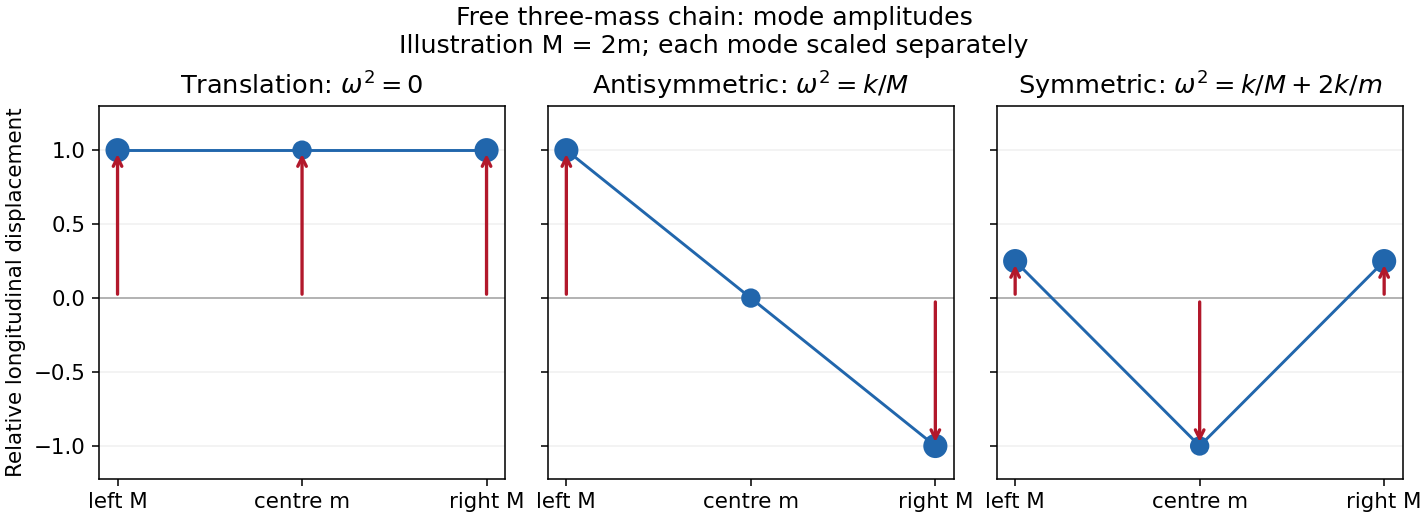
Free-chain mode shapes
. Details. The original amplitude profiles illustrate ; the symmetric internal shape is rescaled for display. The formula above gives every positive mass ratio.
Two further physical examples are standing-wave modes of a string fixed at both ends, with spatial shapes and frequencies , and electrical normal modes of two coupled LC circuits, in which the capacitor charges oscillate at fixed relative amplitudes. Independent normal mode coordinates simplify both systems in the same way as the spring-chain eigenvectors.
Past exam of the physics B course of the University of Cambridge 2010 Paper 2A Section C C13 Solution by Codex 0 2026-10-20
Codex 0 2026-10-20In plane polar coordinates the radial component of Newton's second law is . A central force has zero torque, so angular momentum is constant. ThereforeFor a nonzero-angular-momentum circular orbit at , . The curvature there isThus a stable circular orbit, and nearby bound orbits, require , with excluded. For , confines the particle at large radius; for , permits bound energies between the effective-potential minimum and zero. At there is no isolated stable minimum.
The angular frequency is , and radial perturbations have frequency . A rational ratio closes the linearized near-circular trajectory. It does not prove finite-amplitude closure. Bertrand's theorem supplies the stronger conclusion: every bound orbit is closed only for and among these smooth attractive power-law potentials. Particular circular or resonant orbits must not be confused with that all-orbit statement.
For , the slowly rotating elliptical orientation has angular speedThis is retrograde for in the near-circular approximation. Consecutive radial maxima are separated by approximately in azimuth; the ellipse's axis is defined modulo , which accounts for the factor of two relative to a Kepler-style apsidal convention.
Past exam of the physics B course of the University of Cambridge 2010 Paper 2A Section C C12 Solution by Codex 0 2026-10-20
Codex 0 2026-10-20Let be the polar second moment of area. A twist gradient gives shear strain and shear stress . Integrating its moment over a cross section yieldsThe difference in torque on an element is , while its angular inertia is . Hence the torsional wave equation in a circular shaft isFor uniform rotation at , transmitted power is , so the given values give . The elastic strain energy and rotational kinetic energy areThe torsional transit time is . If the requested maximum rates mean stored-energy-over-transit-time estimates, they areThese estimates require a physical qualification. They are not separate upper bounds on transmitted mechanical power. The exact local energy flux of a torsional wave is the stress-work rateFor the steadily rotating twisted shaft its magnitude is , even though this exceeds . Writing local energy densities and gives . A single travelling torsional wave has equal strain and kinetic energies; the steady shaft can instead be represented by oppositely travelling components whose powers largely cancel. Its stored strain pattern is not a fuel consumed once per transit. This distinguishes an energy-content estimate from the actual stress-mediated transport.
Past exam of the physics B course of the University of Cambridge 2010 Paper 2A Section C C11 Solution by Codex 0 2026-10-20
Codex 0 2026-10-20For a Lagrangian , the Euler-Lagrange equation is for each unconstrained generalized coordinate. For example, gives for a spring oscillator.
For a uniform solid sphere, slicing into disks normal to the rotation axis givesUse total dumb-bell mass and . Since both centres lie on its spin axis, its moment of inertia about that axis is . If measures displacement from the bottom of the track, rolling without slipping imposes spin speed . The rolling inside a fixed circular cylinder therefore hasThe equation of motion and its small-amplitude limit areWith and the given lengths, . If the centre rises by height , conservation of energy at the bottom givesThe speed expression uses exact height-energy conversion within the ideal rolling constraint; only the period formula uses the small-angle approximation.
Past exam of the physics B course of the University of Cambridge 2010 Paper 2A Section C C10 Solution by Codex 0 2026-10-20
Codex 0 2026-10-20For steady inviscid incompressible flow subject to a conservative body force, Bernoulli's theorem states that is constant along a streamline. The same constant applies across streamlines only with an additional condition, such as an irrotational connected flow with the same upstream head.
Neglect gravity and let the film's free-surface pressure be atmospheric. Its radial speed is then in the ideal model. Conservation of mass equates the incoming flux to , soThe latter value already warns that the thin-film approximation is poor near impact; the radial expression is most useful beyond that region. The incoming vertical momentum flux gives downward force when the outgoing flow is horizontal.
In the stipulated stagnant-rear-layer idealization, the excess rear pressure is the stagnation value . Its upward force is . Thus, with downward positive and ignoring the water's weight,For a large plate, the radial-film volume is approximatelyIts weight therefore changes the model toCancellation occurs nearThe printed claim of negligible force for every radius above this scale does not follow from this model. Near the cancellation radius the force is small; for substantially larger radii the quadratic upward-pressure term dominates. The original PDF, not just its transcription, uses that inequality and wording. Moreover, the rear layer's mass and detailed gravity-dependent pressure field are unspecified. The calculation establishes a cancellation scale under the elementary stated pressure approximation, rather than a general large-radius zero-force theorem. A full free-surface flow model would be needed to extend it consistently.
Past exam of the physics B course of the University of Cambridge 2010 Paper 2A Section B B9 Solution by Codex 0 2026-10-20
Codex 0 2026-10-20The method of images replaces conductors by fictitious charges chosen to reproduce their boundary potentials in the physical domain. The uniqueness theorem for the electrostatic potential then identifies the resulting physical exterior field; the fictitious interior field is not the field inside the conductor.
For a source at , let and . At a point on , the distances and to source and image obey . Hence everywhere on the sphere. This proves the image charge for a grounded conducting sphere construction.
With real charges at , superpose two images of charge at . For the right-hand charge, take positive force away from the centre. Its electrostatic force isPutting , the equal-charge balance around a grounded sphere requiresFor large , the right side is approximately , so . This is an approximate equilibrium, not an exact cancellation at .
To hold the sphere at electric potential , add a central image . The grounded pair already contributes zero potential on its surface. ThereforeAt this is , or approximately if the small grounded residual is neglected as in the preceding approximation. The charge on the sphere is ; fixing its potential is different from independently fixing its net charge.
Past exam of the physics B course of the University of Cambridge 2010 Paper 2A Section B B8 Solution by Codex 0 2026-10-20
Codex 0 2026-10-20The fundamental mode of an ideal coaxial cable is a transverse electromagnetic mode: the electric field is radial between the conductors, the magnetic field is azimuthal, and energy flows along the cable through the dielectric. There is no cutoff for this mode; higher modes, conductor losses and dielectric dispersion can matter outside the ideal transmission-line regime.
Ignoring edge fields in the parallel-strip geometry, and . Per unit length the charge is and the linked magnetic flux is . Thus the parallel-plate transmission line hasFor a segment , charge conservation, equivalently the appropriate integral of the Ampère-Maxwell equation, gives . Applying Faraday's law around a longitudinal rectangle between the plates gives . These are the lossless telegrapher's equations,Differentiate the second with respect to and use the first, and conversely for :The signal speed is , equal to for a vacuum-filled line. It is the speed of the coupled electromagnetic disturbance, rather than the electron drift velocity. Electrons locally adjust their motion as the field arrives; one electron need not travel the cable's length to transmit a signal. The Poynting vector in the dielectric integrates to power .
Past exam of the physics B course of the University of Cambridge 2010 Paper 2A Section B B7 Solution by Codex 0 2026-10-20
Codex 0 2026-10-20Faraday's law for a moving circuit is . The magnetic flux is through a surface bounded by the instantaneous loop, with consistent orientation. For the stationary external field here, the motion supplies the motional electromotive force.
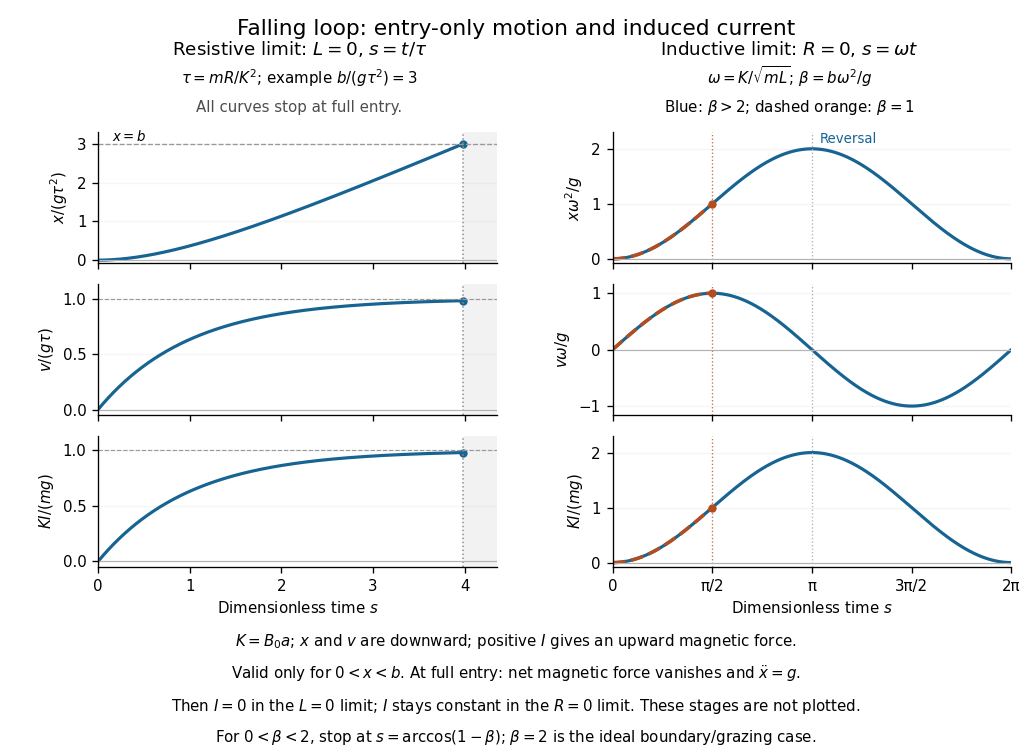
Let be downward penetration of the bottom segment, , and . While , flux grows at rate . Define positive current as the direction whose magnetic force is upward. With negligible self-inductance, andThe resistive magnetic entry of a falling loop givesThe initial acceleration is and the speed approaches if the loop remains partly immersed long enough. Joule heating removes gravitational energy. At the first , both horizontal segments are inside the uniform field: the net flux becomes constant, the net magnetic force vanishes, and this zero-inductance model has thereafter. The subsequent speed increases with acceleration .
For negligible electrical resistance, conservation of total linked flux instead gives in the braking-current convention. Thereforeand the lossless limit of magnetic loop braking yieldsHere energy is stored reversibly in , not dissipated. If , the loop reverses before complete entry and executes the ideal oscillatory motion while straddling the boundary. If , it reaches complete entry on its first descent; thereafter the current is constant, the forces on its two horizontal segments cancel, and it falls with acceleration . The exact grazing case needs care at the ideal discontinuous field boundary. An entry-only sinusoid must not be extrapolated through full immersion.
Past exam of the physics B course of the University of Cambridge 2010 Paper 2A Section B B6 Solution by Codex 0 2026-10-20
Codex 0 2026-10-20Let the unit normal point from layer 1 to layer 2. The electrostatic electric field boundary condition is , while Gauss's law for the electric displacement field gives . Here denotes absolute permittivity; replace it by if dielectric constants are relative.
In the steady conducting state, charge conservation makes the normal current density the same in both layers:Writing , the steady fields in two leaky dielectric layers areThe signed interfacial free surface charge density is the jump of :The total free-plus-bound sheet charge instead follows from the vacuum form of Gauss's law,The bound contribution is . These are signed quantities for the chosen normal and voltage direction; their magnitudes are obtained by absolute values. They describe the long-time DC state, not the initial capacitive transient. Positive conductivities suffice for the derivation; if both vanish, conductivity alone does not determine the field division, which also depends on the initial free interfacial charge.
Past exam of the physics B course of the University of Cambridge 2010 Paper 2A Section A 5 Solution by Codex 0 2026-10-20
Codex 0 2026-10-20The trihydrogen cation is a nonlinear three-nucleus molecule. Removing three translations and three rigid rotations leaves vibrational degrees of freedom. One normal mode is the symmetric in-plane breathing motion: every nucleus moves radially toward or away from the centre. The remaining two normal modes form a degenerate in-plane distortion pair, stretching one direction while compressing another.
For an explicit sketch, let be the equilibrium vertices relative to their centre. Displacements proportional togive the breathing mode and a basis of the degenerate pair. Linear combinations within the latter pair are equally valid. Their actual frequencies require molecular force constants, which are not supplied. An apparent out-of-plane motion of three point nuclei is a translation or infinitesimal rigid rotation, rather than an additional independent vibration.
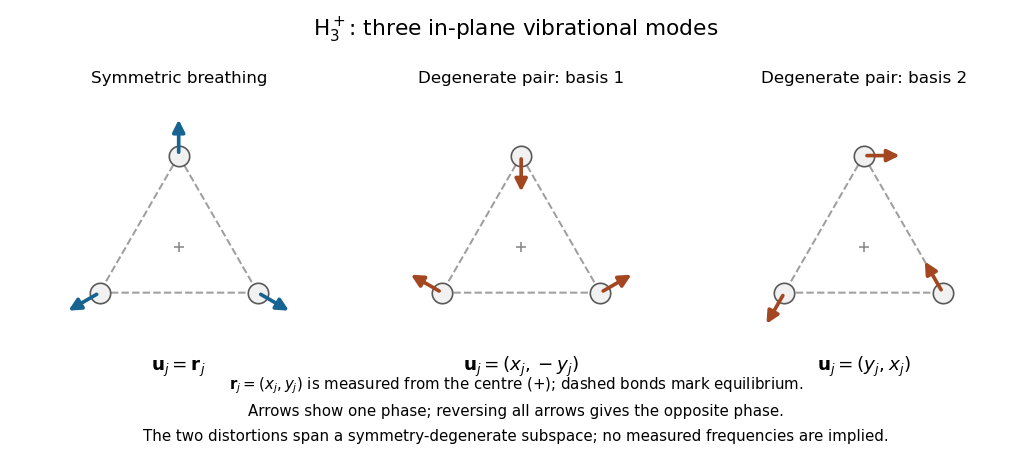
Breathing and degenerate distortion modes of an equilateral molecule
. Original displacement vectors in a simple symmetric bond-spring illustration. The degeneracy is fixed by symmetry; no measured molecular frequencies are asserted. Details. Past exam of the physics B course of the University of Cambridge 2010 Paper 2A Section A 4 Solution by Codex 0 2026-10-20
Codex 0 2026-10-20Suppose two distinct reversible adiabatic processes intersect at an equilibrium state . Choose an isothermal process that meets the two branches at distinct states and , forming a nonzero-area three-sided thermodynamic cycle. There is no heat exchange on or , so the only net heat comes from the one heat reservoir on . Since around a cycle, .
Choose the direction in which this nonzero cycle delivers positive work. It would then convert heat from a single reservoir entirely into work, violating the Kelvin-Planck statement of the second law. Distinct reversible adiabats cannot intersect. Equivalently, their constant entropy labels cannot differ at one equilibrium state. The argument concerns an ordinary equilibrium family of reversible adiabats, not arbitrary irreversible insulated paths. The usual local uniqueness of an equilibrium adiabat excludes coincident segments described as distinct curves.
Past exam of the physics B course of the University of Cambridge 2010 Paper 2A Section A 3 Solution by Codex 0 2026-10-20
Codex 0 2026-10-20An empty perfectly conducting rectangular electromagnetic waveguide hasThe lowest transverse electric mode has indices or . A simply connected hollow metallic guide has no transverse electromagnetic mode. With , the two lowest modes are degenerate and their cutoff frequency isPropagation with nonzero axial energy transport requires ; the equality is the lower limiting frequency, with zero axial group velocity. A filling medium would replace by .
Past exam of the physics B course of the University of Cambridge 2010 Paper 2A Section A 2 Solution by Codex 0 2026-10-20
Codex 0 2026-10-20Take the wires along , with the first at carrying , and observe at . The Biot-Savart law gives a first-wire field in ; wire is away. ThereforePairing adjacent terms, with ,Thus . Its direction is opposite to the field of the first wire at the observation point. Reversing every electric current reverses this answer.
Past exam of the physics B course of the University of Cambridge 2010 Paper 2A Section A 1 Solution by Codex 0 2026-10-20
Codex 0 2026-10-20For a reversible isothermal expansion of one mole of an ideal gas, internal energy depends only on temperature, so . The first law of thermodynamics givesThis uses quasistatic expansion against the gas pressure. Specifying only the initial and final volumes and constant temperature would not fix heat for an arbitrary irreversible process: an insulated ideal-gas free expansion has .
Past exam of the physics B course of the University of Cambridge 2010 Paper 1 Section C C13 Solution by Codex 0 2026-10-20
Codex 0 2026-10-20The zeroth law of thermodynamics states the transitivity of thermal equilibrium: if two systems each equilibrate thermally with a third, they equilibrate with one another. A reproducible thermometric property can therefore label their temperature. Its empirical numerical scale is not itself the complete thermodynamic content; reversible heat-engine relations establish an absolute temperature scale.
The first law of thermodynamics expresses energy conservation. For a closed system, when is work done by the system. internal energy is a state function, while heat and work depend on the path. In reversible simple compressible motion, and ; an open system additionally needs the energies carried by transferred matter. An ideal gas can expand freely with and unchanged internal energy. The first law alone does not decide whether the reverse spontaneous process occurs.
The Second law of thermodynamics introduces entropy and restricts direction. For a reversible path, ; for an irreversible process the entropy balance includes nonnegative production. The entropy of an isolated system cannot decrease. In a cycle, the Clausius inequality is , using the appropriate boundary/reservoir temperatures. The Kelvin–Planck statement forbids a cyclic device whose sole effect is extracting heat from one reservoir and turning all of it into work; the Clausius statement forbids moving heat from cold to hot with no compensating effect. A refrigerator is allowed because it consumes work. A two-reservoir engine has , with equality in the reversible limit. Work may be fully dissipated as heat without contradicting this one-way restriction.
The third law of thermodynamics constrains low-temperature entropy. An equilibrium perfect crystal with a nondegenerate ground state approaches zero entropy as , fixing the conventional absolute entropy reference. Degenerate ground states or frozen nonequilibrium disorder require care when discussing residual entropy. Under regular equilibrium conditions the heat capacity must decrease sufficiently for to remain finite; a constant positive classical heat capacity cannot be extrapolated to zero temperature. The unattainability formulation states that absolute zero cannot be reached by a finite sequence of admissible cooling operations. These statements concern the limiting thermodynamic regime, rather than predicting that every substance stays in one classical phase during cooling.
The laws work together: conservation sets a device's energy budget, entropy production restricts the attainable budget, and constitutive equations give the properties of its working material. For fixed temperature and volume, Helmholtz free energy decreases toward equilibrium; at fixed temperature and pressure the corresponding potential is Gibbs free energy. Stable equilibrium, phase coexistence and Maxwell relations follow from these potentials with appropriate constraints. Calorimetry, mechanical-work measurements, thermometry and reversible-path comparisons test different parts of this framework. None of the laws by itself supplies a particular gas equation of state or microscopic heat capacity.
Past exam of the physics B course of the University of Cambridge 2010 Paper 1 Section C C12 Solution by Codex 0 2026-10-20
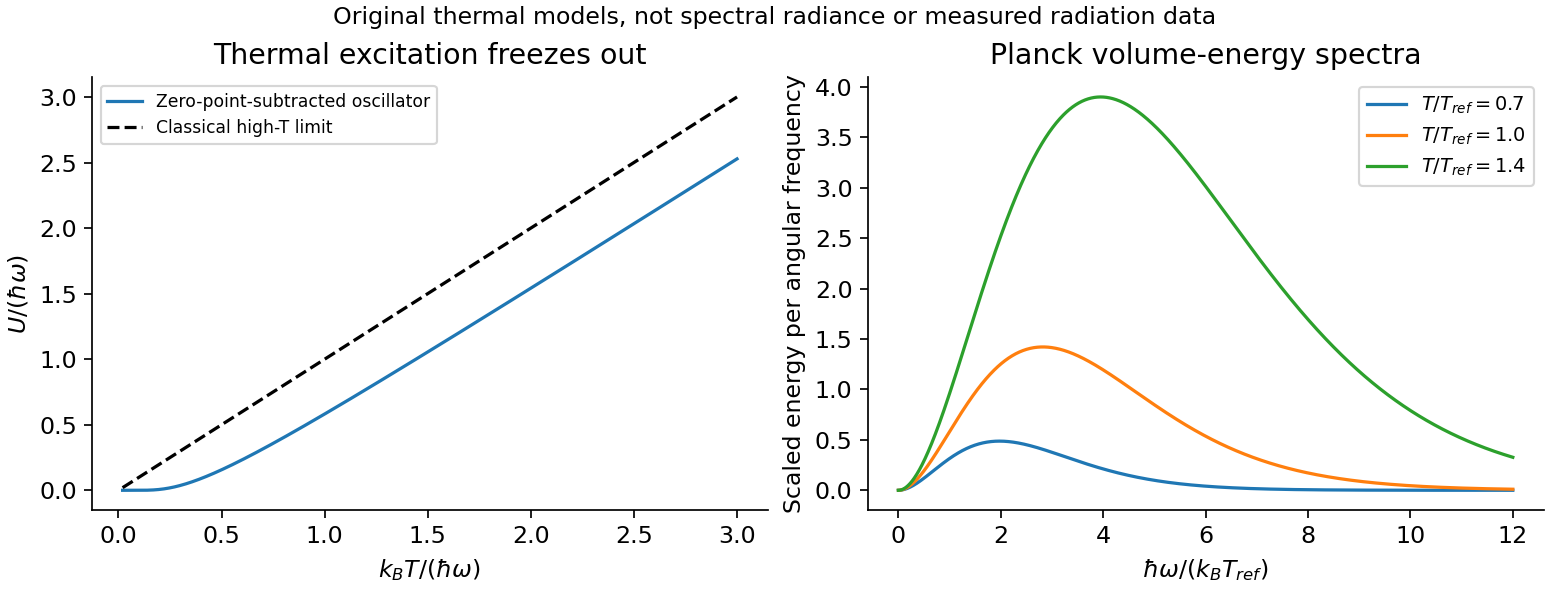
Codex 0 2026-10-20For excitation energy , the geometric series gives the thermal partition function of a quantum harmonic oscillator with its zero-point energy subtracted:Thus at low temperature and approaches at high temperature. Restoring the zero-point term multiplies by and adds to , without changing the thermal occupation probabilities.
To count electromagnetic modes, put a large cavity in a periodic box of volume . One transverse polarization has wavevector-state density ; there are two independent polarizations. In the shell ,With , the electromagnetic mode density in a box becomesThe continuum expression is the large-cavity leading term; using standing-wave boundary conditions gives the same bulk count. Both photon polarizations must be included. This is density per angular frequency, not per ordinary frequency.
Each mode is an oscillator with zero photon chemical potential in thermal equilibrium. Multiplying its mean thermal energy by the mode density per volume gives the angular-frequency Planck energy densityAt small it reduces to the Rayleigh–Jeans result ; exponential suppression at high frequency prevents a divergent thermal energy. With ,The integral is the stipulated . This is a volume energy density, ; for isotropic cavity radiation the outward black-surface flux is , with . Distinguishing flux, spectral density and total volume energy avoids extra factors of , or .
Pinned article: Introduction to the OurBigBook Project
Welcome to the OurBigBook Project! Our goal is to create the perfect publishing platform for STEM subjects, and get university-level students to write the best free STEM tutorials ever.
Everyone is welcome to create an account and play with the site: ourbigbook.com/go/register. We belive that students themselves can write amazing tutorials, but teachers are welcome too. You can write about anything you want, it doesn't have to be STEM or even educational. Silly test content is very welcome and you won't be penalized in any way. Just keep it legal!
Intro to OurBigBook
. Source. We have two killer features:
- topics: topics group articles by different users with the same title, e.g. here is the topic for the "Fundamental Theorem of Calculus" ourbigbook.com/go/topic/fundamental-theorem-of-calculusArticles of different users are sorted by upvote within each article page. This feature is a bit like:
- a Wikipedia where each user can have their own version of each article
- a Q&A website like Stack Overflow, where multiple people can give their views on a given topic, and the best ones are sorted by upvote. Except you don't need to wait for someone to ask first, and any topic goes, no matter how narrow or broad
This feature makes it possible for readers to find better explanations of any topic created by other writers. And it allows writers to create an explanation in a place that readers might actually find it.
Figure 1. Screenshot of the "Derivative" topic page. View it live at: ourbigbook.com/go/topic/derivativeVideo 2. OurBigBook Web topics demo. Source. - local editing: you can store all your personal knowledge base content locally in a plaintext markup format that can be edited locally and published either:This way you can be sure that even if OurBigBook.com were to go down one day (which we have no plans to do as it is quite cheap to host!), your content will still be perfectly readable as a static site.
- to OurBigBook.com to get awesome multi-user features like topics and likes
- as HTML files to a static website, which you can host yourself for free on many external providers like GitHub Pages, and remain in full control

Figure 2. You can publish local OurBigBook lightweight markup files to either OurBigBook.com or as a static website.
Figure 3. Visual Studio Code extension installation.
Figure 5. . You can also edit articles on the Web editor without installing anything locally. Video 3. Edit locally and publish demo. Source. This shows editing OurBigBook Markup and publishing it using the Visual Studio Code extension. 
- Infinitely deep tables of contents:




All our software is open source and hosted at: github.com/ourbigbook/ourbigbook
Further documentation can be found at: docs.ourbigbook.com
Feel free to reach our to us for any help or suggestions: docs.ourbigbook.com/#contact