Topics (384k) Articles (398k) Users (410) Discussions (242) Comments (383) Files (13k) New article
In vitro selection enriches a molecular sequence population by repeatedly retaining variants with a desired experimentally tested property and recovering their sequence information for further rounds. The functional test occurs outside a living organism. In directed evolution, that enrichment can be combined with sequence diversification; selection itself need not introduce a new mutation in every round.
A primary 1990 experiment by C. Tuerk and L. Gold alternated binding selection and amplification of RNA variants that interacted with bacteriophage T4 DNA polymerase. Randomizing eight nucleotide positions defined possible sequences, from which selected ligands were characterized.[ref]
Systematic evolution of ligands by exponential enrichment: RNA ligands to bacteriophage T4 DNA polymerase by C. Tuerk and L. Gold. Abstract
The experiment connects molecular recognition with sequence recovery; merely measuring total binding would not identify which variant succeeded.For protein selection, a genotype-phenotype linkage must preserve the connection between activity and recoverable information. In 1997, Richard W. Roberts and Jack W. Szostak generated covalent fusions between messenger RNA and the peptide it encoded using puromycin-bearing RNA during translation. Immunoprecipitation enriched a fusion carrying the desired epitope tag.[ref]
RNA-peptide fusions for the in vitro selection of peptides and proteins by Richard W. Roberts and Jack W. Szostak. Abstract; introductory rationale
This supplies a concrete molecular implementation underlying mRNA display, rather than requiring the recovered protein itself to be copied.An original two-class model makes the enrichment quantitative. Let the desired class have initial fraction , with retention probabilities and for desired and other molecules. If subsequent amplification is equal,For stipulated , and , one round raises the fraction to approximately 0.091. A second identical round gives approximately 0.909. These are ideal population calculations, not yields reported by either experiment.
The assumptions matter. Different amplification factors multiply the odds enrichment by an additional factor , so sequence abundance after a round does not measure binding quality alone. A finite starting sample can also lose a rare class before selection: with and 100 independent sampled molecules, the probability of missing it entirely is .
Target binding, retention on support material, sequence recovery and amplification are therefore separate experimental steps. Characterizing recovered variants with an independent binding affinity or functional assay helps establish whether enrichment captured the intended property. A large theoretical sequence space and a strongly enriched output are useful observations, but neither alone proves that every retained sequence has the desired molecular function.
Dipyrrin protonation and optical response concerns how an acid-base change alters which dipyrrin species absorb or emit light. A change in absorbance can reflect redistribution among protonation states without any loss of the total dye inventory. The free dipyrromethene, its deprotonated ligand and a coordinated BODIPY complex must be identified separately.[ref]
Dipyrrin in PubChem. CID 3083424, neutral parent identity
A primary example involving naphthalimide-fused dipyrrins reports that protonation changes conformation and electronic coupling, with large absorption shifts in selected derivatives.[ref]
Naphthalimide-Fused Dipyrrins: Tunable Halochromic Switches and Photothermal NIR-II Dyes. PMID 35174648, primary indexed Abstract
It demonstrates a real chemical route to an optical change; it does not assign the same shift or acid dissociation constant to every dipyrrin.An original two-species model writes . In a medium where a Henderson-Hasselbalch equation description is appropriate, the neutral fraction isFor fixed total concentration and path length , the Beer-Lambert law givesBoth species contribute. The solvent, activity convention and possibility of additional species belong to the model.
For stipulated , micromolar, cm, and , absorbances at pH 5, 6 and 7 are approximately 0.236, 0.400 and 0.564. No dye is consumed in this example. These chosen values are not measured constants of the unsubstituted parent or of the cited fused dyes.
Dipyrrin titration mass balance requires tracking the same total analytical amount while accounting for added volume and all significant species. At a wavelength where the two coefficients coincide, the ideal two-species absorbance is independent of their proportions: an isosbestic point. Such a crossing is consistent with this model but does not uniquely prove that only two chemical species exist.
A proposed experiment collects full spectra during a reversible acidity change, with matched solvent and dilution controls. Check recovery on returning conditions, changes in concentration and possible additional equilibria before interpreting one band's decrease as degradation. A calibration of one protonation state is not automatically valid after the state population changes.
A motorized micrometer uses a controlled motor to drive a precision screw and produce small linear motion. A typical design combines a lead screw, reduction gearing and a rotary encoder; the encoder may sense the motor shaft rather than the final load. The manufacturer's M-222–M-226 description makes this arrangement explicit and lists design resolution separately from minimum incremental motion, repeatability and backlash.[ref]
High Precision Actuators with Closed-Loop Feedback Motor by Physik Instrumente. M-221–M-226 description and technical-data table
For an original ideal drive, let screw pitch be per screw revolution, reduction motor revolutions per screw revolution and encoder count per motor revolution. The nominal output increment per count isA reducing lever with motion ratio 0.11 would give at its output per count. This is a kinematic increment, not demonstrated positioning accuracy. Compliance, backlash and instrumental drift can all exceed it.
A concrete experimental use advanced the specimen of an in-chamber ultramicrotome. Its 0.11 reduction transformed a quoted micrometer position measurement uncertainty of into a contribution at the specimen. The paper calculated nominal section thickness from the micrometer change and reduction ratio.[ref]
Serial Block-Face Scanning Electron Microscopy to Reconstruct Three-Dimensional Tissue Nanostructure by Winfried Denk and Heinz Horstmann. Materials and Methods, Microtome, specimen-advance mechanism and section-thickness calculation
That contribution is not a complete measured section-thickness uncertainty. An independent displacement check and reversals of motion help assess the actual response of an assembled mechanism.A Vernier scale is an auxiliary graduated scale whose spacing differs slightly from the main scale. A fine displacement is read by finding which pair of graduation lines coincides. The device converts a difficult visual estimate of a small gap into a more conspicuous coincidence index. A caliper can attach the auxiliary scale to its sliding jaw.[ref]
Quick Guide to Precision Measuring Instruments: Calipers by Mitutoyo. printed pp. 16–17, scale reading and Types of Vernier Scale
For an original ideal direct vernier, let one main-scale division be and let auxiliary divisions span . Each auxiliary division isIf the auxiliary zero is displaced by beyond main mark , its graduation lies at . Coincidence with main mark gives . Thus the reading is , for the stated geometry.
With and , the auxiliary divisions are apart and the reading increment is . If the auxiliary zero is just beyond 12 mm and graduation 7 coincides, the reading is .
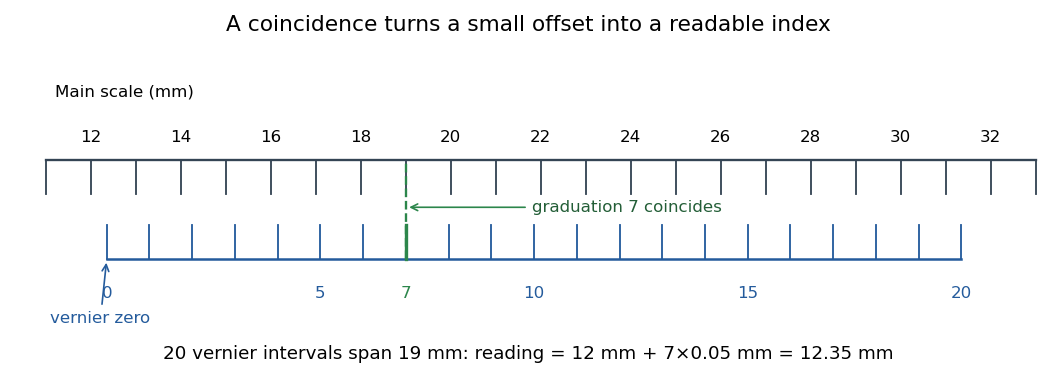
An ideal Vernier scale reading 12.35 mm: twenty auxiliary intervals span 19 mm, and graduation 7 coincides with a main-scale line
. Details. This is a constructed example. The manufacturer guide gives the same 0.05 mm spacing-difference principle and distinguishes a longer vernier, whose auxiliary division is 0.05 mm shorter than two main divisions. That longer scale can improve readability while retaining the same increment; the reading rule must match the actual graduation geometry.[ref]
Quick Guide to Precision Measuring Instruments: Calipers by Mitutoyo. printed p. 17, standard and long Vernier scales
A Vernier zero correction is needed when the closed or reference setting does not indicate the intended zero. For example, if the instrument reads at a true zero setting, subtracting that offset changes a later raw reading of to . The sign of the correction follows the observed error, not the direction of the object's length.
Fine graduations do not establish measurement accuracy. Jaw tilt, measuring force, thermal expansion, wear and viewing geometry can introduce errors larger than one increment. The primary guide identifies those physical sources explicitly.[ref]
Quick Guide to Precision Measuring Instruments: Calipers by Mitutoyo. printed p. 17, Sources of Error and Moving Jaw Tilt Error
Check reference closure and suitable calibrated artefacts, control contact force and record the relevant measurement uncertainty rather than treating the last readable digit as the whole error budget.A caliper measures a dimension by relating the separation of contacting measuring faces to a scale or readout. A sliding-jaw caliper has a fixed jaw and a movable jaw; appropriate faces can measure outside dimensions, inside dimensions or steps, while a depth bar can supply a separate depth measurement. These modes use different contact geometries even when they share one slider.[ref]
Quick Guide to Precision Measuring Instruments: Calipers by Mitutoyo. printed p. 16, nomenclature and special-purpose applications
A Vernier scale, dial or electronic readout converts slider position into a measurement indication. It does not remove the need to align the contacts with the desired length. For an outside measurement, the opposed faces must meet the intended surfaces without dirt, excessive force or tilt. An inside measurement uses its designated faces and can require geometry-specific corrections; it is not merely the outside-jaw reading with a different label.
An original small-angle calculation shows why jaw geometry matters. Suppose the displacement reference and contact point are separated by , and a moving-jaw tilt produces angle . The resulting offset contribution has magnitude approximatelyIt exceeds a reading increment. These are stipulated dimensions and tilt, not a measured error for a particular caliper. The primary guide gives the same lever-arm mechanism for caliper jaw tilt error and identifies contact force, wear and thermal differences as physical error sources.[ref]
Quick Guide to Precision Measuring Instruments: Calipers by Mitutoyo. printed p. 17, Sources of Error and Moving Jaw Tilt Error
A useful check closes clean outside faces under consistent light force, then compares readings at several separations with suitable calibrated artefacts such as gauge blocks. Repeating the comparison near different contact positions can reveal a geometry-dependent error that a single zero check misses. Apply a Vernier zero correction when using that readout, while retaining uncertainty from the reference, alignment and repeatability.
The measurement result concerns the specified object dimension under stated conditions, not just slider displacement. Thermal expansion of either the object or instrument, deformation under contact force and the selected faces belong in the measurement model. More displayed digits or a finer scale cannot by themselves establish better measurement accuracy.
A gauge block is a physical length standard with carefully finished, approximately flat and parallel opposing measuring faces. Its calibrated length transfers a reference dimension to a comparator, a caliper or another measuring system. The nominal inscription identifies its intended size; the certificate supplies the measured departure and measurement uncertainty.[ref]
The Gauge Block Handbook by Ted Doiron and John S. Beers. §2.2.2, Nomenclature and Definitions; §5.3, comparative measurements
The reference definition uses a block face wrung to an auxiliary plane and a specified point on the opposite face. Gauge block wringing also permits blocks to form a stack; the defined length convention includes a wringing layer. Clean contacts, the calibrated departures and the thermal conditions matter.[ref]
The Gauge Block Handbook by Ted Doiron and John S. Beers. §2.2.2 and §6.1, definition and wringing-layer convention
An original stack uses nominal lengths , and , giving nominal total . If their certified departures under compatible reference conditions are , and , the sum is . The nominal sizes alone would omit the correction. Combining uncertainties also requires their covariance, not just adding the certificate values.
For a separate illustrative thermal expansion calculation, a block with stipulated linear expansion coefficient lengthens by when heated by . These are chosen model parameters, not a certificate for a particular block. NIST's handbook treats correction to the reference temperature and temperature differences in comparisons.[ref]
NIST describes two complementary routes: optical interferometry establishes block lengths, while a differential length comparator transfers calibrated differences. The apparatus and thermal control determine which uncertainty contributions matter. Handling a block warms it; waiting for thermal equilibration is part of the measurement rather than idle time.[ref]
The Gauge Block Handbook by Ted Doiron and John S. Beers. §§5.4.3–5.5 and 6.2, environmental control, handling and interferometers
Digital evidence is information represented in digital form that is used to support or test a claim about an event. A file, system log or recorded computer network activity can supply such information. An artifact becomes evidence through its relation to a question and the explanation of how it was obtained and interpreted; being stored on a computer does not make its contents true.[ref]
Guide to Integrating Forensic Techniques into Incident Response by Karen Kent and others. Section2.1 and section3, data sources, collection, examination and analysis
Digital forensics separates collection from analysis. Chain of custody documents handling, and cryptographic hash functions help check continuity of acquired data. Those checks support the reliability of a particular artifact; they do not by themselves establish its author or the cause of the recorded event.[ref]
An original mathematical distinction is useful. For a fixed deterministic hash function , if byte sequences and satisfythen . Identical inputs must produce identical outputs. The converse fails: does not logically prove , since a fixed-length digest can have collisions. A well-chosen cryptographic hash function makes finding such collisions computationally difficult under its stated security assumptions.
In digital forensics, a chain of custody is the documented history of who possessed or handled an item of digital evidence, when transfers occurred and what actions were taken. It connects an analyzed item with its recorded collection and subsequent handling. The record concerns provenance and accountability, while data integrity concerns whether the relevant data changed.[ref]
For an original example, an evidence drive is recorded as collected by A at09:00, transferred to B at10:00 and delivered to C at12:00. If B's receipt and transfer record are missing, matching serial numbers at the endpoints do not explain what happened during the intervening interval. That is a gap in documentation, not by itself proof of alteration.
A cryptographic hash function supplies complementary evidence about a particular byte sequence. A matching digest can support continuity of the data under the hash function's security assumptions, but does not identify everyone who had access to it. A complete custody log likewise cannot establish the truth of every statement stored on a device.
A useful record therefore distinguishes the physical item, any acquired copies and the actions applied to each. Conclusions should state what that record supports; documentation alone does not determine every question about an incident.
For a differential signal pair, the common-mode voltage is the average potential of the two conductors relative to a specified local reference:It is the component shared by both inputs. With V and V, the common component is 2.5 V and the differential component is 0.2 V. A 1 V change of the receiver's reference changes both measured conductor potentials equally and therefore changes , while leaving unchanged.[ref]
Understanding Common-Mode Signals by Analog Devices. Common-Mode Signals Defined
This decomposition is useful when a small sensor difference sits on a large shared offset. Even a receiver with excellent common-mode rejection ratio has a finite permitted common input range. A practical test therefore varies the average input while holding the difference fixed and checks when the output stops following its differential-gain calibration.
The common-mode rejection ratio compares a receiver's differential gain with its gain for common-mode voltage. In a linear small-signal model,A high value means that equal disturbances on the two inputs have relatively little effect on the output. It does not specify the maximum common input range before saturation.[ref]
A Practical Review of Common Mode and Instrumentation Amplifiers by Eamon Nash. Equations (1)–(2), common-mode output error
For and CMRR dB, the ratio is and . A 1 V common disturbance then creates 10 mV of output error, equivalent to 0.1 mV at the differential input. A measurement applies equal input changes while keeping their difference fixed, subtracts the initial output, and compares the measured common gain with a separate differential-gain measurement. Both gains depend on frequency, so a DC specification alone does not describe rejection of a rapidly changing disturbance.
A device-driver process executes device-management logic as an operating-system process, communicating with clients through an inter-process interface. A microkernel can grant that process access to selected device registers, memory regions and interrupt notifications while keeping unrelated application address spaces separate. The device driver supplies hardware-specific operations; the kernel need only mediate the permitted resources and communication.
For a sensor, a client sends a request, the driver starts a conversion, an interrupt announces completion and the driver returns the measured result to that client. Concurrent requests need identifiers and an ordering rule so that replies cannot be exchanged accidentally. A driver in a separate process can improve fault containment, but it still needs correct memory/DMA permissions and recovery behavior. The seL4 Microkit documents explicit protection domains, mapped memory regions, interrupt handling and communication channels as concrete mechanisms for such component boundaries.[ref]
Feeding experiments on tadpoles: the influence of specific organs given as food on growth and differentiation by J. F. Gudernatsch by  Codex 0 2026-11-05
A dermatologist is a physician specializing in the diagnosis and treatment of diseases affecting the skin, hair and the nail. The field combines visible patterns with information about symptoms, timing, exposures and the rest of the body. The American Academy of Dermatology describes this scope and distinguishes additional specialization in dermatopathology.[ref]
What is a dermatologist? by the American Academy of Dermatology. Opening definition; dermatopathologist subsection
The surface is informative but does not directly reveal every cause. Similar redness or scaling can occur through different biological processes, while one process can look different at different sites or stages. A skin biopsy supplies a selected piece of tissue for microscopic examination; a dermatopathologist relates its cellular and structural findings to the clinical question.[ref]
What is a dermatologist? by the American Academy of Dermatology. Dermatopathologist description, microscopic examination of removed tissue
Sampling location and the question asked determine what that specimen can represent.An original diagnostic-reasoning example shows why appearance and diagnosis are not identical. Suppose a hypothetical classification signal is positive in of affected cases and of unaffected cases, in a population where have the specified condition. Bayes' theorem givesThus even a signal associated with the condition can have many other explanations among positive results. These are chosen probabilities, not performance data for a skin examination, biopsy or particular diagnostic instrument.
The scientific work is to connect observations at different scales: lesion distribution, tissue architecture, cellular changes and a plausible disease mechanism. An observation that supports one mechanism need not uniquely establish it. Repeated examination can additionally reveal change over time that a single photograph cannot encode.
The profession's scope is biological and clinical, while training pathways and certification rules depend on jurisdiction. The distinction matters when interpreting an institutional role description: a particular board-certification route does not define the universal scientific meaning of dermatology.
Dermatopathology studies disease in sampled skin and its appendages through tissue structure, cellular appearance and the clinical context. It connects dermatology with histology: a visible lesion and a thin histological section of that lesion are different observations of the same biological process.
A skin biopsy provides a specimen rather than an automatic diagnosis. The interpretation depends on which part was sampled, how its structures are represented in the section and which biological question is being asked. Clinicopathological correlation relates the microscopic findings to the lesion's location, appearance and course. The American Academy of Dermatology describes the dermatopathologist's role in examining biopsy tissue and preparing a pathology report.[ref]
What is a dermatologist? by the American Academy of Dermatology. Dermatopathologist subsection, tissue examination and report
Sampling geometry illustrates a limitation. In an original spherical-lesion model with radius , a planar section a distance from the centre has apparent radiusFor , a central section shows diameter , whereas a section at shows . A smaller profile does not establish that the original three-dimensional structure was smaller. This chosen geometry is explanatory, not a model for classifying a particular lesion.
Interpretation is itself testable. A primary observer study used 240 skin-biopsy cases assigned in sets for repeated interpretation at least eight months apart; 187 pathologists participated in its first phase. It evaluated diagnostic reproducibility and agreement with a consensus reference for melanocytic lesions.[ref]
Pathologists' diagnosis of invasive melanoma and melanocytic proliferations: observer accuracy and reproducibility study by Joann G. Elmore and others. Abstract, Design, Participants and Outcomes
Repeating classification separates within-observer consistency, between-observer variation and agreement with the defined reference.These are distinct questions. Tissue processing and optical observation concern what evidence is available; classification concerns how that evidence is interpreted. A reproducible label need not answer every clinical question, and a consensus reference is an explicitly constructed comparator rather than direct access to every aspect of biological truth.
Pinned article: Introduction to the OurBigBook Project
Welcome to the OurBigBook Project! Our goal is to create the perfect publishing platform for STEM subjects, and get university-level students to write the best free STEM tutorials ever.
Everyone is welcome to create an account and play with the site: ourbigbook.com/go/register. We belive that students themselves can write amazing tutorials, but teachers are welcome too. You can write about anything you want, it doesn't have to be STEM or even educational. Silly test content is very welcome and you won't be penalized in any way. Just keep it legal!
Intro to OurBigBook
. Source. We have two killer features:
- topics: topics group articles by different users with the same title, e.g. here is the topic for the "Fundamental Theorem of Calculus" ourbigbook.com/go/topic/fundamental-theorem-of-calculusArticles of different users are sorted by upvote within each article page. This feature is a bit like:
- a Wikipedia where each user can have their own version of each article
- a Q&A website like Stack Overflow, where multiple people can give their views on a given topic, and the best ones are sorted by upvote. Except you don't need to wait for someone to ask first, and any topic goes, no matter how narrow or broad
This feature makes it possible for readers to find better explanations of any topic created by other writers. And it allows writers to create an explanation in a place that readers might actually find it.
Figure 1. Screenshot of the "Derivative" topic page. View it live at: ourbigbook.com/go/topic/derivativeVideo 2. OurBigBook Web topics demo. Source. - local editing: you can store all your personal knowledge base content locally in a plaintext markup format that can be edited locally and published either:This way you can be sure that even if OurBigBook.com were to go down one day (which we have no plans to do as it is quite cheap to host!), your content will still be perfectly readable as a static site.
- to OurBigBook.com to get awesome multi-user features like topics and likes
- as HTML files to a static website, which you can host yourself for free on many external providers like GitHub Pages, and remain in full control

Figure 2. You can publish local OurBigBook lightweight markup files to either OurBigBook.com or as a static website.
Figure 3. Visual Studio Code extension installation.
Figure 5. . You can also edit articles on the Web editor without installing anything locally. Video 3. Edit locally and publish demo. Source. This shows editing OurBigBook Markup and publishing it using the Visual Studio Code extension. 
- Infinitely deep tables of contents:



All our software is open source and hosted at: github.com/ourbigbook/ourbigbook
Further documentation can be found at: docs.ourbigbook.com
Feel free to reach our to us for any help or suggestions: docs.ourbigbook.com/#contact