Topics (384k) Articles (398k) Users (410) Discussions (242) Comments (383) Files (13k) New article
Past exam of the MPhil in micro- and nanotechnology enterprise course of the University of Cambridge 2018 Paper 2 Section A(ii) 13 iii Solution by  Codex 0 2026-10-20
At greater concentration, the mean separation falls and the independent-moment approximation can fail. The magnetic dipole interaction has characteristic scalewith sign and angular dependence set by moment orientation. Correlated clusters, chains or frustrated arrangements change local fields and relaxation barriers.
A plausible example is a progressively less reversible loop with larger remanence/magnetic coercivity when interactions slow collective relaxation; the figure illustrates that case. The trend is not universal: some arrangements reduce susceptibility or suppress remanence, and aggregation can introduce a different response from a uniform concentrated dispersion. Neither loop area nor magnetic coercivity must vary monotonically with concentration.
At the actual drive frequency, the dissipated energy per cycle per unit volume is proportional to . Measure this dynamic loop rather than inferring dissipation from an unrelated slow sweep. Compare equal magnetic-material amounts, inspect dispersion state, and vary frequency to separate concentration-driven interactions from simple signal scaling. No biological efficacy is inferred.
Past exam of the MPhil in micro- and nanotechnology enterprise course of the University of Cambridge 2018 Paper 2 Section A(ii) 13 ii Solution by Codex 0 2026-10-20
Codex 0 2026-10-20Thermally activated moment reversal, or Néel relaxation, often has an activated timescaleLowering temperature increases . When it becomes comparable to the observation time , the ensemble crosses an operational magnetic blocking temperature,Above this blocking crossover, an equilibrated ensemble remains reversible; its low-field susceptibility can increase as temperature falls. Below it, moments cannot fully relax during the field sweep, so magnetic coercivity and remanence can emerge and the loop opens. A distribution of particle volumes/anisotropies broadens the crossover.
This is a timescale-dependent blocking effect, not necessarily a thermodynamic phase transition. Rotation of whole particles in a fluid can supply an additional relaxation channel, and the particle orientation distribution affects the observed loop. Compare sweep rates and temperatures before interpreting one curve as an intrinsic static material law.
Past exam of the MPhil in micro- and nanotechnology enterprise course of the University of Cambridge 2018 Paper 2 Section A(ii) 13 i Solution by Codex 0 2026-10-20
Codex 0 2026-10-20Only the magnetic-response physics is addressed here; biological and clinical application is user-deferred.
A single-domain particle has an approximately coherent magnetic dipole moment, but single-domain does not by itself imply rapid thermal reversal. If moments equilibrate within the measurement time, a dilute, noninteracting ensemble is superparamagnetic: its quasistatic magnetization is reversible, odd in field and approaches saturation with negligible remanence or magnetic coercivity.
For freely orientable classical moments,At small field, ; at large field moments align. This Langevin form is an ideal limit, not a universal exact curve for anisotropic fixed-axis particles.
The missing timescale/magnetic anisotropy information must be stated: blocked single-domain particles can already show hysteresis. Also, a reversible quasistatic curve does not preclude a finite-frequency loss loop when relaxation lags an alternating field. The original curves illustrate an equilibrated dilute limit and possible blocked/interacting alternatives, not measured treatment performance.
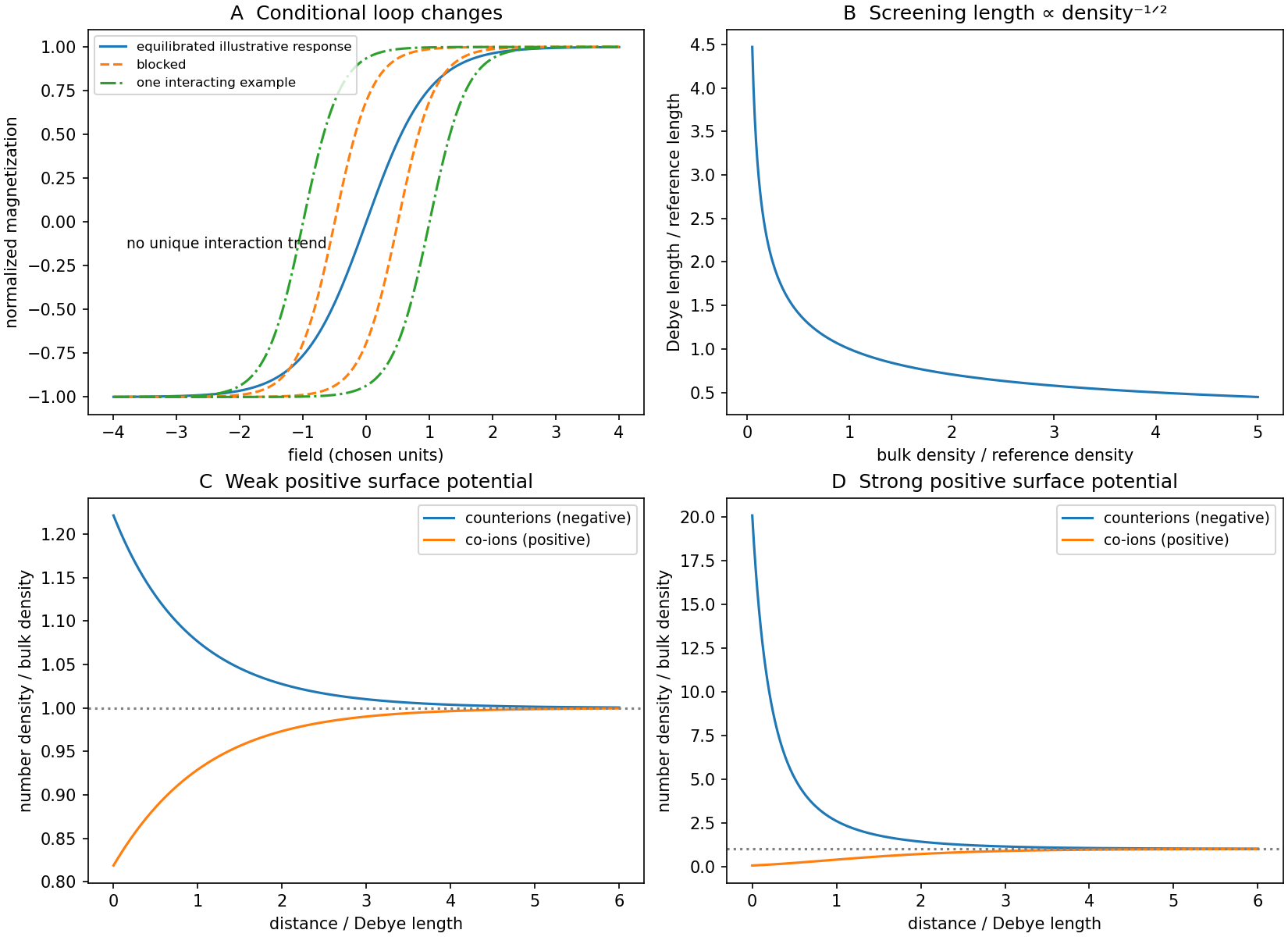
Conditional magnetic loops and electrostatic screening profiles
. Original illustrative magnetic curves and calculated planar mean-field ion profiles. Magnetic-loop broadening is one possible interaction outcome, not a concentration-dependent experimental fit or a clinical prediction. Details. Past exam of the MPhil in micro- and nanotechnology enterprise course of the University of Cambridge 2018 Paper 2 Section A(i) 12 iii Solution by Codex 0 2026-10-20
Codex 0 2026-10-20Since energy and angular frequency are related by , the given eigenvalue relation yieldsWith ,The are dimensionless modal eigenvalues, not optical wavelengths despite the symbol. The same multiplies both mode and bulk angular frequencies and cancels in the energy ratio. These are bare-core predictions of the stipulated lossless Drude model; adding a dielectric/metallic shell, interband response or damping changes the actual resonances.
Past exam of the MPhil in micro- and nanotechnology enterprise course of the University of Cambridge 2018 Paper 2 Section A(i) 12 ii Solution by Codex 0 2026-10-20
Codex 0 2026-10-20The Wulff construction minimizes total orientation-dependent surface free energy at fixed crystal volume:Planes at distances proportional to their surface energies bound the equilibrium shape. The construction is thermodynamic; observed growth rates need not select the same shape.
For a mixed-metal particle, minimize a more complete free energy including bulk mixing/ordering, Au–Ag interface energy, exposed-surface composition, adsorbates and elastic strain, while conserving the amount of each metal. Important parameters include orientation-dependent surface energies, metal chemical potentials, interface coherency, lattice mismatch, temperature and ligand coverage. surface segregation can change the exposed composition and hence the relevant .
A generalized free-energy minimization can address a multicomponent particle; the elementary Wulff construction alone does not predict its core-shell composition. Sequential Au-core formation and Ag deposition can preserve a kinetically trapped interface when diffusion is too slow to reach equilibrium. If shape relaxation is fast but interdiffusion slow, an external shape may approach a constrained minimum even though the complete particle is not at global equilibrium. Growth kinetics, ligand stabilization and finite-size effects limit a bare-surface equilibrium model. A faceted image is therefore insufficient proof that either shape or composition is an equilibrium state.
Past exam of the MPhil in micro- and nanotechnology enterprise course of the University of Cambridge 2018 Paper 2 Section A(i) 12 i Solution by Codex 0 2026-10-20
Codex 0 2026-10-20Read the displayed axes as horizontal and vertical ; the viewing direction is therefore consistent with . crystal facets edge-on in this projection have normals in the plane. The flat upper/lower boundaries are approximately horizontal, the end face vertical, and the bevels approximately to both.
A probable low-index assignment is upper face , end face and lower-right bevel , with the upper-right bevel if it is also indexed. Thus the flat faces belong to and the diagonal faces to .
For example,giving and between normals. The upper normal and lower bevel normal instead make ; their acute unoriented plane angle is . Adjacent polygon corners between a flat edge and bevel have internal angles near .
The distinction between a normal angle, an acute plane angle and an internal polygon angle avoids a supplementary-angle error. This is a probable projected indexation, not a unique full three-dimensional crystal facet reconstruction. The associated work uses tomography precisely to recover information absent from one projection.[ref]
Three-Dimensional Elemental Mapping at the Atomic Scale in Bimetallic Nanocrystals by Bart Goris and others. 2013, study scope: three-dimensional structure and composition from electron-tomography data
The original facet-normal diagram in the growth-and-LED figure shows the relation independently of the source micrograph. Past exam of the MPhil in micro- and nanotechnology enterprise course of the University of Cambridge 2018 Paper 2 Section A(i) 11 ii Solution by Codex 0 2026-10-20
Codex 0 2026-10-20The floating-catalyst direct-spinning route commonly requires a small sulfur promoter addition. sulfur changes catalyst-particle nucleation and surface chemistry, influencing the active Fe-particle population, carbon incorporation and whether sufficiently long, numerous tubes form a drawable aerogel.
A sulfur-rich catalyst surface or Fe–S-containing state can alter surface energy, wetting and particle coarsening; a low-melting interfacial state can also affect catalyst activity. These are process-dependent mechanisms, not a statement that sulfur is a structural constituent required in every carbon nanotube. Excess sulfur can suppress useful growth or worsen impurities. The useful dose therefore has a window and depends on catalyst and feed chemistry.
A controlled comparison changes sulfur supply while holding the carbon/catalyst feed and collection conditions fixed, then measures tube population, catalyst residue and spinnability rather than judging only the presence of soot. The primary direct-spinning study specifically treats sulfur-dependent processing and purity.[ref]
Past exam of the MPhil in micro- and nanotechnology enterprise course of the University of Cambridge 2018 Paper 1 Section B 9 vii Solution by Codex 0 2026-10-20
Codex 0 2026-10-20Taking the printed reference to part(iii) literally, measure an equilibrium water contact angle with a calibrated sessile-drop goniometer on a smooth homogeneous surface. With independently constrained interfacial tensions, test . Advancing and receding measurements reveal pinning and hysteresis; contact angle alone cannot independently determine both unknown solid-interface energies.
If the intended reference was instead the polymer-size prediction in the preceding part, use static light scattering or small-angle neutron scattering at both temperatures on appropriately dilute solutions. At small scattering wave number , the Guinier approximationgives from the slope of against . Control concentration, aggregation and scattering contrast, and compare the extracted radii. Dynamic light scattering normally measures a hydrodynamic size rather than directly the same radius of gyration. Answering both readings avoids silently correcting the printed cross-reference.
Past exam of the MPhil in micro- and nanotechnology enterprise course of the University of Cambridge 2018 Paper 1 Section B 9 vi Solution by Codex 0 2026-10-20
Codex 0 2026-10-20This is the second printed “(vi)”, concerning solvent temperature. The coil is expected to expand, so its radius of gyration increases. For the usual upper-critical-solution-temperature behavior of polystyrene in cyclohexane, heating above the stated theta condition improves solvent quality. Effective repulsion between segments favors more expanded conformations than the ideal coil.
In a Flory–Huggins solution theory description, the theta condition corresponds approximately to interaction parameter , whereas a good solvent has a positive effective excluded volume. The asymptotic size dependence crosses toward with near for a flexible chain in three dimensions. These scaling ideas establish the expected direction, not a numerical expansion factor for a ten-degree temperature change. Its value would require measured solvent-interaction data or a calibrated crossover model.
Past exam of the MPhil in micro- and nanotechnology enterprise course of the University of Cambridge 2018 Paper 1 Section B 9 vi Solution by Codex 0 2026-10-20
Codex 0 2026-10-20This is the first printed “(vi)”, concerning adhesion. The reversible work per unit area to separate the solid–liquid interface into solid–vapor and liquid–vapor interfaces isSubstitute from Young's equation:This is the Young-Dupré equation. It has units , equivalent to . The liquid–vapor tension is the multiplier; the abbreviated printed subscript does not denote a new interface. Within this equilibrium model, smaller water contact angle means larger reversible work of adhesion for fixed liquid–vapor tension.
Past exam of the MPhil in micro- and nanotechnology enterprise course of the University of Cambridge 2018 Paper 1 Section B 9 v Solution by Codex 0 2026-10-20
Codex 0 2026-10-20At the theta temperature, use the long-chain ideal-coil relationsThe two stated molar masses have ratio . ThereforeThe input is an end-to-end root-mean-square distance, not a radius of gyration: omitting would give the wrong result. The apparent missing superscript in the printed masses does not affect the factor-five ratio used here. The estimate assumes the same chain architecture and unperturbed segment statistics, and uses the long-chain rather than finite-link correction.
Past exam of the MPhil in micro- and nanotechnology enterprise course of the University of Cambridge 2018 Paper 1 Section B 9 iii Solution by Codex 0 2026-10-20
Codex 0 2026-10-20Use unambiguous symbols for solid–vapor, solid–liquid and liquid–vapor interfacial energies. The printed description repeats an interface subscript, so it cannot be used literally for two different interfaces.
For a smooth homogeneous equilibrium surface, take a horizontal displacement of the contact line. The substrate-parallel force balance isThus the contact-angle relation is Young's equation:The same result follows by varying interfacial free energy at fixed liquid volume. It assumes equilibrium, no contact-line pinning, and negligible line-tension and roughness corrections. If the inferred cosine lies outside , the finite-angle equilibrium construction fails and a wetting limit must be considered.
The name in the question should be distinguished from the Young–Laplace equation, which relates a pressure jump to interface curvature. The horizontal interfacial balance derived here is Young's equation; it does not require introducing a pressure-curvature formula.
Past exam of the MPhil in micro- and nanotechnology enterprise course of the University of Cambridge 2018 Paper 1 Section B 9 ii Solution by Codex 0 2026-10-20
Codex 0 2026-10-20The contact angle is measured through the liquid between the solid surface and the tangent to the liquid–vapor interface at the contact line. The right panel of the wetting diagram labels that angle and the three interfacial tensions.
At , the ideal macroscopic limit is complete wetting: a film spreads rather than remaining a finite-angle cap. Angles between and are conventionally called hydrophilic for water; the drop wets the surface relatively well. At the tangent is vertical. Between and the water drop is conventionally hydrophobic, with increasingly weak wetting. The exact limit represents vanishing macroscopic contact in an ideal model, not a routine finite-area sessile drop on a real solid.
The categories describe water under specified conditions. Roughness, contamination and contact-line pinning can make advancing and receding angles differ from each other and from the ideal equilibrium angle.
Past exam of the MPhil in micro- and nanotechnology enterprise course of the University of Cambridge 2018 Paper 1 Section B 8 iii Solution by Codex 0 2026-10-20
Codex 0 2026-10-20Replace one-wire discovery and bespoke alignment with reproducible placement, uniform device geometry and a scalable interconnect process. A circuit needs wires at known sites and orientations with controlled diameter, channel length, composition and electrical properties. Directed assembly, transfer or patterned growth can address placement, but must be validated for occupancy and alignment yield.
Use aligned array patterning rather than locating every randomly deposited wire individually. Control contact resistance, dielectric continuity and gate overlap across the wafer. Plan dielectric isolation, crossovers, vias and multiple interconnect levels so that connections do not short neighboring gates or channels. A reliable supply of the required device polarities and threshold voltages is also needed for the intended logic architecture.
Circuit manufacture additionally requires contamination control, compatible thermal budgets, passivation, dimensional and electrical metrology, defect detection, test structures and repair or redundancy strategies where appropriate. Serial electron-beam writing is useful for prototypes but can become a throughput bottleneck; scalable optical or imprint-based pattern transfer is attractive when its alignment and resolution meet the design. A successful isolated transistor does not establish circuit-level yield or reliability.
Past exam of the MPhil in micro- and nanotechnology enterprise course of the University of Cambridge 2018 Paper 1 Section B 8 ii Solution by Codex 0 2026-10-20
Codex 0 2026-10-20Locate an isolated nanowire first, then align source, drain, dielectric and top-gate patterns to it. A suitable research-device sequence is the following; the semiconductor is unspecified, so contact-barrier and surface-cleaning details cannot be assumed universally ohmic.
Prepare a clean electrically insulating substrate, with alignment marks. Disperse a sparse population of nanowires from the suspension, remove the carrier solvent compatibly, and locate a suitable isolated wire by microscopy. Record its position relative to the marks.
Use aligned electron beam lithography and a suitable lift-off process to open contact regions near the two ends while leaving a central channel. Clean the exposed contact regions without destroying the wire, evaporate gold and lift off. The contacts overlap the ends but do not bridge the central channel; test their electrical behavior before assuming an ohmic response.
In a second aligned pattern, define a central dielectric patch that extends beyond the proposed gate edges. Evaporate the specified silicon monoxide and lift off using a profile that permits film separation. Verify coverage over the wire and absence of pinholes: directional deposition onto curved nanoscale geometry is not automatically conformal.
Define and evaporate a gold top gate over that insulated central patch, with its lead kept electrically separated from the source, drain and wire. Lift off and test gate leakage before extracting transistor characteristics. The dielectric must remain continuous under the gate and overlap its edges; the illustrated central gate is not a third direct metal contact to the semiconductor. Gold and silicon monoxide are used as stipulated, without silently replacing SiO by a different oxide.
Past exam of the MPhil in micro- and nanotechnology enterprise course of the University of Cambridge 2018 Paper 1 Section B 8 i Solution by Codex 0 2026-10-20
Codex 0 2026-10-20A useful scale estimate is , where . Five complementary developments are immersion optics, illumination shaping, phase-shifting masks, computational proximity correction and multiple patterning. They address different parts of the process rather than repeal diffraction.
Immersion lithography raises numerical aperture by putting a compatible high-index liquid between the final lens and wafer. Off-axis, annular or dipole illumination places useful diffraction orders within the projection pupil and improves contrast for selected pattern directions.
A phase-shift mask uses controlled optical phase differences to sharpen destructive interference around selected features. Optical proximity correction modifies mask edges and adds assist features to compensate pattern-dependent image formation, resist and etch biases.
Multiple patterning divides a dense final layout into more widely spaced optical patterns, or uses spacer-based pitch division after an optical definition step. Overlay, etch control and pattern decomposition are then critical. For example, with , and , a single-exposure scale is roughly ; obtaining dense features of order commonly requires pitch multiplication rather than attributing everything to one exceptionally sharp aerial image.
These resolution enhancements also require suitable resist contrast, focus control and metrology. The manufacturer's description explains the numerical-aperture benefit of immersion; no claim about a particular 2018 production process is inferred from its current product pages.[ref]
Lenses and mirrors by ASML. Lithography-principles description of water immersion and increased numerical aperture
Pinned article: Introduction to the OurBigBook Project
Welcome to the OurBigBook Project! Our goal is to create the perfect publishing platform for STEM subjects, and get university-level students to write the best free STEM tutorials ever.
Everyone is welcome to create an account and play with the site: ourbigbook.com/go/register. We belive that students themselves can write amazing tutorials, but teachers are welcome too. You can write about anything you want, it doesn't have to be STEM or even educational. Silly test content is very welcome and you won't be penalized in any way. Just keep it legal!
Intro to OurBigBook
. Source. We have two killer features:
- topics: topics group articles by different users with the same title, e.g. here is the topic for the "Fundamental Theorem of Calculus" ourbigbook.com/go/topic/fundamental-theorem-of-calculusArticles of different users are sorted by upvote within each article page. This feature is a bit like:
- a Wikipedia where each user can have their own version of each article
- a Q&A website like Stack Overflow, where multiple people can give their views on a given topic, and the best ones are sorted by upvote. Except you don't need to wait for someone to ask first, and any topic goes, no matter how narrow or broad
This feature makes it possible for readers to find better explanations of any topic created by other writers. And it allows writers to create an explanation in a place that readers might actually find it.
Figure 1. Screenshot of the "Derivative" topic page. View it live at: ourbigbook.com/go/topic/derivativeVideo 2. OurBigBook Web topics demo. Source. - local editing: you can store all your personal knowledge base content locally in a plaintext markup format that can be edited locally and published either:This way you can be sure that even if OurBigBook.com were to go down one day (which we have no plans to do as it is quite cheap to host!), your content will still be perfectly readable as a static site.
- to OurBigBook.com to get awesome multi-user features like topics and likes
- as HTML files to a static website, which you can host yourself for free on many external providers like GitHub Pages, and remain in full control

Figure 2. You can publish local OurBigBook lightweight markup files to either OurBigBook.com or as a static website.
Figure 3. Visual Studio Code extension installation.
Figure 5. . You can also edit articles on the Web editor without installing anything locally. Video 3. Edit locally and publish demo. Source. This shows editing OurBigBook Markup and publishing it using the Visual Studio Code extension. 
- Infinitely deep tables of contents:



All our software is open source and hosted at: github.com/ourbigbook/ourbigbook
Further documentation can be found at: docs.ourbigbook.com
Feel free to reach our to us for any help or suggestions: docs.ourbigbook.com/#contact