Topics (384k) Articles (398k) Users (410) Discussions (242) Comments (383) Files (13k) New article

Ian Czekala teaches a physical account of heating and cooling in H II regions. His nebular energy balance distinguishes the energy spent removing an electron from an atom from the excess photon energy that becomes electron kinetic energy.
In the lecture's account, photoionization supplies heating, while radiative recombination and collisional excitation followed by photon emission remove thermal energy. Balancing these processes determines the gas temperature. This explains why neither the ionization threshold nor the typical photon energy alone specifies the equilibrium temperature.[ref]
Heating and Cooling of HII regions by Ian Czekala. Opening physical overview and Heating by photoionization: excess energy and competing losses

Portrait of Ian Czekala
. External portrait linked from the identified institutional or researcher profile. Source.Daniel J. Mortlock works on statistical inference in astrophysics. He led the 2011 report of the quasar ULAS J1120+0641 at cosmological redshift .
The observation connected two questions about the early universe: how a very massive black hole could already have grown, and how much of the surrounding intergalactic gas remained neutral. The paper interpreted the small ionized region and the absorption profile as evidence about cosmic reionization. Its quoted age and black hole mass are inferences within the adopted physical model, alongside the measured radiation spectrum.[ref]
A luminous quasar at a redshift of z = 7.085 by Daniel J. Mortlock and collaborators. Abstract: redshift, inferred black-hole mass, ionized near zone and suggested neutral intergalactic fraction
Portrait of Daniel J. Mortlock
. Source. Alar Toomre connected the stability of a stellar galactic disk to the competition between self-gravity, rotation and random stellar motion. His 1964 analysis gave a local axisymmetric stability criterion, commonly expressed through the Toomre parameter. A dynamically cold disk can be more vulnerable to gravitational structure formation than one with larger velocity dispersion.[ref]
On the Gravitational Stability of a Disk of Stars by Alar Toomre. p. 1217, abstract and local stability problem
With Juri Toomre, he also modeled the tidal bridges and tails of interacting galaxies. Their test-particle encounters showed how gravity alone can draw long structures out of rotating galactic disks.[ref]

Portrait of Alar Toomre
. Via Wikimedia Commons; credits and usage information are on the linked source file page. Source.Juri Toomre and Alar Toomre demonstrated how close gravitational encounters between galaxies can generate long bridges and tails. Their 1972 calculations represented each galactic disk by noninteracting test particles orbiting a central mass, then followed its response to another passing galaxy.
Despite this deliberately simplified model, tidal forces produced narrow extended structures resembling observed interacting systems. The paper reconstructed several particular pairs, connecting recognizable morphology to encounter geometry. It showed that dramatic luminous extensions can arise from ordinary gravity acting on pre-existing disk material.[ref]

Portrait of Juri Toomre
. External portrait hosted by JILA, University of Colorado Boulder. Source.Sara Seager develops physical methods for interpreting exoplanets. With Dimitar Sasselov, she calculated atmospheric transmission during an exoplanet transit: absorption in the planetary limb makes the measured transit depth depend on wavelength. Their work identified strong atomic features and cloud height as observationally useful diagnostics.[ref]
Theoretical Transmission Spectra During Extrasolar Giant Planet Transits by Sara Seager and Dimitar Sasselov. Abstract: transmission method, predicted absorption and cloud-depth constraint
Her models of solid planets also connect measured mass and radius to bulk composition through an equation of state. They showed how such measurements can distinguish broad iron-rich, silicate-rich and water-rich families while leaving finer compositional ambiguities. A measured mean mass density therefore constrains a family of interior models rather than uniquely revealing an interior.[ref]
Mass-radius relationships for solid exoplanets by Sara Seager and others. Abstract: composition families, equations of state and limits of mass–radius inference

Portrait of Sara Seager
. NASA/Joel Kowsky. Public domain (NASA). Source usage terms, via Wikimedia Commons. Source.Gabriela Mallén-Ornelas coauthored, with Sara Seager, an analytic study of what an exoplanet transit reveals about a planet and its host star. A light curve supplies more than a depth: durations and the orbital period also constrain the geometry.
Their result shows that the mean stellar mass density can be inferred from the light curve under stated assumptions, including a circular orbit and negligible limb darkening in the observing band. These conditions matter: a claim of a unique solution under a specified model does not make the same inference model-independent.[ref]
On the Unique Solution of Planet and Star Parameters from an Extrasolar Planet Transit Light Curve by Sara Seager and Gabriela Mallén-Ornelas. Abstract: circular-orbit and limb-darkening assumptions, stellar density and photometric requirements
James B. Pollack led numerical models of gas giant formation that calculated solid and gaseous accretion together. The simulations combined capture of planetesimals, evolution of the planetary gas envelope and dissolution of incoming solid material within that envelope.
The coupling matters because accreting solids both increase the central mass and deposit energy, changing the envelope's subsequent ability to collect gas. The resulting evolutionary phases include rapid solid growth, slower growth of both components and eventually rapid gas accumulation. This gave a physical account of how an initially modest solid core could become a giant planet within the available disk lifetime.[ref]
Formation of the giant planets by concurrent accretion of solids and gas by James B. Pollack and others. p. 62, abstract: coupled numerical components and three evolutionary phases

Portrait of James B. Pollack
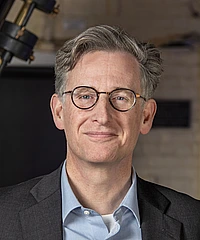
. NASA/Ames Research Center. Public domain in the United States (NASA work, as marked on Commons), via Wikimedia Commons. Source.Charles F. Gammie studies accretion disks, black holes and computational approaches to their dynamics. His 2001 study used local, razor-thin models to investigate gravitational instability in a cooling astrophysical disk.
The models distinguish two outcomes. Sufficiently slow radiative cooling permits a fluctuating state in which dissipation of turbulence replaces the lost heat; faster cooling permits gravitational fragmentation. The reported transition depends on the local model and its assumptions. Its broader importance is the explicit link between an energy balance and whether a disk transports angular momentum or breaks into bound structures.[ref]
Nonlinear Outcome of Gravitational Instability in Cooling, Gaseous Disks by Charles F. Gammie. Abstract: local razor-thin model, cooling–dissipation balance and the distinction between turbulence and fragmentation
Portrait of Charles F. Gammie
. Source. Clément Baruteau studies the gravitational interaction between planets and their surrounding protoplanetary disks. He led a review of how those interactions alter planetary orbits during the formation of planetary systems.
The key comparison is between the time over which a planet's orbital elements change and the lifetime of the protoplanetary disk. If the former is short, planetary migration can substantially reshape the system before the gas disappears. Predicting that change requires a model of the disk's physical structure, because the gravitational forces depend on the disk's response to the planet.[ref]
Dimitar Sasselov studies the physics of exoplanets and their atmospheres. With Sara Seager, he modeled how a transiting gas giant's atmosphere would imprint absorption features on the host star's radiation spectrum.
During an exoplanet transit, a small fraction of the stellar light passes through gas above the planetary limb. Strong atomic absorption can therefore make the apparent blocking area depend on wavelength. Their calculation identified promising sodium, potassium and helium features and emphasized the role of cloud height in interpreting the signal.[ref]
Theoretical Transmission Spectra During Extrasolar Giant Planet Transits by Sara Seager and Dimitar Sasselov. Abstract: atmospheric transmission geometry, strong absorption signatures and cloud-depth constraint

Portrait of Dimitar Sasselov
. External portrait hosted by Harvard University Department of Astronomy. Source.Geoffrey W. Marcy worked on the radial velocity method for finding exoplanets, including precision iodine-cell Doppler calibration. His paper with R. Paul Butler combined a wide recorded stellar radiation spectrum with reference absorption lines introduced directly into the stellar beam.
Measuring a small Doppler shift requires distinguishing real stellar motion from instrumental changes. The superimposed reference constrains the spectrograph's wavelength scale and point spread function during the exposure, allowing the stellar shift to be fitted with those effects included. The paper reported year-long tests of the technique on three solar-type stars.[ref]
Precision Radial Velocities with an Iodine Absorption Cell by Geoffrey W. Marcy and R. Paul Butler. p. 270, abstract and introduction: iodine reference, spectrograph response and three-star tests

Portrait of Geoffrey W. Marcy
. Laurie Hatch (embedded EXIF author); Commons summary credits NASA / Media Telecon. Via Wikimedia Commons; credits and usage information are on the linked source file page. Source.R. Paul Butler develops precise stellar radial velocity measurements for detecting orbiting companions. With Geoffrey W. Marcy, he developed iodine-cell Doppler calibration, superimposing a dense reference spectrum on the same light entering a stellar spectrograph.
The reference lines constrain both the wavelength scale and the instrumental point spread function during the observation. Modeling them together with the shifted stellar radiation spectrum reduces errors caused by changes in the instrument. Their 1992 tests obtained a velocity scatter below over a year, providing a practical foundation for searches for low-mass companions.[ref]
Precision Radial Velocities with an Iodine Absorption Cell by Geoffrey W. Marcy and R. Paul Butler. p. 270, abstract; introduction on differing optical paths and systematic errors

Portrait of R. Paul Butler
. NASA Astrobiology Institute. Public domain (NASA). Source usage terms, via Wikimedia Commons. Source.David C. Nicholls led a 2012 investigation of discrepant nebular temperature measurements. The paper, with Michael A. Dopita and Ralph S. Sutherland, explores a Kappa distribution for electron energies instead of imposing a Maxwell-Boltzmann distribution.
Different spectral diagnostics weight electron energies differently. Consequently, a departure from the assumed distribution can change inferred temperatures and abundances in different ways. The study presents the nonthermal distribution as a physical explanation to test, rather than treating agreement obtained under a changed assumption as a direct measurement of the distribution itself.[ref]
Resolving the electron temperature discrepancies in H II regions and planetary nebulae: kappa-distributed electrons by David C. Nicholls and others. Abstract: alternative electron distribution and consequences for temperature and abundance diagnostics
Ralph S. Sutherland coauthored a study of probability distributions of electron kinetic energy in H II regions and planetary nebulae. With David C. Nicholls and Michael A. Dopita, he investigated whether deviations from a Maxwell-Boltzmann distribution could account for disagreements between different inferred temperatures and chemical abundances.
The authors explored a Kappa distribution with an enhanced high-energy population. The methodological point is that a temperature diagnostic depends on the assumed particle distribution; fitting different spectral lines can probe that assumption rather than merely repeat the same measurement.[ref]
Resolving the electron temperature discrepancies in H II regions and planetary nebulae: kappa-distributed electrons by David C. Nicholls and others. Abstract: discrepancies between diagnostics and the proposed kappa-distribution interpretation
Jerry A. Sellwood studies the dynamics of galactic disks, including the origin and evolution of spiral density waves. His review with Karen L. Masters compares observations, dynamical theory and simulations of recurring spiral patterns.
The review emphasizes a physical feedback: transient spiral activity increases random stellar motion, which can make further spiral activity harder to sustain. A dissipative gas component can alter that evolution. This connects the visible shape of a spiral galaxy to the changing dynamical state of its stars and gas, rather than treating the arms as a permanently fixed decoration.[ref]
Spirals in Galaxies by Jerry A. Sellwood and Karen L. Masters. Abstract: self-excited patterns, random motion and the role of dissipative gas

Portrait of Jerry A. Sellwood
. External portrait linked from the identified institutional or researcher profile. Source.Karen L. Masters studies the structure and evolution of galaxies. Her review with Jerry A. Sellwood connects observed spiral arms to the dynamics of galactic disks, comparing proposed mechanisms with observations and numerical numerical simulations.
A visible spiral pattern need not be a permanent set of the same stars. Recurrent patterns can rearrange a galactic disk and increase random stellar motion; continuing activity then depends in part on the dissipative gas component. Their review also used the number of spiral arms to discuss how much mass resides in the thin galactic disk relative to its surrounding halo.[ref]
Spirals in Galaxies by Jerry A. Sellwood and Karen L. Masters. Abstract: gravitational instability, recurring transient spirals, gas dissipation and arm-number constraints

Portrait of Karen L. Masters
. Via Wikimedia Commons; credits and usage information are on the linked source file page. Source.John Kormendy investigates the structure of galaxies and their central supermassive black holes. His 2013 review with Luis C. Ho examines black hole mass measurements inferred from spatially resolved motion and their correlations with different components of the host galaxy.
An important distinction is between a galactic bulge, a galactic disk and a pseudobulge: the authors find that the same simple coevolution story does not describe all three. A correlation such as the M-sigma relation is therefore evidence to interpret in its structural context, rather than a universal description of every galaxy.[ref]
Coevolution (Or Not) of Supermassive Black Holes and Host Galaxies by John Kormendy and Luis C. Ho. Abstract: spatially resolved kinematics, bulge velocity dispersion and different correlations for disks and pseudobulges

Portrait of John Kormendy
. Source. Luis C. Ho investigates supermassive black holes and their connections to host galaxies. His review with John Kormendy organized dynamically measured black hole masses by host structure, including classical bulges, galactic disks and pseudobulges.
The distinction changes the physical interpretation of a scaling relation. Strong correlations with some bulge properties do not establish equally close coupling to every component of a galaxy. The review argued that weak relations for galactic disks and pseudobulges require a richer account of black hole growth than a single universal coevolution rule.[ref]
Coevolution (Or Not) of Supermassive Black Holes and Host Galaxies by John Kormendy and Luis C. Ho. Abstract: dynamically measured demographics, component-dependent correlations and proposed growth regimes

Portrait of Luis C. Ho
. External portrait hosted by Kavli Institute for Astronomy and Astrophysics, Peking University. Source.Robert C. Kennicutt Jr. studies how gas becomes stars in galaxies. His 1998 observational analysis combined normal spiral galaxies and starburst galaxies, finding an approximately power law between disk-averaged star formation rate per unit area and gas surface density. This Kennicutt–Schmidt law connects measurements across whole galaxies to prescriptions used in models of galaxy formation.[ref]
The Global Schmidt Law in Star Forming Galaxies by Robert C. Kennicutt Jr.. Abstract: combined samples, disk averaging and fitted index 1.4±0.15
With Neal J. Evans II, he also reviewed how different observations estimate star formation rates and how the gas–star formation relation changes between molecular clouds and whole galaxies.[ref]
Star Formation in the Milky Way and Nearby Galaxies by Robert C. Kennicutt Jr. and Neal J. Evans II. Abstract: rate diagnostics and cloud-to-galaxy scales

Portrait of Robert C. Kennicutt Jr.
. External portrait linked from the identified institutional or researcher profile. Source.Neal J. Evans II studies star formation and the connection between interstellar gas and newly formed stars. His 2012 review with Robert C. Kennicutt Jr. compares ways of estimating gas content and star formation rates, from individual molecular clouds to entire galaxies.
The comparison matters because neither quantity is simply read off a photograph: a measured signal must be converted into gas mass or a star formation rate. The review assembles those measurement prescriptions before comparing the physical relations inferred from them.[ref]
Star Formation in the Milky Way and Nearby Galaxies by Robert C. Kennicutt Jr. and Neal J. Evans II. Abstract: gas measurements, updated rate prescriptions and the range of spatial scales
Pinned article: Introduction to the OurBigBook Project
Welcome to the OurBigBook Project! Our goal is to create the perfect publishing platform for STEM subjects, and get university-level students to write the best free STEM tutorials ever.
Everyone is welcome to create an account and play with the site: ourbigbook.com/go/register. We belive that students themselves can write amazing tutorials, but teachers are welcome too. You can write about anything you want, it doesn't have to be STEM or even educational. Silly test content is very welcome and you won't be penalized in any way. Just keep it legal!
Intro to OurBigBook
. Source. We have two killer features:
- topics: topics group articles by different users with the same title, e.g. here is the topic for the "Fundamental Theorem of Calculus" ourbigbook.com/go/topic/fundamental-theorem-of-calculusArticles of different users are sorted by upvote within each article page. This feature is a bit like:
- a Wikipedia where each user can have their own version of each article
- a Q&A website like Stack Overflow, where multiple people can give their views on a given topic, and the best ones are sorted by upvote. Except you don't need to wait for someone to ask first, and any topic goes, no matter how narrow or broad
This feature makes it possible for readers to find better explanations of any topic created by other writers. And it allows writers to create an explanation in a place that readers might actually find it.
Figure 1. Screenshot of the "Derivative" topic page. View it live at: ourbigbook.com/go/topic/derivativeVideo 2. OurBigBook Web topics demo. Source. - local editing: you can store all your personal knowledge base content locally in a plaintext markup format that can be edited locally and published either:This way you can be sure that even if OurBigBook.com were to go down one day (which we have no plans to do as it is quite cheap to host!), your content will still be perfectly readable as a static site.
- to OurBigBook.com to get awesome multi-user features like topics and likes
- as HTML files to a static website, which you can host yourself for free on many external providers like GitHub Pages, and remain in full control

Figure 2. You can publish local OurBigBook lightweight markup files to either OurBigBook.com or as a static website.
Figure 3. Visual Studio Code extension installation.
Figure 5. . You can also edit articles on the Web editor without installing anything locally. Video 3. Edit locally and publish demo. Source. This shows editing OurBigBook Markup and publishing it using the Visual Studio Code extension. 
- Infinitely deep tables of contents:




All our software is open source and hosted at: github.com/ourbigbook/ourbigbook
Further documentation can be found at: docs.ourbigbook.com
Feel free to reach our to us for any help or suggestions: docs.ourbigbook.com/#contact