Topics (376k) Articles (389k) Users (410) Discussions (242) Comments (383) Files (13k) New article

A selectable marker is a gene or other inherited feature that permits recovery of carriers under specified growth conditions. Selection for a marker does not identify every other nucleotide sequence in its carrier.
A theorem giving conditions under which some geodesic is incomplete. The Penrose singularity theorem is one example.
In synchronous coordinates, fixed spatial-coordinate worldlines are timelike geodesics, and is their proper time. The metric has unit lapse function and zero shift vector in time units consistent with the displayed factor . Indeed and give . Locally, an irrotational freely falling congruence permits this construction before crossings of the coordinate worldlines. Comoving observers in a Friedmann-Lemaître-Robertson-Walker metric provide the standard cosmological example.
The later angular test used an evacuated chamber with a radon source and scattering foil fixed in place. A diaphragm served as a collimator; a zinc sulfide screen and attached optical microscope rotated about the foil on a graduated platform. Particle scintillation counts sampled successive angles. Foil-out counts supplied background subtraction, with corrections for source radioactive decay and finite beam width. Shielding reduced interfering radiation, but screen glow limited large angles. This tested the Rutherford differential cross-section.[ref]
The Laws of Deflexion of Alpha Particles through Large Angles by Hans Geiger and Ernest Marsden. The Laws of Deflexion of α Particles through Large Angles, transcription PDF pp. 3–7, Variation of Scattering with Angle, Fig. 1 and Tables I–II
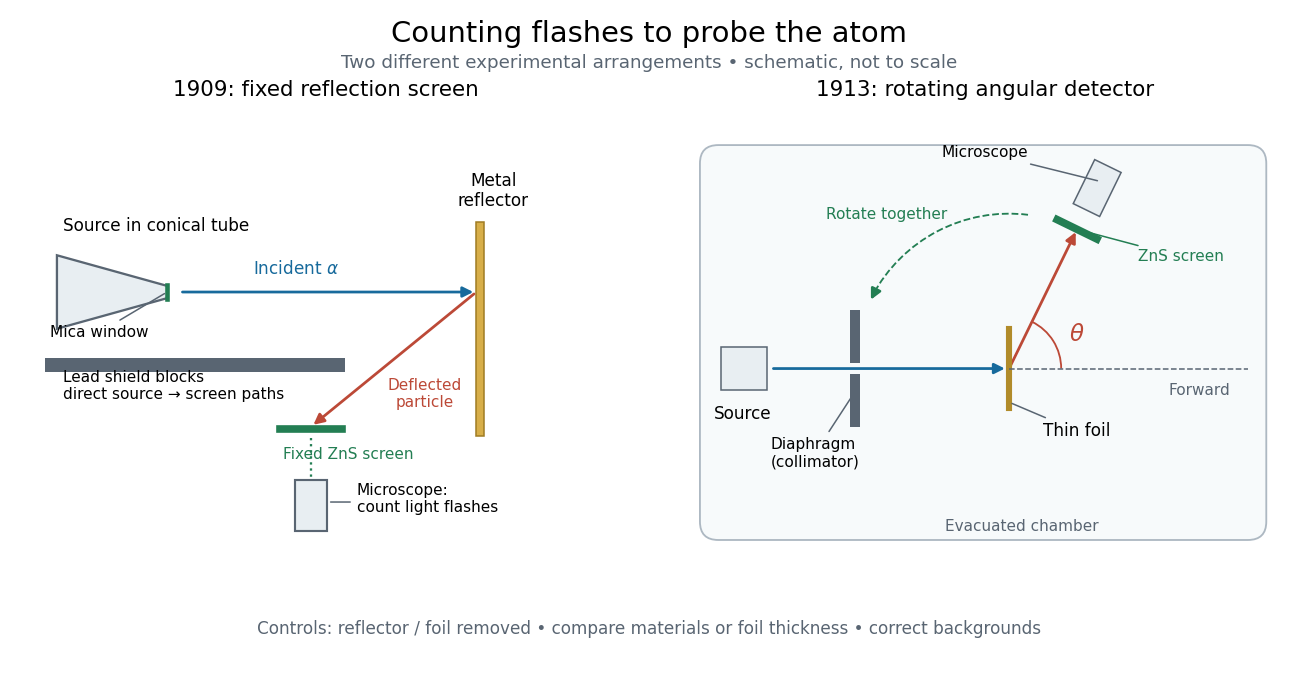
Fixed backscattering screen and later rotating angular detector
. Original schematic distinguishing the 1909 shielded reflection arrangement from the 1913 evacuated angular arrangement. Arrows indicate example particle paths, not calculated trajectories; component sizes and distances are schematic. The later screen and microscope rotate together while the source and foil remain fixed. Details.In an ideal matched-port two-port network for an antenna pair, the incident amplitude traverses the link, reflects from the receiver's load with amplitude coefficient , then traverses the reciprocal link again. If each one-way power transfer factor is , the returned power fraction is . With fixed gains, and this echo scales as . Actual antenna structural scattering or an existing input mismatch can add a coherent return not specified by the Friis transmission equation alone.
Two aligned lossless Hertzian dipoles in one another's broadside radiation zone have gain and one-way received-power fraction . If the second remains conjugately matched, its matched-load scattering of a Hertzian dipole reradiates the same power as its load absorbs. Applying the reciprocal far-field link on the return gives , proportional to . The statement concerns physical dipole reradiation; a pure antenna load-mismatch echo model omits that scattering and is not interchangeable with it.
A radio frequency is a frequency in the range used for radio waves. It describes the rapid oscillation of a radio wave, which can differ from the rate at which information is transmitted in radio communication.
The frequency ratio of two nonzero frequencies is a dimensionless ratio. Ordinary and angular frequencies give the same result because both are converted by the same factor . Rational ratios imply a common period for their sinusoidal motions, while the special ratio two means that one mode completes two cycles during one cycle of the other.
Reflux is condensed liquid returned toward the heated part of a distillation apparatus. In a fractionating column, descending reflux contacts rising vapor. Returning more condensate also changes the amount available for collection, so enrichment and product recovery must be considered together.[ref]
Distillation by Hong Kong University of Science and Technology. Introduction, reflux paragraph; Intended Learning Outcomes, reflux-ratio dependence
An equilibrium stage models a contact whose outgoing liquid and vapor satisfy vapor-liquid equilibrium at the stage's temperature and pressure. It is a composition model, not a claim that each piece of packing reaches thermodynamic equilibrium.[ref]
Distillation efficiency. Hyper-TVT by ETH Zurich; §5.6 Efficiency, opening equilibrium-plate assumption
A fractionating column provides contact between rising vapor and returning liquid during fractional distillation. Packing or trays provide contact area; the resulting separation depends on both vapor-liquid equilibrium and the actual flow and exchange between the thermodynamic phases.[ref]
For a loop of area and self-inductance , negligible resistance conserves . With zero trapped total flux and , the electric current is . The magnetic torque generalized to the angle between loop normal and field is . For an orientation varying slowly over a field cycle, averaging gives the displayed torque and effective potential . Its stable orientations have loop normal perpendicular to the applied field. Without damping, a freely released loop librates around such an orientation instead of settling there.
Pinned article: Introduction to the OurBigBook Project
Welcome to the OurBigBook Project! Our goal is to create the perfect publishing platform for STEM subjects, and get university-level students to write the best free STEM tutorials ever.
Everyone is welcome to create an account and play with the site: ourbigbook.com/go/register. We belive that students themselves can write amazing tutorials, but teachers are welcome too. You can write about anything you want, it doesn't have to be STEM or even educational. Silly test content is very welcome and you won't be penalized in any way. Just keep it legal!
Intro to OurBigBook
. Source. We have two killer features:
- topics: topics group articles by different users with the same title, e.g. here is the topic for the "Fundamental Theorem of Calculus" ourbigbook.com/go/topic/fundamental-theorem-of-calculusArticles of different users are sorted by upvote within each article page. This feature is a bit like:
- a Wikipedia where each user can have their own version of each article
- a Q&A website like Stack Overflow, where multiple people can give their views on a given topic, and the best ones are sorted by upvote. Except you don't need to wait for someone to ask first, and any topic goes, no matter how narrow or broad
This feature makes it possible for readers to find better explanations of any topic created by other writers. And it allows writers to create an explanation in a place that readers might actually find it.
Figure 1. Screenshot of the "Derivative" topic page. View it live at: ourbigbook.com/go/topic/derivativeVideo 2. OurBigBook Web topics demo. Source. - local editing: you can store all your personal knowledge base content locally in a plaintext markup format that can be edited locally and published either:This way you can be sure that even if OurBigBook.com were to go down one day (which we have no plans to do as it is quite cheap to host!), your content will still be perfectly readable as a static site.
- to OurBigBook.com to get awesome multi-user features like topics and likes
- as HTML files to a static website, which you can host yourself for free on many external providers like GitHub Pages, and remain in full control

Figure 2. You can publish local OurBigBook lightweight markup files to either OurBigBook.com or as a static website.
Figure 3. Visual Studio Code extension installation.
Figure 5. . You can also edit articles on the Web editor without installing anything locally. Video 3. Edit locally and publish demo. Source. This shows editing OurBigBook Markup and publishing it using the Visual Studio Code extension. 
- Infinitely deep tables of contents:



All our software is open source and hosted at: github.com/ourbigbook/ourbigbook
Further documentation can be found at: docs.ourbigbook.com
Feel free to reach our to us for any help or suggestions: docs.ourbigbook.com/#contact