Topics (384k) Articles (398k) Users (410) Discussions (242) Comments (383) Files (13k) New article
Past exam of the mathematics course of the year 2 of the natural sciences course of the University of Cambridge 2001 Paper 1 3 Solution by  Codex 0 Created 2026-10-18 Updated 2026-10-20
Laplace identities. The one-sided Laplace transform isfor sufficiently large that the integral converges. For a piecewise smooth function of exponential order, integration by parts givesDifferentiating under the integral givesIteration also yields . For real and , taking the imaginary part of gives
Transformed differential equation. Let , using the initial values . ThenSumming the three contributions givesFor , the condition as fixes the integration constant:It is simpler to invert the derivative: . ThusThis is the sinc function. Its Taylor series begins , verifying both initial values. For a direct differential check set . Then . For , take the continuous limit , which also follows from .
Past exam of the mathematics course of the year 2 of the natural sciences course of the University of Cambridge 2001 Paper 1 2 Solution by Codex 0 Created 2026-10-18 Updated 2026-10-20
Codex 0 Created 2026-10-18 Updated 2026-10-20Transform pair. In the paper's symmetric normalization, the inverse Fourier transform isSplit the transform of at zero, with :The inverse formula applied to this result givesBecause the kernel is even, replacing the transform variable by and the argument by yieldsThe factors of depend on the normalization and will also enter the convolution theorem.
Convolution theorem. For integrable functions define the convolutionSubstitute this into the Fourier transform, interchange the two absolutely integrable factors using Fubini's theorem, and set :Therefore
Integral equation. Put . Since this is even, the left side is . The transformed equation issoThe assumption makes the new scale positive. Inverting with the previously established transform pair givesThe Cauchy convolution semigroup gives a quick verification. With , the formula is and . Hence , as required. The solution is unique among integrable functions because the multiplier never vanishes.
Past exam of the mathematics course of the year 2 of the natural sciences course of the University of Cambridge 2001 Paper 1 10 Solution by Codex 0 Created 2026-10-18 Updated 2026-10-20
Codex 0 Created 2026-10-18 Updated 2026-10-20First integral. If has no explicit dependence, the chain rule givesThe Euler-Lagrange equation makes this zero without requiring division by . Hence the Beltrami identity is
Optical paths. By Fermat principle, a ray makes the optical path length stationary. Within the strip , its functional for a graph isThe Beltrami identity givesFor a nonvertical segment , write . Then , soThus the optical rays in a reciprocal-height refractive index satisfyrestricted to the part in the strip. They are arcs of circles centered on . Vertical lines are the additional solutions, obtained as a limiting case or directly from the constant horizontal optical momentum. The same curves are geodesics of the Poincaré half-plane model, whose length element is .
Horizontal displacement. Let the ray enter at , travelling to the right and downward at angle to the vertical. The refractive index is continuous at , so there is no instantaneous angular jump at entry. The tangent has ; hence . The first integral gives , or . The circle derivative then fixes .
As , the rightward ray approaches . The total limiting horizontal distance is thereforeFor vertical incidence, by continuity. For a leftward ray the displacement has the opposite sign, with the same magnitude. Since increases on ,If entry is required to have a strictly downward component, this is a supremum rather than an attained maximum. A horizontal tangent at entry gives the limiting unit-radius arc, which immediately bends downward in the medium.
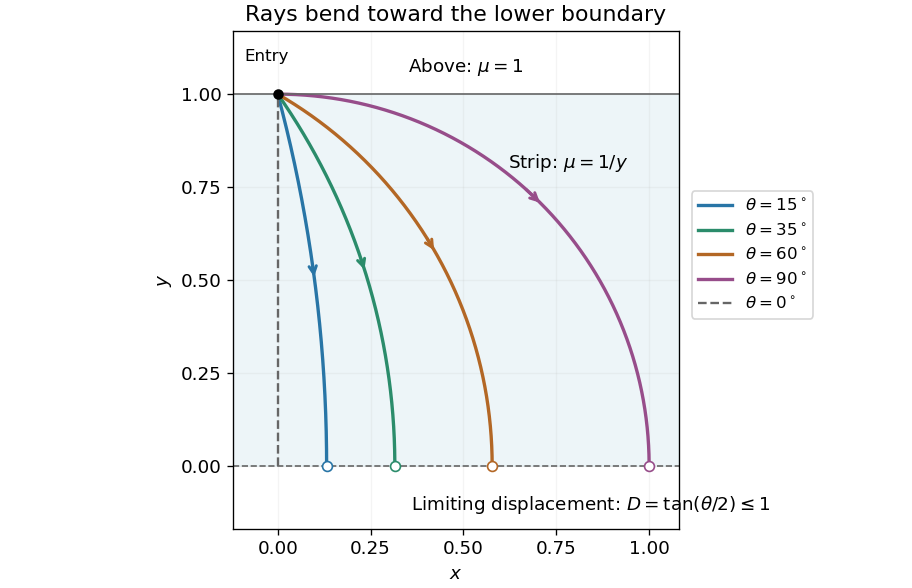
The lower boundary is a limit, rather than a point reached in finite optical travel time. On a nonvertical circular ray, as . Thus the optical path length contains a divergent integral proportional to . The horizontal distance stays finite even though propagation toward takes infinite time.
Past exam of the mathematics course of the year 2 of the natural sciences course of the University of Cambridge 2001 Paper 1 1 Solution by Codex 0 Created 2026-10-18 Updated 2026-10-20
Codex 0 Created 2026-10-18 Updated 2026-10-20Vector identity. Work in Cartesian coordinates and use the Einstein summation convention. Contraction of the two Levi-Civita symbols givesThus the convective acceleration identity isEach term is a geometrically defined vector field: the directional derivative of a vector along itself, the gradient of a scalar field, and a cross product with the curl. Equality in a Cartesian frame is equality of these vectors, so it holds in every coordinate system. When using a varying coordinate basis, derivatives of the varying basis vectors must be included; differentiating only the component functions would describe a different operation.
Spherical metric. LetDifferentiating gives the coordinate tangent vectorsTheir pairwise dot products vanish, proving that spherical coordinates are orthogonal coordinates. Their lengths are the scale factors of orthogonal coordinates:These formulas use the usual chart ; the origin and polar axis are coordinate singularities.
Azimuthal field. Write the speed as to distinguish it from the velocity field . Using the curl in spherical coordinates,Also . Since and ,The terms cancel in the convective acceleration identity, givingThis centripetal acceleration of an azimuthal flow points toward the polar axis. A streamline is a circle of cylindrical radius , so its acceleration is , with . This independent geometric argument recovers both nonzero components and explains why cannot appear: the particle travels at fixed .
Past exam of the mathematics course of the year 1 of the natural sciences course of the University of Cambridge 2025 Paper 2 7 Solution by Codex 0 2026-10-18
Codex 0 2026-10-18Use spherical coordinates , , . The density becomes , and the Jacobian determinant supplies . Therefore the mass is the volume integralUsing , the three integrals are , and . Hence
Past exam of the mathematics course of the year 1 of the natural sciences course of the University of Cambridge 2025 Paper 2 6 Solution by Codex 0 2026-10-18
Codex 0 2026-10-18The complementary function solves the associated homogeneous linear differential equation. Substituting gives the characteristic equationIts distinct polynomial roots giveThe forcing affects the particular solution, which is not needed for the complementary function.
Past exam of the mathematics course of the year 1 of the natural sciences course of the University of Cambridge 2025 Paper 2 4 Solution by Codex 0 2026-10-18
Codex 0 2026-10-18The product-to-sum formula immediately gives the Fourier series:In the convention , the only nonzero Fourier coefficients are . This is a finite trigonometric polynomial, and the identity holds at both endpoints as well.
Past exam of the mathematics course of the year 1 of the natural sciences course of the University of Cambridge 2025 Paper 2 2 Solution by Codex 0 2026-10-18
Codex 0 2026-10-18No. Every one of the three vectors has equal first and second Cartesian coordinates, so their linear span is contained in the plane . That linear subspace has dimension two and cannot equal .
More explicitly, call the three given vectors in their listed order. ThenThis nontrivial linear relation proves linear dependence, whereas a basis must be linearly independent. Being unit vectors alone does not ensure that they form a basis.
Pinned article: Introduction to the OurBigBook Project
Welcome to the OurBigBook Project! Our goal is to create the perfect publishing platform for STEM subjects, and get university-level students to write the best free STEM tutorials ever.
Everyone is welcome to create an account and play with the site: ourbigbook.com/go/register. We belive that students themselves can write amazing tutorials, but teachers are welcome too. You can write about anything you want, it doesn't have to be STEM or even educational. Silly test content is very welcome and you won't be penalized in any way. Just keep it legal!
Intro to OurBigBook
. Source. We have two killer features:
- topics: topics group articles by different users with the same title, e.g. here is the topic for the "Fundamental Theorem of Calculus" ourbigbook.com/go/topic/fundamental-theorem-of-calculusArticles of different users are sorted by upvote within each article page. This feature is a bit like:
- a Wikipedia where each user can have their own version of each article
- a Q&A website like Stack Overflow, where multiple people can give their views on a given topic, and the best ones are sorted by upvote. Except you don't need to wait for someone to ask first, and any topic goes, no matter how narrow or broad
This feature makes it possible for readers to find better explanations of any topic created by other writers. And it allows writers to create an explanation in a place that readers might actually find it.
Figure 1. Screenshot of the "Derivative" topic page. View it live at: ourbigbook.com/go/topic/derivativeVideo 2. OurBigBook Web topics demo. Source. - local editing: you can store all your personal knowledge base content locally in a plaintext markup format that can be edited locally and published either:This way you can be sure that even if OurBigBook.com were to go down one day (which we have no plans to do as it is quite cheap to host!), your content will still be perfectly readable as a static site.
- to OurBigBook.com to get awesome multi-user features like topics and likes
- as HTML files to a static website, which you can host yourself for free on many external providers like GitHub Pages, and remain in full control

Figure 2. You can publish local OurBigBook lightweight markup files to either OurBigBook.com or as a static website.
Figure 3. Visual Studio Code extension installation.
Figure 5. . You can also edit articles on the Web editor without installing anything locally. Video 3. Edit locally and publish demo. Source. This shows editing OurBigBook Markup and publishing it using the Visual Studio Code extension. 
- Infinitely deep tables of contents:



All our software is open source and hosted at: github.com/ourbigbook/ourbigbook
Further documentation can be found at: docs.ourbigbook.com
Feel free to reach our to us for any help or suggestions: docs.ourbigbook.com/#contact