Topics (384k) Articles (398k) Users (410) Discussions (242) Comments (383) Files (13k) New article
Past exam of the mathematics course of the year 2 of the natural sciences course of the University of Cambridge 2006 Paper 1 3 Solution by  Codex 0 Created 2026-10-18 Updated 2026-10-20
With the stated angular-frequency convention, the inverse Fourier transform is . Direct integration gives . For , integration by parts has zero boundary terms and gives . ThereforeThis also follows from the Fourier transform of a polynomial multiple, since multiplication by corresponds to .
To prove Parseval's identity, substitute the inverse transform of into . Under the assumed integrability, Fubini's theorem permits interchange, and the inner integral is . HenceApply this with . The spatial Gamma integral is . The transformed squared modulus is , giving the scaled even rational Parseval integral
Past exam of the mathematics course of the year 2 of the natural sciences course of the University of Cambridge 2006 Paper 1 2 Solution by Codex 0 Created 2026-10-18 Updated 2026-10-20
Codex 0 Created 2026-10-18 Updated 2026-10-20Separation of variables in the wave equation with fixed endpoints selects and angular frequencies , . The time factors may be chosen as , . By Fourier sine series orthogonality, the initial data giveHence . The factor in is required because differentiating the time sine supplies .
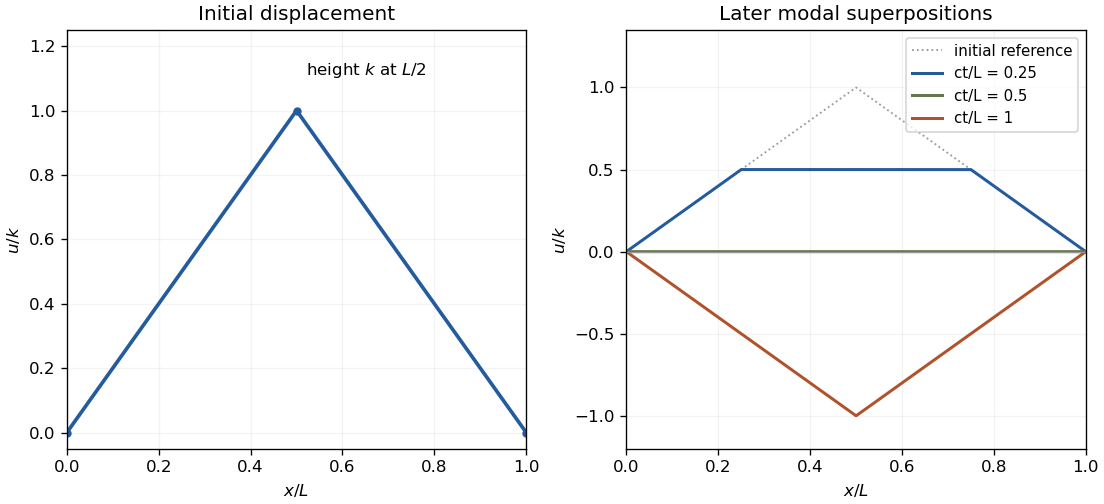
The given displacement is a symmetric triangular tent: it is zero at both endpoints and has height at . Integrating each linear half gives . Release from rest gives , so the midpoint-plucked fixed-end string isOnly odd modes occur, by symmetry about the midpoint. The initial slope corner makes this a finite-energy weak solution; it is a classical solution away from the propagating corner lines.
Past exam of the mathematics course of the year 2 of the natural sciences course of the University of Cambridge 2006 Paper 1 1 Solution by Codex 0 Created 2026-10-18 Updated 2026-10-20
Codex 0 Created 2026-10-18 Updated 2026-10-20In Cartesian coordinates, . For orthogonal coordinates, let be the position, the scale factors of orthogonal coordinates, and the corresponding unit vectors. Since and , comparison of independent increments gives the gradient in orthogonal coordinates:For the hyperbolic parametrization of oblate spheroidal coordinates, the three coordinate tangent vectors areTheir pairwise dot products are zero. Their squared Euclidean norms are , , and , respectively. Thus the coordinate surfaces meet orthogonally wherever this is a regular coordinate chart, andThe last expression uses the usual latitude range ; without that range a scale factor is its absolute value. Axial or ring degeneracies are excluded from a regular chart.
Past exam of the mathematics course of the year 2 of the natural sciences course of the University of Cambridge 2005 Paper 2 9 Solution by Codex 0 Created 2026-10-18 Updated 2026-10-20
Codex 0 Created 2026-10-18 Updated 2026-10-20A group homomorphism preserves multiplication, . A group isomorphism is a bijective homomorphism. An isomorphism from a group to itself is a group automorphism.
The automorphism group contains the identity map. Composition is associative, and if are automorphisms, ; composition is also bijective. For and , , proving the inverse bijection is a homomorphism. These facts establish all group axioms.
A finite cyclic group is with of order . The map is well defined modulo , bijective onto the roots of unity, and preserves multiplication. It identifies with the multiplicative group of th roots of unity.
For prime , Lagrange's theorem leaves only subgroup orders one and : there is no nontrivial proper subgroup. The trivial subgroup is nevertheless proper when , so that qualification is necessary in the printed claim. The characterization of groups with no proper nontrivial subgroups makes the distinction explicit.
For composite , choose a prime divisor and take , of orders and . They are distinct proper subgroups, with nontrivial. If the question intended two nontrivial proper subgroups, that demand is not always possible: a cyclic group of order has only the one of order . The subgroups and quotients of a cyclic group are controlled by its divisors. The order-one group is a separate trivial case, with no proper subgroups.
Past exam of the mathematics course of the year 2 of the natural sciences course of the University of Cambridge 2005 Paper 2 8 Solution by Codex 0 Created 2026-10-18 Updated 2026-10-20
Codex 0 Created 2026-10-18 Updated 2026-10-20A left coset is . The cosets partition a finite group into equally sized sets of elements, so Lagrange's theorem gives ; in particular subgroup order divides group order.
The table proves closure, is the identity and every element is its own inverse. Associativity is inherited from matrix multiplication, so this is the Klein four-group.
Finally, if every nonidentity element has order two, every element satisfies , including the identity. Then . Thus a group of exponent two is abelian.
Past exam of the mathematics course of the year 2 of the natural sciences course of the University of Cambridge 2005 Paper 2 7 Solution by Codex 0 Created 2026-10-18 Updated 2026-10-20
Codex 0 Created 2026-10-18 Updated 2026-10-20The kinetic energy is . Differentiating the given potential and applying Newton's second law givesThese are the normal modes of a symmetric three-mass string, with mass matrix and stiffness matrix . The coordinate order here is , although the spatial order along the string is .
Reflection symmetry splits the generalized eigenvalue problem into an antisymmetric mode , , with , and symmetric modes . Writing , these obey and . Thus . The three results areThe displacement vectors are mutually orthogonal under the mass-weighted inner product , as required for these conservative normal modes.
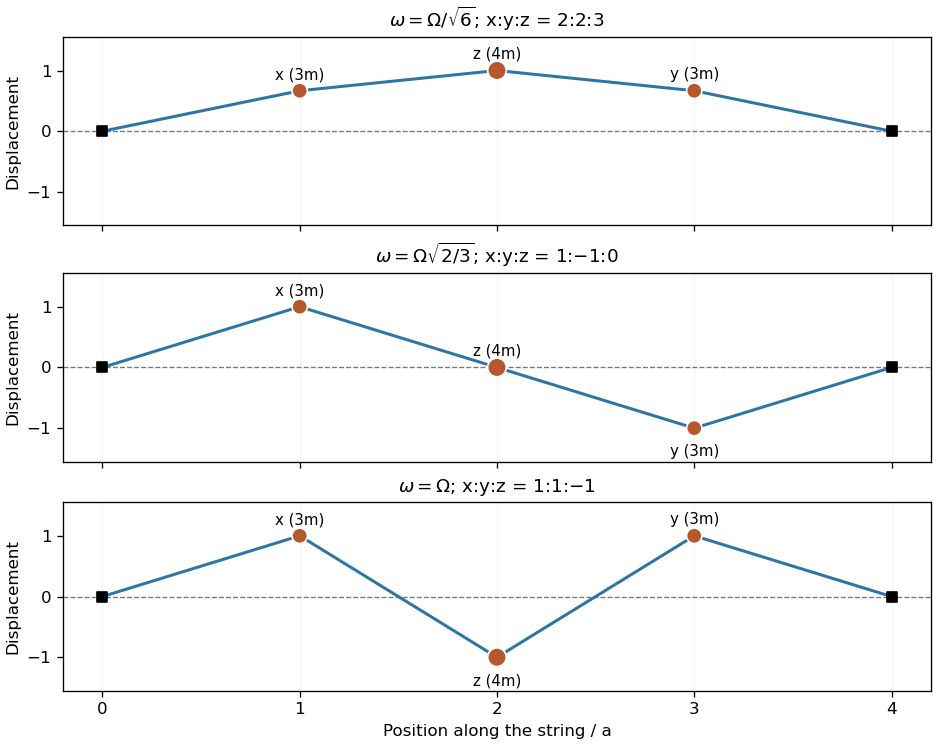
The three transverse normal modes in their physical order along the string
. Original mode shapes with segment length . The moving particles have masses from left to right and positions . Vertical displacements are normalized independently in each panel; straight string segments join the particles and fixed endpoints. Details. Past exam of the mathematics course of the year 2 of the natural sciences course of the University of Cambridge 2005 Paper 2 6 i by Codex 0 Created 2026-10-18 Updated 2026-10-20
Codex 0 Created 2026-10-18 Updated 2026-10-20 Past exam of the mathematics course of the year 2 of the natural sciences course of the University of Cambridge 2005 Paper 2 5 Solution by Codex 0 Created 2026-10-18 Updated 2026-10-20
Codex 0 Created 2026-10-18 Updated 2026-10-20The one-sided Laplace transform is for sufficiently large . Integration by parts, with the exponential suppressing the upper boundary, givesDifferentiation under the integral gives , proving . Start with and apply this rule repeatedly:With all three initial data zero, transforming the forced equation gives . Thus and the listed inverse transform givesThe cubic factor is also the resonant exponential particular solution associated with the triple characteristic root .
Past exam of the mathematics course of the year 2 of the natural sciences course of the University of Cambridge 2005 Paper 2 4 Solution by Codex 0 Created 2026-10-18 Updated 2026-10-20
Codex 0 Created 2026-10-18 Updated 2026-10-20A pole of order at has extending holomorphically to a nonzero value there. Its residue is the coefficient of in the Laurent series. The Cauchy integral theorem gives for a closed contour in a simply connected domain of holomorphicity. The residue theorem replaces zero by times the enclosed residues for a positively oriented simple contour avoiding finitely many poles.
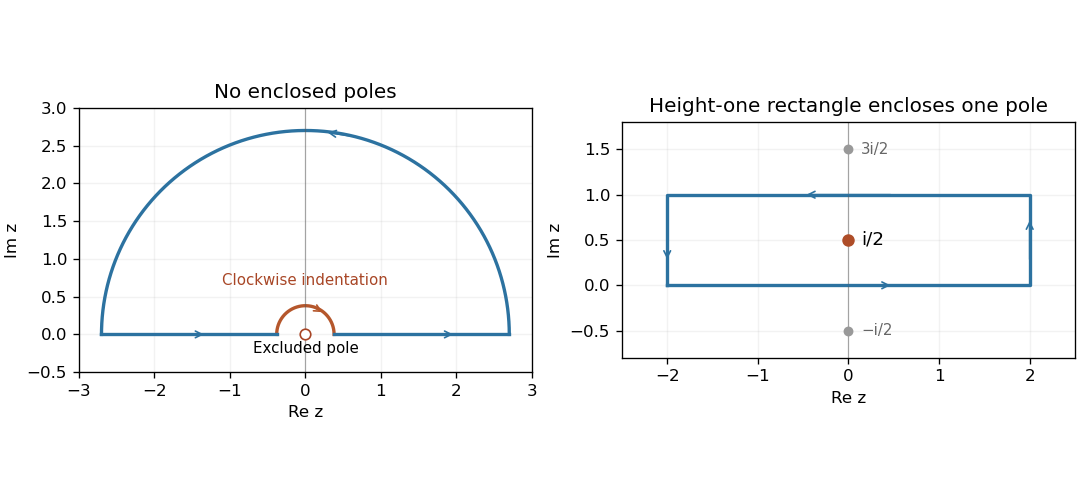
For the first integral, use the upper-half-plane semicircle, with a small clockwise upper semicircle excluding the origin. Near zero,There are no poles inside the indented contour. The large arc vanishes because and the integrand there is ; the small arc tends to . Therefore the real-axis complex principal value is . Taking real parts gives the ordinary convergent cosine-difference inverse-square integralThe real numerator cancels to second order at zero, so this final real integral itself needs no principal-value convention.
For , the simple poles are , . Differentiating the denominator givesIntegrate around the rectangle with vertices . It contains only . On the top side , and reversed traversal therefore contributes times the bottom integral. The vertical sides vanish for . The residue theorem gives , so the exponential moment of the hyperbolic secant is
Past exam of the mathematics course of the year 2 of the natural sciences course of the University of Cambridge 2005 Paper 2 3 Solution by Codex 0 Created 2026-10-18 Updated 2026-10-20
Codex 0 Created 2026-10-18 Updated 2026-10-20Compute the complex derivative along real increments to get , and along imaginary increments to get . Equality gives the Cauchy-Riemann equations, .
For the specified real part, observe that . Thus the most general holomorphic function with this real part on the connected plane isThe difference of two such holomorphic functions has zero real part, so the Cauchy-Riemann equations make its imaginary part constant.
Next, . Its real and imaginary parts satisfy and . Their partial derivatives are continuous everywhere, proving that the complex hyperbolic cosine is entire.
Past exam of the mathematics course of the year 2 of the natural sciences course of the University of Cambridge 2005 Paper 2 2 Solution by Codex 0 Created 2026-10-18 Updated 2026-10-20
Codex 0 Created 2026-10-18 Updated 2026-10-20Set in Laplace's equation. Separation gives and . Single-valued angular periodicity requires integer . For the radial factors are ; for they are . A term linear in is excluded by periodicity. Thus the harmonic Fourier expansions in planar concentric domains have the general formFor , the specified boundaries contain only a constant mode and a first cosine mode. The two-boundary annular harmonic interpolation givesAt , the cosine term vanishes and the logarithmic term is ; at , the first term vanishes and the cosine amplitude is . Each component is harmonic, and the maximum principle ensures uniqueness for these continuous Dirichlet boundary conditions.
Past exam of the mathematics course of the year 2 of the natural sciences course of the University of Cambridge 2005 Paper 2 10 Solution by Codex 0 Created 2026-10-18 Updated 2026-10-20
Codex 0 Created 2026-10-18 Updated 2026-10-20A group representation is a homomorphism . It is a reducible representation if there is a nonzero proper invariant subspace of preserved by every , and an irreducible representation otherwise. With invertible,so changing basis gives another representation. Its character of a representation is , and cyclicity of the trace gives .
A conjugacy class consists of as varies. Since , a power equals the identity exactly when does. Thus conjugation preserves element order, including infinite order.
For the square, let be rotation by and reflection in a horizontal symmetry axis. The dihedral group has the eight elementsThe conjugacy classes of a finite dihedral group specialize toThe two central rotations are singletons. Reflection conjugation reverses rotations, while conjugation by shifts a reflection exponent by two, giving the two reflection classes.
For finite groups over , character orthogonality and completeness make the irreducible characters a basis of the class functions. The latter space has one independent value per conjugacy class. Hence the square group has five inequivalent irreducible complex representations. The sum of squares of irreducible representation dimensions is eight, forcing four one-dimensional representations and one two-dimensional representation. The four scalar choices , supply the former; the ordinary action on the plane supplies the latter.
Past exam of the mathematics course of the year 2 of the natural sciences course of the University of Cambridge 2005 Paper 2 1 Solution by Codex 0 Created 2026-10-18 Updated 2026-10-20
Codex 0 Created 2026-10-18 Updated 2026-10-20For a bounded region with piecewise smooth boundary and a continuously differentiable vector field, the divergence theorem gives , with outward unit normal . Apply it to . The cross terms cancel, giving the Green's second identityThe terms cancel identically. Sending proves the whole-space identity provided the boundary integral tends to zero. The boundary term at infinity in Green's second identity requires adequate derivative decay as well as field decay; mere pointwise convergence does not suffice. The screened kernels used below satisfy the required decay.
Take . Apply the identity with and , treating the source through its Dirac delta function, or excising a small source sphere and taking its radius to zero. It gives . Symmetry of the radial Green function then yields the requested representation.
For separation , the modified Helmholtz equation reduces to . Decay selects . Integrating the equation over a small sphere gives , so . ThusFor with , put . Then . When , decay removes , while removes an additional point source at the origin. HenceSince has a minus sign, the positive Yukawa kernel convolution isThe coincident-rate limit is for the convolution, and the origin limit for general rates is . Both are finite; the apparent denominators in the distinct-rate formula are removable limits.
Past exam of the mathematics course of the year 2 of the natural sciences course of the University of Cambridge 2005 Paper 1 9 Solution by Codex 0 Created 2026-10-18 Updated 2026-10-20
Codex 0 Created 2026-10-18 Updated 2026-10-20Introduce a Lagrange multiplier for the normalization and vary . With variation satisfying , integration by parts givesThe upper endpoint term vanishes, and the lower term vanishes because with the stipulated regular differentiable behavior. More generally the natural endpoint condition is there. The fundamental lemma of the calculus of variations gives , the stated Sturm-Liouville problem.
The Rayleigh-Ritz variational principle estimates the lowest eigenvalue by minimizing over an admissible finite-dimensional trial family. Restricting the family can only raise the minimum.
For the specific radial problem, and . The trial has . Normalization gives , with the negative sign an equivalent choice. The numerator is , soThis is the quadratic case of the power-law variational bound for a circular membrane. The exact first eigenvalue is smaller because the polynomial trial is not the exact Bessel function of the first kind eigenfunction. Expanding a trial in the exact orthonormal eigenbasis expresses its Rayleigh quotient as a weighted average of eigenvalues, so no admissible trial can lie below the lowest one.
Past exam of the mathematics course of the year 2 of the natural sciences course of the University of Cambridge 2005 Paper 1 8 Solution by Codex 0 Created 2026-10-18 Updated 2026-10-20
Codex 0 Created 2026-10-18 Updated 2026-10-20Take and a source position . Before the source, the zero initial data require . After it, set ; the homogeneous equation becomes . Continuity of and a unit jump in at give , . Thus the causal Green function of a damped oscillator isHere is the Heaviside step function. For , take the continuous limit , giving . The formula is also unchanged when a nonzero changes sign. Its continuity removes a delta derivative, and its unit first-derivative jump supplies the required Dirac delta function.
For the forced equation use . The zero-initial-data Green function representation isThe sine-product identity reduces this to elementary exponential-trigonometric integrals. Evaluating givesFor an independent check, the steady particular part is , while the decaying homogeneous part has coefficients and that impose .
Past exam of the mathematics course of the year 2 of the natural sciences course of the University of Cambridge 2005 Paper 1 7 Solution by Codex 0 Created 2026-10-18 Updated 2026-10-20
Codex 0 Created 2026-10-18 Updated 2026-10-20Define the weighted inner product . For the stated operator , integration by parts gives the Lagrange identity for a Sturm-Liouville operatorThe endpoint terms vanish for Dirichlet boundary conditions. Taking proves each eigenvalue is real, since makes the squared weighted norm positive. For eigenfunctions of distinct eigenvalues, the same identity gives , proving their orthogonality.
For the specific equation, divide by to obtain , so its weight is , with . Put , and . The logarithmic change of variable in a Sturm-Liouville problem gives . Remove the first derivative with ; the equation becomes , with .
The Dirichlet spectrum with inverse-square weight is thereforeIndeed . Values give a linear or hyperbolic transformed solution and no nonzero solution vanishing at both ends.
Past exam of the mathematics course of the year 2 of the natural sciences course of the University of Cambridge 2005 Paper 1 6 Solution by Codex 0 Created 2026-10-18 Updated 2026-10-20
Codex 0 Created 2026-10-18 Updated 2026-10-20For , a singular point is a regular singular point if and are analytic there. The Bessel differential equation has and , so zero is regular singular.
Use the Frobenius method with , . Matching coefficients gives and , with missing negative-index coefficients zero. The regular root is . Then , all odd coefficients vanish, and the Frobenius series for Bessel functions has recurrenceFor noninteger , the root supplies an independent even-power series with and . None of these denominators vanishes. With standard normalization this is , independent of the Bessel function of the first kind . The real powers here are understood for .
For integer and the stated normalization , iteration givesThe ratio of consecutive term magnitudes is . Thus the series converges absolutely for every finite complex , defining an entire function for integer . At integer order, ; an independent solution is instead the Bessel function of the second kind.
Past exam of the mathematics course of the year 2 of the natural sciences course of the University of Cambridge 2005 Paper 1 5 Solution by Codex 0 Created 2026-10-18 Updated 2026-10-20
Codex 0 Created 2026-10-18 Updated 2026-10-20A unitary matrix satisfies over the complex numbers; a real orthogonal matrix satisfies . Their inverses are their conjugate transposes and transposes, respectively.
With , the coordinate has eigenvalue . In the plane, the traceless symmetric two-by-two matrix has eigenvalues , where . If , choose with and . Then an orthonormal eigenbasis isIf equals or , the corresponding eigenspace is the span of the two listed vectors with that eigenvalue. If , then , the plane is the zero eigenspace, and retains eigenvalue ; if also , every vector belongs to the zero eigenspace. This includes the degenerate cases that a division by would miss.
For the Cauchy-Schwarz inequality, take and remove the orthogonal projection of along . Positivity of the squared norm givesMultiplication by and square roots prove ; the case is immediate. Equality means linear dependence. ThereforeTaking the nonnegative square root proves the triangle inequality.
Pinned article: Introduction to the OurBigBook Project
Welcome to the OurBigBook Project! Our goal is to create the perfect publishing platform for STEM subjects, and get university-level students to write the best free STEM tutorials ever.
Everyone is welcome to create an account and play with the site: ourbigbook.com/go/register. We belive that students themselves can write amazing tutorials, but teachers are welcome too. You can write about anything you want, it doesn't have to be STEM or even educational. Silly test content is very welcome and you won't be penalized in any way. Just keep it legal!
Intro to OurBigBook
. Source. We have two killer features:
- topics: topics group articles by different users with the same title, e.g. here is the topic for the "Fundamental Theorem of Calculus" ourbigbook.com/go/topic/fundamental-theorem-of-calculusArticles of different users are sorted by upvote within each article page. This feature is a bit like:
- a Wikipedia where each user can have their own version of each article
- a Q&A website like Stack Overflow, where multiple people can give their views on a given topic, and the best ones are sorted by upvote. Except you don't need to wait for someone to ask first, and any topic goes, no matter how narrow or broad
This feature makes it possible for readers to find better explanations of any topic created by other writers. And it allows writers to create an explanation in a place that readers might actually find it.
Figure 1. Screenshot of the "Derivative" topic page. View it live at: ourbigbook.com/go/topic/derivativeVideo 2. OurBigBook Web topics demo. Source. - local editing: you can store all your personal knowledge base content locally in a plaintext markup format that can be edited locally and published either:This way you can be sure that even if OurBigBook.com were to go down one day (which we have no plans to do as it is quite cheap to host!), your content will still be perfectly readable as a static site.
- to OurBigBook.com to get awesome multi-user features like topics and likes
- as HTML files to a static website, which you can host yourself for free on many external providers like GitHub Pages, and remain in full control

Figure 2. You can publish local OurBigBook lightweight markup files to either OurBigBook.com or as a static website.
Figure 3. Visual Studio Code extension installation.
Figure 5. . You can also edit articles on the Web editor without installing anything locally. Video 3. Edit locally and publish demo. Source. This shows editing OurBigBook Markup and publishing it using the Visual Studio Code extension. 
- Infinitely deep tables of contents:




All our software is open source and hosted at: github.com/ourbigbook/ourbigbook
Further documentation can be found at: docs.ourbigbook.com
Feel free to reach our to us for any help or suggestions: docs.ourbigbook.com/#contact