Topics (376k) Articles (389k) Users (410) Discussions (242) Comments (383) Files (13k) New article
A Galerkin method retaining one stream function mode, two temperature modes and two transverse-velocity modes produces five coupled amplitudes. A useful normalization gives , , , , . Here is the Prandtl number, , and measures squared rotation. The trivial equilibrium point has characteristic polynomial in its three coupled linear modes; the remaining two modes decay. Stationary bifurcations and oscillatory onset meet at , when .
For a binary cyclic code with defining zeros of a cyclic code and , a single error in coordinate has polynomial and syndromes , . If and , recover from the exponent of , flip that coordinate, and verify that the resulting polynomial vanishes at both roots. When the linear code has minimum Hamming distance at least five, this verified correction is the unique codeword within two errors. The syndrome relation alone should not replace checking the corrected word.
An amplification root of a multistep method is parasitic when it represents an additional numerical mode rather than the principal mode approximating the exact differential-equation flow. For a consistent method the principal root starts at one as the step tends to zero, while other roots can start elsewhere. A simple parasitic root on the unit circle is compatible with zero-stability, but its motion outside the circle for a negative test parameter can destroy absolute stability. Fixed-time convergence and all-time damping must be distinguished.
If stationary mass arrives at the same constant time rate as fuel is ejected, total rocket mass stays fixed. The rocket equation with stationary mass accretion is then . For initial rest, speed approaches the relative exhaust speed exponentially with relaxation time . This is the regular equal-rate limit of the unequal-rate mass-power formula.
Poisson uniqueness with a nonnegative Robin normal coefficient by  Codex 0 Created 2026-10-14 Updated 2026-10-31
On a bounded region, two sufficiently regular solutions of the Poisson equation with the same forcing and boundary condition , where , have harmonic difference . Green's first identity gives . Hence is constant on each component, and the boundary condition makes that constant zero. The proof never divides by , so it includes variable coefficients and Dirichlet portions where .
A continuous symmetric coercive bilinear form on a real Hilbert space and a continuous linear functional give a unique minimum of . The parallelogram identity makes any minimizing sequence Cauchy in the energy norm; coercivity and completeness give its limit. Differentiation gives , and proves uniqueness. A nonsymmetric operator instead differentiates to its symmetric part. Mere pointwise positivity without a lower bound in the chosen norm need not yield a minimizing vector.
A commutative ring spectrum, in the homotopy-category convention, satisfies , where interchanges the factors of the smash product of spectra. This condition alone does not assert an refinement.
For the frame fixed by zero mean height and zero first height moment, the variance profile is . It obeys , and . Integrating a white noise curvature field twice, subtracting its affine projection and integrating the squared kernel proves the profile. These free-end conditions must not be confused with physically clamping the ends.
The quadratic bending energy makes curvature a white noise field in the generalized thermal description. Integrate it twice, then subtract the affine least-squares projection to fix translation and tilt. With and , the dimensionless kernel is . Its second spatial derivative is the source delta and its mean and first moment are zero. Its squared integral yields the free-filament variance with fixed translation and tilt.
The assertion that every surjective function has a right inverse is equivalent to the axiom of choice. Choice selects one member of each nonempty fiber of a function, giving a right inverse. Conversely, for a family of nonempty sets, the projection from the disjoint union onto is surjective. A right inverse selects one element from each , giving a choice function.
An isometry between oriented Riemannian manifolds that reverses orientation. Its differential is orthogonal with determinant minus one in oriented orthonormal frames, so it reverses the oriented volume form while preserving the associated positive volume measure. Reflection in a geodesic of the hyperbolic plane is an example. An orientation-reversing isometry still identifies the scalar Laplace spectra, even though it does not preserve the chosen complex orientation of a Riemann surface.
In a relatively compact coordinate ball the Riemannian metric norm is bounded above and below by positive multiples of the Euclidean norm. A coordinate segment gives the upper distance bound. A path leaving the ball has a positive lower length bound before its first exit; paths staying in it have the Euclidean displacement lower bound. Consequently distinct points have positive Riemannian distance, and the resulting metric topology equals the manifold topology. Connectedness makes the distance finite because smooth manifolds are locally path connected.
On the lateral surface of an infinite circular cylinder of radius , the induced metric is . Lifting a curve to the unrolled plane preserves its arc length. If the endpoints differ by angular coordinate and height , the possible lifted endpoint displacements are for integers . Each straight segment gives a geodesic, and the shortest of their lengths isChoose the representative of with smallest absolute value modulo ; if its absolute value is , the two angular directions tie. This minimum is attained because the candidate lengths tend to infinity as . The formula concerns travel on the lateral surface; it does not allow a shortcut through the cylinder's interior or across end caps.
For , take and in surrounding Euclidean space. The angular difference is and height difference is . The route has length . The route goes the other way around and has length . Both are among the geodesics on a circular cylinder, but only the first is a minimizing geodesic between these endpoints.
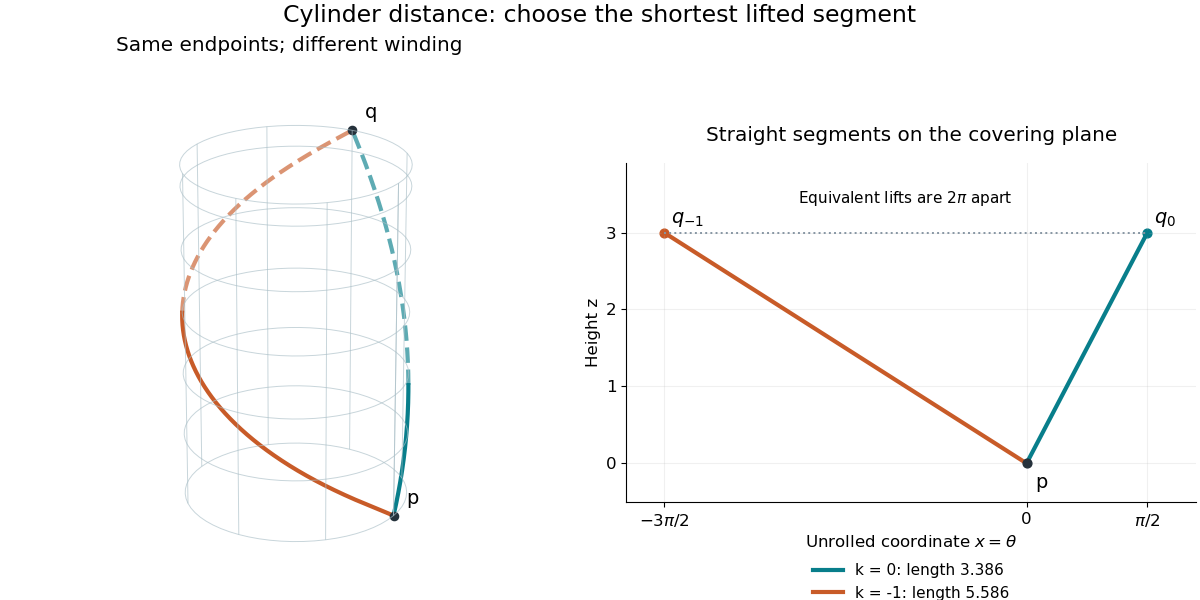
This is a global consequence of intrinsic flatness of a circular cylinder: locally everything is Euclidean, yet the periodic angular coordinate leaves several competing routes. A shortest-route problem on the curved surface becomes a family of ordinary planar distance calculations.
The pole-subtracted theta integral for the completed zeta function bounds the Riemann xi function on by a polynomial in times . The Stirling formula gives logarithmic growth . On the positive real axis, the definition and give . Thus its order of an entire function is exactly one.
// Target: analytic-number-theory.bigb
List positive ordinates of Nontrivial zeros of the Riemann zeta function in nondecreasing order, including multiplicity. The Riemann–von Mangoldt formula gives . For each fixed , evaluate this at to bracket the th ordinate. Letting decrease to zero proves the displayed asymptotic without assuming simple zeros or distinct ordinates.
List positive ordinates of Nontrivial zeros of the Riemann zeta function in nondecreasing order, including multiplicity. If all sufficiently late gaps were at most , summing would give , since with the sum starting at two. The Riemann–von Mangoldt formula would then give , a contradiction when . The same argument applies when only distinct ordinates are listed, because still holds.
A contact discontinuity in one-dimensional gas dynamics moves with the common fluid velocity and has continuous pressure, while mass density and specific entropy can jump. The mass jump condition is automatic with common ; momentum conservation then requires . The energy jump condition is also satisfied. Thus a contact is a material interface, not a compression shock. A smooth self-similar positive-density flow cannot spread this zero-speed-relative-to-the-fluid family into a fan: on an interval would require both and, from continuity, .
Two positive uniform ideal-gas states can be joined by one nontrivial rarefaction wave precisely when their specific entropy agrees, , and for one they satisfy with . These equations are the constant-entropy and Riemann invariant conditions of the self-similar ideal-gas rarefaction. They are sufficient because its affine profiles match the two states at and , and . The left family has , while the right family has . The inequality alone does not impose the two matching equalities.
For a univalent function with , suppose is omitted. Apply the disk automorphism so the resulting image omits zero, take a holomorphic square root, then apply the disk automorphism taking the value at to zero. If is a simply connected domain, the root exists. The resulting normalized univalent map has derivative magnitude multiplied by , since . Thus a map maximizing the derivative cannot omit an interior disk point.
A rational jump with no zeros or poles on the contour can be split into factors analytic and nonvanishing on the two sides. The exterior factor may carry a power of recording the winding number. For a circle enclosing , the jump has the canonical factors , . The exterior growth of imposes compatibility conditions when a Cauchy transform is required to vanish at infinity.
Pinned article: Introduction to the OurBigBook Project
Welcome to the OurBigBook Project! Our goal is to create the perfect publishing platform for STEM subjects, and get university-level students to write the best free STEM tutorials ever.
Everyone is welcome to create an account and play with the site: ourbigbook.com/go/register. We belive that students themselves can write amazing tutorials, but teachers are welcome too. You can write about anything you want, it doesn't have to be STEM or even educational. Silly test content is very welcome and you won't be penalized in any way. Just keep it legal!
Intro to OurBigBook
. Source. We have two killer features:
- topics: topics group articles by different users with the same title, e.g. here is the topic for the "Fundamental Theorem of Calculus" ourbigbook.com/go/topic/fundamental-theorem-of-calculusArticles of different users are sorted by upvote within each article page. This feature is a bit like:
- a Wikipedia where each user can have their own version of each article
- a Q&A website like Stack Overflow, where multiple people can give their views on a given topic, and the best ones are sorted by upvote. Except you don't need to wait for someone to ask first, and any topic goes, no matter how narrow or broad
This feature makes it possible for readers to find better explanations of any topic created by other writers. And it allows writers to create an explanation in a place that readers might actually find it.
Figure 1. Screenshot of the "Derivative" topic page. View it live at: ourbigbook.com/go/topic/derivativeVideo 2. OurBigBook Web topics demo. Source. - local editing: you can store all your personal knowledge base content locally in a plaintext markup format that can be edited locally and published either:This way you can be sure that even if OurBigBook.com were to go down one day (which we have no plans to do as it is quite cheap to host!), your content will still be perfectly readable as a static site.
- to OurBigBook.com to get awesome multi-user features like topics and likes
- as HTML files to a static website, which you can host yourself for free on many external providers like GitHub Pages, and remain in full control

Figure 2. You can publish local OurBigBook lightweight markup files to either OurBigBook.com or as a static website.
Figure 3. Visual Studio Code extension installation.
Figure 5. . You can also edit articles on the Web editor without installing anything locally. Video 3. Edit locally and publish demo. Source. This shows editing OurBigBook Markup and publishing it using the Visual Studio Code extension. 
- Infinitely deep tables of contents:



All our software is open source and hosted at: github.com/ourbigbook/ourbigbook
Further documentation can be found at: docs.ourbigbook.com
Feel free to reach our to us for any help or suggestions: docs.ourbigbook.com/#contact