Topics (384k) Articles (398k) Users (410) Discussions (242) Comments (383) Files (13k) New article

The number of target chemical atoms per incident area along the beam. For a uniform foil at normal incidence, number density and thickness give , in . At oblique incidence the traversed path must replace . The single-encounter count model requires the chance of two significant deflections to be negligible and energy loss through the foil to be small. A small probability in one detector patch alone does not establish either condition.
The Peltier effect is heat transfer associated with an electric current crossing a junction between materials with different Peltier coefficients. At fixed junction temperature, its contribution changes sign when the conventional current reverses. A junction can absorb heat from its surroundings for one direction and release it for the other. Joule heating, proportional to the square of the electric current, accompanies this transport but does not reverse sign. Consequently, observing a warm device alone does not identify the Peltier effect.
This makes the Peltier effect useful as an electrically controlled heat pump: reversing the supply can switch an object's thermal role without changing any plumbing. In thermoelectric cooling, however, the useful cooling is the junction's absorbed heat minus returning heat conduction and its share of Joule heating. Increasing electric current eventually makes cooling worse. The distinction between transported heat and net cooling is the central practical lesson of the thermoelectric cooler energy balance.
A thermoelectric module connects thermoelectric material pairs between thermal faces. Electrical series connections and thermal parallel connections combine their transport responses for thermoelectric cooling or electrical generation.
The Thomson effect is distributed reversible heating or cooling when an electric current flows through a homogeneous material with a temperature gradient. It is distinct from junction Peltier effect heating and even-in-current Joule heating.
A dilution refrigerator removes heat at very low temperatures by transferring helium-3 from a concentrated phase into a dilute phase rich in helium-4. The enthalpy per circulating helium-3 atom is higher in the dilute phase, so crossing the phase boundary absorbs energy from the mixing chamber of a dilution refrigerator. This is the useful cooling process.
Continuous operation requires a circulation loop. A dilution refrigerator still preferentially evaporates helium-3 from the returning mixture; pumps return it through a condensing and precooling path. Heat exchangers let the outgoing cold stream cool the incoming stream before it reaches the mixing region.[ref]
How Does a Dilution Refrigerator Work? by Bluefors. Phase Separation of Helium Isotopes and Operation of the Dilution Unit: enthalpy difference, mixing chamber, still and return heat exchangers
A heater attached to the cold stage can impose a known test load, allowing a measurement of cooling power versus temperature. Unwanted heat conduction through supports and wiring, and absorbed thermal radiation, enter that same load budget. The refrigerator therefore needs both the microscopic mixing mechanism and careful thermal coupling to the experiment.Maxwell's demon is a thought experiment in which a controller measures microscopic motion and selectively operates a barrier, apparently driving a system away from thermal equilibrium without the usual thermodynamic cost. For example, admitting fast gas particles preferentially to one side seems to create a temperature difference that a heat engine could exploit.
The controller must be included in the physical accounting. Its measurement record becomes correlated with the gas, and a repeatable cyclic device must deal with that record rather than treating information storage as an unlimited free resource. Landauer's principle connects logically irreversible memory erasure with a thermodynamic cost under its stated conditions. This does not mean that every measurement automatically dissipates exactly one bit's erasure cost. The point is to track the complete cycle, correlations and resources. A controller that reduces one subsystem's entropy can still respect the Second law of thermodynamics by increasing entropy elsewhere.
In his Nobel lecture, delivered on 12 December 1929 for the 1928 prize, Owen Willans Richardson recalled heating wires for weeks while hand-pumping away gas released by the apparatus. With platinum, he found a finite emission per unit area that rose rapidly with temperature. His initial 1901 formula used ; he preferred the form in 1911.[ref]
Thermionic Phenomena and the Laws which Govern Them by Owen Willans Richardson. Nobel Lectures, Physics 1922–1941; pp. 224–225 and 229, preparation and chronology
The early apparatus surrounded a heated platinum wire with a metal cylinder connected to earth through a galvanometer. Wire electrical resistance supplied the temperature readout. After checking collection saturation, Richardson measured at a wire potential of , over roughly –; reversing polarity suppressed the negative discharge.[ref]
O. W. Richardson and the Electron Theory of Matter, 1901–1916 by Ole Knudsen. Histories of the Electron: The Birth of Microphysics edited by Jed Z. Buchwald and Andrew Warwick; pp. 229–231, resistance thermometry and Fig. 7.2, reproducing the 1903 apparatus
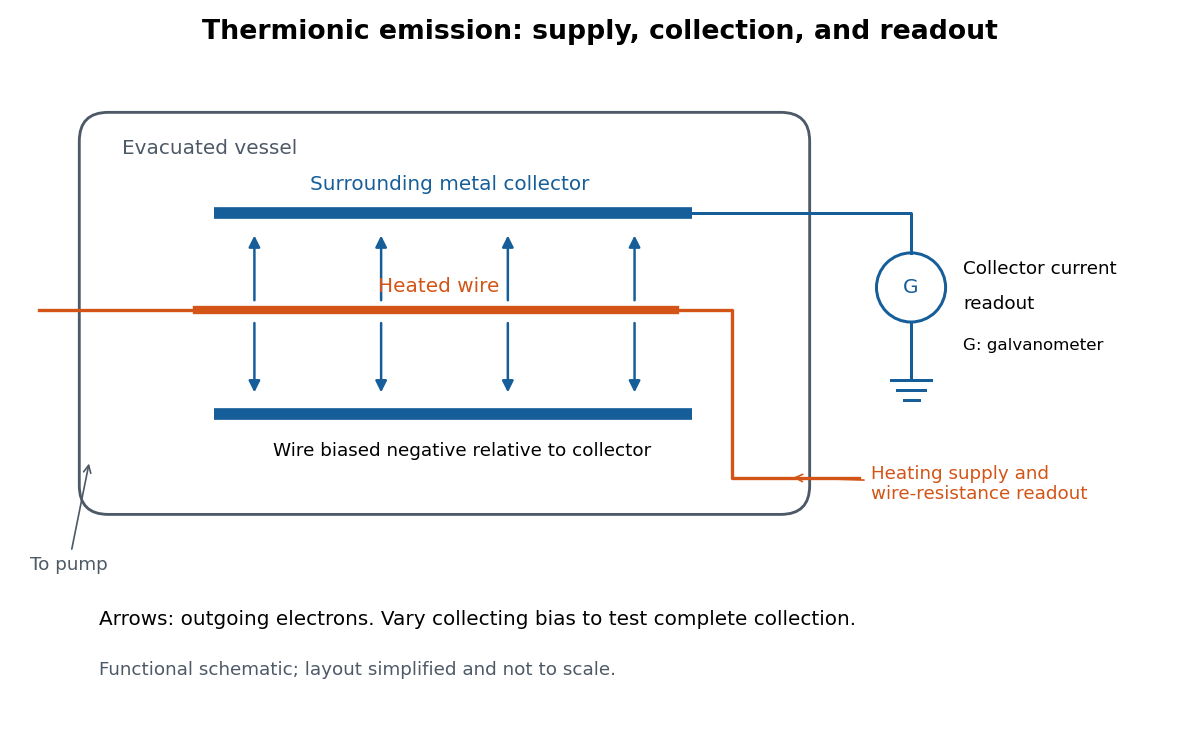
Heated-wire emission and separate collection and temperature measurements
. Original functional schematic of the measurement principle, with a wire and surrounding collector shown in section. The layout is simplified; no dimensions or instrument performance are asserted. Details.The inference rests on several controls. A temperature sweep probes thermal escape; reversing the collecting electric field tests the sign of the mobile electric charge; varying collection voltage tests whether transport is limiting. Prolonged pumping and heating test whether a transient gas release is responsible. These controls address different alternatives, and none by itself establishes a clean, uniform surface.
For a modern repetition, stabilize each temperature, measure the collector electric current against collecting electric potential difference, and record the pressure and surface preparation. Repeat selected temperatures after cooling to reveal drift. Use the collection plateau and the actual emitting area to construct a Richardson plot. The resulting slope estimates the work function only within the stated surface and transport assumptions; it does not turn an uncontrolled wire into a reference material.
A space-charge-limited thermionic current occurs when the negative space charge of emitted electrons creates an electric field that obstructs further transport across the gap. Raising the emitter temperature may then increase the surface supply without producing the corresponding collector electric current. The gap geometry and collecting electric potential difference matter even when the surface is stable.
To distinguish this from an emission-limited thermionic current, vary the collecting electric potential difference at fixed emitter temperature, then repeat at another temperature. A voltage-dependent transport region followed by a collection plateau separates a gap constraint from a supply constraint. A weak collector electric current alone cannot establish a high work function. Nor does simply choosing a very large collecting electric potential difference guarantee a valid zero-field measurement: the surface barrier may then change.
An emission-limited thermionic current is set by the rate at which the heated surface supplies electrons, with nearly complete collection. At fixed temperature, increasing the attracting electric potential difference then produces an approximate collection plateau. That plateau is the useful regime for fitting the Richardson-Dushman law, provided the electric field has not significantly lowered the surface barrier.
The emitting surface still matters in this regime. Adsorption changes the work function; different crystal faces can have different barriers. Heating may desorb contaminants or change a coating, so repeated measurements at the same temperature need not agree unless the surface preparation is controlled. For fixed , a barrier change multiplies by . In the chosen model at , raising the barrier by reduces to about 0.313 of its previous value.
The Richardson-Dushman law models the magnitude of emitted electric current density asHere is absolute thermodynamic temperature, is the work function, is the Boltzmann constant, and is the Thermionic Richardson constant. The signed electric current density points opposite to the outgoing electron motion; here is positive. For uniform emission over area , the emitted electric current magnitude is .
The Richardson-Dushman law assumes an emitter close to thermal equilibrium, a surface with a well-defined and approximately constant work function over the fitted temperature range, and predominantly thermal escape over the barrier. Interpreting a measured collector electric current with this law additionally requires an emission-limited thermionic current, known emitting area, and negligible return emission from the collector. Strong electric fields can lower the surface barrier or enable quantum tunnelling; then this zero-field expression is insufficient.
For a deliberately chosen teaching model, take and , expressing the barrier in electronvolts. These are illustrative parameters, not measured properties of a named material. Using , at the Boltzmann factor is about , yetA 20 percent increase in temperature raises the predicted electric current density by about 69 times. For a chosen emitting area , these correspond to approximately and if collection is complete. The small escaping fraction is replenished by the external electrical circuit.
The sensitivity is especially clear from the logarithmic derivative at fixed :In the chosen model at , a rise changes by about 2.5 percent to first order. Accurate temperature measurement matters even when electric current measurement is easy.
For fixed particle number and temperature, a bubble with surface tension and area has effective availability . Its stationary condition is . Its curvature is . Positive curvature is required for stable Gaussian fluctuation approximation. The variance follows from availability curvature and equilibrium fluctuations. For an ideal gas, the restoring denominator becomes for positive . Treating the internal pressure as externally fixed instead of fixing the gas particle number changes the stability problem.
For gapped excitations with and approximately constant prefactor, two heat capacity measurements at give the displayed activation-energy estimate. A more general prefactor changes its numerator to . The two-point estimate measures an effective exponential scale; it does not independently determine the prefactor or establish a detailed excitation density of states.
Pinned article: Introduction to the OurBigBook Project
Welcome to the OurBigBook Project! Our goal is to create the perfect publishing platform for STEM subjects, and get university-level students to write the best free STEM tutorials ever.
Everyone is welcome to create an account and play with the site: ourbigbook.com/go/register. We belive that students themselves can write amazing tutorials, but teachers are welcome too. You can write about anything you want, it doesn't have to be STEM or even educational. Silly test content is very welcome and you won't be penalized in any way. Just keep it legal!
Intro to OurBigBook
. Source. We have two killer features:
- topics: topics group articles by different users with the same title, e.g. here is the topic for the "Fundamental Theorem of Calculus" ourbigbook.com/go/topic/fundamental-theorem-of-calculusArticles of different users are sorted by upvote within each article page. This feature is a bit like:
- a Wikipedia where each user can have their own version of each article
- a Q&A website like Stack Overflow, where multiple people can give their views on a given topic, and the best ones are sorted by upvote. Except you don't need to wait for someone to ask first, and any topic goes, no matter how narrow or broad
This feature makes it possible for readers to find better explanations of any topic created by other writers. And it allows writers to create an explanation in a place that readers might actually find it.
Figure 1. Screenshot of the "Derivative" topic page. View it live at: ourbigbook.com/go/topic/derivativeVideo 2. OurBigBook Web topics demo. Source. - local editing: you can store all your personal knowledge base content locally in a plaintext markup format that can be edited locally and published either:This way you can be sure that even if OurBigBook.com were to go down one day (which we have no plans to do as it is quite cheap to host!), your content will still be perfectly readable as a static site.
- to OurBigBook.com to get awesome multi-user features like topics and likes
- as HTML files to a static website, which you can host yourself for free on many external providers like GitHub Pages, and remain in full control

Figure 2. You can publish local OurBigBook lightweight markup files to either OurBigBook.com or as a static website.
Figure 3. Visual Studio Code extension installation.
Figure 5. . You can also edit articles on the Web editor without installing anything locally. Video 3. Edit locally and publish demo. Source. This shows editing OurBigBook Markup and publishing it using the Visual Studio Code extension. 
- Infinitely deep tables of contents:



All our software is open source and hosted at: github.com/ourbigbook/ourbigbook
Further documentation can be found at: docs.ourbigbook.com
Feel free to reach our to us for any help or suggestions: docs.ourbigbook.com/#contact