Topics (384k) Articles (398k) Users (410) Discussions (242) Comments (383) Files (13k) New article

An interferometer compares round-trip light travel times along perpendicular arms as its orientation changes. The absence of the classical stationary-aether fringe shift at the expected scale constrains orientation dependence of the round-trip speed of light. The result is consistent with special relativity, but alone does not select it uniquely from every alternative theory.[ref]
On the Relative Motion of the Earth and the Luminiferous Ether by Albert Abraham Michelson and Edward W. Morley. 1887 report, interferometer arrangement and comparison of predicted and observed orientation-dependent shifts

The 1887 Michelson-Morley experiment apparatus
. Historical photograph credited by Wikimedia Commons to Case Western Reserve University; public domain in the United States. The stone support floated in a trough of mercury so that the interferometer could turn. Source.The instrument's stone support and floating mounting allowed the experimenters to change its orientation while limiting mechanical disturbance. The measured quantity was the fringe shift produced as the apparatus rotated, rather than a direct timing of a single light pulse.[ref]
On the Relative Motion of the Earth and the Luminiferous Ether by Albert Abraham Michelson and Edward W. Morley. 1887 report, apparatus description and observation procedure

A spin-boson model couples a two-state quantum system to a collection of quantum harmonic oscillators. The oscillator modes provide environmental degrees of freedom that can exchange energy with the spin and change its reduced density matrix. One transverse-coupling convention isThe choice of coupling axis matters: here the Pauli matrix flips the energy-basis spin states. Coupling only through has a different effect, since it commutes with the free spin Hamiltonian operator.
The Brookhaven proton synchrotron used for the Lederman-Schwartz-Steinberger two-neutrino beam experiment.
A monodisperse particle suspension has a narrow distribution of particle sizes. Treating its particles as having a single radius simplifies the Perrin sedimentation experiment model; residual size variation can still affect the inferred Avogadro constant.
Sedimentation is separation of suspended particles through a body-force-driven relative motion. In the Perrin sedimentation experiment, diffusion balances gravitational settling to produce a stationary height profile.
Motion of a liquid through a narrow space due to surface tension and contact with the walls; it draws the chromatographic mobile phase through a thin-layer chromatography coating.
For a film described by , with material content fixed, its Helmholtz free energy obeys . Equality of mixed partial derivatives gives the Maxwell relation . If depends only on temperature, write ; thenHere is the heat capacity at constant area. For and , reversible adiabatic stretching cools the film, since , although positive mechanical input can increase its total internal energy. If with constant positive and constant , the isentropic process satisfies , where is an arbitrary fixed reference temperature. The work convention uses the total area conjugate to ; a two-surface film described by projected area requires the corresponding factor of two consistently throughout.
For a vacuum-material interface at , write the magnetic phasor as , with in vacuum and in the material. The Ampere-Maxwell law gives and . Tangential field continuity gives . Together with , this gives the displayed relation and requires for real propagating and decay on both sides. For , the branch has and approaches that upper frequency only as . At low frequency, .
Helium-3 superfluidity involves Cooper pairs of fermions; helium-4 atoms are bosons. Individual helium-3 atoms do not undergo Bose-Einstein condensation. [ref]
The Extraordinary Phases of Liquid 3He by David Morris Lee. Lee, 1996 lecture; 1997 reprint pp.645–647
The helium-3 superfluid discovery experiment connects an unexpected pressure feature to a change in the state of a liquid. Its lesson is unusually instructive: finding a reproducible anomaly and identifying the material that changed are separate experimental achievements. Pomeranchuk cooling explains how the experiment reached its operating regime; an independent nuclear magnetic resonance channel distinguishes the phases.
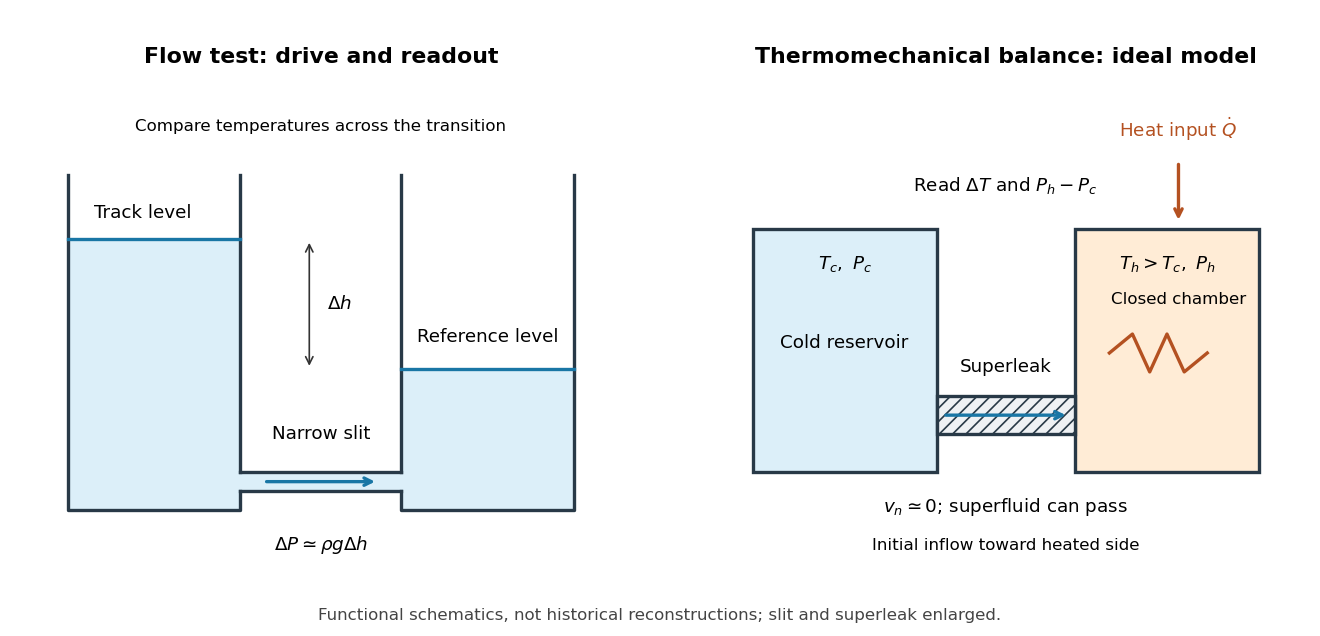
Pyotr Leonidovich Kapitza's 1938 test compared helium flow through optically flat glass disks. Suspension set the tube-to-bath level difference; a cathetometer read levels. The gap was estimated as . Levels barely moved over minutes above the transition, but equalized in seconds below. A laminar flow viscosity calculation gave only an upper bound.[ref]
Viscosity of Liquid Helium below the λ-Point by Pyotr Leonidovich Kapitza. Kapitza, 1938 viscosity paper, reprint chapter 34, pp.506–507
The essential control is to compare the same restriction and level readout at different temperatures. A changed pressure head is not itself evidence for a changed material response: the driving head must be included when interpreting the flow. For an idealized comparison at equal vapor pressure, negligible surface tension corrections and nearly constant mass density , hydrostatic equilibrium givesHere is the difference in free-surface heights and is gravitational acceleration. This explains why following a liquid level provides both a driving pressure and a transported volume; it does not turn a finite-resolution observation into proof of zero viscosity.
The particle-number density associated with the superfluid response. In two dimensions it is a number per unit area and gives the phase stiffness for particles of mass . It differs from total density and need not equal condensate density.
The lambda point is the temperature of the transition between ordinary liquid helium-4 and its superfluid phase, named after the sharp lambda-shaped heat capacity feature. At saturated vapor pressure it lies near . Its value varies with pressure.
High-temperature superconductivity is a historical name for superconductivity above earlier metallic benchmarks. The original Bednorz-Müller experiment operated at tens of kelvins, requiring deep cooling; cuprate superconductors opened a new materials family.[ref]
Perovskite-type oxides: The new approach to high-Tc superconductivity by Johannes Georg Bednorz and Karl Alexander Müller. Part 1, p.426, historical comparison
A higher superconducting transition temperature enlarges the available operating range, but useful transport also needs a sufficient superconducting critical current at the operating temperature and magnetic field. In a ceramic, connections between grains can limit the whole specimen even when individual grains support superconductivity. This connects the materials problem to superconducting weak links and the Josephson effect. The parallel-path model of a superconducting ceramic below isolates why connectivity matters.
A superconductor is a material in a state of superconductivity, characterized by dissipationless steady bulk charge transport in the appropriate regime and the equilibrium magnetic screening of the Meissner effect. The state exists only within limits on temperature, magnetic field and electric current.
A zero measured electrical resistance is an important transport signature, but magnetic measurements distinguish superconductivity from the idealized perfect conductor. Type-I superconductors and type-II superconductors differ in their equilibrium response to increasing magnetic field; a type-II material can remain superconducting while containing Abrikosov vortices. Superconducting magnets exploit persistent electric currents, while superconducting circuits exploit the Josephson effect. A material's useful operating range also depends on processing, geometry and flux pinning, not solely on its transition temperature.
Single-electron superconducting tunneling transfers individual electrons across a barrier into or out of quasiparticle states of a material with superconductivity. In a normal-metal–insulator–superconductor junction, abbreviated NIS, only one electrode has superconductivity. Such a junction can reveal a superconducting energy gap without supporting a DC Josephson effect between two superconducting reservoirs.
For an elementary interpretation, assume an opaque barrier, approximately constant normal-electrode density of states, and an energy-independent tunneling matrix element over the range probed. Write the superconducting density of states divided by its normal-state value as , with measured from its chemical potential. A signed voltage convention chosen for positive normal-electrode injection giveswhere is the Fermi-Dirac distribution at a common temperature and is the normal-state junction electrical resistance. This current convention is local to the NIS measurement. The expression counts occupied initial and empty final states; it is a quasiparticle transport model, not a current-phase relation of a superconducting weak link.
An original analytic illustration uses the ideal fully gapped BCS theory spectrum at zero temperature, with positive gap edge :For positive , the occupation difference restricts the integral to . Since , integration and odd extension giveThe threshold is for this NIS model. In the corresponding zero-temperature single-electron process between two fully gapped superconductors, creating excitations on both sides instead requires . That quasiparticle threshold does not forbid coherent pair electric current below it. At finite temperature, thermally populated quasiparticles soften the simple threshold argument.
At zero temperature in the NIS approximation, away from the singular gap edge. Thus a voltage sweep probes the excitation density of states. The ideal divergence is rounded in real measurements, and at nonzero temperature the derivative samples a thermally broadened range of energies. For , the model has : electrical work creates excitations and is dissipated on relaxation. This distinguishes its steady transport from the conservative Josephson coupling energy.
A Josephson junction couples two regions with superconductivity through a weak link. A tunnel barrier is one implementation.
The remarkable possibility is a steady electric current across an insulating barrier at zero electric potential difference. This is the DC Josephson effect, carried by coherent transfer of Cooper pairs. It differs from single-electron superconducting tunneling, which probes the quasiparticle excitation spectrum and produces a dissipative current-voltage characteristic. Both contributions can occur in the same superconducting tunnel device. Brian D. Josephson predicted the pair contribution in 1962; his paper treats transfer that leaves the quasiparticle distribution unchanged. [ref]
Possible new effects in superconductive tunnelling by Brian D. Josephson. Josephson (1962), pp. 251–252, opening paragraph and equation (3)
The Josephson effect turns a difference of quantum phases into a measurable electric current, and an applied electric potential difference into a rate of phase advance. The Giaever gap experiment instead turns an electric potential difference into an excitation energy scale. These complementary measurements expose two aspects of superconductivity: its coherent order parameter and its gapped quasiparticle spectrum. The microscopic pairing calculation belongs to BCS theory and the BCS gap equation. A tunnel diode uses a different device, a semiconductor p-n junction.
Adding capacitance and an external bias makes the Gauge-invariant Josephson phase dynamical. Current-biased Josephson phase dynamics explains how its trapped energy levels and escape can be measured electrically.
Vitaly Lazarevich Ginzburg and Lev Landau applied an order parameter description to superconductivity in 1950. A spatially varying complex amplitude extends the fixed-amplitude description of the London equations. Their initial charge assumption preceded the later identification of the universal pair charge.[ref]
Consider the following isotropic, local SI Helmholtz free energy model near a continuous superconducting transition temperature:Here , is a phenomenological mass parameter, and fixes the electron-pair convention. The uniform superconducting minimum for has . The gradient term penalizes changes of the amplitude and the gauge-invariant quantum phase; the magnetic term penalizes magnetic field penetration. The gauge-coupling sign in Ginzburg-Landau superconductivity keeps the electric current and field equation consistent. This model omits material anisotropy, microscopic nonlocality and critical fluctuations.
A superconducting critical current is the limiting electric current, for a specified sample, temperature, external magnetic field and measurement criterion, beyond which the chosen state of superconductivity no longer sustains dissipation-free transport. A weak connection can limit a loop before the rest of its material does. A magnetic field generated by the electric current itself also contributes to the sample's conditions. A limit on the initial superconducting persistent current and a bound on its subsequent electrical resistance answer different experimental questions.
Pinned article: Introduction to the OurBigBook Project
Welcome to the OurBigBook Project! Our goal is to create the perfect publishing platform for STEM subjects, and get university-level students to write the best free STEM tutorials ever.
Everyone is welcome to create an account and play with the site: ourbigbook.com/go/register. We belive that students themselves can write amazing tutorials, but teachers are welcome too. You can write about anything you want, it doesn't have to be STEM or even educational. Silly test content is very welcome and you won't be penalized in any way. Just keep it legal!
Intro to OurBigBook
. Source. We have two killer features:
- topics: topics group articles by different users with the same title, e.g. here is the topic for the "Fundamental Theorem of Calculus" ourbigbook.com/go/topic/fundamental-theorem-of-calculusArticles of different users are sorted by upvote within each article page. This feature is a bit like:
- a Wikipedia where each user can have their own version of each article
- a Q&A website like Stack Overflow, where multiple people can give their views on a given topic, and the best ones are sorted by upvote. Except you don't need to wait for someone to ask first, and any topic goes, no matter how narrow or broad
This feature makes it possible for readers to find better explanations of any topic created by other writers. And it allows writers to create an explanation in a place that readers might actually find it.
Figure 1. Screenshot of the "Derivative" topic page. View it live at: ourbigbook.com/go/topic/derivativeVideo 2. OurBigBook Web topics demo. Source. - local editing: you can store all your personal knowledge base content locally in a plaintext markup format that can be edited locally and published either:This way you can be sure that even if OurBigBook.com were to go down one day (which we have no plans to do as it is quite cheap to host!), your content will still be perfectly readable as a static site.
- to OurBigBook.com to get awesome multi-user features like topics and likes
- as HTML files to a static website, which you can host yourself for free on many external providers like GitHub Pages, and remain in full control

Figure 2. You can publish local OurBigBook lightweight markup files to either OurBigBook.com or as a static website.
Figure 3. Visual Studio Code extension installation.
Figure 5. . You can also edit articles on the Web editor without installing anything locally. Video 3. Edit locally and publish demo. Source. This shows editing OurBigBook Markup and publishing it using the Visual Studio Code extension. 
- Infinitely deep tables of contents:




All our software is open source and hosted at: github.com/ourbigbook/ourbigbook
Further documentation can be found at: docs.ourbigbook.com
Feel free to reach our to us for any help or suggestions: docs.ourbigbook.com/#contact