Topics (384k) Articles (398k) Users (410) Discussions (242) Comments (383) Files (13k) New article

The persistent current in a superconducting loop experiment prepares a closed cold path, changes the externally linked magnetic flux, and follows the resulting superconducting persistent current through its magnetic field. The essential measurement starts after the inducing magnetic field has stopped changing.
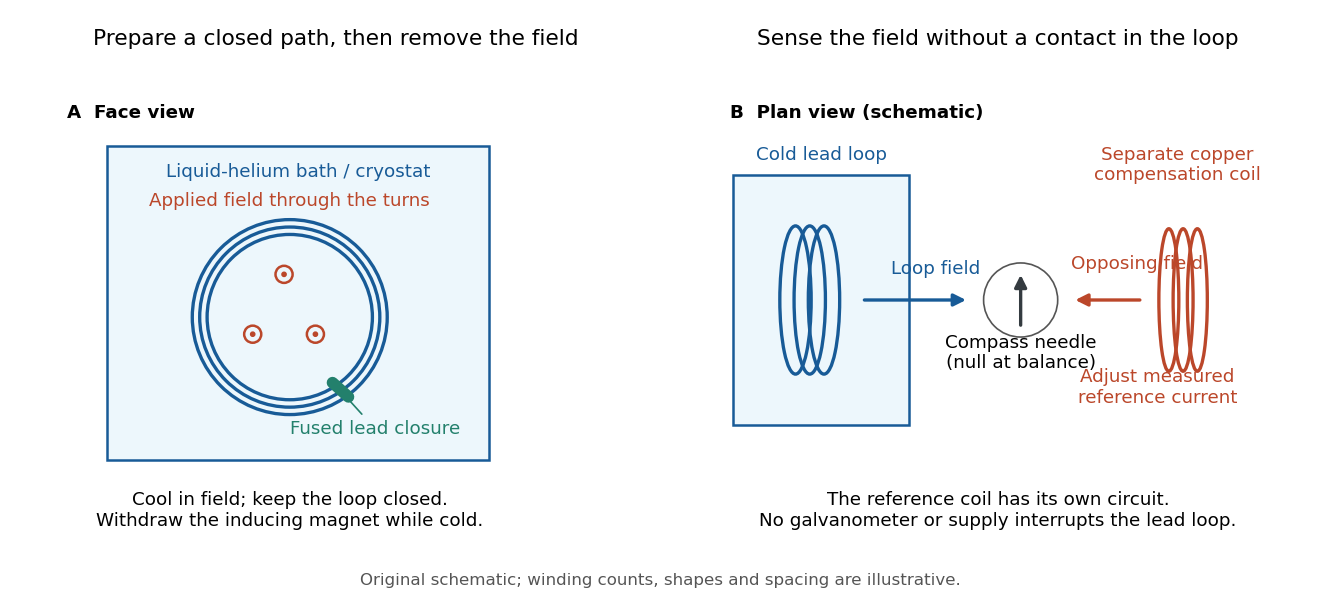
Heike Kamerlingh Onnes's 1914 Communication 140c describes a lead coil closed by fused lead connections. Cooling in a magnetic field and removing the inducing magnet prepared the circulation. A magnetic compass sensed it without contacts; a separate copper coil, cooled in liquid air, supplied a measured balancing magnetic field. Reversing orientation and compensation reduced offsets. [ref]
Further Experiments with Liquid Helium, J (Continued) by Heike Kamerlingh Onnes. Communication 140c (1914), §5, pp. 278–280; §7, pp. 280–281
The liquid-helium cryostat maintained low temperature, but refilling temporarily warmed the apparatus and changed the inferred electric current. A later run used a smaller initial electric current. Apparatus deformation and needle-zero drift limited comparison; cutting the closure still left a smaller magnetic signal, warning against assigning every signal to circulation around the whole loop. The report consequently gave an upper bound under a residual Ohm's law hypothesis. [ref]
Further Experiments with Liquid Helium, J (Continued) by Heike Kamerlingh Onnes. Communication 140c, §5, pp. 279–280; §6, p. 280; §8, pp. 281–283
For interpreting such a measurement, write a locally calibrated magnetic signal asHere is the coupling and gain, while contains the background magnetic field and readout offset. Only after establishing stable and correcting does a ratio of signals determine a ratio of electric currents. A gradual change in geometry, a drifting background magnetic field, or a change of temperature can imitate or conceal a decay. A pickup coil connected only to a voltage meter obeys Faraday's law of induction and detects a changing linked magnetic flux; its zero steady output cannot demonstrate that the underlying static magnetic field has disappeared. A magnetic compass can respond to that static magnetic field.
Opening the path, reversing the preparation, and repeating with smaller initial electric current are useful controls for separating whole-loop circulation, magnetic background and a superconducting critical current. Keep the temperature and external magnetic field stable during the interval used to infer electrical resistance. A sudden reduction near a superconducting critical current is not evidence for the constant- exponential decay model at smaller electric current. Persistence also does not replace the Field-cooled Meissner experiment: transport around a hole and magnetic expulsion from the material test different properties.
A superconducting persistent current is an electric current circulating in a closed path with superconductivity after the external driving electromotive force has ceased. Its associated magnetic field makes the circulation observable without inserting a measuring instrument into the path. This article concerns macroscopic circulation in superconductivity. A finite experiment establishes persistence over its observation window with a stated measurement error, rather than directly observing an infinite lifetime.
The ideal circuit connection is flux conservation in a superconducting loop. In a fixed loop with self-inductance , a single circulating electric current , and externally imposed linked magnetic flux , the lumped circuit approximation givesWhen the electrical resistance vanishes, integrating gives . Removing the external linked magnetic flux therefore changes the circulating electric current; holding it fixed afterwards preserves that electric current. This is a circuit approximation with a specified self-inductance, not a derivation of the microscopic state of superconductivity. For thin paths where the carrier contribution matters, fluxoid and flux quantization in a superconductor supplies the more careful description.
For constant , constant effective electrical resistance , and no changing external linked magnetic flux, the RL circuit instead predictsThis exponential decay follows by separating . A long relaxation time tests extremely small electrical resistance without trying to resolve an equally tiny steady electric potential difference. The stored magnetic energy is , so the same model gives , exactly the Joule heating loss. The finite energy stored in the loop supplies the magnetic readout; the circulating electric current is not a continuously powered source of useful work.
A superconducting device uses superconducting behavior to perform a function such as generating a strong magnetic field, detecting flux, switching or manipulating quantum states. Examples include superconducting magnets, SQUIDs and Josephson junction circuits.
Its performance depends on the full operating environment: temperature, magnetic field, applied current, losses and thermal coupling. A superconducting component does not make every part of a device lossless. Junction interfaces, quasiparticles and vortices can produce measurable dissipation or noise even when the intended circuit element has a superconducting state.
A proposed bench test can isolate the mechanism without a gas burner. Illuminate a blackened and a polished sample of matched material and geometry, record both temperatures and their relative displacement, then block the beam. Measure incident irradiance separately. Swap the surface treatments, hold the ambient temperature fixed for the illumination test, and change it with the beam blocked for a common-heating control. This is a model-based experiment proposal, not a report of measurements.
A larger response of the dark sample would support a difference in absorbed power; the displacement and cooling curves test the assumed linear thermal expansion coefficient and time constant. A stable illumination step that never reaches the switching gap challenges the chosen parameter model rather than the existence of thermal expansion. Nonuniform sample temperature, unequal losses and mechanical friction can separate the physical device from the ideal equations.
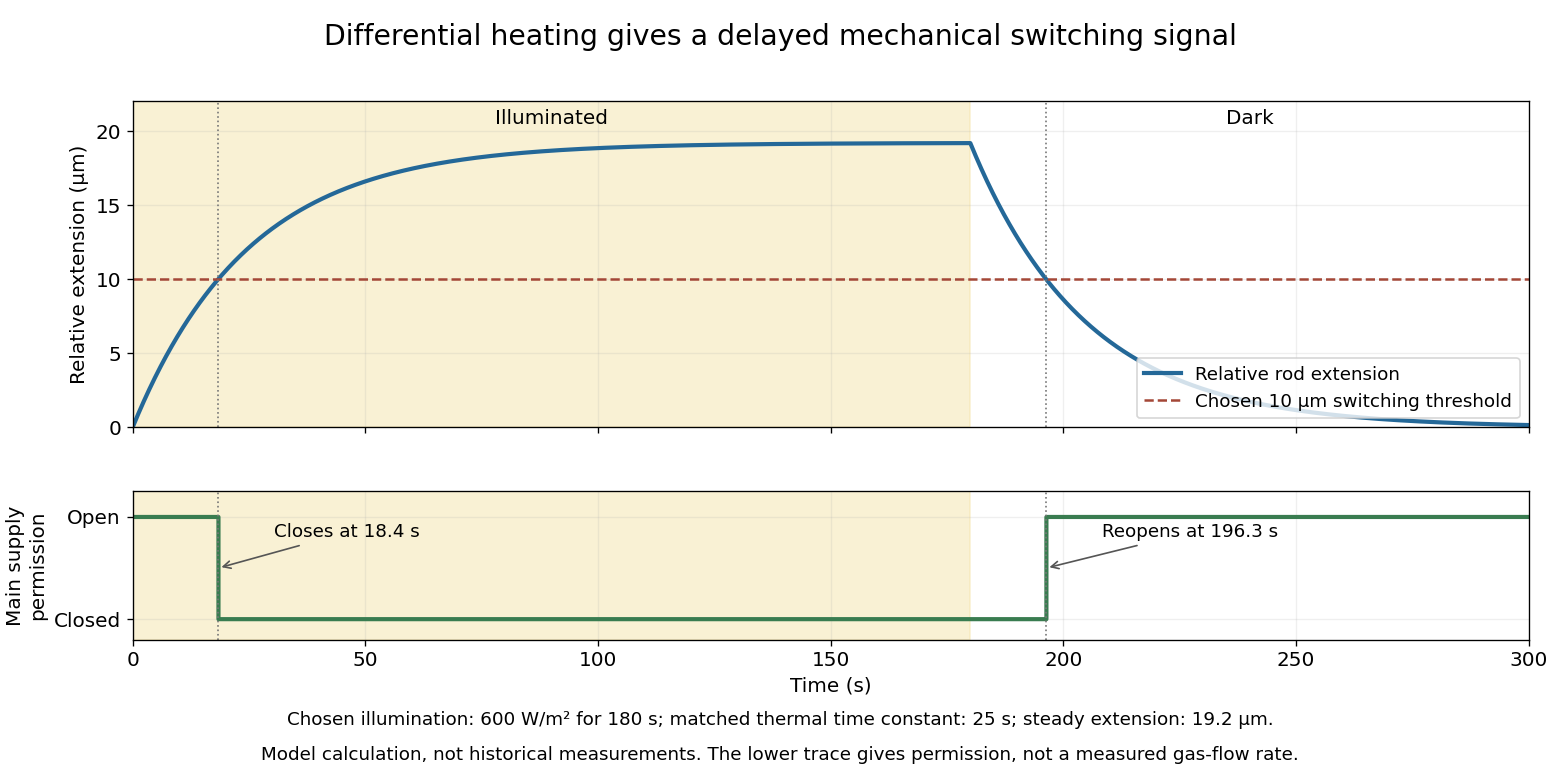
Take a stipulated pair of effective rods with common length , linear thermal expansion coefficient , heat capacity , projected illuminated area , and thermal conductance to an environment at constant temperature . One reference represents the symmetric polished-rod assembly. Write and . Let their effective radiometric absorptances be for a fixed incident optical spectrum, and let be the common irradiance. A spatially uniform, linear heat-balance model givesHere includes a linear approximation to the relevant losses; changing the surface treatment can also change those losses in a real device. We stipulate equal and to isolate the response to absorbed illumination, with thermal coupling from the burner neglected. Small, mechanically unconstrained extensions then give a differential displacementThe time constant describes thermal memory. A common imposed temperature shift cancels from the extension difference under the matched-coefficient assumptions; mismatched materials, geometry or thermal coupling can spoil that cancellation.
For a step from darkness to constant irradiance , with initially equal rod temperatures, the first-order linear differential equation givesChoose , , , , , , and . The calculated difference of absorbed powers is , givingFor an illustrative ideal valve that closes at , the closing time isThis threshold is crossed only when . These are chosen model parameters, not a fit to a historical valve.
Fructose is a six-carbon ketose monosaccharide with the same molecular formula as glucose, but different connectivity in the open-chain form. In aqueous chemical solution, fructose occurs mainly in cyclic forms.
Fructose supplies one of the two sugar units in sucrose and is the repeating building block of many fructans. These examples distinguish a free monosaccharide from its residues inside larger carbohydrates.[ref]
25.1 Classification of Carbohydrates. Classification of monosaccharides
In the sudden approximation, changing the nuclear charge of a one-electron hydrogen atom from to leaves its electronic state unchanged during the change. Its subsequent probability to occupy a final state is the squared overlap with that state. Using normalized wavefunctions , , givesThis follows by integrating over positive . A spherically symmetric initial state has zero overlap with every final state of nonzero orbital angular momentum, by the orthogonality of the spherical harmonics. Nuclear recoil and interactions with emitted particles can invalidate the perfectly spherical sudden-change model.
In an original constructed example, seed biological cells in of cell culture medium. Suppose the recoverable count becomes before the next subculture. Transfer a well-mixed quarter of that harvest into a new vessel and bring its final volume to . Assume complete recovery, no loss during transfer and no division during handling. The selected portion containsThe other biological cells remain outside the tracked vessel. The lower count after transfer is selection of a portion, not evidence of death. Adding fresh cell culture medium lowers the number density further without changing the selected count.
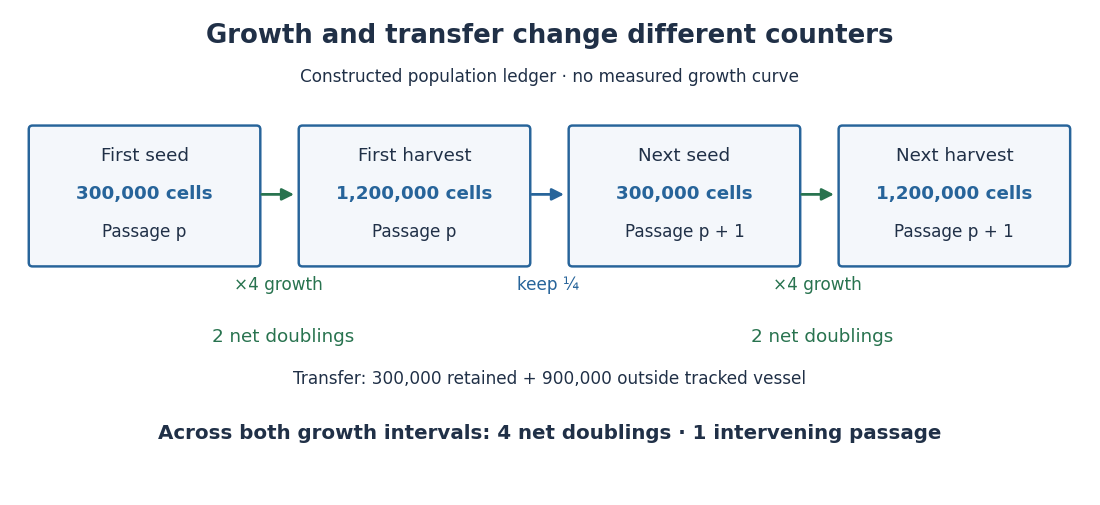
One subculture transfer can follow two cell line population doublings
. Original constructed count ledger, not an observed HeLa growth curve. Each growth interval multiplies the recoverable count by four; each transfer retains one quarter. The tracked lineage gains four net cell line population doublings across two intervals although both seed counts are . Boxes describe whole cultured populations, not persistent individual biological cells. Details.If the next interval again changes to , the two growth intervals contribute net cell line population doublings. At the second harvest there has been just one intervening passage. Another quarter-transfer would add another passage without adding a growth interval. Thus neither passage number nor the logarithm of the final count divided by the very first seed count records all growth when portions are removed.
Neutrino astronomy infers properties of astronomical sources from detected neutrino reactions. Solar neutrino detection probes ongoing stellar nuclear fusion; the SN 1987A neutrino burst probes a brief episode of core-collapse supernova evolution. A detector observes reaction products, so source inference depends on cross sections, neutrino flavor, thresholds and detection efficiency.
Stellar activity is variable magnetic behaviour in a star's outer layers, including starspots, atmospheric heating and eruptive phenomena. Rotation carries regions of different brightness and line shape across the visible disc. Their changing contribution alters both the stellar light curve and the apparent Doppler shift, even when the star's centre of mass has no corresponding orbital motion.
This makes stellar activity both a subject of study and a source of stellar noise in exoplanet searches. A changing stellar spectral-line bisector tests whether a line is deforming rather than simply translating in wavelength. Simultaneous brightness measurements supply another diagnostic. Actual observing times matter because an activity-period alias in radial-velocity sampling can place an activity-related signal at a misleading period.
Pinned article: Introduction to the OurBigBook Project
Welcome to the OurBigBook Project! Our goal is to create the perfect publishing platform for STEM subjects, and get university-level students to write the best free STEM tutorials ever.
Everyone is welcome to create an account and play with the site: ourbigbook.com/go/register. We belive that students themselves can write amazing tutorials, but teachers are welcome too. You can write about anything you want, it doesn't have to be STEM or even educational. Silly test content is very welcome and you won't be penalized in any way. Just keep it legal!
Intro to OurBigBook
. Source. We have two killer features:
- topics: topics group articles by different users with the same title, e.g. here is the topic for the "Fundamental Theorem of Calculus" ourbigbook.com/go/topic/fundamental-theorem-of-calculusArticles of different users are sorted by upvote within each article page. This feature is a bit like:
- a Wikipedia where each user can have their own version of each article
- a Q&A website like Stack Overflow, where multiple people can give their views on a given topic, and the best ones are sorted by upvote. Except you don't need to wait for someone to ask first, and any topic goes, no matter how narrow or broad
This feature makes it possible for readers to find better explanations of any topic created by other writers. And it allows writers to create an explanation in a place that readers might actually find it.
Figure 1. Screenshot of the "Derivative" topic page. View it live at: ourbigbook.com/go/topic/derivativeVideo 2. OurBigBook Web topics demo. Source. - local editing: you can store all your personal knowledge base content locally in a plaintext markup format that can be edited locally and published either:This way you can be sure that even if OurBigBook.com were to go down one day (which we have no plans to do as it is quite cheap to host!), your content will still be perfectly readable as a static site.
- to OurBigBook.com to get awesome multi-user features like topics and likes
- as HTML files to a static website, which you can host yourself for free on many external providers like GitHub Pages, and remain in full control

Figure 2. You can publish local OurBigBook lightweight markup files to either OurBigBook.com or as a static website.
Figure 3. Visual Studio Code extension installation.
Figure 5. . You can also edit articles on the Web editor without installing anything locally. Video 3. Edit locally and publish demo. Source. This shows editing OurBigBook Markup and publishing it using the Visual Studio Code extension. 
- Infinitely deep tables of contents:




All our software is open source and hosted at: github.com/ourbigbook/ourbigbook
Further documentation can be found at: docs.ourbigbook.com
Feel free to reach our to us for any help or suggestions: docs.ourbigbook.com/#contact