Topics (384k) Articles (398k) Users (410) Discussions (242) Comments (383) Files (13k) New article

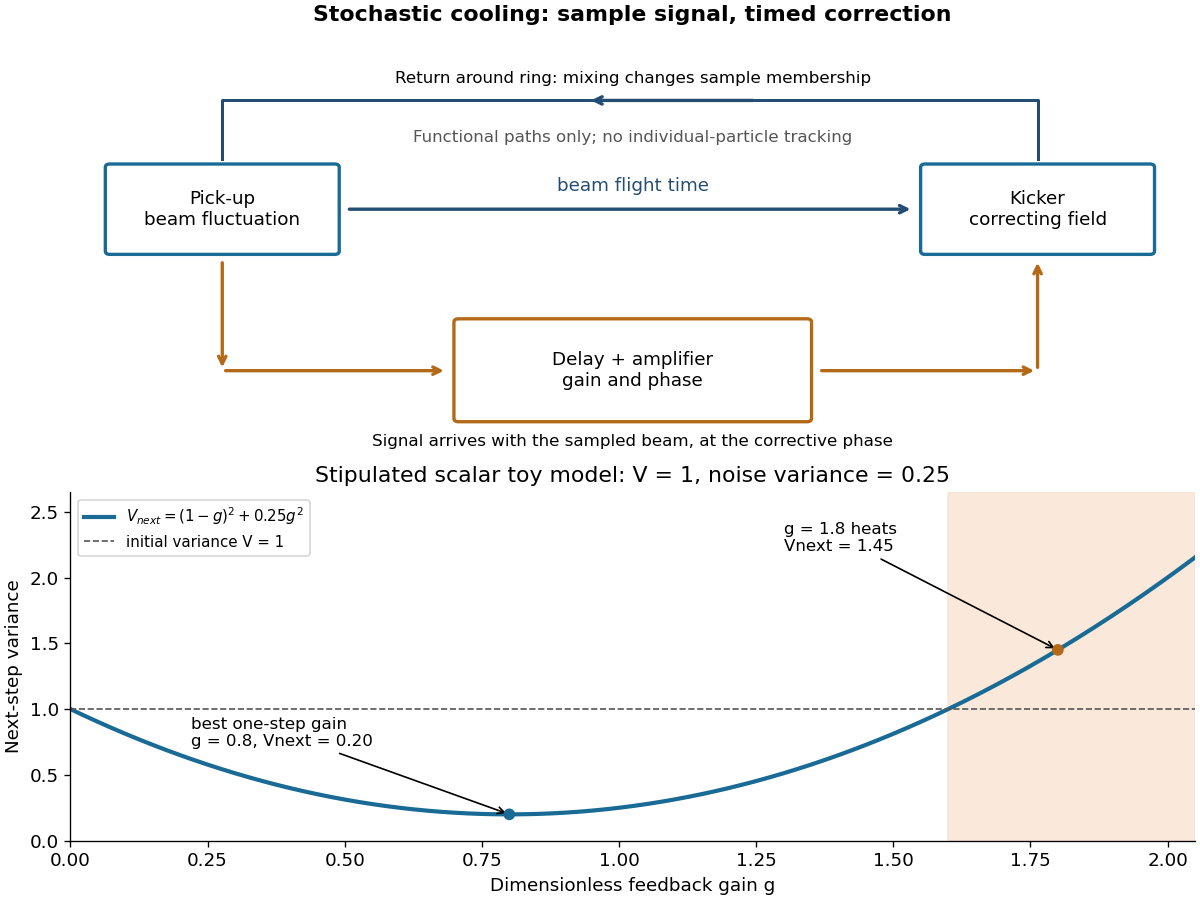
Simon van der Meer's stochastic cooling uses measured beam fluctuations, a pick-up, amplifier and timed kicker. Finite samples supply the signal; other particles and electronic noise contribute unwanted kicks. Delay and oscillation phase must make the correction oppose the sampled deviation.[ref]
This active system dissipates energy; it is no one-particle Maxwell's demon individually tracking antiprotons. The stochastic cooling variance model isolates the tradeoff.
A strong interaction decay must conserve quark flavour and have final rest energy below the initial mass. An excited light baryon can often decay to a lighter baryon plus a pion. A ground-state strange baryon may lack any such open flavour-conserving channel even when its spin permits one. In particular, the Omega baryon cannot decay strongly to a Xi baryon plus a pion because that changes strangeness; its flavour-conserving Xi-kaon channel is closed by the mass threshold. A spin-three-half assignment alone does not imply a strong decay.
A near-surface region whose predominant mobile charge carrier species is opposite to that in the interior: for example a layer rich in electron holes on an n-type semiconductor.
Ordinary solid sodium chloride has the rock salt structure. Choose a conventional cube of side with chlorine anions at the corners and face centers, and sodium cations at the edge centers and cube center. Corner sites are shared by eight cubes, face sites by two and edge sites by four. The unit cell counts are thereforeThere are four formula units per conventional unit cell, rather than four separate NaCl molecules.[ref]
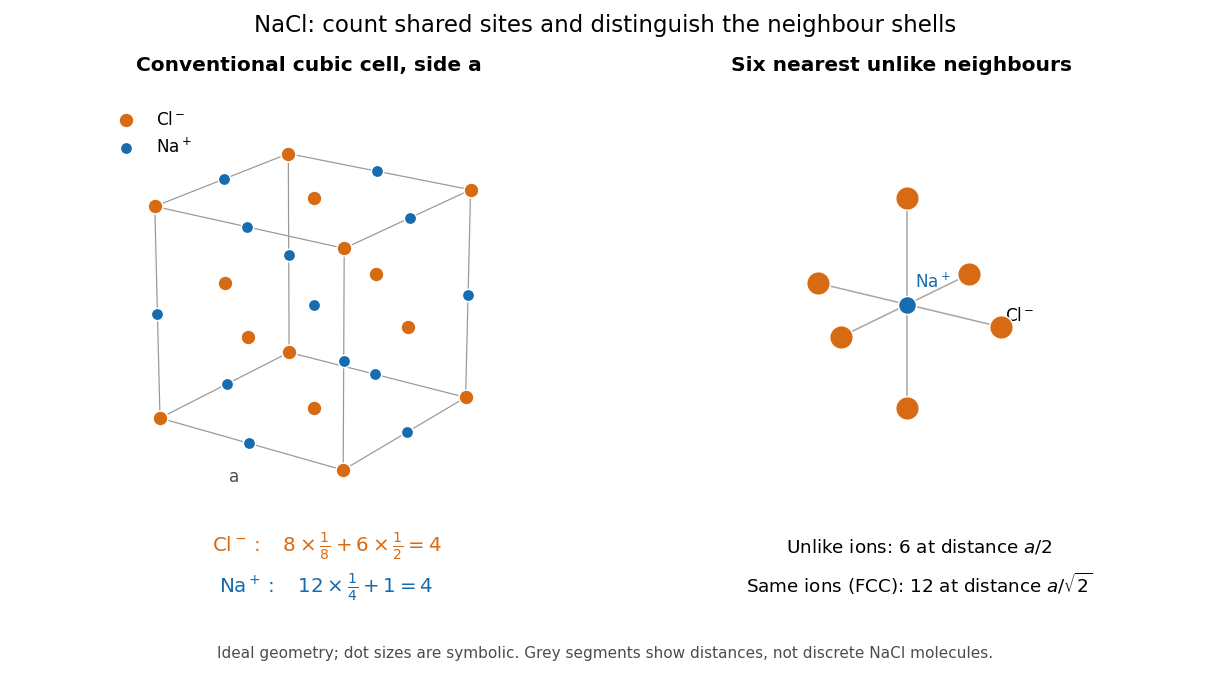
NaCl conventional-cell accounting and the six nearest unlike neighbors
. Original ideal rock salt structure geometry. The left panel includes all boundary sites before sharing is accounted for; the right panel isolates one sodium cation and its six nearest chlorine anions. Grey segments indicate distances, not discrete molecules. Marker sizes do not encode ionic radii. Details.The Bravais lattice is a face-centered cubic lattice. One choice of primitive lattice translation vectors and atomic basis isThe determinant gives a primitive unit cell volume of ; that cell represents one cation and one anion. Four such volumes make the conventional cube. The union of all ion positions resembles a primitive cubic lattice of step only if the chemical labels are discarded: translation by exchanges unlike ions and fails to preserve the chemical structure.
Each ion has six nearest unlike neighbors at distance , along the positive and negative directions of the three cube axes. Thus the coordination number is six. Within either same-species face-centered cubic lattice, the nearest same-ion neighbors instead number twelve: their displacements are permutations of , all of length . Since , those twelve are a more distant shell in the complete sodium chloride structure. The number twelve describes the same-ion FCC lattice neighborhood; six describes the nearest unlike-ion neighborhood.
Let the net cooling per unit mass of an ideal gas be , with positive constants . At fixed pressure and composition, is constant, so . At a thermal equilibrium , . The specific heat capacity at constant pressure gives . Thus with the displayed growth rate. The equilibrium is stable for , unstable for , and marginal at linear order for . In particular, optically thin Bremsstrahlung with is unstable under this heating law and the isobaric constraint. Fixed-density perturbations have a different criterion.
A binary black hole is a binary system whose two components are black holes. Gravitational waves carry away orbital energy and angular momentum, gradually reducing the separation; sufficiently close systems progress through inspiral, merger and the settling of the final black hole. The increasing orbital angular velocity produces a signal whose gravitational-wave frequency rises, called a chirp. In GW150914, two LIGO interferometers recorded a signal sweeping from about 35 to 250 hertz in September 2015. Comparing that measured gravitational wave strain with general relativity waveforms inferred the component masses and the merger's properties. This permits the study of systems that need no luminous surrounding gas to be detected.[ref]
An arithmetic series adds the sequence terms of an arithmetic progression. Its -th partial sum is , with the empty sum convention . For ,Thus the total is the number of sequence terms multiplied by the arithmetic mean of the two endpoints. The formula also covers decreasing and constant arithmetic progressions.[ref]
1 Algebraic and Analytic Methods. NIST Digital Library of Mathematical Functions, §1.2(ii) Finite Series, equation 1.2.10: arithmetic progression sum and last-term definition
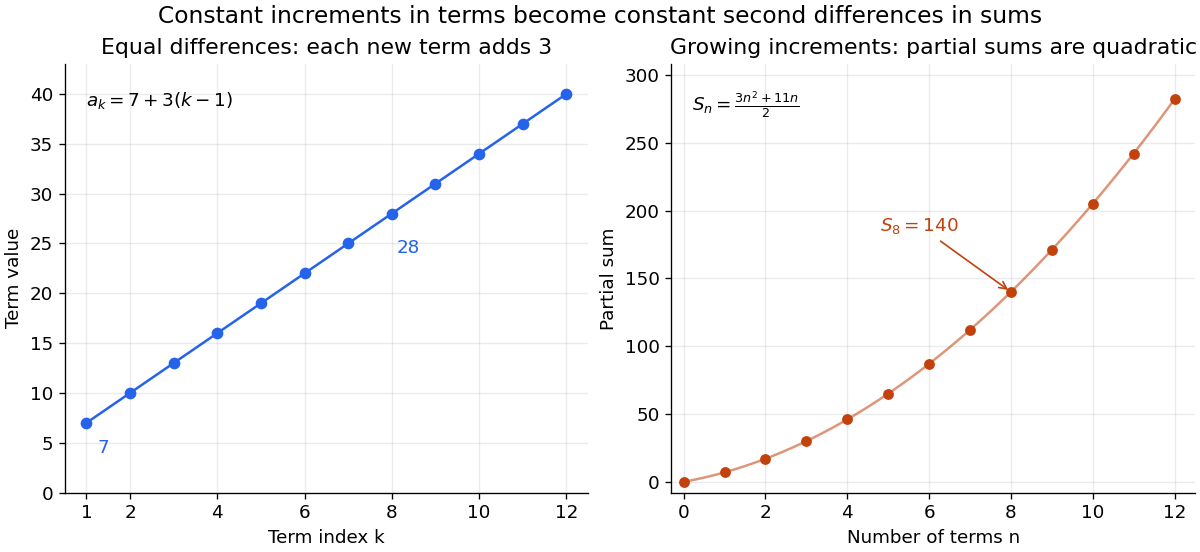
For the eight-entry example, the sum is , and the arithmetic mean of all eight entries is . A decreasing example gives . Negative values cause no algebraic difficulty: has sum .
The triangular number is the special case , giving . More generally, an equal increase in each successive allocation makes the total grow as a quadratic function of the number of allocations. The eight-entry example hasIts first four entries add to , its first eight to , and its first twelve to . The sequence terms lie on a straight line when plotted against their sequence indices, while the partial sums follow a quadratic function.
Pinned article: Introduction to the OurBigBook Project
Welcome to the OurBigBook Project! Our goal is to create the perfect publishing platform for STEM subjects, and get university-level students to write the best free STEM tutorials ever.
Everyone is welcome to create an account and play with the site: ourbigbook.com/go/register. We belive that students themselves can write amazing tutorials, but teachers are welcome too. You can write about anything you want, it doesn't have to be STEM or even educational. Silly test content is very welcome and you won't be penalized in any way. Just keep it legal!
Intro to OurBigBook
. Source. We have two killer features:
- topics: topics group articles by different users with the same title, e.g. here is the topic for the "Fundamental Theorem of Calculus" ourbigbook.com/go/topic/fundamental-theorem-of-calculusArticles of different users are sorted by upvote within each article page. This feature is a bit like:
- a Wikipedia where each user can have their own version of each article
- a Q&A website like Stack Overflow, where multiple people can give their views on a given topic, and the best ones are sorted by upvote. Except you don't need to wait for someone to ask first, and any topic goes, no matter how narrow or broad
This feature makes it possible for readers to find better explanations of any topic created by other writers. And it allows writers to create an explanation in a place that readers might actually find it.
Figure 1. Screenshot of the "Derivative" topic page. View it live at: ourbigbook.com/go/topic/derivativeVideo 2. OurBigBook Web topics demo. Source. - local editing: you can store all your personal knowledge base content locally in a plaintext markup format that can be edited locally and published either:This way you can be sure that even if OurBigBook.com were to go down one day (which we have no plans to do as it is quite cheap to host!), your content will still be perfectly readable as a static site.
- to OurBigBook.com to get awesome multi-user features like topics and likes
- as HTML files to a static website, which you can host yourself for free on many external providers like GitHub Pages, and remain in full control

Figure 2. You can publish local OurBigBook lightweight markup files to either OurBigBook.com or as a static website.
Figure 3. Visual Studio Code extension installation.
Figure 5. . You can also edit articles on the Web editor without installing anything locally. Video 3. Edit locally and publish demo. Source. This shows editing OurBigBook Markup and publishing it using the Visual Studio Code extension. 
- Infinitely deep tables of contents:




All our software is open source and hosted at: github.com/ourbigbook/ourbigbook
Further documentation can be found at: docs.ourbigbook.com
Feel free to reach our to us for any help or suggestions: docs.ourbigbook.com/#contact