Topics (384k) Articles (398k) Users (410) Discussions (242) Comments (383) Files (13k) New article
Fetal bovine serum is the liquid fraction obtained after blood from bovine fetuses clots, used as a complex supplement for some cell cultures. It supplies a mixture of proteins, carrier molecules and growth-supporting components. Because it is a biological mixture, composition and growth effects can vary between lots. A result obtained in serum-containing medium therefore depends on a less chemically defined environment than one using individually specified components. [ref]
Animal Cell Culture Guide by ATCC. Media and supplements: sera and serum variability
The trypan blue exclusion test reads cell membrane integrity through trypan blue exclusion. Prolonged dye exposure can itself increase staining.[ref]
An unstained biological cell is dye-excluding at the time of this assay. That observation alone does not demonstrate future division, sustained metabolism or long-term renewal of a cell line. Conversely, a smaller unstained count can reflect both staining and loss of biological cells from the recovered preparation. Report the denominator and recovery procedure alongside the fraction.
An original constructed hemocytometer count uses four such squares after mixing the biological cell preparation with the same volume of stain. The dye-excluding counts are ; the dye-stained counts are . The dilution factor is . With the sampled volume per square and the arithmetic mean count per square,Hence the undiluted preparation has dye-excluding number density and total number density . Its dye-excluding fraction is . If the well-mixed preparation contains , it contains an estimated dye-excluding biological cells. The chamber sample itself contains only counted dye-excluding biological cells.
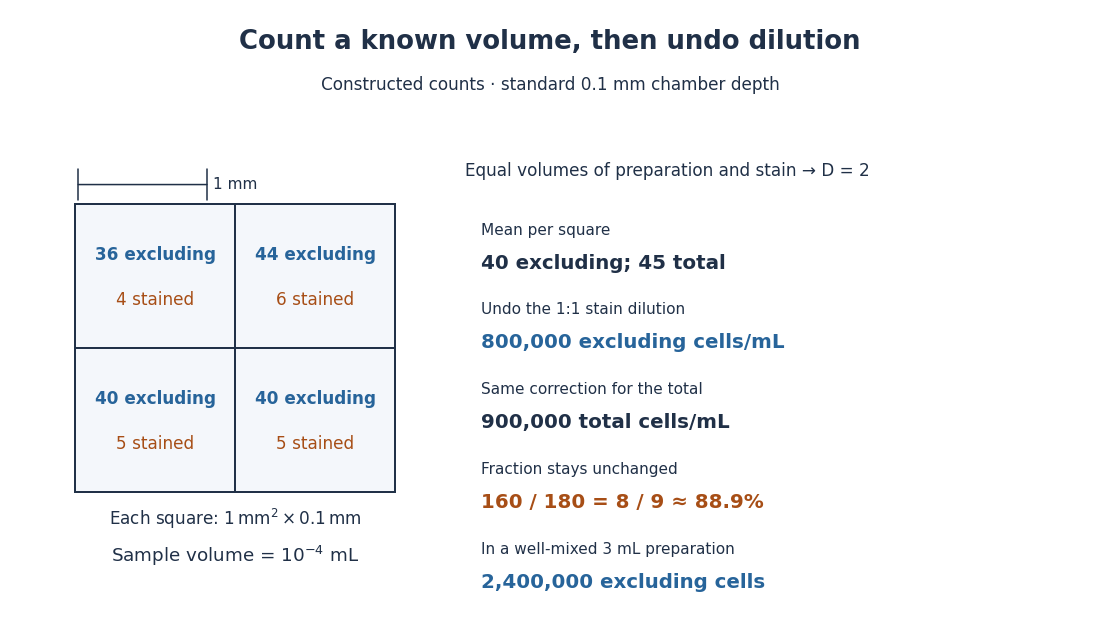
The relation follows from counting material in a known volume, then undoing dilution. It assumes a representative mixed sample and correctly identified single biological cells. Clumps, inconsistent decisions at grid edges, wrong chamber depth and nonrepresentative sampling introduce measurement error. A fixed convention such as including top and left edges while excluding bottom and right edges assigns shared-edge centers to just one square. Adding ten times as much suspension to a correctly filled chamber does not make each square's calibrated volume ten times larger.
A stellar orbit is a star's trajectory in the gravitational field of its surroundings. A close binary star can often be approximated by a Kepler orbit, while a star moving through a galaxy responds to an extended distribution of stars, gas and dark matter. Its path need not close into an ellipse.
Observed positions, proper motion and line-of-sight velocity constrain different components of the motion. Reconstructing an orbit also requires a distance and a model of the gravitational potential. Comparing many stellar orbits can therefore constrain an unseen mass distribution, but one projected track need not uniquely determine the full three-dimensional trajectory or potential.
Orbital energy is the mechanical energy associated with relative motion and mutual attraction. In the isolated Newtonian two-body problem, let be the reduced mass, the separation and the relative speed. ThenDividing by gives specific orbital energy. With zero potential energy at infinity, negative gives a bound Kepler orbit, zero gives the parabolic limit and positive gives an unbound encounter.
For an elliptic orbit, with semi-major axis . Energy loss can therefore shrink a bound orbit, whereas a sufficiently large gain can unbind it. External forces or interactions with additional bodies invalidate conservation of the isolated pair's orbital energy.
Two objects orbiting their common center of mass under their mutual gravity.
Orbital speed is the magnitude of the velocity of an orbiting body in a specified reference frame. For a Newtonian circular orbit around a point source of mass , equating to gives . In a curved spacetime, a speed inferred from coordinate radius and coordinate time generally differs from a speed measured by a local observer. For a circular orbit in the Schwarzschild metric, a static local observer measures ; uses the clock normalization at infinity instead.
Orthogonality of regular real and imaginary level curves by  Codex 0 Created 2026-10-18 Updated 2026-10-24
For a holomorphic function , the Cauchy-Riemann equations give the displayed gradient identities. Where , both level sets are regular curves; their nonzero normal vectors are perpendicular, so their tangents are perpendicular as well. The qualification is necessary. At a critical point both gradients vanish and the zero level sets may have several tangent branches. For at zero, consists of two diagonals while consists of the two coordinate axes; there is no general orthogonality assertion at that point.
For an inviscid material volume element, neglecting body forces, Newton's second law gives . Since mass conservation keeps constant, the result is . Cancelling before differentiating would incorrectly omit its changing volume. A fixed control volume instead requires the advected momentum flux, yielding .
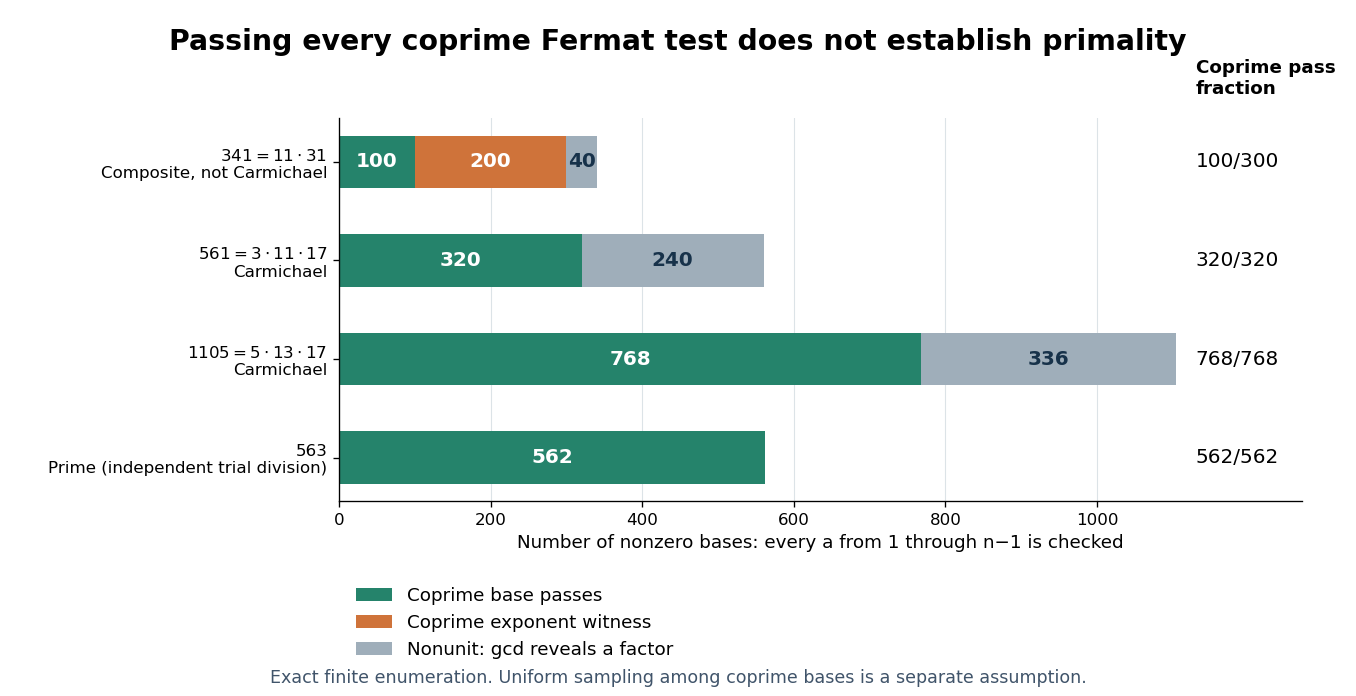
Among the units modulo , the passing residue classes form the kernel of a group homomorphism . If each trial samples independently and uniformly from those units, with replacement, the probability that trials all pass is . This statement assumes that sampling rule; it does not describe arbitrary or dependent choices of bases.
For , the Chinese remainder theorem identifies the unit group with cyclic groups of orders and . The number of solutions of is , among units. Thus . The Carmichael numbers and have passing fractions and , so their conditional false-pass probability remains one regardless of the number of independent trials.
Malic acid is a four-carbon dicarboxylic acid with one hydroxyl group. Its deprotonated form, malate, is an intermediate of the citric acid cycle.
Oxidation of malate to oxaloacetate couples a change in the carbon skeleton's functional groups to reduction of NAD+. The reaction illustrates why protonation state and oxidation state are separate aspects of a metabolite's identity.[ref]
The citric acid cycle by Hans Adolf Krebs. Table 1, malic and oxaloacetic acids
Pinned article: Introduction to the OurBigBook Project
Welcome to the OurBigBook Project! Our goal is to create the perfect publishing platform for STEM subjects, and get university-level students to write the best free STEM tutorials ever.
Everyone is welcome to create an account and play with the site: ourbigbook.com/go/register. We belive that students themselves can write amazing tutorials, but teachers are welcome too. You can write about anything you want, it doesn't have to be STEM or even educational. Silly test content is very welcome and you won't be penalized in any way. Just keep it legal!
Intro to OurBigBook
. Source. We have two killer features:
- topics: topics group articles by different users with the same title, e.g. here is the topic for the "Fundamental Theorem of Calculus" ourbigbook.com/go/topic/fundamental-theorem-of-calculusArticles of different users are sorted by upvote within each article page. This feature is a bit like:
- a Wikipedia where each user can have their own version of each article
- a Q&A website like Stack Overflow, where multiple people can give their views on a given topic, and the best ones are sorted by upvote. Except you don't need to wait for someone to ask first, and any topic goes, no matter how narrow or broad
This feature makes it possible for readers to find better explanations of any topic created by other writers. And it allows writers to create an explanation in a place that readers might actually find it.
Figure 1. Screenshot of the "Derivative" topic page. View it live at: ourbigbook.com/go/topic/derivativeVideo 2. OurBigBook Web topics demo. Source. - local editing: you can store all your personal knowledge base content locally in a plaintext markup format that can be edited locally and published either:This way you can be sure that even if OurBigBook.com were to go down one day (which we have no plans to do as it is quite cheap to host!), your content will still be perfectly readable as a static site.
- to OurBigBook.com to get awesome multi-user features like topics and likes
- as HTML files to a static website, which you can host yourself for free on many external providers like GitHub Pages, and remain in full control

Figure 2. You can publish local OurBigBook lightweight markup files to either OurBigBook.com or as a static website.
Figure 3. Visual Studio Code extension installation.
Figure 5. . You can also edit articles on the Web editor without installing anything locally. Video 3. Edit locally and publish demo. Source. This shows editing OurBigBook Markup and publishing it using the Visual Studio Code extension. 
- Infinitely deep tables of contents:




All our software is open source and hosted at: github.com/ourbigbook/ourbigbook
Further documentation can be found at: docs.ourbigbook.com
Feel free to reach our to us for any help or suggestions: docs.ourbigbook.com/#contact