Topics (384k) Articles (398k) Users (410) Discussions (242) Comments (383) Files (13k) New article

An experimental physicist whose advice on preparing superconducting films helped expose new behavior. According to Alexei Alexeyevich Abrikosov, Shalnikov urged keeping the deposition substrate at liquid-helium temperatures so metal atoms would remain in place rather than collect into droplets. The resulting films changed the measured critical-field behavior, showing how sample preparation can reveal physics hidden by an inhomogeneous specimen.[ref]
Nobel Lecture: Type-II superconductors and the vortex lattice by Alexei Alexeyevich Abrikosov. p. 975: Shalnikov's cooled-substrate recommendation and Zavaritskii's measurements
Carl Wieman and Eric Allin Cornell helped realize Bose-Einstein condensation in a dilute trapped rubidium gas. Laser cooling prepared a cold sample, and evaporative cooling preferentially removed energetic chemical atoms to reach quantum degeneracy.
The appearance of a narrow component in the expanded distribution distinguished the condensate from the surrounding thermal population. This made a many-particle quantum state experimentally visible through a controlled cooling sequence and an ordinary spatial image.[ref]
Observation of Bose-Einstein Condensation in a Dilute Atomic Vapor by M. H. Anderson and others. 1995 experiment: cooling sequence, transition and expanded density distributions

Portrait of Carl Wieman
. Tina Hager. Public domain (US federal government work). Source usage terms, via Wikimedia Commons. Source.Wolfgang Ketterle helped produce and investigate Bose-Einstein condensation in a dilute sodium gas. Cooling a trapped sample into the quantum-degenerate regime produced a population concentrated in a common low-energy state.
Expansion images distinguished the narrow condensed component from the broader thermal cloud. Subsequent experiments used coherence and collective motion to test how the macroscopic population behaves as a matter wave. His Nobel lecture connects the condensation apparatus with interference experiments and the atom laser.[ref]
Bose-Einstein Condensation in a Gas of Sodium Atoms by K. B. Davis and others. 1995 experiment: cooling and condensed distribution
[ref]
Portrait of Wolfgang Ketterle
. Kenneth C. Zirkel (Kzirkel); Brown University symposium, 12 April 2007; revised by the photographer in 2012. CC BY-SA 3.0, via Wikimedia Commons. Source.An experimental atomic physicist who coauthored a 1997 study of sound in a Bose-Einstein condensate. Its sequence of nondestructive images made it possible to watch a density disturbance move through the trapped gas, rather than infer the motion from a different cloud in each image.[ref]
Propagation of Sound in a Bose-Einstein Condensate by M. R. Andrews and others. Author list and abstract: rapid sequencing of nondestructive phase-contrast images
An experimental atomic physicist who coauthored a measurement of collective density disturbances in a Bose-Einstein condensate. The experiment launched sound with a focused laser beam and followed its propagation with repeated nondestructive images, connecting a macroscopic speed of sound to a dilute gas's quantum excitation spectrum.[ref]
Propagation of Sound in a Bose-Einstein Condensate by M. R. Andrews and others. Abstract and author list; erratum identifies D. M. Stamper-Kurn, Physical Review Letters 80, 2967 (1998)
A theoretical particle physicist who established asymptotic freedom for a class of Yang-Mills theories in 1973. The effective interaction becomes weak at sufficiently high energy, allowing perturbation theory to be useful in a theory that has strong interactions at longer distances. This supplies a key theoretical route from quantum chromodynamics to quantitative short-distance predictions.[ref]
Reliable Perturbative Results for Strong Interactions? by Hugh David Politzer. Abstract and short-distance perturbative calculation
Frank Wilczek and David Gross established asymptotic freedom in a class of Non-Abelian gauge theories. The effective interaction weakens at shorter distances, up to calculable logarithmic corrections. This permits perturbation theory to describe sufficiently high-energy processes in quantum chromodynamics, despite its strong long-distance interactions. Their 1973 result connected the approximate scaling seen in deep inelastic scattering with the dynamics of a gauge theory.[ref]
Ultraviolet Behavior of Non-Abelian Gauge Theories by David J. Gross and Frank Wilczek. 1973 abstract: free-field asymptotic behavior, logarithmic corrections and Bjorken scaling
A physicist working in theoretical physics.[ref]
Professional profile of Frank Wilczek. Independent professional identity

Portrait of Frank Wilczek
. Bengt Oberger, own photograph, 9 December 2017. Creative Commons Attribution-Share Alike 4.0 International., via Wikimedia Commons. Source.An experimental optical physicist who coauthored a 1986 generation of optical squeezed vacuum. A cavity enhanced spontaneous parametric down-conversion, while balanced homodyne detection measured reduced optical quadrature noise. The comparison with attenuation models linked a directly observed noise reduction to the source's underlying quantum field.[ref]
Generation of Squeezed States by Parametric Down Conversion by Ling-An Wu and others. Abstract: cavity source, homodyne noise and attenuation correction
An experimental optical physicist who coauthored the 1987 Hong-Ou-Mandel effect study. Interference of two down-converted photons allowed their relative timing to be inferred from coincidence counts. The experiment links the indistinguishability of quantum alternatives to a measured optical correlation, making two-photon interference a tool for precision measurement.[ref]
A physicist who, with Robert Hanbury Brown, developed optical stellar intensity interferometry. Correlations between detected intensity fluctuations reveal spatial coherence even when the optical phases at the detectors are not directly combined. Their experiment on Sirius connected this correlation measurement to stellar angular size, providing an astronomical application of the Hanbury Brown and Twiss effect.[ref]
A Test of a New Type of Stellar Interferometer on Sirius by Robert Hanbury Brown and Richard Quentin Twiss. Original 1956 stellar-interferometer report
An experimental optical physicist whose precision laser spectroscopy connects stable optical oscillators with frequency standards. His lecture explains how optical frequency combs joined ultrashort-pulse technology to highly stable laser frequencies, making direct comparisons of optical and microwave clocks practical. Measuring an optical frequency becomes a controlled counting problem rather than an isolated wavelength calibration.[ref]
Nobel Lecture: Defining and measuring optical frequencies by John L. Hall. Opening account of the convergence of ultrafast pulses, stable lasers and frequency combs
An experimental optical physicist who coauthored a demonstration of carrier-envelope phase control in a femtosecond laser. Measuring and stabilizing the offset of the resulting optical frequency comb permits absolute optical frequency synthesis, showing how control of a pulse train in time determines a precise ruler in frequency.[ref]
Carrier-Envelope Phase Control of Femtosecond Mode-Locked Lasers and Direct Optical Frequency Synthesis by David J. Jones and others. Abstract and connection between pulse phase and comb offset
An experimental optical physicist who coauthored direct optical frequency synthesis with a stabilized optical frequency comb. Controlling both repetition rate and carrier-envelope offset fixes the frequencies of the comb teeth. It provides a coherent bridge between a microwave reference and much faster optical oscillations.[ref]
An experimental optical physicist who coauthored control of the carrier-envelope phase of a mode-locked laser. Stabilizing the pulse-to-pulse phase evolution also stabilizes the offset of an optical frequency comb, connecting ultrashort-pulse dynamics to absolute frequency measurement.[ref]
Carrier-Envelope Phase Control of Femtosecond Mode-Locked Lasers and Direct Optical Frequency Synthesis by David J. Jones and others. Abstract: phase stabilization and optical frequency synthesis
Yoichiro Nambu transferred the idea of dynamical symmetry breaking from superconductivity into particle. His model with Giovanni Jona-Lasinio treats particle mass as a self-consistent interaction effect, while collective excitations reflect the underlying chiral symmetry breaking. This makes the physical vacuum and its excitations part of the explanation of particle properties. Their simplified four-fermion theory is a model of the mechanism, rather than the modern fundamental theory of the strong interaction.[ref]
Dynamical Model of Elementary Particles Based on an Analogy with Superconductivity. I by Yoichiro Nambu and Giovanni Jona-Lasinio. 1961 abstract and model: superconducting analogy, generated fermion mass and collective bound states
A physicist working on spontaneous symmetry breaking.[ref]
Guide to the Yoichiro Nambu Papers 1917-2009 by University of Chicago Library. Independent professional identity

Portrait of Yoichiro Nambu
. Betsy Devine; Franklin Institute ceremony in Philadelphia, 2005; existing Commons image adjusted by WikiPedant. CC BY-SA 3.0, via Wikimedia Commons. Source.Giovanni Jona-Lasinio and Yoichiro Nambu proposed a dynamical model of particle mass inspired by superconductivity. A nonlinear four-fermion interaction produces a self-consistent massive fermionic state, analogous to the gap in a superconductor. The model also produces a massless pseudoscalar bound state in its symmetry limit, interpreted as an idealized pion. It demonstrates how both a massive constituent-like excitation and a light collective mode can arise from one interacting theory.[ref]
Dynamical Model of Elementary Particles Based on an Analogy with Superconductivity. I by Yoichiro Nambu and Giovanni Jona-Lasinio. 1961 abstract: self-energy, generalized Hartree-Fock treatment and idealized massless pion
A physicist working in mathematical physics.[ref]
Professional profile of Giovanni Jona-Lasinio. Independent professional identity

Portrait of Giovanni Jona-Lasinio
. Prolineserver. GNU Free Documentation License 1.2 only, via Wikimedia Commons. Source.Jeffrey Goldstone established a central consequence of spontaneous symmetry breaking: under the usual relativistic assumptions, breaking a continuous global symmetry produces massless Goldstone bosons. Moving along equivalent vacuum states costs no restoring potential energy, giving a low-energy collective mode. His work also developed diagrammatic methods for interacting many-fermion systems. These contributions connect the symmetries of an underlying theory with the physical excitations that an experiment can detect.[ref]
Jeffrey Goldstone by MIT Department of Physics. Biographical sketch and award citations: many-body diagrammatic methods and theorem on spontaneously broken global symmetry
A physicist working on spontaneous symmetry breaking.[ref]
Jeffrey Goldstone by MIT Department of Physics. Independent professional identity
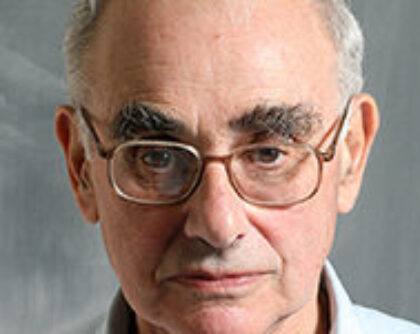
Portrait of Jeffrey Goldstone
. Makoto Kobayashi co-developed a mechanism linking CP violation to quark mixing. With Toshihide Maskawa, he examined which phases of the weak-interaction mixing matrix can survive field redefinitions. Three fermion generations permit one independent CP-violating phase in the usual three-by-three Cabibbo-Kobayashi-Maskawa matrix. The proposal connected apparently separate questions about particle families and symmetry, and made comparison with flavor-changing decays a test of one common mixing structure.[ref]
CP-Violation in the Renormalizable Theory of Weak Interaction by Makoto Kobayashi and Toshihide Maskawa. 1973, discussion of the six-quark scheme and nonremovable matrix phase
A physicist working on quark mixing.[ref]
Professional profile of Makoto Kobayashi. Independent professional identity

Portrait of Makoto Kobayashi
. Marcella Bona from Geneva, Switzerland. CC BY-SA 2.0, via Wikimedia Commons. Source.Toshihide Maskawa and Makoto Kobayashi investigated how CP violation could fit within a renormalizable theory of the weak interaction. A complex quark mixing matrix is not enough by itself: phases removable by redefining quark fields have no physical effect. With three fermion generations, a physical complex phase can remain in the Cabibbo-Kobayashi-Maskawa matrix. Their 1973 analysis connected an observed symmetry failure with the possible number and organization of quarks.[ref]
CP-Violation in the Renormalizable Theory of Weak Interaction by Makoto Kobayashi and Toshihide Maskawa. 1973, six-quark scheme and phases of the three-by-three unitary mixing matrix
A physicist working on quark mixing.[ref]
Professional profile of Toshihide Maskawa. Independent professional identity

Portrait of Toshihide Maskawa
. 日本学士院ホームページ (Japan Academy website). CC BY 4.0, via Wikimedia Commons. Source.Nicola Cabibbo organized decay probability amplitudes of the weak interaction through a single mixing angle. His 1963 paper related strangeness-conserving and strangeness-changing processes within a symmetry-based weak current. In modern quark notation, the combination expresses this quark mixing: the relative strengths depend on one Cabibbo angle. Comparing different decay rates therefore tests one common structure instead of fitting every weak channel independently. The quark notation is a later interpretation of the original current construction.[ref]
Unitary Symmetry and Leptonic Decays by Nicola Cabibbo. 1963, weak-current assumptions and one-angle relation among decay amplitudes; modern quark illustration
A physicist working on quark mixing.[ref]
Nicola Cabibbo (1935-2010) by CERN. Independent professional identity

Portrait of Nicola Cabibbo
. Marcella Bona. CC BY-SA 2.0, via Wikimedia Commons. Source. Pinned article: Introduction to the OurBigBook Project
Welcome to the OurBigBook Project! Our goal is to create the perfect publishing platform for STEM subjects, and get university-level students to write the best free STEM tutorials ever.
Everyone is welcome to create an account and play with the site: ourbigbook.com/go/register. We belive that students themselves can write amazing tutorials, but teachers are welcome too. You can write about anything you want, it doesn't have to be STEM or even educational. Silly test content is very welcome and you won't be penalized in any way. Just keep it legal!
Intro to OurBigBook
. Source. We have two killer features:
- topics: topics group articles by different users with the same title, e.g. here is the topic for the "Fundamental Theorem of Calculus" ourbigbook.com/go/topic/fundamental-theorem-of-calculusArticles of different users are sorted by upvote within each article page. This feature is a bit like:
- a Wikipedia where each user can have their own version of each article
- a Q&A website like Stack Overflow, where multiple people can give their views on a given topic, and the best ones are sorted by upvote. Except you don't need to wait for someone to ask first, and any topic goes, no matter how narrow or broad
This feature makes it possible for readers to find better explanations of any topic created by other writers. And it allows writers to create an explanation in a place that readers might actually find it.
Figure 1. Screenshot of the "Derivative" topic page. View it live at: ourbigbook.com/go/topic/derivativeVideo 2. OurBigBook Web topics demo. Source. - local editing: you can store all your personal knowledge base content locally in a plaintext markup format that can be edited locally and published either:This way you can be sure that even if OurBigBook.com were to go down one day (which we have no plans to do as it is quite cheap to host!), your content will still be perfectly readable as a static site.
- to OurBigBook.com to get awesome multi-user features like topics and likes
- as HTML files to a static website, which you can host yourself for free on many external providers like GitHub Pages, and remain in full control

Figure 2. You can publish local OurBigBook lightweight markup files to either OurBigBook.com or as a static website.
Figure 3. Visual Studio Code extension installation.
Figure 5. . You can also edit articles on the Web editor without installing anything locally. Video 3. Edit locally and publish demo. Source. This shows editing OurBigBook Markup and publishing it using the Visual Studio Code extension. 
- Infinitely deep tables of contents:




All our software is open source and hosted at: github.com/ourbigbook/ourbigbook
Further documentation can be found at: docs.ourbigbook.com
Feel free to reach our to us for any help or suggestions: docs.ourbigbook.com/#contact