Topics (384k) Articles (398k) Users (410) Discussions (242) Comments (383) Files (13k) New article

A theoretical atomic physicist who coauthored calculations of the Lamb shift in hydrogen and light hydrogen-like ions. The work reviews theoretical contributions and uncertainties needed for precision spectroscopy. Such predictions let a small measured difference between energy levels test relativistic quantum interactions rather than just the leading Coulomb potential.[ref]
Theory of the Lamb shift in hydrogen and light hydrogen-like ions by Vladimir Yerokhin and others. Abstract and summary of theoretical contributions
A theoretical atomic physicist who coauthored a precision review of the Lamb shift. The analysis assembles distinct corrections to hydrogenic energy levels, allowing high-resolution spectroscopy to be compared with quantum electrodynamics. Separating nuclear-size contributions from purely electronic corrections is essential when extracting a nuclear radius.[ref]
Theory of the Lamb shift in hydrogen and light hydrogen-like ions by Vladimir Yerokhin and others. Abstract and treatment of radiative, recoil and nuclear-size contributions
A theoretical atomic physicist who coauthored precision calculations of the Lamb shift in hydrogen and light hydrogen-like ions. These calculations combine radiative, recoil and finite-nuclear-size effects. Their uncertainty matters when a measured transition is used to test quantum electrodynamics or infer nuclear structure.[ref]
Henry Michael Foley and Polykarp Kusch compared atomic magnetic resonance frequencies to determine the electron magnetic moment. They selected quantum states whose orbital angular momentum and spin contributions enter with different weights. Ratios of the measured frequencies revealed a departure from the simplest electron spin g-factor of exactly two. Comparing responses in the same magnetic field reduces dependence on absolute field calibration, turning a small spectral difference into a precision test of the magnetic response.[ref]
The Magnetic Moment of the Electron by Polykarp Kusch and Henry Michael Foley (1948). Abstract: compared gallium, indium and sodium states, measured resonance-frequency ratios and departure from the simple magnetic-factor values
A physicist and professor of physics at Columbia University.[ref]
https://findingaids.library.columbia.edu/pdf/cul-4078769.pdf. p. 3, creator name and Biographical / Historical note
The Kusch-Foley magnetic moment experiment describes his work with Polykarp Kusch.John Bardeen and Walter Brattain connected semiconductor surface behavior with the operation of the point-contact transistor. Carrier injection near closely spaced contacts allowed a small input to control a larger electrical response, making amplification possible in a solid-state device.[ref]
The Transistor, A Semi-Conductor Triode by John Bardeen and Walter Houser Brattain. Physical Review 74, 230 (1948), device operation
He later coauthored BCS theory, in which a coherent paired-electron ground state explains central properties of conventional superconductivity. This links microscopic interactions with an excitation gap and collective magnetic and thermal response.[ref]
Theory of Superconductivity by John Bardeen and others. Physical Review 108, 1175 (1957), microscopic paired-state theory
A physicist.[ref]
https://www.nobelprize.org/prizes/physics/1956/bardeen/biographical/?NMW_TRANS=ext. Independent professional profile

Portrait of John Bardeen
. Source. Tsung-Dao Lee co-developed experimentally testable challenges to parity conservation with Yang Chen-Ning. In a polarized nuclear decay, the parent spin supplies an axial direction while the emitted particle's momentum supplies a polar direction. Their scalar product changes sign under parity, so a preferred emission direction can expose a symmetry failure. The proposal made a foundational assumption into a laboratory question.[ref]
A physicist.[ref]
https://www.nobelprize.org/prizes/physics/1957/lee/biographical/. Independent professional profile

Portrait of Tsung-Dao Lee
. user:smartneddy. CC BY-SA 2.5, via Wikimedia Commons. Source.Chien-Shiung Wu and collaborators tested parity conservation by measuring the beta decay of oriented cobalt-60 nuclei at very low temperature. Their apparatus placed a beta counter inside a demagnetization cryostat and used the accompanying gamma ray anisotropy to monitor nuclear orientation. The emitted electrons favored one direction relative to the nuclear spin. Because parity reverses momentum while leaving angular momentum unchanged, that directional asymmetry distinguishes a process from its mirror image and demonstrated parity violation in the weak interaction.[ref]
Experimental Test of Parity Conservation in Beta Decay by Chien-Shiung Wu and others. Opening argument, Fig. 1 cryostat and observed electron asymmetry
A physicist.[ref]
The Fall of Parity Photo Gallery with Short Biographies by National Institute of Standards and Technology. Independent professional profile

An experimental physicist whose cryogenic expertise contributed to the Wu experiment. The National Bureau of Standards laboratory could align atomic nuclei at extremely low temperature, enabling a directional beta decay test in cobalt-60. The collaboration demonstrated a failure of parity conservation.[ref]
The Reversal of Parity Law in Nuclear Physics by National Institute of Standards and Technology. NBS low-temperature laboratory, collaboration list and nuclear alignment
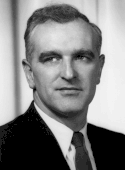
Portrait of Ernest Ambler
. External portrait linked by the National Institute of Standards and Technology institutional exhibit. Source.An experimental nuclear physicist who coauthored the 1957 test of parity conservation in cobalt-60 beta decay. Its directional counting measurement depended on orienting the nuclei at very low temperature. As the sample warmed and orientation was lost, the asymmetry disappeared, linking the observed signal to the nuclear orientation.[ref]
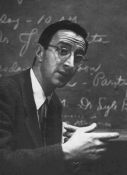
Portrait of Raymond Webster Hayward
. External portrait linked by the National Institute of Standards and Technology institutional exhibit. Source.An experimental nuclear physicist who coauthored the Wu experiment. Comparing beta decay from oriented cobalt-60 nuclei with the opposite orientation tested whether a mirror-reflected process would have the same probability. The observed directional asymmetry showed failure of parity conservation in the weak interaction.[ref]

Portrait of Dale D. Hoppes
. External portrait linked by the National Institute of Standards and Technology institutional exhibit. Source.An experimental nuclear physicist who coauthored the Wu experiment testing parity conservation in beta decay. The collaboration combined low-temperature nuclear orientation with directional radiation counting. Cooling the cobalt-60 sample made it possible to compare emitted electrons with a known nuclear orientation rather than average over random spins.[ref]
The Reversal of Parity Law in Nuclear Physics by National Institute of Standards and Technology. Collaboration list and account of low-temperature nuclear alignment
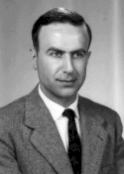
Portrait of Ralph Percy Hudson
. External portrait linked by the National Institute of Standards and Technology institutional exhibit. Source.An optical physicist who studied luminescence, including its quenching by impurities and concentration changes. His distinction between persistent excited-state emission and other light-generation mechanisms helped frame the analysis of radiation observed by Pavel Cherenkov. Measuring how emission changes with its environment thus served both as a probe of excited matter and as a way to distinguish different physical sources of light.[ref]
Sergey Ivanovich Vavilov by Russian Academy of Sciences. Scientific-work account: quenching, definition of luminescence and Cherenkov investigations
Owen Chamberlain helped establish the antiproton by distinguishing a rare massive negative particle from an intense background of lighter particles. Magnetic analysis fixed momentum, while time-of-flight and Cherenkov radiation measurements constrained speed. Together these quantities tested whether the inferred mass matched that of the proton. His lecture emphasizes both the apparatus and the inference drawn from the particle's existence, separating discovery from later studies of its interactions.[ref]
The early antiproton work by Owen Chamberlain. 1959 lecture, magnetic selection, velocity measurements and antiproton identification
A physicist.[ref]
https://www.nasonline.org/wp-content/uploads/2024/06/chamberlain-owen.pdf. Independent professional profile

Portrait of Owen Chamberlain
. Nobel Foundation; individual photographer unidentified. Commons PD-Sweden designation in primary File category and upload history. No independent United States or worldwide determination., via Wikimedia Commons. Source.An experimental particle physicist who contributed to the discovery of the antiproton. A negative particle had to be distinguished from the much more abundant light particles with the same electric charge: momentum selection and velocity-sensitive detectors together established its large mass. Instrument design therefore formed part of identifying the new particle, alongside its production in an accelerator.[ref]
https://www2.lbl.gov/Science-Articles/Archive/Claude-Wiegand-obit.html. Berkeley Lab account: central role and contributions to the 1955 antiproton experiment
Robert Hofstadter investigated nuclear charge distributions through energetic electron scattering. His 1956 review compares electrons scattered from helium gas with predictions for point charges and several extended charge profiles. Beyond about , the elastic scattering was over a hundred times smaller than the point-charge prediction. The extracted nuclear charge form factor distinguishes candidate spatial profiles, connecting measured angular counts with a model of nuclear size and shape.[ref]
Electron Scattering and Nuclear Structure by Robert Hofstadter. pp. 237–238, Figs. 32–33, helium angular distribution and alternative charge-profile fits
A physicist.[ref]
https://physics.stanford.edu/people/robert-hofstadter. Independent professional profile

Portrait of Robert Hofstadter
. Nobel Foundation, 1961 Nobel portrait; individual photographer unspecified. Public domain in Sweden according to the Commons Swedish-photograph template. Source usage terms, via Wikimedia Commons. Source.A particle physicist who coauthors reference material on the passage of particles through matter with Spencer Klein. Their review connects stopping power, radiation length and electromagnetic showers to practical detector calculations. These quantities translate a material thickness and incident particle energy into estimates of signal formation and shower development.[ref]
Passage of Particles Through Matter by Donald E. Groom and Spencer Klein. Sections 34.2, 34.4.2 and 34.5: stopping power, radiation length and cascades
An experimental particle physicist who coauthors the Particle Data Group review of particle passage through matter with Donald E. Groom. It relates energy loss, multiple scattering and radiation processes to the signals and limitations of particle detectors. The same relations let an experimenter estimate whether a charged track will be detectable, stopped or significantly deflected.[ref]
Passage of Particles Through Matter by Donald E. Groom and Spencer Klein. Sections 34.2–34.4: stopping, multiple scattering and photon/electron interactions
An experimental physicist who coauthored the 1966 zero sound propagation experiment with Ansel Cochran Anderson and John Charles Wheatley. Sound measurements in very cold helium-3 tested whether collective density motion survives in the collisionless regime predicted for a Fermi liquid.[ref]
Propagation of Zero Sound in Liquid He3 at Low Temperatures by William Russell Abel and others. Byline and zero-sound propagation study
An experimental condensed matter physicist who coauthored an observation of zero sound in helium-3. The experiment probed a collective density wave in a regime where quasiparticle collisions are slow compared with the oscillation. This distinguishes collisionless quantum-fluid dynamics from ordinary hydrodynamic sound.[ref]
Propagation of Zero Sound in Liquid He3 at Low Temperatures by William Russell Abel and others. Byline and low-temperature propagation experiment
An experimental physicist who coauthored measurements of zero sound in liquid helium-3. At sufficiently low temperature, collisions become too infrequent to maintain ordinary local equilibrium during an acoustic cycle. The resulting collective response tests the theory of a Fermi liquid through propagation of a density disturbance.[ref]
Propagation of Zero Sound in Liquid He3 at Low Temperatures by William Russell Abel and others. Original 1966 low-temperature sound-propagation report
Pinned article: Introduction to the OurBigBook Project
Welcome to the OurBigBook Project! Our goal is to create the perfect publishing platform for STEM subjects, and get university-level students to write the best free STEM tutorials ever.
Everyone is welcome to create an account and play with the site: ourbigbook.com/go/register. We belive that students themselves can write amazing tutorials, but teachers are welcome too. You can write about anything you want, it doesn't have to be STEM or even educational. Silly test content is very welcome and you won't be penalized in any way. Just keep it legal!
Intro to OurBigBook
. Source. We have two killer features:
- topics: topics group articles by different users with the same title, e.g. here is the topic for the "Fundamental Theorem of Calculus" ourbigbook.com/go/topic/fundamental-theorem-of-calculusArticles of different users are sorted by upvote within each article page. This feature is a bit like:
- a Wikipedia where each user can have their own version of each article
- a Q&A website like Stack Overflow, where multiple people can give their views on a given topic, and the best ones are sorted by upvote. Except you don't need to wait for someone to ask first, and any topic goes, no matter how narrow or broad
This feature makes it possible for readers to find better explanations of any topic created by other writers. And it allows writers to create an explanation in a place that readers might actually find it.
Figure 1. Screenshot of the "Derivative" topic page. View it live at: ourbigbook.com/go/topic/derivativeVideo 2. OurBigBook Web topics demo. Source. - local editing: you can store all your personal knowledge base content locally in a plaintext markup format that can be edited locally and published either:This way you can be sure that even if OurBigBook.com were to go down one day (which we have no plans to do as it is quite cheap to host!), your content will still be perfectly readable as a static site.
- to OurBigBook.com to get awesome multi-user features like topics and likes
- as HTML files to a static website, which you can host yourself for free on many external providers like GitHub Pages, and remain in full control

Figure 2. You can publish local OurBigBook lightweight markup files to either OurBigBook.com or as a static website.
Figure 3. Visual Studio Code extension installation.
Figure 5. . You can also edit articles on the Web editor without installing anything locally. Video 3. Edit locally and publish demo. Source. This shows editing OurBigBook Markup and publishing it using the Visual Studio Code extension. 
- Infinitely deep tables of contents:




All our software is open source and hosted at: github.com/ourbigbook/ourbigbook
Further documentation can be found at: docs.ourbigbook.com
Feel free to reach our to us for any help or suggestions: docs.ourbigbook.com/#contact