Topics (384k) Articles (398k) Users (410) Discussions (242) Comments (383) Files (13k) New article

A physicist who studied ruby fluorescence for high-pressure measurements.[ref]
High Pressure X-Ray Crystallography With the Diamond Cell at NIST⁄NBS by Gasper J. Piermarini. §4: BYU guest scientist and ruby-fluorescence research; §4.2: spectrometer development
A physicist who investigated spectroscopy and ruby fluorescence under pressure.[ref]
High Pressure X-Ray Crystallography With the Diamond Cell at NIST⁄NBS by Gasper J. Piermarini. §4: Forman’s spectroscopy laboratory and ruby-fluorescence investigations
Yakir Aharonov and David Bohm showed how scalar potentials and vector potentials can affect quantum interference even when a charged particle travels through a region with vanishing magnetic field. In the ideal magnetic arrangement, two paths enclose a confined magnetic flux , and their relative quantum phase changes by for charge . This makes the observable interference shift sensitive to the enclosed flux and the geometry of the paths, rather than only the local magnetic force along either path.[ref]
A physicist researching quantum theory and the Aharonov-Bohm effect.[ref]
Dr. Yakir Aharonov. Biography: professor of theoretical physics; Institute for Quantum Studies directorship

Portrait of Yakir Aharonov
. Kobi Kalmanovitz (קובי קלמנוביץ), as credited in the Hebrew File record; EMET Prize website. Creative Commons Attribution-Share Alike 3.0 Unported., via Wikimedia Commons. Source.Akira Tonomura used electron holography to test the Aharonov-Bohm effect with magnetic flux confined away from the electron paths. A coated magnetic toroid let electron waves pass through its hole and outside it while a superconducting shield excluded the magnetic field from those paths. The measured relative phase still depended on the enclosed flux. The experiment isolates a quantum phase effect that cannot be inferred from the local classical magnetic force along either path.[ref]
A physicist who developed electron holography and investigated the Aharonov-Bohm effect.[ref]
Benjamin Franklin Medal Awarded to Akira Tonomura, Senior Chief Research Scientist at Hitachi, Ltd.. Opening paragraph: Senior Chief Research Scientist; development of holography electron microscopy

Portrait of Akira Tonomura
. OIST (Okinawa Institute of Science and Technology), 11 May 2009; existing Commons crop by Materialscientist. CC BY 2.0, via Wikimedia Commons. Source.Pascual Jordan and Max Born helped turn the new quantum mechanics into a systematic matrix calculus. In this description, a position operator and a momentum operator generally do not commute; the canonical rule is . The order of multiplication therefore carries physical information, rather than being a notational detail. Their 1925 paper developed the mathematical rules connecting these noncommuting quantities with the dynamics and transition frequencies of quantum systems.[ref]
Zur Quantenmechanik by Max Born and Pascual Jordan. 1925 paper, matrix multiplication and canonical quantum condition
A physicist who developed matrix mechanics and held a professorship in theoretical physics at Hamburg.[ref]
Jordan, Pascual (1902–1980). Bezug zu Hamburg: theoretical physics professor; Lebenslauf: full name and 1902–1980 dates

Portrait of Pascual Jordan
. Unknown photographer; Mondadori Publishers. Public domain (anonymous historical photograph, as declared on Commons). Source and usage information on the linked Wikimedia file page. Source.August Kundt made standing wave patterns of sound waves visible through the dust patterns in Kundt's tube. Neighboring repeat marks in the ideal pattern are separated by half a wavelength, so a measured spacing and known frequency give speed of sound . The tube turns an oscillation too rapid to follow directly into a spatial ruler. Comparing resonance conditions in a solid rod and a gas also connects the method with measurements of sound propagation in different materials.[ref]
A physicist whose appointments took him from Zürich in 1868 through Würzburg and Strasbourg to the Berlin chair of experimental physics in 1888.[ref]
August Kundt by Berlin-Brandenburgische Akademie der Wissenschaften. Kurzbiographie: physics professorships and life dates

Portrait of August Kundt
. Source. A physicist appointed to the Paris Observatory in 1855 who developed telescopes.[ref]
Léon Foucault à l’Observatoire by Observatoire de Paris. Léon Foucault à l’Observatoire, p. 2: appointed physicist in 1855; telescope development

Portrait of Léon Foucault
. Muzelle - E. Pérot, as credited on Commons; portrait reproduced in Recueil des travaux scientifiques de Léon Foucault, Gauthier-Villars, Paris, 1878; Gallica digital reproduction. Commons claims public domain in the country of origin and jurisdictions with life-plus-70 terms or shorter. Source usage terms, via Wikimedia Commons. Source.An experimental optical physicist who measured the Sagnac effect with a rotating interferometer. Beams traveling around the same closed path in opposite directions acquire a rotation-dependent phase difference. His apparatus mounted the source and optical components on a rotating plate, connecting a fringe displacement to rotation; his ether interpretation must be distinguished from the observed effect itself.[ref]
Regarding the Proof for the Existence of a Luminiferous Ether Using a Rotating Inteferometer Experiment by Georges Sagnac. 1913 paper, translated 2008: rotating-plate apparatus and closed optical path
Wander Johannes de Haas and Albert Einstein investigated mechanical motion produced by changing the magnetization of a suspended body. Magnetic reversal changes microscopic angular momentum; a compensating rotation of the body tests angular-momentum conservation. Their experiment connected an apparently internal magnetic property with a visible mechanical response. Interpreting a gyromagnetic measurement requires the relation between magnetic moment and angular momentum, rather than treating magnetization as a force acting independently of its microscopic carriers.[ref]
Experimental proof of the existence of Ampère's molecular currents by Albert Einstein and Wander Johannes de Haas. 1915 report, magnetic reversal and mechanical rotation experiment
A physicist who researched magnetism and became a professor at Leiden in 1924.[ref]
Wander Johannes de Haas, 1878–1960 by H. B. G. Casimir. Career paragraphs: PTR research staff 1913–1915; Delft, Groningen and Leiden professorships

Portrait of Wander Johannes de Haas
. Unknown photographer; Huygens Laboratorium, Universiteit Leiden; reproduced in Dirk van Delft, Heike Kamerlingh Onnes: Een biografie (2005), p. 529. Public domain (author life plus 70 years; published before 1931). Source usage terms, via Wikimedia Commons. Source.Anders Jonas Ångström developed quantitative optical spectroscopy, including precise measurements of the solar spectrum. His 1868 study measured the wavelengths of Fraunhofer lines, turning reproducible spectral landmarks into numerical standards. The ångström, metres, bears his name. Such calibrated wavelength measurements let observations made with different instruments be compared, helping move spectroscopy from descriptions of colour to tests of material composition and physical models.[ref]
Anders Ångström by Uppsala University. 1853 optical investigations, 1868 solar-spectrum measurements and the wavelength unit
A physicist appointed professor at Uppsala in 1858, whose research included spectroscopy.[ref]
Anders Ångström by Uppsala University. Anders Ångström: optical spectroscopy research and appointment as professor of physics in 1858

Portrait of Anders Jonas Ångström
. Hulda Schenson; Vetenskapsakademiens porträttsamling. Public domain (PD-Art / Public Domain Mark 1.0, as stated on Commons). Source usage terms, via Wikimedia Commons. Source.An experimental optical physicist who coauthored measurements of the spatial coherence of three bright stars. Separate telescopes recorded intensity fluctuations whose correlations depend on their separation, applying stellar intensity interferometry to angular measurements. The approach links a laboratory quantum-optics correlation to a stellar observation.[ref]
An experimental optical physicist who coauthored stellar stellar intensity interferometry work, publishing under the surname Fouché. The experiment correlated fluctuations of starlight recorded by separate telescopes, applying the Hanbury Brown and Twiss effect to astronomical observations.[ref]
Spatial intensity interferometry on three bright stars by William Guerin and others. Byline M. Fouché and telescope intensity-correlation experiment
[ref]Mathilde Hugbart. CV: publications under Hugbart or Fouché
An experimental optical physicist who coauthored stellar stellar intensity interferometry measurements. Correlating fluctuations detected at separated telescopes probes the spatial coherence of starlight. The method extracts angular information from photon statistics rather than requiring the optical electric fields from the telescopes to remain phase locked.[ref]
Robin Kaiser studies collective scattering of light and coherent transport in clouds of cold chemical atoms. His ANDLICA project asks whether Anderson localization of light can be observed in three-dimensional cold ytterbium samples. The project distinguishes localization from effects such as absorption and inelastic scattering of light, which can imitate some transport signatures. It connects controlled atomic samples and time-resolved measurements with the physical question of whether disorder can prevent extended wave transport.[ref]
ANDLICA cold-atom research project. Project description, sample choice, interpretation of transport signatures and Kaiser as principal investigator; stated aims, not a claim of successful localization
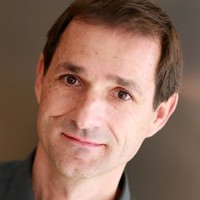
Portrait of Robin Kaiser
. External portrait hosted by Université Côte d’Azur, Institut de Physique de Nice. Source.Clinton Davisson and Lester Germer measured strong angular structure in electron scattering from a nickel crystal. Its dependence on incident electron energy agreed with a wavelength set by the electron momentum through the de Broglie wavelength. The crystal therefore supplied a periodic structure against which electron wave behavior could be tested. The Davisson–Germer experiment linked a tunable electron source and angularly resolved detector with the theoretical idea of matter waves.[ref]
A physicist whose route into research included a telephone-company job when he could not afford to continue at Chicago. He later worked at Bell Telephone Laboratories, retiring in 1946 after 29 years, and taught physics at Virginia in 1947–1949.[ref]
Clinton Davisson – Biographical. Biography: financial interruption, laboratory employment and visiting professorship
The Davisson–Germer experiment connects that industrial-laboratory work to electron diffraction and matter waves.
Portrait of Clinton Davisson
. Source. A physicist associated with the Barkhausen effect: the magnetization of a ferromagnet can change in discrete jumps even when the applied magnetic field varies smoothly. A pickup coil detects the accompanying changes in magnetic flux; amplification makes the irregular signal audible. The experiment connects a macroscopic noise measurement with sudden rearrangements of magnetic domains and the motion of domain walls.[ref]
The Barkhausen effect by Gianfranco Durin and Stefano Zapperi. Experimental methods, domain-wall interpretation and translation of Barkhausen’s original report
His work at Dresden also developed the experimental teaching of electrical engineering.[ref]Uni-Gebäude und ihre Namen: Barkhausen-Bau by Jörg Zaun. Heinrich Barkhausen section: founding of the Dresden institute and teaching
A physicist responsible for magnetism, materials and spintronics research at INRiM in 2023.[ref]
Settori scientifici omogenei by INRiM. January 2023 scientific sectors, ML5: Magnetismo, materiali e spintronica — Gianfranco Durin
Stefano Zapperi and Gianfranco Durin studied the statistics of Barkhausen effect avalanches in soft ferromagnets. Slowly changing the applied magnetic field produces bursts of magnetization as pinned domain walls move. Their 2000 work measured avalanche-size distributions in polycrystalline and amorphous materials and found distinct scaling classes in the slow-drive limit. Interpreting the data through the release of pinned domain walls connects irregular magnetic noise with a collective phase transition, including a quantitative relation between the distribution cutoff and the demagnetizing factor.[ref]
Scaling exponents for Barkhausen avalanches in polycrystals and amorphous ferromagnets by Gianfranco Durin and Stefano Zapperi. abstract: measured exponents, slow-drive limit and domain-wall interpretation
A physicist and professor of theoretical physics of matter at Milan.[ref]
Stefano Zapperi: university profile. Description, Professional positions: professor of theoretical physics of matter, University of Milan, from 2015

Portrait of Stefano Zapperi
. Francesc Font Clos (explicit caption credit on the official FAU article). External portrait hosted by Friedrich-Alexander-Universität Erlangen-Nürnberg. Source.Walter Schottky explained a fundamental source of electrical noise: even a steady mean electric current can fluctuate because charge arrives in discrete units. His 1918 paper studies intrinsic limits to detecting weak signals with amplifying tubes, distinguishing charge discreteness from thermal motion. For independent charge-transfer events, the modern shot noise relation is for the one-sided current-noise power spectral density. Its dependence on the mean current makes the noise a probe of charge-transfer statistics, rather than merely a defect of an amplifier.[ref]
Über spontane Stromschwankungen in verschiedenen Elektrizitätsleitern by Walter Schottky. Annalen der Physik 57, 541–567 (1918), introduction and charge-discreteness contribution
A physicist who held a theoretical-physics professorship at Rostock from 1923 to 1927.[ref]
Walter Schottky by Stiftung Werner-von-Siemens-Ring. Werdegang: professor of theoretical physics at Rostock, 1923–1927; subsequent Siemens research

Portrait of Walter Schottky
. Source. Samuel Jackson Barnett demonstrated that mechanical rotation can magnetize a material, the Barnett effect. Rotation couples to the angular momentum associated with microscopic magnetic moments, producing a magnetic response without using an applied field as the driving cause. The effect connects mechanical angular momentum with magnetization and complements experiments in which a change of magnetization produces mechanical motion. It makes the magnetic moment's connection with microscopic angular momentum experimentally accessible.[ref]
A physicist listed as professor of physics at the University of California, Los Angeles, in its 1927–1928 faculty announcement.[ref]
Announcement of the University of California at Los Angeles for the Academic Year 1927–28 by University of California, Los Angeles. Officers and Faculty, p. 15: Professor of Physics (1927–1928)
Pinned article: Introduction to the OurBigBook Project
Welcome to the OurBigBook Project! Our goal is to create the perfect publishing platform for STEM subjects, and get university-level students to write the best free STEM tutorials ever.
Everyone is welcome to create an account and play with the site: ourbigbook.com/go/register. We belive that students themselves can write amazing tutorials, but teachers are welcome too. You can write about anything you want, it doesn't have to be STEM or even educational. Silly test content is very welcome and you won't be penalized in any way. Just keep it legal!
Intro to OurBigBook
. Source. We have two killer features:
- topics: topics group articles by different users with the same title, e.g. here is the topic for the "Fundamental Theorem of Calculus" ourbigbook.com/go/topic/fundamental-theorem-of-calculusArticles of different users are sorted by upvote within each article page. This feature is a bit like:
- a Wikipedia where each user can have their own version of each article
- a Q&A website like Stack Overflow, where multiple people can give their views on a given topic, and the best ones are sorted by upvote. Except you don't need to wait for someone to ask first, and any topic goes, no matter how narrow or broad
This feature makes it possible for readers to find better explanations of any topic created by other writers. And it allows writers to create an explanation in a place that readers might actually find it.
Figure 1. Screenshot of the "Derivative" topic page. View it live at: ourbigbook.com/go/topic/derivativeVideo 2. OurBigBook Web topics demo. Source. - local editing: you can store all your personal knowledge base content locally in a plaintext markup format that can be edited locally and published either:This way you can be sure that even if OurBigBook.com were to go down one day (which we have no plans to do as it is quite cheap to host!), your content will still be perfectly readable as a static site.
- to OurBigBook.com to get awesome multi-user features like topics and likes
- as HTML files to a static website, which you can host yourself for free on many external providers like GitHub Pages, and remain in full control

Figure 2. You can publish local OurBigBook lightweight markup files to either OurBigBook.com or as a static website.
Figure 3. Visual Studio Code extension installation.
Figure 5. . You can also edit articles on the Web editor without installing anything locally. Video 3. Edit locally and publish demo. Source. This shows editing OurBigBook Markup and publishing it using the Visual Studio Code extension. 
- Infinitely deep tables of contents:




All our software is open source and hosted at: github.com/ourbigbook/ourbigbook
Further documentation can be found at: docs.ourbigbook.com
Feel free to reach our to us for any help or suggestions: docs.ourbigbook.com/#contact