Topics (119k) Articles (119k) Users (287) Discussions (237) Comments (383) Files (715) New article
Introduction to Spintronics by Aurélien Manchon (2020)
Source. The Spin on Electronics by Stuart Parkin
. Source. 2013.This is closely linked to the Pauli exclusion principle.
What does a particle even mean, right? Especially in quantum field theory, where two electrons are just vibrations of a single electron field.
Another issue is that if we consider magnetism, things only make sense if we add special relativity, since Maxwell's equations require special relativity, so a non approximate solution for this will necessarily require full quantum electrodynamics.
As mentioned at lecture 1 youtube.com/watch?video=H3AFzbrqH68&t=555, relativistic quantum mechanical theories like the Dirac equation and Klein-Gordon equation make no sense for a "single particle": they must imply that particles can pop in out of existence.
Bibliography:
- www.youtube.com/watch?v=Og13-bSF9kA&list=PLDfPUNusx1Eo60qx3Od2KLUL4b7VDPo9F "Advanced quantum theory" by Tobias J. Osborne says that the course will essentially cover multi-particle quantum mechanics!
- physics.stackexchange.com/questions/54854/equivalence-between-qft-and-many-particle-qm "Equivalence between QFT and many-particle QM"
- Course: Quantum Many-Body Physics in Condensed Matter by Luis Gregorio Dias (2020) from course: Quantum Many-Body Physics in Condensed Matter by Luis Gregorio Dias (2020) give a good introduction to non-interacting particles
No closed form solution, but good approximation that can be calculated by hand with the Hartree-Fock method, see hartree-Fock method for the helium atom.
Bibliography:
Carbon has electronic structure 1s2 2s2 2p2.
For term symbols we only care about unfilled layers, because in every filled layer the total z angular momentum is 0, as one electron necessarily cancels out each other:
- magnetic quantum number varies from -l to +l, each with z angular momentum to and so each cancels the other out
- spin quantum number is either + or minus half, and so each pair of electron cancels the other out
So in this case, we only care about the 2 electrons in 2p2. Let's list out all possible ways in which the 2p2 electrons can be.
There are 3 p orbitals, with three different magnetic quantum numbers, each representing a different possible z quantum angular momentum.
We are going to distribute 2 electrons with 2 different spins across them. All the possible distributions that don't violate the Pauli exclusion principle are:
m_l  +1  0 -1  m_L  m_S
     u_ u_ __    1    1
     u_ __ u_    0    1
     __ u_ u_   -1    1
     d_ d_ __    1   -1
     d_ __ d_    0   -1
     __ d_ d_   -1   -1
     u_ d_ __    1    0
     d_ u_ __    1    0
     u_ __ d_    0    0
     d_ __ u_    0    0
     __ u_ d_   -1    0
     __ d_ u_   -1    0
     ud __ __    2    0
     __ ud __    0    0
     __ __ ud   -2    0
where:
m_lis , the magnetic quantum number of each electron. Remember that this gives a orbital (non-spin) quantum angular momentum of to each such electronm_Lwith a capital L is the sum of the of each electronm_Swith a capital S is the sum of the spin angular momentum of each electron
For example, on the first line:we have:and so the sum of them has angular momentum . So the value of is 1, we just omit the .
m_l  +1  0 -1  m_L  m_S
u_ u_ __ 1 1- one electron with , and so angular momentum
- one electron with , and so angular momentum 0
TODO now I don't understand the logic behind the next steps... I understand how to mechanically do them, but what do they mean? Can you determine the term symbol for individual microstates at all? Or do you have to group them to get the answer? Since there are multiple choices in some steps, it appears that you can't assign a specific term symbol to an individual microstate. And it has something to do with the Slater determinant. The previous lecture mentions it: www.youtube.com/watch?v=7_8n1TS-8Y0 more precisely youtu.be/7_8n1TS-8Y0?t=2268 about carbon.
youtu.be/DAgEmLWpYjs?t=2675 mentions that is not allowed because it would imply , which would be a state
uu __ __ which violates the Pauli exclusion principle, and so was not listed on our list of 15 states.He then goes for and mentions:and so that corresponds to states on our list:Note that for some we had a two choices, so we just pick any one of them and tick them off off from the table, which now looks like:
ud __ __    2    0
u_ d_ __    1    0
u_ __ d_    0    0
__ u_ d_   -1    0
__ __ ud -2 0 +1 0 -1 m_L m_S
u_ u_ __ 1 1
u_ __ u_ 0 1
__ u_ u_ -1 1
d_ d_ __ 1 -1
d_ __ d_ 0 -1
__ d_ d_ -1 -1
d_ u_ __ 1 0
d_ __ u_ 0 0
__ d_ u_ -1 0
__ ud __ 0 0Then for the choices are:so we have 9 possibilities for both together. We again verify that 9 such states are left matching those criteria, and tick them off, and so on.
Ciro Santilli is against all affirmative action, except for one: giving amazing free eduction to the poor.
Notably, Ciro is against university entry quotas.
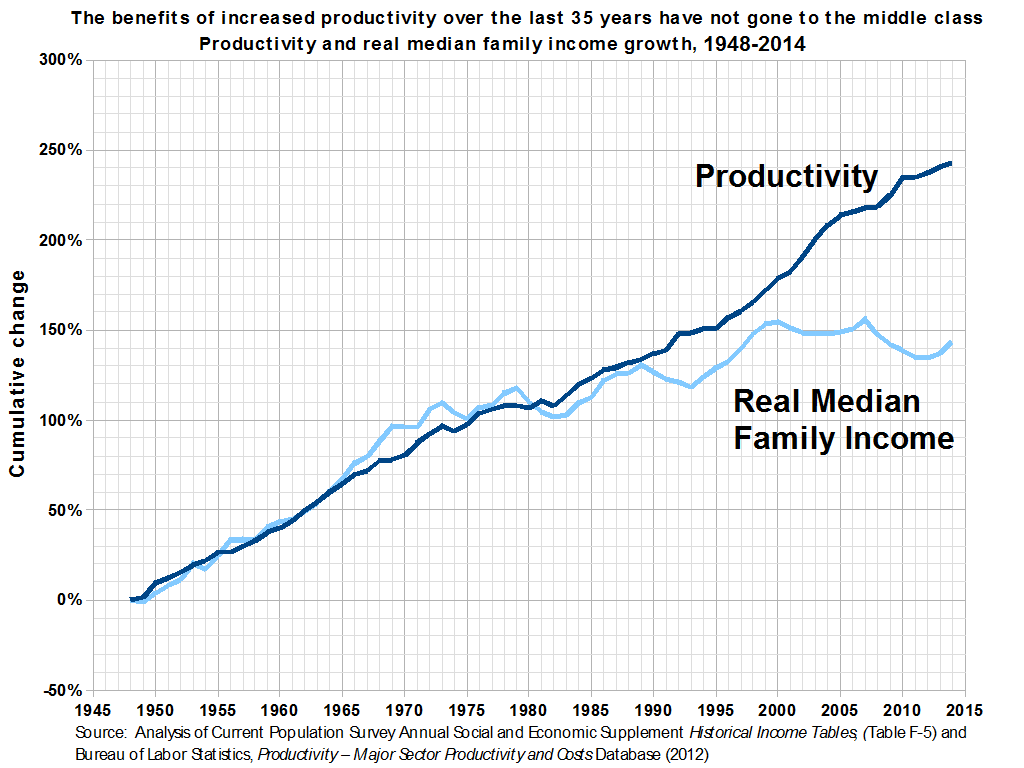
www.cbpp.org/wealth-concentration-has-been-rising-toward-early-20th-century-levels-2 shows historical for top 1% and 0.5% from 1920 to 2010.
TODO why is it so hard to find a proper cumulative distribution function-like curve? OMG. This appears to be also called a Lorenz curve.
Wealth Inequality in America by politizane
. Source. You can then detect one of the photons, and when you do you know that the other one is there as well and ready to be used. two photon interference experiment comes to mind, which is the basis of photonic quantum computer, where you need two photons to be produced at the exact same time to produce quantum entanglement.
Features Alan Migdall of the National Institute of Standards and Technology. Produced by the Joint Quantum Institute (JQI).
Mentions that this phenomena is useful to determine the efficiency of a single photon detector, as you have the second photon of the pair as a control.
Also briefly describes how the input energy and momentum must balance out the output energy and momentum of the two photons coming out (determined by the output frequency and angle).
Shows the crystal close up of the crystal branded "Cleveland Crystals Inc.". Mentions that only one in a billion photon gets scattered.
Also shows a photomultiplier tube.
Then shows their actual optical table setup, with two tunnels of adjustable angle to get photons with different properties.
Very short whiteboard video by Peter Mosley from the University of Bath, but it's worth it for newbs. Basically describes spontaneous parametric down-conversion.
One interesting thing he mentions is that you could get single photons by making your sunglasses thicker and thicker to reduce how many photons pass, but one big downside problem is that then you don't know when the photon is going to come through, that becomes essentially random, and then you can't use this technique if you need two photons at the same time, which is often the case, see also: two photon interference experiment.
Can be achieved in two ways it seems:
- macroscopic beam splitter and optical table
- photolithography
Animation of Hong-Ou-Mandel Effect on a silicon like structure by Quantum Light University of Sheffield (2014): www.youtube.com/watch?v=ld2r2IMt4vg No maths, but gives the result clear: the photons are always on the same side.
- quantum dot source. TODO how do you produce identical photons from two separate quantum dots? See also: quantum dot single photon source.
- superconducting nanowire detector. So the device has to be cooled then? Video "Jeremy O'Brien: "Quantum Technologies" by GoogleTechTalks (2014)" youtube.com/watch?v=7wCBkAQYBZA&t=2497 however says that semiconducting devices can also be used
Pinned article: Introduction to the OurBigBook Project
Welcome to the OurBigBook Project! Our goal is to create the perfect publishing platform for STEM subjects, and get university-level students to write the best free STEM tutorials ever.
Everyone is welcome to create an account and play with the site: ourbigbook.com/go/register. We belive that students themselves can write amazing tutorials, but teachers are welcome too. You can write about anything you want, it doesn't have to be STEM or even educational. Silly test content is very welcome and you won't be penalized in any way. Just keep it legal!
Intro to OurBigBook
. Source. We have two killer features:
- topics: topics group articles by different users with the same title, e.g. here is the topic for the "Fundamental Theorem of Calculus" ourbigbook.com/go/topic/fundamental-theorem-of-calculusArticles of different users are sorted by upvote within each article page. This feature is a bit like:
- a Wikipedia where each user can have their own version of each article
- a Q&A website like Stack Overflow, where multiple people can give their views on a given topic, and the best ones are sorted by upvote. Except you don't need to wait for someone to ask first, and any topic goes, no matter how narrow or broad
This feature makes it possible for readers to find better explanations of any topic created by other writers. And it allows writers to create an explanation in a place that readers might actually find it.
Figure 1. Screenshot of the "Derivative" topic page. View it live at: ourbigbook.com/go/topic/derivativeVideo 2. OurBigBook Web topics demo. Source. - local editing: you can store all your personal knowledge base content locally in a plaintext markup format that can be edited locally and published either:This way you can be sure that even if OurBigBook.com were to go down one day (which we have no plans to do as it is quite cheap to host!), your content will still be perfectly readable as a static site.
- to OurBigBook.com to get awesome multi-user features like topics and likes
- as HTML files to a static website, which you can host yourself for free on many external providers like GitHub Pages, and remain in full control

Figure 2. You can publish local OurBigBook lightweight markup files to either OurBigBook.com or as a static website.
Figure 3. Visual Studio Code extension installation.
Figure 5. . You can also edit articles on the Web editor without installing anything locally. Video 3. Edit locally and publish demo. Source. This shows editing OurBigBook Markup and publishing it using the Visual Studio Code extension. 
- Infinitely deep tables of contents:



All our software is open source and hosted at: github.com/ourbigbook/ourbigbook
Further documentation can be found at: docs.ourbigbook.com
Feel free to reach our to us for any help or suggestions: docs.ourbigbook.com/#contact