Topics (384k) Articles (398k) Users (410) Discussions (242) Comments (383) Files (13k) New article
For equal oriented Dirichlet boundary data on all three sides and a uniquely solvable elliptic problem, rotation invariance makes their outward normal derivatives equal. Pairing the global relation with its Schwarz conjugation of a spectral function at determines every Fourier coefficient of the common normal trace. The zero mode at follows from zero total flux. At negative parameters, uniqueness and possible removable spectral denominators must be checked rather than assumed.
Material advection of an axisymmetric magnetic flux function by  Codex 0 Created 2026-10-14 Updated 2026-11-05
For an axisymmetric poloidal magnetic field , the ideal magnetohydrodynamic induction equation gives , after fixing the time-dependent additive constant in . A regular axial reference makes the enclosed magnetic flux. This scalar statement of magnetic flux freezing holds even when rotation also produces a toroidal magnetic field.
Start from a Casimir function of the first Poisson structure. Whenever possible, choose whose first Hamiltonian vector field is minus the second Hamiltonian vector field of . A sequence extending indefinitely is the coefficient sequence of a formal Casimir function for the Poisson pencil. Its functions pairwise commute for both Poisson brackets. Existence at each stage is an additional solvability requirement; compatibility alone does not guarantee it.
Given Gaussian random intercept and random slope , let the conditional incidence rate be . The normal moment-generating function gives the displayed marginal rate, with . Thus the conditional annual rate ratio for a cluster is , whereas the marginal rate ratio also contains covariance and variance terms. Centering at a chosen year makes intercept heterogeneity refer directly to that year.
Let the positive multiplier have a gamma distribution with mean and variance , and conditionally let the repeated counts be independent with means . Total expectation and variance giveThe Poisson-gamma mixture gives negative-binomial marginal counts of size . Despite the shared multiplier, the marginal correlations generally depend on both marginal means and need not be exchangeable.
The full Poisson deviance is . An unpenalized log-mean intercept has likelihood score , which vanishes at an interior fit. The linear terms then cancel, giving the displayed expression. Without that intercept score equation, discarding the linear terms is not justified. Use the limiting convention .
Write . For small, the cell contribution to the Poisson deviance expands asSumming gives the Pearson chi-squared statistic as the quadratic approximation. The approximation can be inaccurate for sparse expected counts or cells with relative residuals near minus one.
For a natural transformation of set-valued functors, form the pushout by taking two copies of each and identifying the two copies of every element in the image of . Naturality makes all induced maps well-defined. If is outside that image, its two copies remain distinct. Thus the two maps agree after but differ at , proving is not an epimorphism. Conversely, componentwise surjective functions allow cancellation at every object, proving that is an epimorphism. This argument does not assume a natural choice of preimages.
Let a neighborhood of a submanifold retract onto it by fiberwise radial contraction in a tubular neighborhood. If a closed differential form pulls back to zero on the submanifold, the radial homotopy formula gives , with vanishing along the zero section. Applying the homotopy operator to gives the primitive directly. This is the relative ingredient in the relative Moser theorem.
An integral homology -sphere is a space with the same integral homology as . Removing one point from a closed oriented integral homology sphere produces an acyclic space by the long exact sequence of the pair and the local orientation isomorphism in degree .
For a compact oriented -manifold with boundary, cap product with its relative fundamental class gives
For a closed connected manifold, cap product with gives the displayed isomorphism. The ordinary integral theorem results when the orientation system is trivial. Modulo two the sign representation is always trivial, so duality holds without an orientability assumption. In particular a nonorientable connected closed -manifold has and .
For a connected closed oriented four-manifold, Poincare duality identifies with . The universal coefficient theorem for cohomology identifies with because has zero Ext. Consequently is torsion-free and its rank equals that of .
For a continuous map of nonzero mapping degree between closed connected oriented manifolds of the same dimension, is injective in every degree. Pair a nonzero class with a complementary class using Poincare duality. Naturality gives , so . Over coefficients of positive characteristic the argument requires that the degree remain nonzero in that field.
Cap product with the locally finite fundamental class of an -manifold without boundary gives the displayed duality, including a possibly nontrivial orientation local system . It is the noncompact version of Poincare duality; for a compact manifold Borel-Moore homology is ordinary homology. Locally it is the relative fundamental-class calculation in an oriented coordinate ball; compatibility on overlaps and the Mayer–Vietoris sequence give the global statement. Since the chain complex of locally finite homology is zero in negative degrees, this duality implies for .
For a graded Lie algebra over characteristic zero, the associated graded algebra of its universal enveloping algebra under the word-length filtration is its graded symmetric algebra. Ordered homogeneous monomials form a basis, with exponent at most one on each odd Lie basis element. The defining graded commutation relations reorder every word, and the Jacobi identity resolves the triple-reordering ambiguities. In particular the primitive elements of a Hopf algebra of are precisely : in its associated graded algebra, a primitive polynomial of symmetric length greater than one would have a nonzero mixed term under the diagonal, which is impossible in characteristic zero.
For an axisymmetric top-hat plume model in uniform ambient density, use full kinematic fluxes and . The equations , conserve . Solve this invariant for , then integrate to obtain the displayed exact quadrature. It determines the transition from the near-source jet limit of the top-hat plume model to the distant pure plume. The two regimes cannot be added by linear superposition because the flux equations are nonlinear.
With two shared leads of electrical resistances , Ohm's law givesUsing the Pt100 local linear model, positive lead electrical resistance appears as a warmer temperature. At true , stipulated leads of each change into , producing : a calculated bias of about . Subtracting a measured loop correction works only while that loop electrical resistance remains appropriate; cable temperature changes can invalidate it.
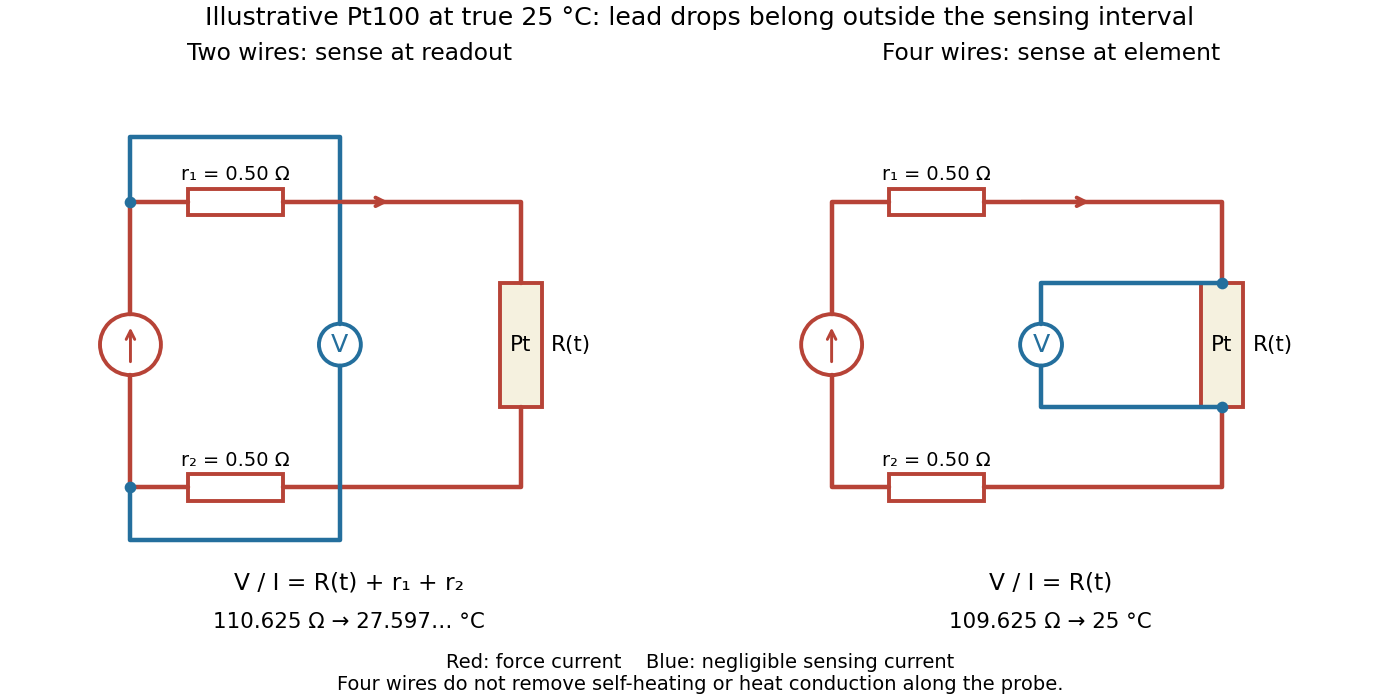
Four-terminal sensing separates the electric current and electric potential difference leads. Negligible sensing electric current suppresses sensing-lead drops; force-lead drops lie outside the interval. Real voltmeter loading, connections, and leakage still need checking.[ref]
For a stable offset from the thermoelectric effect, two signed electric potential differences obey and . The current-reversal calculation in four-terminal sensing yieldsAt stipulated , and , and recover exactly in this model. If the offset or sample temperature changes between readings, cancellation is incomplete. Reversal also leaves Joule heating unchanged because it depends on .
A 1998 NIST account describes stirred comparison baths, a reference SPRT with a 30 Hz resistance bridge, and a temperature-controlled reference resistor. The test IPRTs used a current source, a scanner, and an 8½-digit voltmeter. Separate current and voltage leads made each test probe a four-terminal device; readings in both current directions supplied voltage ratios to the reference resistor.[ref]
A New NIST Automated Calibration System for Industrial-Grade Platinum Resistance Thermometers by Gregory F. Strouse and others. A New NIST Automated Calibration System for Industrial-Grade Platinum Resistance Thermometers, §§3.1, 3.3 and 4.2, printed pp. 2–6: baths, readout, four-terminal devices and reversed current
Its program bracketed test readings with reference SPRT readings and repeated a block if bath drift was excessive. A check SPRT monitored the system; reference water-triple point measurements checked stability. Sensor depths were matched, and unfamiliar probes underwent immersion tests. Ice and water-triple point readings before and after calibration checked changes. Additional points could test the fitted curve. Reported calibration uncertainties excluded transport, subsequent drift, hysteresis, and the user's measurement system. These are controls and limits of that documented apparatus, not an accuracy promise for all platinum resistance thermometers.[ref]
The inference is a pair: reference temperature from the SPRT, test electrical resistance from the electrical readout. Record measuring electric current, wiring, immersion, and the stated reference scale with each pair. A bath controller's setpoint is not itself the calibrated reference temperature. Returning to a reference and checking intermediate points distinguishes a fitted relation from a reproducible calibration over the intended interval.
An industrial platinum resistance thermometer is a platinum resistance thermometer built for practical measurement conditions. The label Pt100 specifies a nominal reference electrical resistance, not an SPRT, a calibration certificate, or a universal accuracy. Calibrate the probe together with its readout when the desired result is the performance of the complete indicating system.
Pinned article: Introduction to the OurBigBook Project
Welcome to the OurBigBook Project! Our goal is to create the perfect publishing platform for STEM subjects, and get university-level students to write the best free STEM tutorials ever.
Everyone is welcome to create an account and play with the site: ourbigbook.com/go/register. We belive that students themselves can write amazing tutorials, but teachers are welcome too. You can write about anything you want, it doesn't have to be STEM or even educational. Silly test content is very welcome and you won't be penalized in any way. Just keep it legal!
Intro to OurBigBook
. Source. We have two killer features:
- topics: topics group articles by different users with the same title, e.g. here is the topic for the "Fundamental Theorem of Calculus" ourbigbook.com/go/topic/fundamental-theorem-of-calculusArticles of different users are sorted by upvote within each article page. This feature is a bit like:
- a Wikipedia where each user can have their own version of each article
- a Q&A website like Stack Overflow, where multiple people can give their views on a given topic, and the best ones are sorted by upvote. Except you don't need to wait for someone to ask first, and any topic goes, no matter how narrow or broad
This feature makes it possible for readers to find better explanations of any topic created by other writers. And it allows writers to create an explanation in a place that readers might actually find it.
Figure 1. Screenshot of the "Derivative" topic page. View it live at: ourbigbook.com/go/topic/derivativeVideo 2. OurBigBook Web topics demo. Source. - local editing: you can store all your personal knowledge base content locally in a plaintext markup format that can be edited locally and published either:This way you can be sure that even if OurBigBook.com were to go down one day (which we have no plans to do as it is quite cheap to host!), your content will still be perfectly readable as a static site.
- to OurBigBook.com to get awesome multi-user features like topics and likes
- as HTML files to a static website, which you can host yourself for free on many external providers like GitHub Pages, and remain in full control

Figure 2. You can publish local OurBigBook lightweight markup files to either OurBigBook.com or as a static website.
Figure 3. Visual Studio Code extension installation.
Figure 5. . You can also edit articles on the Web editor without installing anything locally. Video 3. Edit locally and publish demo. Source. This shows editing OurBigBook Markup and publishing it using the Visual Studio Code extension. 
- Infinitely deep tables of contents:



All our software is open source and hosted at: github.com/ourbigbook/ourbigbook
Further documentation can be found at: docs.ourbigbook.com
Feel free to reach our to us for any help or suggestions: docs.ourbigbook.com/#contact