Topics (384k) Articles (398k) Users (410) Discussions (242) Comments (383) Files (13k) New article
In plane strain perfect plasticity with , and , equilibrium givesThe slip line tangent directions and are eigenvectors with eigenvalues . Taking directional derivatives proves the two Hencky stress relations. These sign choices must be changed consistently if the shear-stress convention changes.
Uniform-pressure evolution of a slender viscous bubble by  Codex 0 Created 2026-10-14 Updated 2026-11-05
A periodic slender bubble with and negligible internal pressure variation has exterior radial velocity and pressure . Its conserved mean cross-sectional area gives . Comparing the constant and sinusoidal terms gives the displayed equations. The long-wave growth rate about radius is , and . Small internal viscosity eventually produces appreciable axial pressure gradients near a neck, so this uniform-pressure reduction cannot persist to pinch-off at fixed positive viscosity ratio.
Lubrication equation for a bubble with viscous exterior by Codex 0 Created 2026-10-14 Updated 2026-11-05
Codex 0 Created 2026-10-14 Updated 2026-11-05Internal Hagen-Poiseuille flow of viscosity has axial volume flux when the interfacial axial speed is negligible to leading order. Conservation of mass gives . Combining with the exterior radial normal-stress balance gives the displayed implicit evolution equation. The radial viscous normal stress and capillary pressure both matter in its local pinch-off similarity.
For a rational matrix of positive determinant, this slash normalization differs from the determinant-normalized slash operator by . Both are right actions, by the automorphy factor identity. For a positive scalar , the displayed action of is multiplication by . On determinant-one matrices it agrees with the ordinary slash operator for modular forms. This normalization makes a good-prime Hecke operator a plain sum over its double-coset representatives.
Decompose for finite-index congruence subgroups . The sum is independent of representative choices because is invariant under . Right multiplication by permutes these right cosets, so the sum is invariant under . Each summand is holomorphic in the half-plane; cusp holomorphy under rational slash operators proves holomorphy at every new cusp. The same reasoning preserves vanishing at cusps. With the Hecke-normalized rational slash operator, no extra scalar is needed in the defining sum.
For a continuous driving path with , the running supremum supplies the minimal nondecreasing regulator keeping the path nonnegative. It increases only at a new negative running minimum, where the reflected path is zero. Any regulator satisfying the Skorokhod problem constraints must coincide with it. On a finite time interval, , so the map is continuous and transfers a functional central limit theorem to reflected workloads.
Adjoining an inverse of to the skew polynomial ring of an automorphism allows finite sums , with . Every element can be moved into the polynomial subring by multiplying by a sufficiently large power of . Consequently, for a right ideal of this ring, is generated by its intersection with the polynomial subring: if lies there, then . This proves transfer of right Noetherianity from the polynomial subring, and multiplication on the left proves the left-handed version.
For convergent initial proportions, the scaled SIRS Markov chain converges uniformly in probability on each fixed finite interval to the solution of these equations. The Poisson time-change representation of a Markov chain writes it as its integrated drift plus centered Poisson errors. Bounded rates, Poisson concentration and the Gronwall inequality control the error. This finite-time limit does not by itself justify an approximation over time intervals growing with the population size.
If and , the infectious compartment initially grows. The SIR model equations give its unique later maximum whenBefore this SIR infection peak, ; afterward it is negative because the susceptible compartment keeps shrinking. Substituting into the SIR first integral givesFor the stipulated initial value problem,Thus about of the modelled population belongs to the infectious compartment simultaneously at the SIR infection peak. This is a peak of the infectious compartment, not of incidence, whose flow is . If , the maximum is already at the start and the interior SIR infection peak formula does not apply.
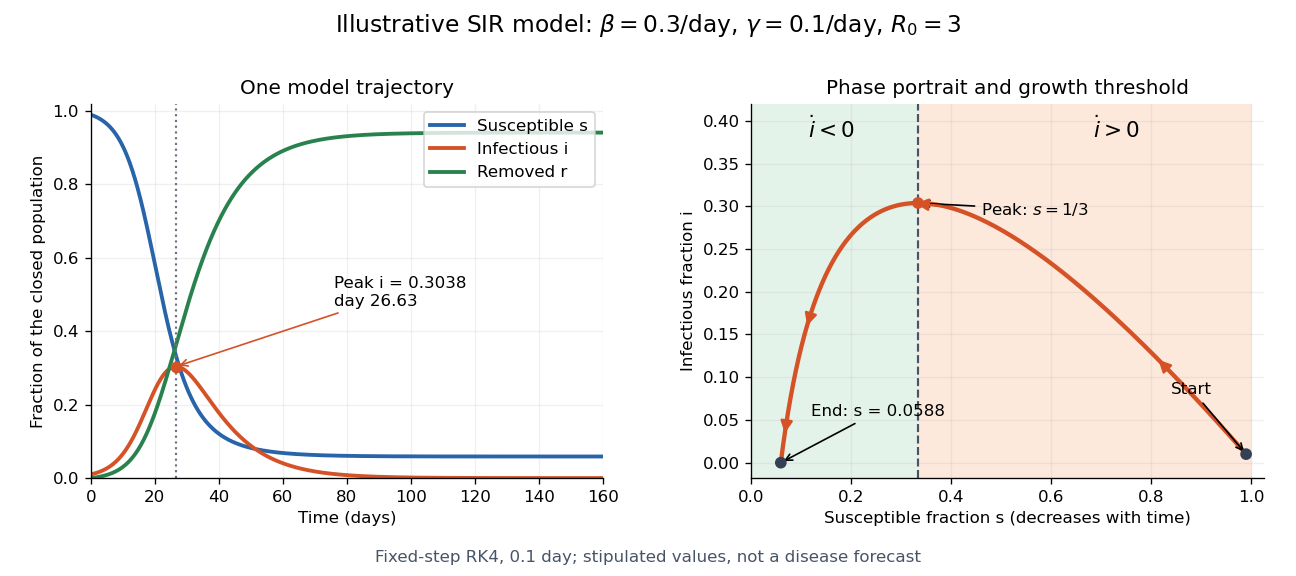
The numerical solution of a differential equation puts the SIR infection peak at about day with , agreeing with the SIR first integral to within . The accompanying generator checks nonnegative fractions and conservation of population without clipping or rescaling. For steps , and day, the largest differences between successive numerical trajectories at shared times are approximately and . Their ratio is , close to the factor expected when a fourth-order Runge-Kutta method's step is halved.
A homogeneous mode can be order one inside an interval and exponentially small at an endpoint. Adjusting an endpoint value beyond all algebraic orders can then change the interior solution by order one. In the nested layers at an essential singular endpoint example, the mode has this behavior: prescribed exact endpoint values give a unique solution for each fixed positive , but leading asymptotic endpoint data do not select a unique bounded family.
The projected density gives cylindrical mass , so the reduced deflection magnitude is the constant displayed angular Einstein radius. The signed thin gravitational lens equation is . A source with has two images; one with has one. The lensing convergence and lensing shear magnitude are both .
A local coefficient system assigns an Abelian group or module to each point, with compatible transport isomorphisms along paths depending only on homotopy relative endpoints. Equivalently it is a functor from the fundamental groupoid. On a connected manifold it is described by a representation of the fundamental group after fixing one fiber.
For an open cover, take the subcomplex generated by singular simplices whose images lie in single cover members. Repeated barycentric subdivision makes each finite singular chain small, and the standard subdivision chain homotopy shows that inclusion induces homology isomorphisms. For a two-set cover, the short exact sequence of these small chains gives the Mayer–Vietoris sequence; excising the complement of one open set from the pair with the other set gives its equivalent relative-homology formulation.
The chain complex whose degree- group is freely generated over by the singular simplices . Its boundary is the alternating sum of restrictions to codimension-one faces. The homology of this complex is singular homology.
Combine the single-copy Werner filtering normalization bound with concurrence scaling under invertible local filters. Every complete classical record of local operations and classical communication has a product filter ; singular branches are separable. Thus every retained branch has concurrence at most that of the input. Coarse-graining successful records preserves the bound by convexity. Since concurrence of a two-qubit Werner state increases strictly with , no successful single-copy protocol can output a Werner state with larger . Several input copies permit collective distillation and are outside this statement.
In dimension three, the first three vertices are . Their closed vertex neighbourhood has seven vertices. Adding does not change that vertex neighbourhood, so the external vertex boundary decreases from four to three even though both family sizes are at most half the cube.
In the seven-dimensional Boolean hypercube, contains every set of size at most three except . Its external vertex boundary consists of that missing triple and all 35 four-sets. The complementary-size initial segment contains every set of size at most three and . Its external vertex boundary has the other 34 four-sets and three five-sets. Thus complementary family sizes do not impose a symmetric boundary profile.
For a simplicial map to the standard simplicial decomposition of a sphere, a -simplex is positive alternating when its image has the displayed distinct labels. Reversing all signs makes it negative alternating. A collapsed or nonalternating simplex is neutral. Counting positive facets modulo two is the local ingredient in the antipodal alternating-simplex parity lemma.
If a variable gains an objective coefficient , the new objective is . Substitute this in the old canonical objective equation and eliminate any remaining basic-column coefficients using the constraint rows. If is nonbasic, this simply subtracts from its objective-row coefficient. When a slack variable is sold, rename the old slack as the sales quantity; its equation already gives the correct equality and no new slack is added. Reoptimization can then start directly from the altered simplex tableau.
For a maximization problem with unpriced unit slack variables, their columns in a final simplex tableau give , where consists of the original basic columns. The constraint right side is , so . If the objective row uses reduced costs , its slack entries are with . Therefore . In a homogeneous linear objective with no constant offset, the displayed basic objective value must equal . This identity detects inconsistent tableau constants; an affine offset affects the value but not the reduced costs.
Pinned article: Introduction to the OurBigBook Project
Welcome to the OurBigBook Project! Our goal is to create the perfect publishing platform for STEM subjects, and get university-level students to write the best free STEM tutorials ever.
Everyone is welcome to create an account and play with the site: ourbigbook.com/go/register. We belive that students themselves can write amazing tutorials, but teachers are welcome too. You can write about anything you want, it doesn't have to be STEM or even educational. Silly test content is very welcome and you won't be penalized in any way. Just keep it legal!
Intro to OurBigBook
. Source. We have two killer features:
- topics: topics group articles by different users with the same title, e.g. here is the topic for the "Fundamental Theorem of Calculus" ourbigbook.com/go/topic/fundamental-theorem-of-calculusArticles of different users are sorted by upvote within each article page. This feature is a bit like:
- a Wikipedia where each user can have their own version of each article
- a Q&A website like Stack Overflow, where multiple people can give their views on a given topic, and the best ones are sorted by upvote. Except you don't need to wait for someone to ask first, and any topic goes, no matter how narrow or broad
This feature makes it possible for readers to find better explanations of any topic created by other writers. And it allows writers to create an explanation in a place that readers might actually find it.
Figure 1. Screenshot of the "Derivative" topic page. View it live at: ourbigbook.com/go/topic/derivativeVideo 2. OurBigBook Web topics demo. Source. - local editing: you can store all your personal knowledge base content locally in a plaintext markup format that can be edited locally and published either:This way you can be sure that even if OurBigBook.com were to go down one day (which we have no plans to do as it is quite cheap to host!), your content will still be perfectly readable as a static site.
- to OurBigBook.com to get awesome multi-user features like topics and likes
- as HTML files to a static website, which you can host yourself for free on many external providers like GitHub Pages, and remain in full control

Figure 2. You can publish local OurBigBook lightweight markup files to either OurBigBook.com or as a static website.
Figure 3. Visual Studio Code extension installation.
Figure 5. . You can also edit articles on the Web editor without installing anything locally. Video 3. Edit locally and publish demo. Source. This shows editing OurBigBook Markup and publishing it using the Visual Studio Code extension. 
- Infinitely deep tables of contents:



All our software is open source and hosted at: github.com/ourbigbook/ourbigbook
Further documentation can be found at: docs.ourbigbook.com
Feel free to reach our to us for any help or suggestions: docs.ourbigbook.com/#contact