Topics (384k) Articles (398k) Users (410) Discussions (242) Comments (383) Files (13k) New article

For the positive scalar Laplace-Beltrami operator on a closed -dimensional Riemannian manifold, the number of eigenvalues at most , counted with multiplicity, has the displayed leading asymptotic. The exponent determines the dimension and the coefficient determines the total volume of the Riemannian metric. There is an analogous result with fixed Dirichlet boundary conditions or Neumann boundary conditions on a compact smooth domain.
For the positive Laplace-Beltrami operator on a closed manifold, the wave trace is the distribution , counting multiplicities. The series is interpreted after testing against smooth compactly supported functions, rather than as an ordinarily convergent sum. Its singularities relate the spectrum to the length spectrum of closed geodesics, through the Duistermaat-Guillemin trace formula.
In units , an isentropic perfect fluid in general relativity has sound speed . Writing gives and . Linearized particle number conservation in a relativistic fluid and the relativistic Euler equation then yield acoustic waves with this speed. Positive is needed for ordinary acoustic stability; a causal fluid model additionally requires .
For an integer , the last-column map has fiber , included as . Local completion of a unit vector by the Gram-Schmidt process gives local fiber bundle charts. Consequently it has the homotopy lifting property and the long exact sequence of homotopy groups of a fibration.
All the special orthogonal groups are connected, and their second homotopy groups vanish. The rotation circle gives . Conjugation by unit quaternions gives the twofold universal cover , so and . The special orthogonal sphere fibration propagates the first two homotopy groups for . In dimension four its exact sequence has a zero map from the torsion group to , giving . For all positive groups vanish, and .
For positive distinct diagonal entries , the critical points of this function are diagonal sign matrices with . Criticality forces symmetric; its square is , so it commutes with the distinct-spectrum diagonal matrix and is diagonal. In the skew coordinates its Hessian is . The sign of each parenthesis is that of , giving Morse index .
The lightest supersymmetric particle is the least massive sparticle in a given spectrum. Exact R-parity makes it stable: a lighter final state cannot contain another odd particle, while a final state of ordinary particles is even. A neutral weakly interacting lightest supersymmetric particle is a possible dark matter constituent, but its cosmological abundance must be computed separately.
In the MSSM, electroweak symmetry breaking mixes the neutral bino, wino and two neutral higgsinos into four neutral Majorana spinor mass eigenstates, the neutralinos. A neutralino can be the lightest supersymmetric particle; with conserved R-parity it then provides a stable possible dark matter candidate.
A maximal ideal of has a common zero: otherwise finitely many have no simultaneous zero, and is invertible, a contradiction. If the common zero is , then is the kernel of evaluation at by maximality. Thus every algebra character is point evaluation. Continuous functions separate distinct points of the unit circle, and the evaluation bijection is a homeomorphism for the Gelfand topology.
Choose in each bounded component of . Every nonvanishing continuous function on extends nonvanishingly to a neighborhood. Use finite-hole neighborhoods of a planar compact set within that neighborhood, and subtract its finite list of winding obstructions by multiplying by . The continuous logarithm lifting criterion gives the remaining exponential. Uniqueness follows by extending a purported logarithm of such a finite product to a smaller neighborhood: a small multiplicative error has a local logarithm, whereas its winding around the th hole is . Thus all vanish. The quotient by exponentials is the free abelian group on the bounded complementary components; each element has finite support.
At fixed temperature and pressure, compare fully specified initial and final states usingThe entropy change is for the whole selected system, including both solute and solvent. Dispersing a solute can increase accessible arrangements while orienting nearby solvent molecules restricts others. One picture of an ordered hydration shell cannot determine the sign of the total entropy change. A negative Gibbs free energy change favors the specified process; it does not determine its reaction rate.[ref]
An illustrative enthalpy accounting path separates solute constituents, reorganizes the solvent, and establishes their interactions:This is a chosen decomposition between compatible states, not a measured sequence. If a gaseous-ion-to-chemical solution solvation term already includes solvent reorganization, do not add that reorganization a second time. Lattice enthalpy from solution calorimetry gives the alternative Hess's law route that combines lattice separation with the complete hydration of ions term.[ref]
11.1 The Dissolution Process. Chemistry 2e by Paul Flowers and others; “The Formation of Solutions”, Figure 11.4
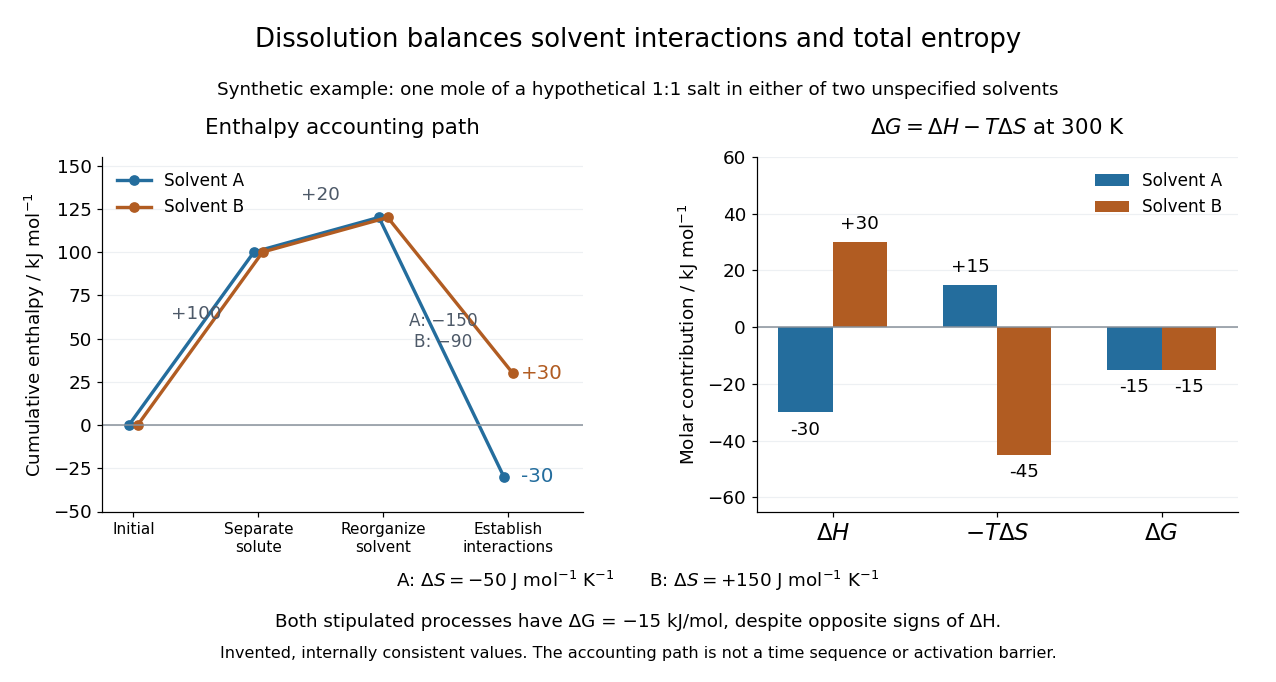
Synthetic dissolution bookkeeping: solvent interactions change the enthalpy balance, while total entropy also enters the Gibbs free energy
. Original stipulated model for one mole of a hypothetical 1:1 salt at , with two unspecified solvents. No plotted value is a measurement or a claim about a named chemical substance. The accounting path is not a reaction coordinate or an activation energy. Details.The invented inputs are for separation and for solvent reorganization, in . Interaction terms of in solvent A and in solvent B give and . Stipulated total entropy changes of and give and at . Both selected processes therefore have . This deliberately constructed comparison shows why the signs of the enthalpy and Gibbs free energy changes need not agree; it does not predict either solvent's solubility.
For incremental dissolution at a particular composition, the relevant chemical potential difference also depends on thermodynamic activities. At chemical equilibrium that driving difference vanishes. A quoted standard Gibbs free energy change and the finite change between arbitrary mixtures answer different questions; use compatible standard states and the reaction quotient when discussing solubility.
The motivating calorimetry experiment is especially instructive. A weighed potassium chloride sample dissolves in a known amount of water in a platinum-lined, shielded calorimeter; a quartz-oscillator thermometer and measured electrical heating provide the readouts. Electrical calibration before and after the reaction, comparison with a resistance thermometer, and checks on residual water and particle size constrain errors. The inspected authored article reports positive enthalpy of solution at for the specified dilution, despite complete dissolution. This is a combined enthalpy balance, not an isolated solvation free energy or direct single-ion hydration of ions measurement. Shield tracking and final concentration matter; the existing lattice enthalpy from solution calorimetry discussion gives the numerical result and the conversion limits.[ref]
The Enthalpy of Solution of SRM 1655 (KCl) in H2O by Marthada V. Kilday. Abstract, §§3–4 and conclusion; inspected indexed authored text, direct PMC access challenged
For transfer of the same species from a gaseous reference state into a solvent , define the molar solvation free energy byHere is a standard chemical potential. Negative solvation free energy means that transfer into the stated solvent lowers the Gibbs free energy relative to the stated gaseous reference. Include solute-solvent interactions, making room in the solvent, and its reorganization; counting only a favorable pair interaction omits part of the transfer.[ref]
State the temperature, gaseous reference pressure, dissolved reference concentration or other standard state convention, and species identity. Reference-state changes alter the quoted solvation free energy. For example, with an ideal dilute thermodynamic activity , replacing by while preserving the physical chemical potential requires to increase by . Thus the corresponding solvation free energy increases by if the gaseous reference stays fixed. This follows directly from , with the molar gas constant.
Desolvation removes some or all of the solvent environment of a species. Removing a hydration shell does not remove an ion's electric charge. Complete reversal of a specified solvation transfer reverses its Gibbs free energy and enthalpy changes when the same states and conventions are used. Partial desolvation, exchange of one solvent for another, and creation of a gaseous species have different endpoints; their costs need not match.
Dissolution transfers material into a chemical solution. It can include separation from an ionic crystal and solvation, or dispersal of neutral molecules. For sucrose and sodium chloride, respectively,Here specifies water as the solvent; it does not specify a fixed number of attached water molecules. The neutral sucrose remains molecular. Dissociation of an ionic compound separates pre-existing ions in the second example; solvation stabilizes their new surroundings.[ref]
11.1 The Dissolution Process. Chemistry 2e by Paul Flowers and others; Opening molecular and ionic dissolution examples
[ref]Ionization instead creates ions from neutral species. Hydrogen chloride reacting with water illustrates protonation of water rather than mere rearrangement of a hydration shell:The hydronium and negative ion together preserve total electric charge. Solvation can influence this chemical reaction, but an ion's solvation does not itself change its net electric charge.[ref]
11.2 Electrolytes. Chemistry 2e by Paul Flowers and others; “Covalent Electrolytes”, HCl proton-transfer example
A solvation shell is the region of solvent constituents surrounding a solute, with local arrangements influenced by their interactions. The first solvation shell contains the closest neighbors under a stated distance or interaction criterion. A coordination number counts those neighbors; it requires such a criterion and can fluctuate. Neither a drawn ring nor a few illustrated molecules determines a measured coordination number.
In a liquid, a solvation shell is an evolving neighborhood: solvent molecules reorient and exchange with the surroundings. Different ions can produce different local dynamics. Spectroscopic measurement of hydration dynamics provides an experimental way to distinguish some of those environments without pretending that a shell is a fixed cage.
For the solid ellipsoid with positive semi-axes, set , , . The Jacobian determinant of this inverse coordinate map is , and becomes the unit ball. Symmetry gives , proving the displayed moment. The other two moments follow by interchanging the semi-axes; mixed moments vanish by reflection symmetry.
A steradian is the solid angle subtended at a sphere's center by a patch of surface area . The whole sphere subtends . In the SI, the steradian has unit one; retaining its symbol identifies a solid angle, just as radians identify an angle. A dimensionless quantity still needs its physical meaning specified.[ref]
The magnetic energy stored in a linear solenoid of constant self-inductance isin the long-solenoid approximation. The first formula is an inductor relation; the second identifies its storage with magnetic energy in the interior magnetic field, under the vacuum-core approximation. This agreement joins the electrical circuit description to the spatial magnetic field description. The expression is the vacuum magnetic energy density. [ref]
https://s3.amazonaws.com/edx-textbooks/mit_802_textbook/Chapter11.pdf. MIT 8.02 course notes, §11.3: magnetic energy and its density
.A short derivation starts from the terminal electric potential difference , with positive electric current entering the terminal at higher potential. The absorbed power is , and integrating from zero electric current givesThe result describes recoverable storage in the inductor; Joule heating in the wire is a separate expenditure of energy. [ref]
https://www.feynmanlectures.caltech.edu/II_17.html#Ch17-S8. Feynman lectures, II.17–8: inductance and magnetic energy
.For the long-coil example, and give . Substituting the ideal and volume into gives the same value. Doubling electric current quadruples stored magnetic energy. In a real coil, reducing electric current can return this energy to an electrical circuit, or release it as Joule heating in a closed RL circuit.
For , the signed circular lens mapping has radial stationary points at . Substituting them gives the displayed caustic radius. An offset point-like astronomical source has three images when , a merging pair plus a separate outer image on the fold, and one image outside. At alignment, the two off-centre images form a ring while a central image remains. For the mapping is monotone and there is no finite multiple-image region. The zero-core singular limit loses the central image and has a different image-count exception.
Pinned article: Introduction to the OurBigBook Project
Welcome to the OurBigBook Project! Our goal is to create the perfect publishing platform for STEM subjects, and get university-level students to write the best free STEM tutorials ever.
Everyone is welcome to create an account and play with the site: ourbigbook.com/go/register. We belive that students themselves can write amazing tutorials, but teachers are welcome too. You can write about anything you want, it doesn't have to be STEM or even educational. Silly test content is very welcome and you won't be penalized in any way. Just keep it legal!
Intro to OurBigBook
. Source. We have two killer features:
- topics: topics group articles by different users with the same title, e.g. here is the topic for the "Fundamental Theorem of Calculus" ourbigbook.com/go/topic/fundamental-theorem-of-calculusArticles of different users are sorted by upvote within each article page. This feature is a bit like:
- a Wikipedia where each user can have their own version of each article
- a Q&A website like Stack Overflow, where multiple people can give their views on a given topic, and the best ones are sorted by upvote. Except you don't need to wait for someone to ask first, and any topic goes, no matter how narrow or broad
This feature makes it possible for readers to find better explanations of any topic created by other writers. And it allows writers to create an explanation in a place that readers might actually find it.
Figure 1. Screenshot of the "Derivative" topic page. View it live at: ourbigbook.com/go/topic/derivativeVideo 2. OurBigBook Web topics demo. Source. - local editing: you can store all your personal knowledge base content locally in a plaintext markup format that can be edited locally and published either:This way you can be sure that even if OurBigBook.com were to go down one day (which we have no plans to do as it is quite cheap to host!), your content will still be perfectly readable as a static site.
- to OurBigBook.com to get awesome multi-user features like topics and likes
- as HTML files to a static website, which you can host yourself for free on many external providers like GitHub Pages, and remain in full control

Figure 2. You can publish local OurBigBook lightweight markup files to either OurBigBook.com or as a static website.
Figure 3. Visual Studio Code extension installation.
Figure 5. . You can also edit articles on the Web editor without installing anything locally. Video 3. Edit locally and publish demo. Source. This shows editing OurBigBook Markup and publishing it using the Visual Studio Code extension. 
- Infinitely deep tables of contents:



All our software is open source and hosted at: github.com/ourbigbook/ourbigbook
Further documentation can be found at: docs.ourbigbook.com
Feel free to reach our to us for any help or suggestions: docs.ourbigbook.com/#contact