Topics (384k) Articles (398k) Users (410) Discussions (242) Comments (383) Files (13k) New article
A basic variable corresponds to a column of the current simplex basis. Given the nonbasic variables, the invertible basis matrix determines the basic variables from the equality constraints.
// Target: mathematical-optimization.bigb
A nonbasic variable corresponds to a column outside the current simplex basis. In standard nonnegative linear programming, it is set to zero at the basic solution. With explicit finite bounds, it is normally fixed at one of its bounds.
// Target: mathematical-optimization.bigb
For positive smooth tube area , the equation becomes under the displayed transformation. Indeed, cancels geometrical spreading and makes the remaining nonlinear and transport coefficients equal. Starting with gives and ; characteristic crossing first occurs when , if that supremum is positive.
Fix real population values . Define the finite population mean and two normalizations of the finite population variance byThe values are fixed; only the selected subset is random. For its sample mean , the exact design expectation and variance areThe sample mean is an unbiased estimator of the finite population mean. At , every unit is observed and exactly, so the variance is zero. The case is deterministic and is handled directly, since is undefined then.[ref]
Chapter 2: Simple Random Sampling. Sampling Theory, Chapter 2, PDF pp. 2, 6–9: variance normalizations, unbiasedness, covariance derivation and finite population correction
The finite population correction depends on the baseline. With the normalization it is multiplying . With the normalization it is multiplying , the exact variance for independent uniform sampling with replacement. The standard error uses the square root of the relevant variance factor. Mixing the two normalizations gives a wrong answer even at , when replacement cannot matter. For the six-value example, , , and , reproducing without replacement and with replacement.
A short proof exposes the statistical dependence. Let be the value at position in uniform sequential sampling without replacement, so each has expected value and variance . Write . Every ordered pair of distinct labels is equally likely, and , hence for ,Linearity of expectation proves unbiasedness without requiring independence. The variance of a sum includes all ordered covariance terms, givingFor the original population, each pair of distinct draw positions has covariance . Drawing a high value leaves a lower mean among the remaining values, balancing subsequent draws. Equal marginal probability distributions therefore coexist with negative covariance.
When , the sample variance is an unbiased estimator of . To check this independently, use : its expected value is . Thus unbiasedly estimates the variance of the sample mean; its square root estimates the standard error, but need not be unbiased.[ref]
Chapter 2: Simple Random Sampling. Sampling Theory, Chapter 2, PDF pp. 10–12: sample-variance and standard-error estimation
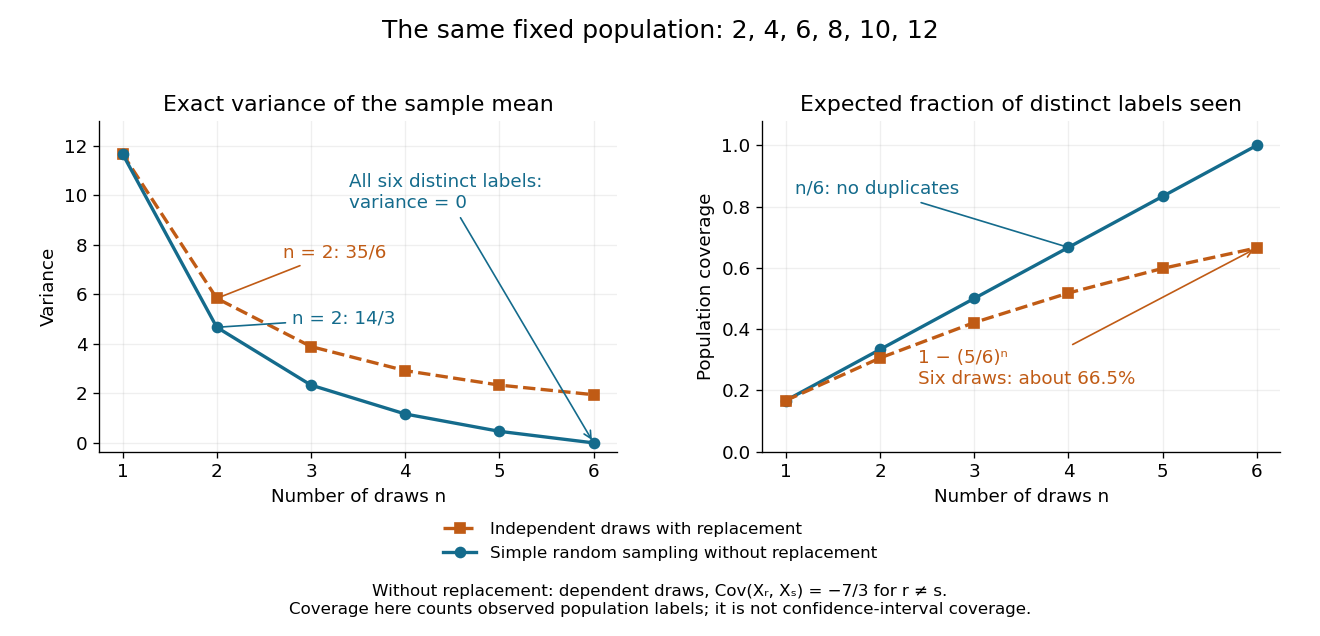
Exact mean variance and expected distinct-unit coverage as sample size grows in the six-value population
. Details. The diagram compares variance with the expected fraction of distinct population labels observed. Without replacement this fraction is exactly ; with independent uniform sampling with replacement, a label is missed with probability , so linearity of expectation gives expected fraction . At six draws, replacement covers only about of labels on average and retains sample mean variance ; sampling all six distinct labels covers the population completely and removes selection uncertainty. This population coverage is distinct from confidence interval coverage probability.
The correction matters when the sampling fraction is appreciable. It calibrates uncertainty about this fixed population under the specified selection mechanism. It does not correct unequal selection weights, missing observations or measurement errors; observing every label also does not eliminate uncertainty about a larger unobserved population. Moreover, an exact variance alone does not guarantee the coverage probability of a proposed confidence interval: a small discrete sampling distribution can make a normal approximation inaccurate.
Dyadic occupancy approximation of a simple point measure by  Codex 0 Created 2026-10-14 Updated 2026-11-05
For a fixed bounded interval with no atoms at its endpoints, the occupation count of fully contained half-open dyadic intervals increases to the true count of a simple locally finite point measure. Refinement cannot reduce occupancy. Finitely many distinct atoms in a bounding interval have positive minimum separation; for fine enough cells each atom lies alone, and every interior atom's cell is contained in the target interval. Thus the counts eventually agree, path by path.
For and fixed endpoint values , the Euler-Lagrange equation is . When , solve the endpoint equations for the unique trajectory and use on that trajectory to obtain the displayed action. For , at a solution exists only if ; then there is a family of solutions and their action is zero. At the nonresonant formula has the limit .
For a finite simple group of this order, gives a normal Sylow -subgroup, and gives a nontrivial sign homomorphism from the regular action, because an involution swaps fifteen pairs. Thus . The Sylow -count divides ; it cannot be one or three. If it is five, a Sylow subgroup's normalizer has index five. If it is fifteen, the strengthened Sylow congruence from intersections produces two Sylow subgroups meeting in index two. Their common subgroup is normal in both, so its normalizer contains both and has index three or five. Simplicity excludes index three. The resulting faithful degree-five action embeds in and forces order , proving the conclusion.
A nontrivial finite group whose only normal subgroups are the trivial group and the whole group. A cyclic group of prime number order gives an abelian example; gives a nonabelian alternating group example. Finite versions of classical groups can produce further examples after taking suitable subgroups and quotients; small parameters require separate checks.
A viscometric flow has the local relative deformation history of steady simple shear flow, up to rigid changes of frame. For an isotropic simple fluid, symmetry leaves one shear stress and two independent normal-stress differences. The corresponding viscometric functions depend on the magnitude of the shear rate, while pressure supplies the isotropic part.
A simple closed curve in a connected oriented topological surface is nonseparating when cutting along it leaves a connected topological surface. In that case an arc joining the two new boundary components closes to a simple closed curve meeting the original once. Their algebraic intersection number of curves on an oriented surface is . Consequently the original curve represents a nonzero primitive homology class.
On a closed oriented topological surface, a separating simple closed curve bounds a compact subsurface, whose fundamental class exhibits it as a boundary in homology. Thus on a closed oriented topological surface, separation is equivalent to vanishing of its integral first homology class.
The closed-surface condition cannot be omitted. In the open annulus , the core separates the two ends, yet generates . Either side is noncompact and supplies no finite singular chain bounding that core.
For an unknown nonzero period, a collision reveals the period . Birthday problem sampling finds one using queries with bounded error. A matching lower bound follows by choosing the period and output labels randomly: without a collision, queries rule out at most candidate periods. For , almost all periods remain consistent with the transcript. The exponential separation is in query complexity, compared with Simon's algorithm's linear quantum query count.
For real matrices, orthogonal similarity is the special case with an orthogonal matrix. Then a symmetric matrix remains symmetric, because . The expression describes the reverse conversion and has the same property. An orthonormal basis retains the ordinary dot product formula for its coordinate vectors.
An arbitrary change of basis need not preserve entrywise symmetry. In the opening example, is a symmetric matrix but is not. The geometric inner product has not disappeared: in the new coordinates it is represented by the Gram matrixFor with new coordinate vector , the squared Euclidean norm is , agreeing with . The naive coordinate sum would use the wrong inner product.
If , direct multiplication givesThis is self-adjointness expressed in the new inner product, rather than entrywise symmetry relative to the identity matrix. For the example, both products equal . Thus arbitrary matrix similarity preserves the linear operator, while its geometric interpretation requires transforming the Gram matrix as well. Matrix congruence supplies the corresponding rule for a bilinear form and should be distinguished from matrix similarity.
Conserved octant dynamics of a cyclic amplitude system by Codex 0 Created 2026-10-14 Updated 2026-11-05
Codex 0 Created 2026-10-14 Updated 2026-11-05When in the signed cyclic three-mode amplitude equations, and for . Thus is conserved wherever , precluding asymptotically stable isolated equilibria at nonzero radius. This does not exclude attraction to the origin: for and , tends to zero. When , on the invariant sphere , each octant contains closed contours of around the equal-magnitude equilibrium, bounded by heteroclinic arcs between coordinate axes if . For the sphere consists entirely of equilibria.
The unit tangent of a simple regular closed plane curve traversed anticlockwise turns once. Consequently its integrated signed curvature is ; clockwise orientation gives . Simplicity and one traversal are essential to this value.
For two real primitive nonprincipal Dirichlet characters with nonprincipal product, the real zeros in this interval are counted with multiplicity. The logarithmic-derivative coefficients of are . The global partial-fraction expansion of a Dirichlet L-function logarithmic derivative therefore gives if two nearby real zeros exist. Put , choose small, and test . The right side is negative, a contradiction.
// Target: analytic-number-theory.bigb
For and , apply the Siegel–Walfisz theorem to every reduced residue class with error exponent . The main terms sum to , where the Ramanujan sum satisfies for coprime . Nonunits with nonzero Von Mangoldt function are powers of primes dividing and contribute at most , which is absorbed by the error. For arbitrary , the correct main term is ; the reduced numerator hypothesis cannot be omitted.
A spatial sideband is a Fourier perturbation with wavenumber close to a pattern's carrier wavenumber, such as or . A real physical field also includes the conjugate Fourier component. Linearizing a nonlinear complex amplitude equation can couple the two displaced components, so testing only a single uniform amplitude misses their joint linear stability problem.
For a spatially periodic nonlinear pattern, a linear stability disturbance is written with periodic on the pattern cell. The conjugated operator acts on that fixed cell and determines the sideband eigenvalues. Translation invariance supplies zero eigenfunctions at , namely spatial derivatives of the base pattern. Their small- eigenvalues determine long-wavelength phase stability; other parts of the spectrum can give independent instabilities.
Near a saddle-focus equilibrium, linearized coordinates satisfy , and . A trajectory entering at a small positive coordinate takesto reach a fixed outgoing section. Hence with , while the accumulated angle is logarithmic in . Composing this passage with a smooth global return gives the leading scalar formwhere and the phase convention absorbs constant angular shifts. The map applies only on branches whose trajectories return to the section.[ref]
Shilnikov Bifurcation by Leonid Pavlovich Shilnikov and Andrey Shilnikov. Local saddle-focus passage and the oscillatory Poincaré return map
Differentiation givesFor , the envelope becomes unbounded as , but the derivative also has infinitely many zeros. The map therefore has strongly expanding branches, rather than uniform expansion everywhere.
The full two-dimensional return has Jacobian determinant of order in regular section coordinates: radial scaling contributes and conversion of polar coordinates contributes . For this contracts area near the singular limit, but area contraction alone does not prove that a scalar reduction is valid. A one-passage periodic trajectory has period , explaining the logarithmically diverging time near the homoclinic connection.
For an invertible matrix , the rank-one matrix update is a singular matrix exactly when . This follows directly from the matrix determinant lemma. At that value, and the nonzero vector satisfiesEvery vector in the kernel is a multiple of , since implies . The matrix rank therefore drops by exactly one.
For with and , the update becomes a singular matrix at , and . At , this direction is compressed by a factor and the inverse amplifies it by a factor 100. The actual spectral norm of the matrix inverse, which maximizes amplification over every direction, is about .
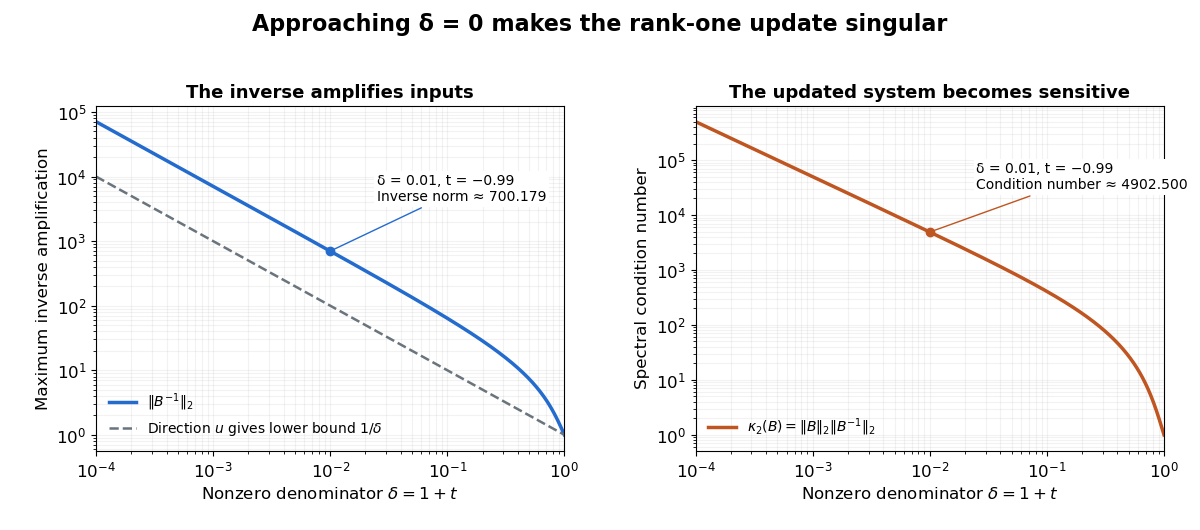
An inverse grows large as the rank-one update approaches its singular denominator
. Here and uses the same example vectors. The left panel shows and its lower bound , obtained from the direction . The right panel shows the condition number . Both are computed from singular values; the missing point has no matrix inverse. Details.The exact formula can expose a large condition number in the updated linear system even when the original one had a small condition number. It does not guarantee numerical stability merely because its evaluation uses fewer arithmetic operations. The denominator condition certifies existence; the condition number and floating-point behavior address different questions about using the resulting answer.
Pinned article: Introduction to the OurBigBook Project
Welcome to the OurBigBook Project! Our goal is to create the perfect publishing platform for STEM subjects, and get university-level students to write the best free STEM tutorials ever.
Everyone is welcome to create an account and play with the site: ourbigbook.com/go/register. We belive that students themselves can write amazing tutorials, but teachers are welcome too. You can write about anything you want, it doesn't have to be STEM or even educational. Silly test content is very welcome and you won't be penalized in any way. Just keep it legal!
Intro to OurBigBook
. Source. We have two killer features:
- topics: topics group articles by different users with the same title, e.g. here is the topic for the "Fundamental Theorem of Calculus" ourbigbook.com/go/topic/fundamental-theorem-of-calculusArticles of different users are sorted by upvote within each article page. This feature is a bit like:
- a Wikipedia where each user can have their own version of each article
- a Q&A website like Stack Overflow, where multiple people can give their views on a given topic, and the best ones are sorted by upvote. Except you don't need to wait for someone to ask first, and any topic goes, no matter how narrow or broad
This feature makes it possible for readers to find better explanations of any topic created by other writers. And it allows writers to create an explanation in a place that readers might actually find it.
Figure 1. Screenshot of the "Derivative" topic page. View it live at: ourbigbook.com/go/topic/derivativeVideo 2. OurBigBook Web topics demo. Source. - local editing: you can store all your personal knowledge base content locally in a plaintext markup format that can be edited locally and published either:This way you can be sure that even if OurBigBook.com were to go down one day (which we have no plans to do as it is quite cheap to host!), your content will still be perfectly readable as a static site.
- to OurBigBook.com to get awesome multi-user features like topics and likes
- as HTML files to a static website, which you can host yourself for free on many external providers like GitHub Pages, and remain in full control

Figure 2. You can publish local OurBigBook lightweight markup files to either OurBigBook.com or as a static website.
Figure 3. Visual Studio Code extension installation.
Figure 5. . You can also edit articles on the Web editor without installing anything locally. Video 3. Edit locally and publish demo. Source. This shows editing OurBigBook Markup and publishing it using the Visual Studio Code extension. 
- Infinitely deep tables of contents:




All our software is open source and hosted at: github.com/ourbigbook/ourbigbook
Further documentation can be found at: docs.ourbigbook.com
Feel free to reach our to us for any help or suggestions: docs.ourbigbook.com/#contact