Topics (384k) Articles (398k) Users (410) Discussions (242) Comments (383) Files (13k) New article

An alternating path in a matching is a graph path whose successive edges alternate between membership in and membership outside . Here graph paths have no repeated vertices. Alternation alone does not make a graph path an augmenting path in a matching: its endpoints must both be unmatched vertices in a matching. For example, relative to in the six-vertex path graph, alternates but has matched endpoints; toggling just those three edges loses one selected edge.
A matching in a graph saturates a specified vertex set when every vertex of is incident to one selected edge. Exactly one selected edge meets each such vertex, since matching edges have disjoint endpoints. Vertices outside may remain unmatched. A perfect matching saturates the entire vertex set; Hall's marriage theorem tests matching saturation of a specified side in a finite bipartite graph.
A vertex is an unmatched vertex in a matching if no edge of is incident to it. It is also called free or exposed, always relative to the specified matching in a graph: changing can change which vertices are free. The endpoints of an augmenting path in a matching must be distinct unmatched vertices in a matching before the change.
Mei-Sywe Hwang is identified as a statistician at the Center for Measurement Standards in Hsinchu, Taiwan, in a 1993 conference paper reprinted by NIST in 1994. The coauthored report examines electronic balances for gravimetric measurements, including solid and liquid density, pycnometer calibration and mass. Its examples connect a physical instrument's readings with corrections and uncertainty in an inferred quantity.[ref]
The Electronic Balance and Some Gravimetric Applications (The Density of Solids and Liquids, Pycnometry and Mass) by Randall M. Schoonover and others. Printed p. 299, author role/affiliation, keywords and abstract; report cover, February 1994
The byline establishes her participation and historical affiliation; it does not identify an individual contribution to each experiment or establish later positions. The technical setting illustrates why measurement error and calibration are substantive parts of applied statistical work.
Shalabh works on statistical models whose assumptions reflect complications in observed data. His IIT Kanpur research page lists linear regression, econometrics, measurement-error models, missing-data models, panel-data models, restricted regression, spatial models and sampling theory.[ref]
These subjects meet in a practical distinction: an observed variable need not equal the scientific quantity intended by the model. An errors-in-variables model describes noisy predictors, a missing-data model describes unobserved measurements, and a panel-data model represents repeated observations from the same units. Explicitly modelling those features separates uncertainty about the measurement process from uncertainty about regression parameters.
Identity and homepage: Shalabh's institutional homepage.

Portrait of Shalabh
. External portrait of Shalabh embedded on his institutional homepage at the Indian Institute of Technology Kanpur; the photograph is hosted by that institution.A researcher who coauthored an account of IP3 receptor activation, relating receptor structure, ligand action and cytosolic calcium regulation. The work distinguishes a channel’s capacity to open from the interacting signals that determine its behavior in a cell.[ref]
Publication record: pubmed.ncbi.nlm.nih.gov/20980441/
A researcher who coauthored an account of IP3 receptor activation, relating receptor structure, ligand action and cytosolic calcium regulation. The work distinguishes a channel’s capacity to open from the interacting signals that determine its behavior in a cell.[ref]
Homepage: www.phar.cam.ac.uk/research/taylor
Thomas J. Fellers is credited with Michael W. Davidson as an author of Linear Measurements (Micrometry) by Thomas J. Fellers and Michael W. Davidson, an educational account of quantitative optical microscopy. Its byline associates the authors with the National High Magnetic field Laboratory at Florida State University. [ref]
Linear Measurements (Micrometry) by Thomas J. Fellers and Michael W. Davidson. Contributing Authors byline
The account explains how a stage micrometer calibrates an eyepiece reticle. Matching a known specimen-plane length to reticle divisions converts an arbitrary scale into a physical measurement. Changing the objective lens changes that calibration, so magnification alone is insufficient for reliable microscopy. The article also discusses optical resolution and errors in locating scale edges. [ref]
Linear Measurements (Micrometry) by Thomas J. Fellers and Michael W. Davidson. Eyepiece Reticle Calibration, Figure 4; Conclusions
A supercritical fluid is a fluid at temperature and pressure above its liquid-gas critical point. There is then no liquid–vapor coexistence boundary separating distinct bulk liquid and gas states. Density can change continuously from relatively gas-like to relatively liquid-like values along a suitable path.
This continuity does not mean that all supercritical states have identical properties. Density, compressibility, viscosity and solvent behavior can vary strongly, particularly near the critical region. Pressure can therefore tune a supercritical solvent's ability to dissolve material without crossing a boiling boundary. The absence of a liquid–vapor boundary applies to that transition; freezing or other transitions can still occur elsewhere in the phase diagram.
Take labels and vectors in the real vector space :Here is the complete independence check for all eight subsets. The empty set is independent. Each of is independent because its vector is nonzero. Every pair is independent: the determinants of the two-column matrices , , and are respectively , , and . The triple is dependent because . ThereforeDeleting elements from any listed subset stays in this list, verifying heredity. Every exchange comparison has sizes , , or . From the empty set, any element of the larger matroid independent set works: this covers three singleton targets and three pair targets. From any singleton to any pair, every element of the pair outside the singleton works, since every resulting pair is independent. This covers all nine singleton-pair comparisons, including disjoint ones. There are no other comparisons: all fifteen ordered size-increasing pairs satisfy exchange.
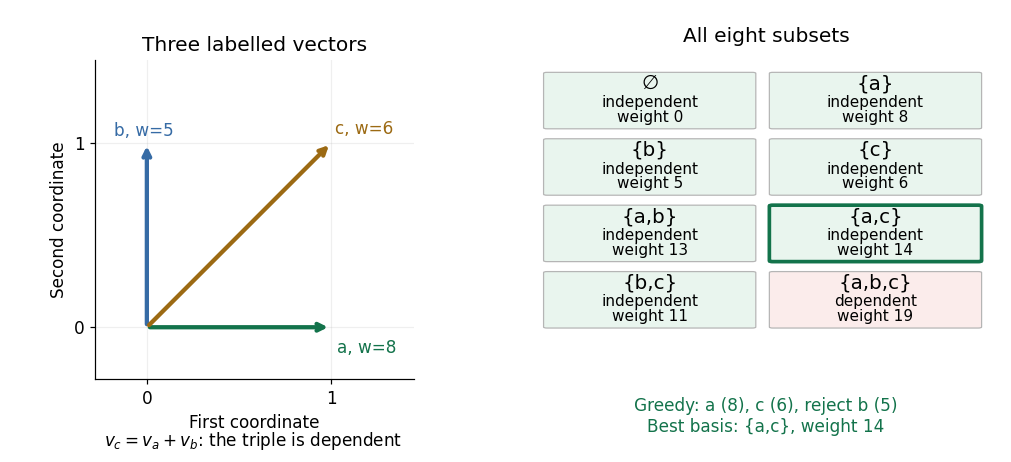
Three vectors have three independent pairs and one dependent triple; the heaviest matroid basis is with weight
. Details. The three matroid bases are , , and , all of cardinality two, with weights , , and . The matroid greedy algorithm considers , then , then : it admits , admits because their determinant is nonzero, and rejects because the triple is dependent. The resulting matroid basis has weight , the largest of the three totals. Every singleton can grow, so none is maximal; the three pairs are both maximal and maximum in cardinality.
A light ray whose path remains in a plane containing the optical axis. In a straight step-index optical fiber, this geometry gives the complementary axis and interface-normal angles used to derive the optical fiber acceptance angle.
A thick lens retains the separation of its refracting surfaces when predicting image formation. In the paraxial approximation with air on both sides, object and image distances measured from the respective principal planes satisfy the familiar imaging equation. Measuring instead from one mechanical centre generally introduces an error.[ref]
Refracting systems (details), University of Tennessee physics teaching resource. University of Tennessee physics teaching resource, Refracting systems (details), final paragraph: object and image distances must refer to the principal planes
Pinned article: Introduction to the OurBigBook Project
Welcome to the OurBigBook Project! Our goal is to create the perfect publishing platform for STEM subjects, and get university-level students to write the best free STEM tutorials ever.
Everyone is welcome to create an account and play with the site: ourbigbook.com/go/register. We belive that students themselves can write amazing tutorials, but teachers are welcome too. You can write about anything you want, it doesn't have to be STEM or even educational. Silly test content is very welcome and you won't be penalized in any way. Just keep it legal!
Intro to OurBigBook
. Source. We have two killer features:
- topics: topics group articles by different users with the same title, e.g. here is the topic for the "Fundamental Theorem of Calculus" ourbigbook.com/go/topic/fundamental-theorem-of-calculusArticles of different users are sorted by upvote within each article page. This feature is a bit like:
- a Wikipedia where each user can have their own version of each article
- a Q&A website like Stack Overflow, where multiple people can give their views on a given topic, and the best ones are sorted by upvote. Except you don't need to wait for someone to ask first, and any topic goes, no matter how narrow or broad
This feature makes it possible for readers to find better explanations of any topic created by other writers. And it allows writers to create an explanation in a place that readers might actually find it.
Figure 1. Screenshot of the "Derivative" topic page. View it live at: ourbigbook.com/go/topic/derivativeVideo 2. OurBigBook Web topics demo. Source. - local editing: you can store all your personal knowledge base content locally in a plaintext markup format that can be edited locally and published either:This way you can be sure that even if OurBigBook.com were to go down one day (which we have no plans to do as it is quite cheap to host!), your content will still be perfectly readable as a static site.
- to OurBigBook.com to get awesome multi-user features like topics and likes
- as HTML files to a static website, which you can host yourself for free on many external providers like GitHub Pages, and remain in full control

Figure 2. You can publish local OurBigBook lightweight markup files to either OurBigBook.com or as a static website.
Figure 3. Visual Studio Code extension installation.
Figure 5. . You can also edit articles on the Web editor without installing anything locally. Video 3. Edit locally and publish demo. Source. This shows editing OurBigBook Markup and publishing it using the Visual Studio Code extension. 
- Infinitely deep tables of contents:



All our software is open source and hosted at: github.com/ourbigbook/ourbigbook
Further documentation can be found at: docs.ourbigbook.com
Feel free to reach our to us for any help or suggestions: docs.ourbigbook.com/#contact