Topics (384k) Articles (398k) Users (410) Discussions (242) Comments (383) Files (13k) New article

The place value is the weight of a position in positional notation. A numeral digit at that position contributes to the represented number.
The radix is the base of positional notation. In the ordinary integer-base case it is an integer , and successive place values differ by a factor of .
A numerical digit is one symbol in a positional notation string, denoting an integer from zero through one less than the radix.
A parallelepiped is a polyhedron with six parallelogram faces in three opposite pairs. Three generating vectors determine its edges; the absolute value of their determinant gives its volume in orthonormal Cartesian coordinates.
A growing extension from a pollen grain. In a compatible flower, the pollen tube provides a route for sperm to the angiosperm female gametophyte.[ref]
A polarimeter uses polarizers to compare the direction of linear polarization before and after light passes through a sample; polarimetry explains the apparatus, readout and controls.
Take the Gaussian function with . Every derivative is a polynomial times the same Gaussian function, so is a Schwartz function. The Fourier transform of a Gaussian gives, in the cycles convention,Thus the Poisson summation formula gives the exact identityThe Gaussian Fourier transform is given in scaled form in Exercise 41 of Terence Tao's 245C, Notes 2: The Fourier transform.[ref]
245C, Notes 2: The Fourier transform by Terence Tao. §3, Exercise 41: transform of a scaled Gaussian; put r=1/sqrt(a) and adjust its prefactor
The identity is also the imaginary-axis transformation of the Jacobi theta function. At the Gaussian function is its own Fourier transform; at reciprocal values of its spatial and spectral widths exchange.For a short derivation of the Gaussian Fourier transform, write . Differentiation under the integral and integration by parts, using , giveThe Gaussian integral gives , so this ordinary differential equation yields the claimed formula. The decay of the Gaussian function justifies these steps and removes the boundary term.[ref]
Lecture 17: The functional equation. Lecture 17, §17.1, Lemma 17.9 and proof, printed p. 3: differential-equation proof for the unit Gaussian; scaled here to a>0
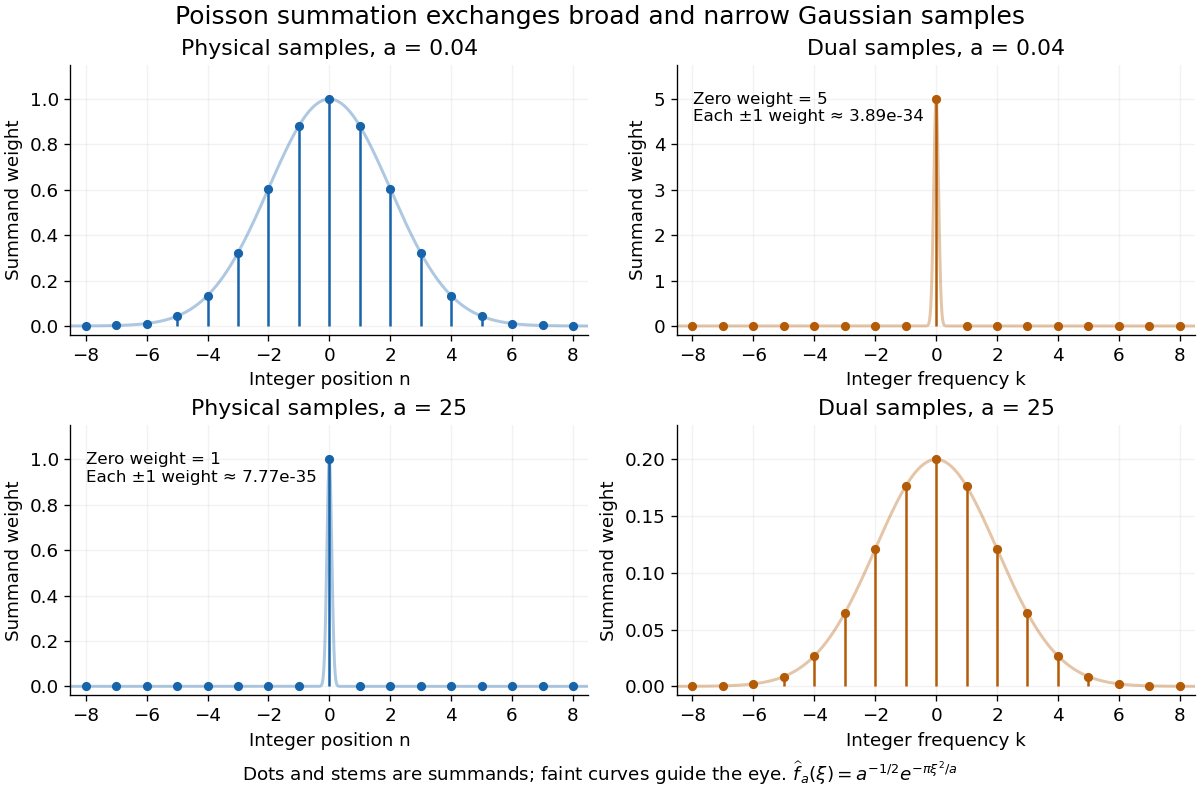
For , the physical Gaussian function has width parameter , while its Fourier transform has width parameter . Many physical samples matter, but the dual zero sample already givesFor , use the physical side instead:These are bounds on the full positive tails, obtained below, rather than estimates based only on the first omitted term. Ordinary floating-point arithmetic rounds these sums to and ; the exact real numbers are slightly larger. A Gaussian sum truncation bound lets us choose the cheaper side and certify its truncation error before evaluating it.
Encircled energy is the fraction of total image radiant flux within a circle of radius around the centre of a point spread function.
PCR extension is template-directed construction of DNA from an annealed PCR primer by a DNA polymerase. Incoming deoxynucleoside triphosphates supply the new nucleotides. Each addition lengthens the growing strand at its end, so the product grows while the template is read . The direction refers to the nucleic acid backbone, not to left or right on a page.[ref]
Principles of PCR by Thermo Fisher Scientific. Description, final paragraph: extension of annealed primers by dNTP incorporation
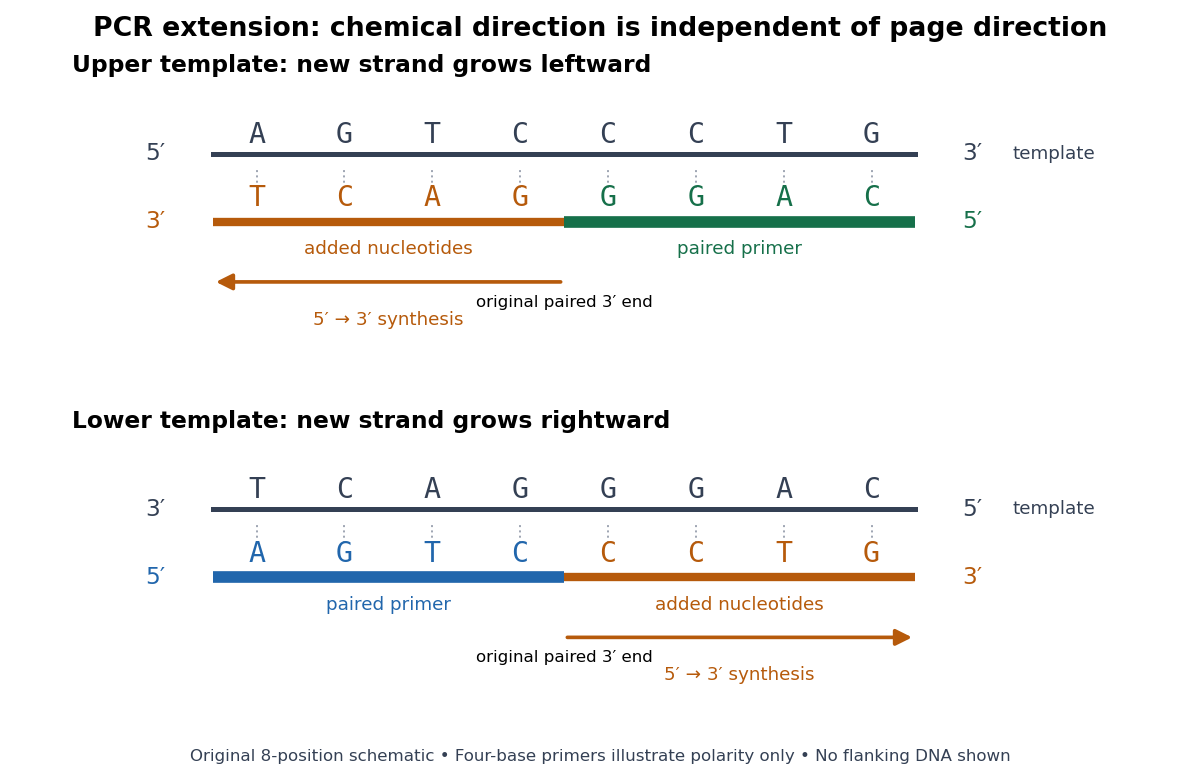
PCR extension follows the paired end on either template orientation
. Original eight-position DNA example with separated complementary templates. Dark rails are existing templates; coloured rails are new strands. The blue PCR primer grows rightward and the green PCR primer grows leftward. Orange marks the material added by DNA polymerase; both arrows point from the original paired end toward the new end. Labels at each end show that both products grow . The templates stop at the displayed boundaries for this teaching example; real starting templates can extend farther. Four-nucleotide PCR primers are deliberately too short to constitute an experimental design. Details.For a complete worked copying step, start with template and paired PCR primer . The next four template letters are GGAC, encountered in the template's -to- direction. The base pairing rule therefore selects CCTG in order, givingThe PCR primer supplies four nucleotides, and PCR extension adds four more; this copying event consumes four deoxynucleoside triphosphates. On the oppositely oriented template , the other PCR primer is . It pairs at the right and extends leftward. Reading that template from right to left encounters CTGA after the paired region, so addition of GACT gives . Both finished products are the reverse complements of their respective templates.
The direction argument is short: the PCR primer and its template are antiparallel nucleic acid strands; extension takes place at the PCR primer's end; hence forward progress along the new strand is backward progress along the template. Reflecting a drawing reverses its arrows on the page without changing either chemical direction. This is why a leftward arrow can represent synthesis.
The time needed depends on how much DNA remains to be copied and the chosen DNA polymerase, while temperature must support that enzyme's activity.[ref]
PCR Cycling Parameters—Six Key Considerations for Success by Thermo Fisher Scientific. Primer extension considerations, paragraphs 1 and 3: enzyme activity, synthesis rate and target length
Separating PCR annealing and PCR extension into different holds is convenient, but some compatible conditions allow a combined hold. The three chemical jobs therefore need not always require three distinct temperatures.[ref]Principles of PCR by Thermo Fisher Scientific. Description, paragraphs 2–3: enzyme-dependent extension temperature and two-step cycling
PCR annealing is association of PCR primers with exposed complementary DNA regions by base pairing. It supplies the paired starting ends required for PCR extension. Cooling can permit this association without itself joining new nucleotides onto the PCR primers. The two templates can also pair with one another again, so exposure after PCR denaturation is an opportunity for binding, not a guarantee of productive copying.[ref]
Principles of PCR by Thermo Fisher Scientific. Description, first and final paragraphs: binding to complementary templates precedes primer-dependent copying
In the example below, pairs with the aligned template segment . The opposite end labels show antiparallel nucleic acid strands. Pairing the right letters in the wrong directional display does not supply a correctly depicted starting end. These four-nucleotide strands are a teaching example, not a laboratory PCR primer recommendation.
The binding temperature balances enough productive pairing against unwanted binding. Its appropriate value depends on the PCR primers and reaction conditions; increasing it can improve PCR specificity but can also prevent useful binding. A predicted binding setting therefore needs experimental assessment rather than being inferred from the label PCR.[ref]
PCR Cycling Parameters—Six Key Considerations for Success by Thermo Fisher Scientific. Primer annealing optimization, paragraphs beginning In this step, Note that the calculated, and If nonspecific PCR products
PCR denaturation is the high-temperature stage that separates a DNA duplex into single-stranded templates for the next copying step. It disrupts the pairing and stacking arrangement of nucleobases; it does not require cutting the phosphodiester bonds along either strand. The distinction matters: breaking the backbone would damage the ordered nucleotide sequence that is meant to serve as a template.
For an original eight-base pair duplex, complete PCR denaturation exposes two eight-nucleotide strands. It leaves sixteen nucleotides altogether: separation has made the templates accessible without yet making more DNA. PCR extension, rather than heating alone, adds the new material. Already copied duplexes also need to separate at the beginning of subsequent cycles.
Separation is a condition-dependent process. Template composition and the buffer solution affect the required temperature and duration; heating longer is not automatically better because prolonged heating can reduce DNA polymerase activity. Incomplete separation leaves fewer accessible templates even when the PCR primers themselves are well chosen.[ref]
PCR controls are scientific controls that separate different explanations for a readout. A no-template reaction contains the PCR primers and copying reagents but replaces the added template with water or sample buffer. Amplification there can indicate carried-over DNA or a primer dimer; a clean result does not exclude contamination confined to one sample.[ref]
How can I distinguish non-template amplification (NTC) from real products? by New England Biolabs. FAQ: target-free control reactions and differing product sizes or melt profiles
Different comparisons answer different questions. A known amplifiable template tests whether the PCR primers, DNA polymerase and thermal cycler can produce the expected amplicon. An extraction blank follows sample preparation without adding the sampled material. A separate amplifiable interval in the sample can test whether recovered DNA supports copying, although success there does not guarantee success at the target. A length standard calibrates gel electrophoresis; it is not a control for the copying reaction. These comparisons are an analytical design extension to the teaching example below, not a claim that its student protocol includes every comparison.
A primer dimer is an amplification artifact in which PCR primers provide extendible partners for one another. Its accumulation consumes substrates and may produce a signal even without the intended template. It is not evidence that the intended amplicon was present.[ref]
Why do I see amplification curves in my NTC samples? by New England Biolabs. FAQ: primer structures as DNA-polymerase substrates, and carryover PCR-product contamination
A PCR plateau is the late phase in which further cycles add little product. Depletion of substrates and accumulation of reaction by-products can reduce PCR efficiency. Consequently, similar final amplicon amounts need not mean similar initial template amounts. In the stipulated green model, implies , and growth approaches the imposed ceiling. That illustrates loss of starting-amount information without claiming to identify the limiting chemical process in an actual tube.[ref]
PCR Cycling Parameters—Six Key Considerations for Success by Thermo Fisher Scientific. PCR cycle number determination and Figure 7: lowered efficiency and plateau from reaction-component depletion and by-products
The p-adic integers form a complete metric space and a discrete valuation ring. Every nonzero is uniquely with and a p-adic unit. The prime is a uniformizer, and reduction modulo gives the residue field . The element has no inverse inside , so the ring is not a field.
For a short ideal-classification outline, take a nonzero ideal and choose an element of smallest p-adic valuation , which exists by the well-ordering principle. Its unit factor is invertible, so the ideal contains . Every other element is divisible by , proving that the ideal is . Completeness follows because is a closed subset of the complete metric space . The zero ideal is separate from this nonzero-ideal classification.
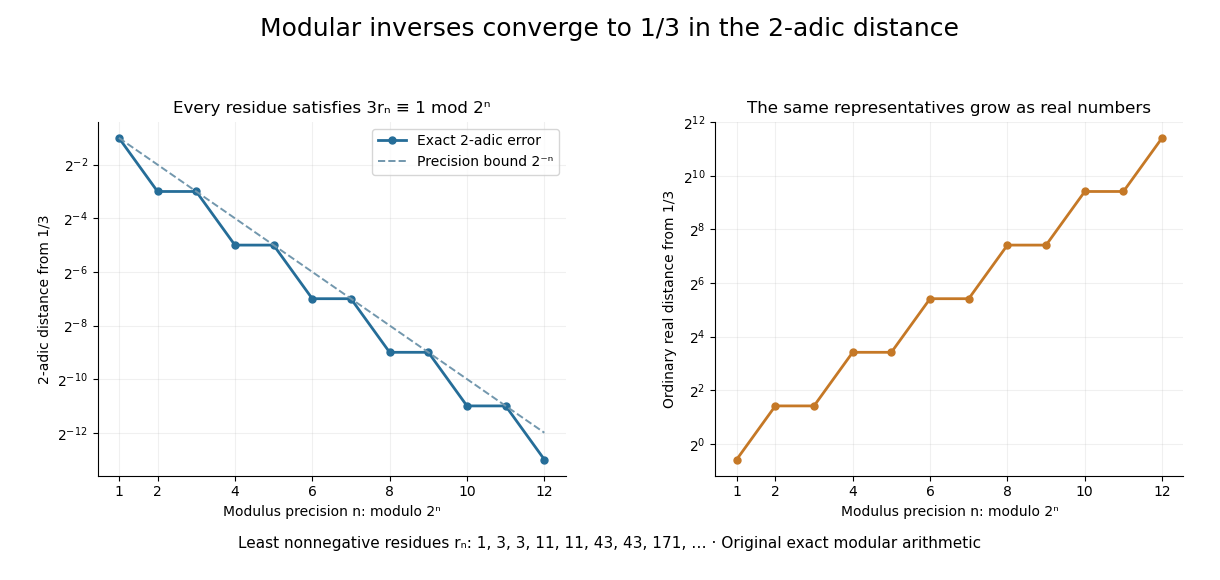
Let be an integer not divisible by . Its modular inverse modulo has a unique least nonnegative representative . Reducing the inverse equation modulo shows that the representatives are compatible. Since is a p-adic unit,so the sequence converges to the inverse in . This computes a fraction through finite integer operations.
For and , the first eight representatives are . Each satisfies . The resulting expansion isThe geometric series has ratio , whose 2-adic absolute value is , and its sum is . In the ordinary real number absolute value, the representatives grow. Different metrics impose different meanings of a good approximation. The periodic digits here are a specific instance of the rational expansions studied in Conrad's authored note.[ref]
Pinned article: Introduction to the OurBigBook Project
Welcome to the OurBigBook Project! Our goal is to create the perfect publishing platform for STEM subjects, and get university-level students to write the best free STEM tutorials ever.
Everyone is welcome to create an account and play with the site: ourbigbook.com/go/register. We belive that students themselves can write amazing tutorials, but teachers are welcome too. You can write about anything you want, it doesn't have to be STEM or even educational. Silly test content is very welcome and you won't be penalized in any way. Just keep it legal!
Intro to OurBigBook
. Source. We have two killer features:
- topics: topics group articles by different users with the same title, e.g. here is the topic for the "Fundamental Theorem of Calculus" ourbigbook.com/go/topic/fundamental-theorem-of-calculusArticles of different users are sorted by upvote within each article page. This feature is a bit like:
- a Wikipedia where each user can have their own version of each article
- a Q&A website like Stack Overflow, where multiple people can give their views on a given topic, and the best ones are sorted by upvote. Except you don't need to wait for someone to ask first, and any topic goes, no matter how narrow or broad
This feature makes it possible for readers to find better explanations of any topic created by other writers. And it allows writers to create an explanation in a place that readers might actually find it.
Figure 1. Screenshot of the "Derivative" topic page. View it live at: ourbigbook.com/go/topic/derivativeVideo 2. OurBigBook Web topics demo. Source. - local editing: you can store all your personal knowledge base content locally in a plaintext markup format that can be edited locally and published either:This way you can be sure that even if OurBigBook.com were to go down one day (which we have no plans to do as it is quite cheap to host!), your content will still be perfectly readable as a static site.
- to OurBigBook.com to get awesome multi-user features like topics and likes
- as HTML files to a static website, which you can host yourself for free on many external providers like GitHub Pages, and remain in full control

Figure 2. You can publish local OurBigBook lightweight markup files to either OurBigBook.com or as a static website.
Figure 3. Visual Studio Code extension installation.
Figure 5. . You can also edit articles on the Web editor without installing anything locally. Video 3. Edit locally and publish demo. Source. This shows editing OurBigBook Markup and publishing it using the Visual Studio Code extension. 
- Infinitely deep tables of contents:




All our software is open source and hosted at: github.com/ourbigbook/ourbigbook
Further documentation can be found at: docs.ourbigbook.com
Feel free to reach our to us for any help or suggestions: docs.ourbigbook.com/#contact