Topics (384k) Articles (398k) Users (410) Discussions (242) Comments (383) Files (13k) New article

The respiratory quotient compares carbon dioxide production with molecular oxygen consumption over the same interval. Complete glucose oxidation in the net equation above gives . In the ideal respirometer gas balance with no absorber, , that conversion gives : substantial cellular respiration can occur without any net gas contraction. A zero contraction therefore does not by itself demonstrate zero metabolism.
Other fuels, incomplete conversion and concurrent synthesis can alter the ratio. Absorber-based respirometry isolates molecular oxygen uptake by deliberately removing the other gas signal; it cannot independently determine the respiratory quotient or identify glucose as the consumed fuel. Separate carbon dioxide measurement would supply the missing account.
Take the original synthetic model and , mutually independent random variables, with the second argument denoting variance. The pair has a multivariate normal distribution with mean zero, unit marginal variances, and Pearson correlation coefficient . Its conditional multivariate normal distribution isFor a first reading , the second reading has conditional expectation and conditional variance , hence standard deviation . There is still conditional probability of , a movement farther from zero, where is the standard normal distribution function. The line describes a conditional mean, not an individual trajectory.
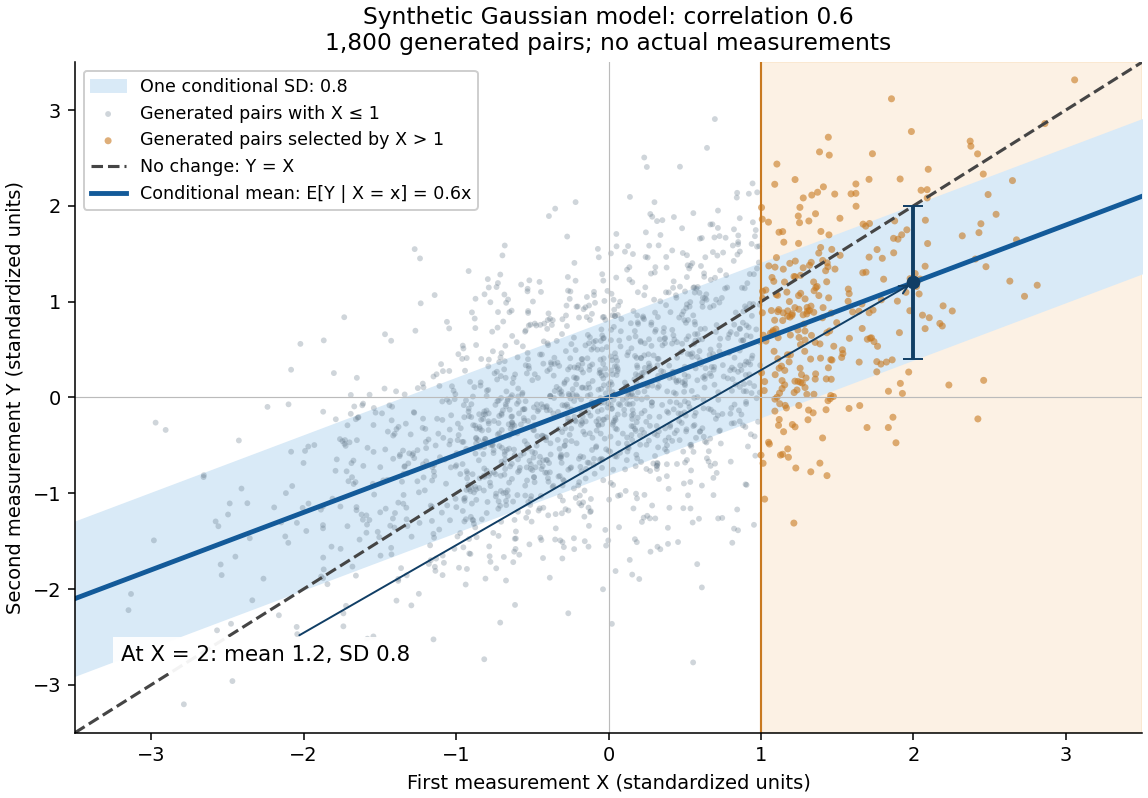
A short derivation isolates . Its covariance with is zero and its variance is . Because has a multivariate normal distribution, zero covariance implies independence: independently of . This also explains why reversing the two measurements gives . The statistical association does not identify a direction of causal effect.
RT-qPCR applies qPCR after reverse transcription. Differences in RNA recovery and conversion into Complementary DNA can affect its inferred starting amount as well as differences in PCR efficiency.
A constant random variable takes the same fixed real number at every outcome in its sample space. Its probability distribution puts mass one at . An almost surely constant random variable may differ on an event of probability zero, while having the same probability distribution.
A microwave is a short-wavelength radio wave, commonly on millimetre-to-centimetre scales. Like other electromagnetic waves, it carries energy through coupled electric fields and magnetic fields; its scale makes conducting waveguides and resonant cavities practical.
A source, conducting guide, movable probe and detector can map a standing wave produced by reflection. Neighboring amplitude maxima are separated by half the guide wavelength, which need not equal the free-space wavelength because guided propagation has its own dispersion relation. Microwaves also drive suitable molecular or spin transitions, linking cavity apparatus to spectroscopy.
A 2018 photonic experiment makes the distinction between populations and quantum coherence controllable. A 400-nm laser pumped a crystal to generate paired photons, filtered near 800 nm. One photon triggered collection; the other entered the apparatus. A half-wave plate and polarizing beam splitter selected horizontal photon polarization; another half-wave plate prepared balanced quantum superpositions. Separated polarization paths and diffraction gratings let a spatial light modulator control their frequency-dependent quantum phases and spectral weights. Recombined paths passed through quartz plates whose adjustable thickness controlled polarization–frequency coupling. Quarter- and half-wave plates plus a polarizing beam splitter selected tomography bases; jointly registered photodetector events supplied the readout. Quantum state tomography inferred polarization density matrices at each thickness. The dephasing model preserves diagonal populations while changing off-diagonal quantum coherence. Here the unobserved photon frequency acts as the environment for the polarization qubit. Finite modulator resolution and imperfect spectral shaping limited agreement with the intended dynamics; this experiment does not establish exact preparation or the ideal probabilities above. [ref]
Experimental implementation of fully controlled dephasing dynamics and synthetic spectral densities by Zhao-Di Liu and others. Experimental implementation of fully controlled dephasing dynamics and synthetic spectral densities, Nature Communications 9, 3453 (2018), Results: Experimental setup, Fig. 1, equations (1)–(5); Using a photon to simulate qubit coupled to Ising chain, systematic-error discussion after Fig. 3
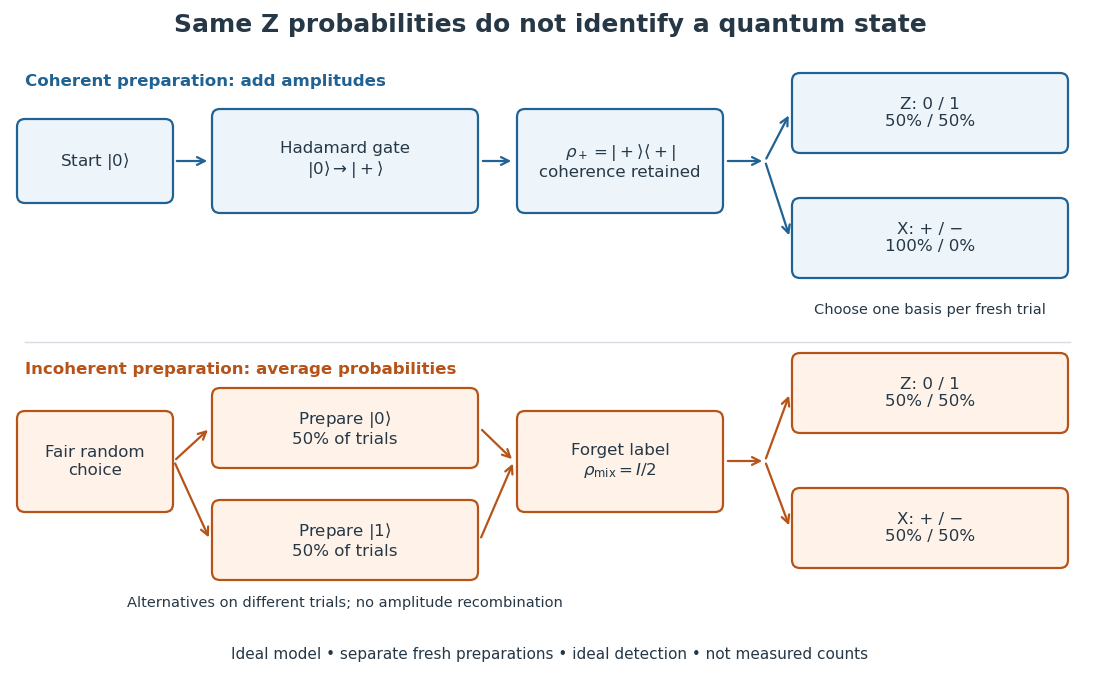
Choose the qubit computational basis , also called the basis, and the Hadamard basis , also called the basis. Compare a coherent preparation of with choosing or at random with equal probabilities and discarding that label:These are original ideal preparation models. Their -basis probabilities are both , because their quantum state populations agree. Their -basis probabilities are respectively and . Indeed , whereas . The missing off-diagonal quantum coherence therefore changes a prediction that the common populations cannot determine.
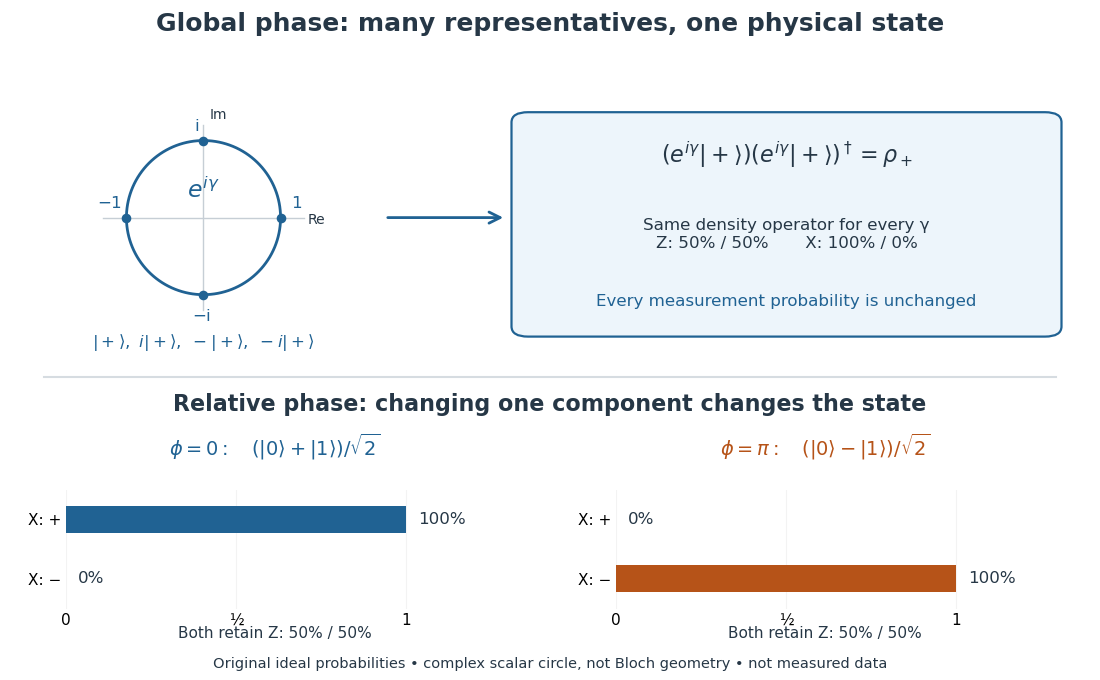
For a relative quantum phase , the coherent family instead hasThe last formula follows by adding or subtracting the two probability amplitudes before taking the squared modulus. At , the state is and the outcomes switch to , while the outcomes remain . In contrast, changes both components by the same global phase and retains the outcomes . In photon polarization, the identification , makes and the two orthogonal diagonal linear polarizations; these labels describe measurement bases, not spatial axes for photon spin.
Even perfect statistics in one basis cannot certify a preparation. The above data fit both density matrices. Conversely, distinct preparation histories can yield the same quantum state:The off-diagonal terms cancel in the right-hand ensemble. Every measurement on the qubit alone then has identical probabilities for those two histories. A retained classical label would allow conditioning on different members of the quantum state ensemble; it is extra information beyond the unlabelled density operator.
A quantum state ray is the equivalence class of nonzero vectors in a complex Hilbert space under multiplication by a nonzero complex number. Its span is a one-dimensional linear subspace, but the zero vector is not a state representative. A unit vector fixes the norm and leaves a global phase free. [ref]
Foundations I: States and Ensembles by John Preskill. Preskill, Foundations I: States and Ensembles, §2.1, printed p. 2, ray equivalence and normalized representatives
For a nonzero representative , the associated pure state density operator isReplacing by multiplies both numerator and denominator by , so the quotient is unchanged. In particular, for every POVM effect ,This proves that a global phase changes no measurement probability. Changing the relative quantum phase of two nonzero components can change the density operator, as the following comparison shows.
Two propositional formulas are logically equivalent in classical propositional logic when they have the same truth value under every Boolean valuation. Identical output columns in a truth table prove logical equivalence; one differing row refutes it. De Morgan's laws give useful examples.
For , the finite population variance measures spread about the finite population mean. Survey-sampling formulas commonly use denominator ; the denominator- version is . The normalization must be specified when using a finite population correction.
The finite population mean for is the arithmetic mean of all fixed values in the target population. Under simple random sampling, the sample mean is an unbiased estimator of it.
Unequal probability sampling assigns different inclusion probabilities to different population units. Estimating an unweighted population summary generally requires accounting for these differences in the estimator.
An inclusion probability is the probability that a particular unit belongs to the selected sample. For sample size in simple random sampling from labels it is . It differs from the selection probability at a particular draw position.
Sampling with replacement returns each selected label to the available population before the next draw. Independent uniform draws from a fixed population are independent and identically distributed; a label can recur. Replacement by itself does not imply uniformity or independence.
A pressure sensor converts a pressure into a recorded signal. An absolute pressure sensor uses a vacuum reference; a gauge pressure sensor uses a specified reference pressure. A closed gas syringe and an absolute pressure sensor can test Boyle's law after allowing the temperature to stabilize.
A Mersenne number has the form for a positive integer . Its binary representation consists of ones. For example, is composite, while is prime. If with , the finite geometric series factorizationhas two factors greater than one. Consequently a Mersenne prime requires a prime exponent, but shows that this condition alone is insufficient.
Pinned article: Introduction to the OurBigBook Project
Welcome to the OurBigBook Project! Our goal is to create the perfect publishing platform for STEM subjects, and get university-level students to write the best free STEM tutorials ever.
Everyone is welcome to create an account and play with the site: ourbigbook.com/go/register. We belive that students themselves can write amazing tutorials, but teachers are welcome too. You can write about anything you want, it doesn't have to be STEM or even educational. Silly test content is very welcome and you won't be penalized in any way. Just keep it legal!
Intro to OurBigBook
. Source. We have two killer features:
- topics: topics group articles by different users with the same title, e.g. here is the topic for the "Fundamental Theorem of Calculus" ourbigbook.com/go/topic/fundamental-theorem-of-calculusArticles of different users are sorted by upvote within each article page. This feature is a bit like:
- a Wikipedia where each user can have their own version of each article
- a Q&A website like Stack Overflow, where multiple people can give their views on a given topic, and the best ones are sorted by upvote. Except you don't need to wait for someone to ask first, and any topic goes, no matter how narrow or broad
This feature makes it possible for readers to find better explanations of any topic created by other writers. And it allows writers to create an explanation in a place that readers might actually find it.
Figure 1. Screenshot of the "Derivative" topic page. View it live at: ourbigbook.com/go/topic/derivativeVideo 2. OurBigBook Web topics demo. Source. - local editing: you can store all your personal knowledge base content locally in a plaintext markup format that can be edited locally and published either:This way you can be sure that even if OurBigBook.com were to go down one day (which we have no plans to do as it is quite cheap to host!), your content will still be perfectly readable as a static site.
- to OurBigBook.com to get awesome multi-user features like topics and likes
- as HTML files to a static website, which you can host yourself for free on many external providers like GitHub Pages, and remain in full control

Figure 2. You can publish local OurBigBook lightweight markup files to either OurBigBook.com or as a static website.
Figure 3. Visual Studio Code extension installation.
Figure 5. . You can also edit articles on the Web editor without installing anything locally. Video 3. Edit locally and publish demo. Source. This shows editing OurBigBook Markup and publishing it using the Visual Studio Code extension. 
- Infinitely deep tables of contents:




All our software is open source and hosted at: github.com/ourbigbook/ourbigbook
Further documentation can be found at: docs.ourbigbook.com
Feel free to reach our to us for any help or suggestions: docs.ourbigbook.com/#contact