Topics (384k) Articles (398k) Users (410) Discussions (242) Comments (383) Files (13k) New article
Schmid et al. tested the Lyot stop on sky using the close binary Hydri with SPHERE/ZIMPOL at the Very Large Telescope. They kept the CLC-S-WF coronagraphic focal plane mask, the NB730 filter and pupil-stabilized imaging mode, and compared observations without a pupil stop and with stopB1_2. Each configuration used ten 8-second exposures. One camera imaged the optical pupil while the other simultaneously imaged the focal plane, connecting the blocked pupil features to the image improvement. [ref]
https://doi.org/10.1051/0004-6361/201833620. Schmid et al., 2018, §4.2, figures 19–20 and table 10, test A
.Bright rings occurred at the inner and outer pupil boundaries; the stop covered them and other unwanted features. To compare point spread functions, the authors multiplied the no-stop image by , accounting for lost off-axis transmission. The companion's reported detection significance rose from to . This demonstrates a useful gain despite lost companion light. It measures the complete stop, including obstruction, support-vane and faulty-actuator blockers; it does not isolate outer-rim clipping alone or establish a universal suppression factor. The figures here are independent toys, not reproductions of those observations. [ref].
Consider an ideal coherent monochromatic wave from an unresolved source on the optical axis, a uniform circular entrance pupil of diameter , and ideal relay optics without wavefront errors. In the scalar Fraunhofer diffraction approximation, a Fourier transform carries the pupil's complex amplitude into the image plane. Choose dimensionless pupil coordinates in units of and angular coordinates , where is the wavelength. DefineThe coronagraphic focal plane mask has transmission , with inside the occulting disk and outside. Thus the field immediately after the mask is . Outside the disk , so the local wave intensity is still : hiding the core has left those rings intact. Reimaging an unlimited pupil giveswhere is convolution, is the Lyot stop transmission, and the proportionality constant in the irradiance is omitted. Coordinate reversals from physical relay optics are absorbed into the coordinate choice. These equations use wave amplitudes throughout propagation; applying a Fourier transform to wave intensity would give a different and incorrect model. This is the pupil/image calculation described by Sivaramakrishnan et al.; the circular disk and numerical choices below are our illustrative specialization. [ref]
https://ao.jpl.nasa.gov/Publications/Technical/2001ApJ.sivaramakrishnan.AO.pdf. Sivaramakrishnan et al., 2001, §2.1, equations 2–6
.The subtraction explains the beauty of the arrangement: in much of the interior, the original pupil field and the convolution term nearly cancel. Near a boundary, that cancellation is incomplete. The Lyot stop can therefore block a region containing disproportionately much unwanted light. A hard-edged coronagraphic focal plane mask has a transform with extended tails, so the interior need not be perfectly dark. With an unlimited relay, gives exactly: no further ring suppression occurs. A stop covering the full original optical pupil instead uses and already clips field outside the optical pupil; an undersized Lyot stop clips more of the remaining rim.
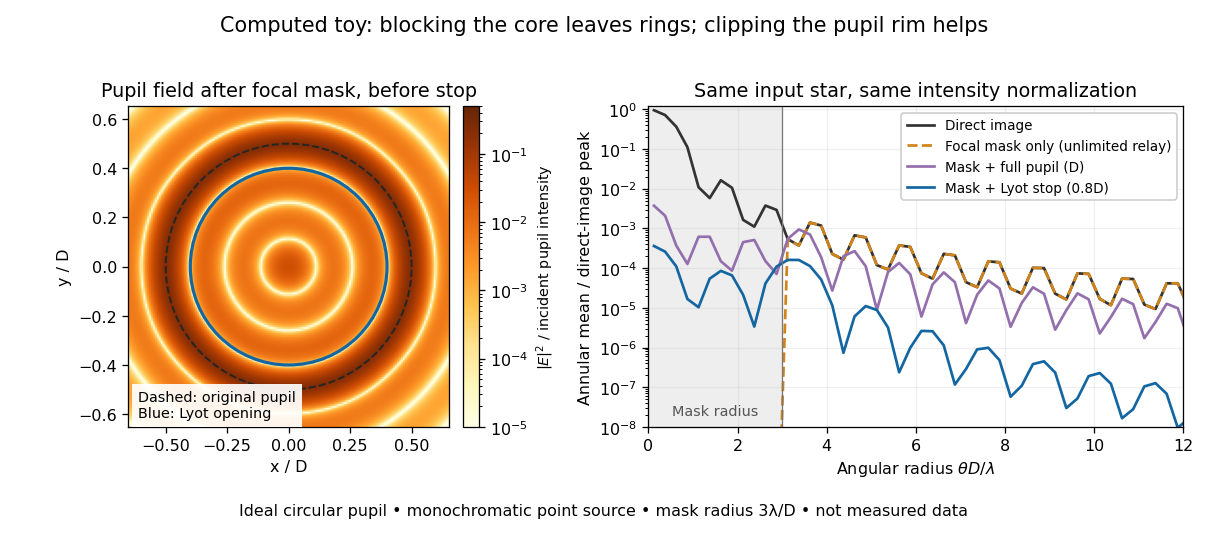
The toy uses a coronagraphic focal plane mask of angular radius and a Lyot stop of diameter . The discrete Fourier transform grid has samples, with 128 across and angular sampling ; it approximates the continuous equations on a finite periodic domain. The plot averages wave intensity in annuli of width . Over the annulus , the mean wave intensity divided by the direct stellar peak is approximately without a coronagraph, the same with only the focal mask and an unlimited relay, with the mask and full pupil, and with the mask and Lyot stop. Thus the undersized opening reduces this particular annular mean about 27-fold relative to the full-pupil comparison. It does not suppress every direction by that factor, and these values do not predict a real instrument's detection limit.
The ideal toy excludes a central obstruction, support vanes, scattering of light, wavefront errors, atmospheric effects, a spread of wavelengths, pointing drift and detector noise. It also contains only the star: no simulated planet or solar corona. For a far off-axis source whose image misses the coronagraphic focal plane mask, the continuous geometric coronagraph throughput of the opening tends to relative to the full disk. Rejecting stellar light therefore costs some desired light as well. Enlarging the coronagraphic focal plane mask narrows the characteristic scale of its pupil-plane transform by the scaling property of the Fourier transform, but also hides a larger neighborhood of the source.
A Lyot stop is a mask in the reimaged optical pupil after a coronagraphic focal plane mask. For an unobstructed circular entrance pupil, it usually transmits a smaller concentric disk. In a classical Lyot coronagraph, much of the residual stellar field lies near the optical pupil boundary; the Lyot stop rejects that field before the final image is formed. It also rejects useful off-axis light, so choosing its opening involves a coronagraph throughput tradeoff. [ref]
https://ao.jpl.nasa.gov/Publications/Technical/2001ApJ.sivaramakrishnan.AO.pdf. Sivaramakrishnan et al., 2001, §2.1
.A coronagraphic focal plane mask modifies the wave amplitude or wave phase in an intermediate focal plane. Here it is a perfectly opaque circular disk centered on the bright source. A finite aperture produces an extended point spread function, so a finite disk blocks only part of the stellar light. Its sharp edge also changes the transmitted field and hence the later diffraction pattern. The exact model below makes both effects visible.
The quasar proximity effect is a reduction of nearby Lyman-alpha forest absorption caused by extra photoionization from the quasar. At fixed density and temperature in photoionization equilibrium, an added rate changes the neutral fraction by the factor . A host environment with positive density contrast can mask this reduction, and a variable or anisotropic source complicates its interpretation.
The Lyman-alpha forest becomes denser and more opaque towards higher cosmological redshift, for a fixed absorption selection over the ordinary post-reionization range. The incidence is often parametrized as , with the index depending on the column density threshold and epoch. The evolution flattens at low redshift as the declining cosmic ionizing background partly offsets dilution of the intergalactic medium. For optically thin gas at fixed overdensity, photoionization equilibrium gives approximately , illustrating why density, temperature and ionizing radiation all matter.
In optically thin, almost fully ionized hydrogen in photoionization equilibrium, and . Thus the neutral fraction is approximately , while the neutral density is proportional to . At fixed overdensity, cosmic dilution gives , hence . Gas density, temperature, ionizing radiation and path length are all required to infer a baryon density from Lyman-alpha absorption.
The neutral-hydrogen column-density distribution counts Lyman-alpha absorption systems per unit column density and redshift. A count in logarithmic column bins is . At low forest columns an approximate power law with near is useful, but the slope and normalization depend on column range and epoch. Lyman limit systems are optically thick at the hydrogen photoionization edge; damped Lyman-alpha systems have strong radiative damping wings. A distribution per absorption distance instead removes the geometrical path factor.
A Lyman limit system has approximately unit or greater optical depth at the neutral-hydrogen Lyman limit near . The threshold follows from with . Its strong continuum absorption distinguishes it from ordinary weak Lyman-alpha forest lines. Classification conventions often separate damped Lyman-alpha systems as the highest-column category.
A damped Lyman-alpha system has a sufficiently high neutral-hydrogen column density that the Lorentzian wings of its Voigt profile are conspicuous. These wings come from the finite lifetime of the excited atomic state, not from unusually high gas temperature. Damped systems usually trace substantial neutral reservoirs associated with galaxies.
For , with both states evolving under the same drift and only receiving , cyclicity of the trace cancels the drift terms and gives the displayed identity. The scalar is real because is Hermitian. Choosing , , makes . This is nonincrease, not by itself convergence to the target: additional invariant-set and reachability conditions are needed.
For the conserved-mean convection amplitude equations before amplitude reduction, the functional generates a gradient flow with increasing . Periodic integration by parts identifies its variational gradient with the evolution equation. Completing the square gives . Hence along a globally smooth solution. Under compactness of the orbit, its limiting states are stationary; a nonstationary periodic orbit is impossible.
Every smooth real-valued function on a closed connected smooth manifold has at least its unnormalized Lusternik–Schnirelmann category many distinct critical points. No nondegeneracy hypothesis is required. If there are infinitely many critical points the bound is immediate; in the finite case, the sublevel-set deformation argument shows that category can increase only at critical levels, by at most the number of critical points on that level. In conjunction with cup length, this gives at least critical points whenever there is a nonzero -fold positive-degree cup product. This theorem is distinct from the antipodal covering theorem also sometimes named the Lusternik–Schnirelmann theorem. A primary account of the critical-point formulation is Conley pairs in geometry—Lusternik–Schnirelmann theory and more.
At exactly , radiant intensity corresponds to luminous intensity . This convention specifies a direction, rather than the source's total luminous flux. [ref]
The lumen is the International System of Units unit of luminous flux: . A source with constant luminous intensity within a cone of solid angle supplies into that cone. A source with the same luminous intensity in every direction supplies over a full sphere. [ref]
Comoving spectral emissivity is emitted spectral luminosity per comoving volume, measured using source-rest-frame time and frequency. For identical sources with comoving number density , it is . For a population with a luminosity function, integrate its rest-frame spectral luminosity over that distribution. Multiplying a proper-volume emissivity by gives this comoving convention for dimensionless scale factor .
A rotating roller with top speed and gap drives a shear-free lubrication approximation flow. No slip below and zero shear above give and . The pressure recovery condition in lubrication flow then gives . With , the excess pressure is . Gravity supports it through the small surface displacement ; the flat leading geometry is consistent when .
For a periodic thin mucus gap translating as a backward wave relative to a force-free foot, put . In the wave frame, the plane and foot have horizontal velocities and . A Couette-Poiseuille flow with periodic pressure has flux . Zero net plane force gives the displayed crawling speed. The leading viscous dissipation per wavelength is .
Cylinder translating parallel to a wall in a thin gap by  Codex 0 Created 2026-10-14 Updated 2026-11-05
For a nonrotating cylinder of radius translating parallel to a stationary wall at minimum gap , the leading gap is . In the cylinder frame, the constant flux is and the pressure gradient is . The pressure is . Integrating the wall shear gives the displayed leading force per unit axial length. Full wetting and negligible inertia are assumed; cavitation would change the pressure boundary conditions.
Pinned article: Introduction to the OurBigBook Project
Welcome to the OurBigBook Project! Our goal is to create the perfect publishing platform for STEM subjects, and get university-level students to write the best free STEM tutorials ever.
Everyone is welcome to create an account and play with the site: ourbigbook.com/go/register. We belive that students themselves can write amazing tutorials, but teachers are welcome too. You can write about anything you want, it doesn't have to be STEM or even educational. Silly test content is very welcome and you won't be penalized in any way. Just keep it legal!
Intro to OurBigBook
. Source. We have two killer features:
- topics: topics group articles by different users with the same title, e.g. here is the topic for the "Fundamental Theorem of Calculus" ourbigbook.com/go/topic/fundamental-theorem-of-calculusArticles of different users are sorted by upvote within each article page. This feature is a bit like:
- a Wikipedia where each user can have their own version of each article
- a Q&A website like Stack Overflow, where multiple people can give their views on a given topic, and the best ones are sorted by upvote. Except you don't need to wait for someone to ask first, and any topic goes, no matter how narrow or broad
This feature makes it possible for readers to find better explanations of any topic created by other writers. And it allows writers to create an explanation in a place that readers might actually find it.
Figure 1. Screenshot of the "Derivative" topic page. View it live at: ourbigbook.com/go/topic/derivativeVideo 2. OurBigBook Web topics demo. Source. - local editing: you can store all your personal knowledge base content locally in a plaintext markup format that can be edited locally and published either:This way you can be sure that even if OurBigBook.com were to go down one day (which we have no plans to do as it is quite cheap to host!), your content will still be perfectly readable as a static site.
- to OurBigBook.com to get awesome multi-user features like topics and likes
- as HTML files to a static website, which you can host yourself for free on many external providers like GitHub Pages, and remain in full control

Figure 2. You can publish local OurBigBook lightweight markup files to either OurBigBook.com or as a static website.
Figure 3. Visual Studio Code extension installation.
Figure 5. . You can also edit articles on the Web editor without installing anything locally. Video 3. Edit locally and publish demo. Source. This shows editing OurBigBook Markup and publishing it using the Visual Studio Code extension. 
- Infinitely deep tables of contents:



All our software is open source and hosted at: github.com/ourbigbook/ourbigbook
Further documentation can be found at: docs.ourbigbook.com
Feel free to reach our to us for any help or suggestions: docs.ourbigbook.com/#contact