Topics (384k) Articles (398k) Users (410) Discussions (242) Comments (383) Files (13k) New article

In a linear isotropic regime, a paramagnetic material has positive magnetic susceptibility: its induced magnetization is aligned with the applied magnetic field intensity. Molecular oxygen supplies an example discussed through molecular orbital theory in the covalent bond article.
For smooth ideal magnetohydrodynamics, write and . The continuity equation and induction equation give . The vector-potential equation becomes . Contracting these two equations cancels their velocity-gradient terms and provesConsequently the magnetic helicity in a material volume satisfies . It is conserved when the magnetic field is tangent to the boundary. A single-valued gauge transformation changes by , which also vanishes under that condition.
An open flux tube carries magnetic flux through its end caps. Its ordinary magnetic helicity can therefore change under a single-valued gauge transformation. For inside and zero outside, a regular family of magnetic vector potentials is , inside and , outside. Their tangential components agree at . Inside, , so the helicity per unit length is . Changing is the gauge transformation , and changes this result whenever . The convention outside gives and helicity per unit length , while gives zero. Without an end-cap or gauge convention the ordinary helicity is not unique.
Current helicity correlates a magnetic field with its curl, which is proportional to electric current density. It differs from magnetic helicity, which uses a magnetic vector potential. For a solenoidal monochromatic field of wavenumber in a periodic domain, choose . Then and .
In a bounded regular domain, fix the global extension or circulation convention for the magnetic vector potential. A bounded inverse of curl on tangent solenoidal vector fields gives . The Cauchy-Schwarz inequality then gives . One construction extends the tangent field by zero outside the domain and uses the whole-space Biot-Savart law; its kernel of size is integrable over a bounded region, giving the required bound. Nonzero conserved magnetic helicity therefore prevents complete decay of magnetic energy.
The weber is the SI unit of magnetic flux, with . A uniform magnetic field of crossing a flat surface of area along its chosen unit normal gives . [ref].
A localized steady electric current density satisfies . Integrate the divergences of and over a region enclosing its support; all boundary fluxes vanish. The first identity removes the monopole term from the magnetic vector potential expansion. The antisymmetric first moment is equivalent to the magnetic dipole moment .
Far outside a localized steady source of size , at distance , its multipole expansion starts with the magnetic dipole moment if that moment is nonzero. In vacuum, using SI units,where is the vacuum permeability, , and the magnetic field is the curl of the magnetic vector potential. The magnetic dipole field falls as , and the magnetic vector potential as . The localized steady-current moment identities remove the putative term in the magnetic vector potential. No magnetic monopole is needed. If different current loops cancel the total magnetic dipole moment, a higher term of the multipole expansion supplies the leading distant magnetic field. [ref].
The approximation is not valid at the center of a finite current loop. For a circular current loop of radius and electric current , the exact on-axis magnetic field of a circular current loop and the distant approximation areTheir ratio is : at , the approximate magnetic field exceeds the exact magnetic field by about relative to the exact value. Near the source, retain its geometry rather than replacing it with a point source specified only by its magnetic dipole moment.
An externally imposed magnetic field that is nearly uniform over a rigid current loop produces the torqueThe angle is measured between the magnetic dipole moment and the external magnetic field, not between the plane of the current loop and the magnetic field. The magnetic dipole potential energy uses a dot product, whereas the torque uses a cross product. The torque is largest when the magnetic dipole moment is perpendicular to the magnetic field; parallel alignment minimizes the potential energy.[ref]
11.5 Force and Torque on a Current Loop. §11.5, equations 11.22–11.23: vector torque and orientation energy
For the sign convention and , positive rotation increases andThus at the torque turns the magnetic dipole moment toward the external magnetic field. Both parallel and antiparallel alignment have zero torque, but they are respectively a stable equilibrium and an unstable equilibrium. With no damping, a freely released current loop can undergo oscillation around the stable equilibrium; settling requires damping.
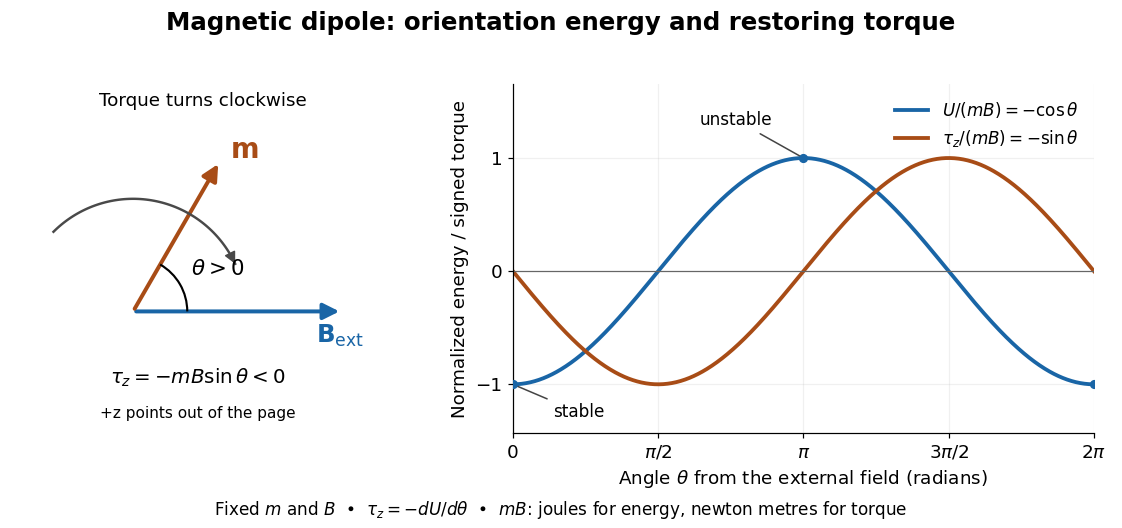
In the twelve-turn example, take and . The predicted torque is and the magnetic dipole potential energy is . The unit check is ; torque and energy have the same physical dimensions but different physical meanings.
A short derivation starts with the magnetic force on a current-carrying wire, . In an exactly uniform magnetic field, the net force is , but its torque need not vanish: opposite sides produce a turning couple. Integrating gives . Integrating at fixed and gives the orientation potential energy. This is the mechanical orientation potential energy for a maintained electric current, with the external source held fixed; the energy accounting for field and power supply is a separate problem. A varying external magnetic field requires corrections across a finite current loop, and can also give a net force.
A current loop is a closed path carrying electric current. For a thin wire following a closed curve , the volume integral defining its magnetic dipole moment becomes a line integral:The vector area is for a planar current loop. For a nonplanar current loop, use the vector area, rather than the scalar area of an arbitrarily chosen spanning surface. Reversing the electric current reverses without changing the geometry. [ref].
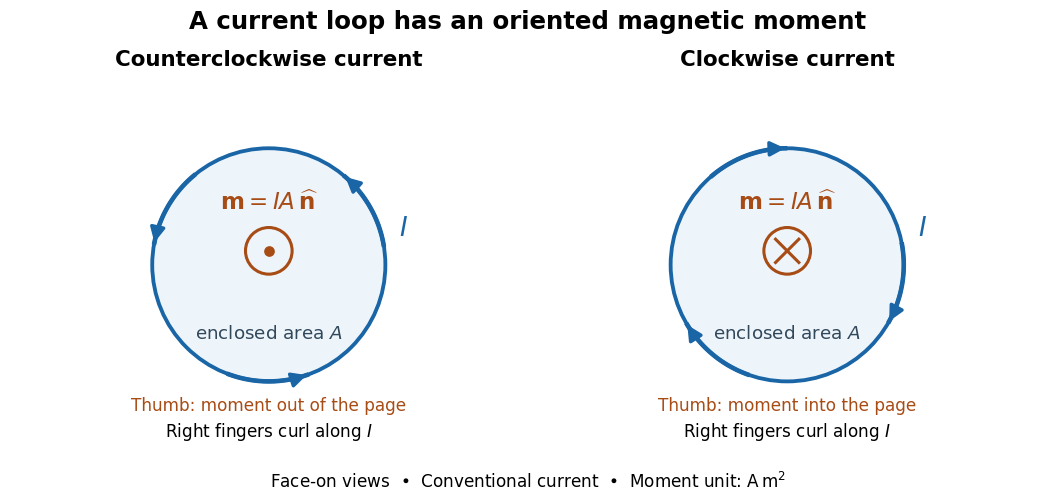
For closely spaced identical turns carrying the same electric current, the magnetic dipole moments add: . Each turn contributes its own vector area; unequal areas or differently oriented turns require a vector sum. As a calculated example, twelve circular turns of radius carrying give . This is an idealized example, not an experimental measurement.
Independent worm acquisition at rate and loss at rate produce a birth-death process for within-host parasite burden. Summing its forward equations against gives . At constant exposure, detailed balance yields a Poisson distribution with mean . Heterogeneous acquisition rates change the pooled burden distribution even when each individual host follows this model.
If host-specific equilibrium mean burden has a gamma distribution, conditional Poisson distributions produce a Poisson-gamma mixture, hence a negative binomial distribution. With mean and shape , its zero-burden probability is . Decreasing increases aggregation: a smaller infected-host prevalence can accompany the same mean burden and more heavily infected individuals.
For sexually reproducing worms, an infected host need not contain both sexes. Independent random sexes split a Poisson total burden of mean into independent male and female Poisson distributions of mean , giving the displayed probability of a fertile mixed-sex burden. For an arbitrary burden probability generating function , this probability is . Its low-burden behaviour can introduce an Allee effect in transmission, so an asexual mean-burden invasion calculation is not automatically valid.
The within-host parasite burden is the number of parasites, or a specified parasite-load measure, carried by one host. A population's mean burden and its infected-host prevalence are different summaries of the burden distribution.
A wrapped M5-brane fixes the heterotic string tension proportional to . Reduction of the gravitational coupling gives . Therefore , yielding the displayed dimensionless coupling relation. This derivation separates the K3 volume modulus from its shape Narain moduli space.
When appropriate negative-square two-cycles of a K3 surface collapse, wrapped M2-branes become massless. Their intersection pattern is an ADE root diagram, and the massless charged states enlarge the abelian gauge algebra to the corresponding simply laced Lie algebra.
// Target: supersymmetry.bigb
D0-branes are circle momentum states, D2-branes are unwrapped M2-branes, D4-branes are circle-wrapped M5-branes, and D6-branes arise from Kaluza-Klein monopoles with the M-circle as fibre. Wrapped M2-branes give fundamental strings, and unwrapped M5-branes give NS5-branes. The D8-brane is a source for Romans mass and is outside this ordinary massless-circle dictionary. Tension matching uses and .
The M2-brane has two spatial dimensions and couples electrically to the supergravity three-form. Its supersymmetric worldvolume description is the supermembrane.
The M5-brane has five spatial dimensions and carries the magnetic charge dual to the M2-brane's electric three-form charge. Wrapping it on a compact cycle lowers its effective spatial dimension and multiplies its brane tension by the cycle volume.
Pinned article: Introduction to the OurBigBook Project
Welcome to the OurBigBook Project! Our goal is to create the perfect publishing platform for STEM subjects, and get university-level students to write the best free STEM tutorials ever.
Everyone is welcome to create an account and play with the site: ourbigbook.com/go/register. We belive that students themselves can write amazing tutorials, but teachers are welcome too. You can write about anything you want, it doesn't have to be STEM or even educational. Silly test content is very welcome and you won't be penalized in any way. Just keep it legal!
Intro to OurBigBook
. Source. We have two killer features:
- topics: topics group articles by different users with the same title, e.g. here is the topic for the "Fundamental Theorem of Calculus" ourbigbook.com/go/topic/fundamental-theorem-of-calculusArticles of different users are sorted by upvote within each article page. This feature is a bit like:
- a Wikipedia where each user can have their own version of each article
- a Q&A website like Stack Overflow, where multiple people can give their views on a given topic, and the best ones are sorted by upvote. Except you don't need to wait for someone to ask first, and any topic goes, no matter how narrow or broad
This feature makes it possible for readers to find better explanations of any topic created by other writers. And it allows writers to create an explanation in a place that readers might actually find it.
Figure 1. Screenshot of the "Derivative" topic page. View it live at: ourbigbook.com/go/topic/derivativeVideo 2. OurBigBook Web topics demo. Source. - local editing: you can store all your personal knowledge base content locally in a plaintext markup format that can be edited locally and published either:This way you can be sure that even if OurBigBook.com were to go down one day (which we have no plans to do as it is quite cheap to host!), your content will still be perfectly readable as a static site.
- to OurBigBook.com to get awesome multi-user features like topics and likes
- as HTML files to a static website, which you can host yourself for free on many external providers like GitHub Pages, and remain in full control

Figure 2. You can publish local OurBigBook lightweight markup files to either OurBigBook.com or as a static website.
Figure 3. Visual Studio Code extension installation.
Figure 5. . You can also edit articles on the Web editor without installing anything locally. Video 3. Edit locally and publish demo. Source. This shows editing OurBigBook Markup and publishing it using the Visual Studio Code extension. 
- Infinitely deep tables of contents:




All our software is open source and hosted at: github.com/ourbigbook/ourbigbook
Further documentation can be found at: docs.ourbigbook.com
Feel free to reach our to us for any help or suggestions: docs.ourbigbook.com/#contact