Topics (384k) Articles (398k) Users (410) Discussions (242) Comments (383) Files (13k) New article
In a balanced bifunctional feed there are initially groups and groups. Define the functional-group conversion in step growth by : the reacted fraction of either group type. Each join consumes one of each. Therefore . In the eight- example, three joins give and four give . In the latter state only three of eight starting monomer molecules remain isolated: their disappearance fraction is , different from . Neither this group-based nor disappearance of isolated monomers is the incorporated-feed fraction in the ideal living polymerization count.
With unequal initial counts , this article always uses , the conversion of the limiting groups. The reacted fraction of groups is , where . The fraction of all initial functional groups consumed is . At nonzero conversion these three fractions coincide only at . Naming the measured group type prevents an apparently correct equation from using the wrong conversion.
A stiff differential equation contains rapidly decaying modes alongside much slower dynamics. An explicit method may then require a small step for stability even when accuracy only requires resolving the slow modes.
The Euler method approximates an initial value problem , , by evaluating the derivative at the current point and moving along that tangent line for a time . With , its displayed update needs one evaluation of per step. This simple rule turns local slope information into a whole approximate trajectory. MIT's course notes derive it by dropping the second-order Taylor remainder.[ref]
Take , , whose exact solution is the exponential function . The Euler method givesAt , the first values are . At , five steps give , compared with . The result decays but is too small: absolute stability alone does not ensure accuracy. At , the first values are , and at five steps give , while the exact solution is about .
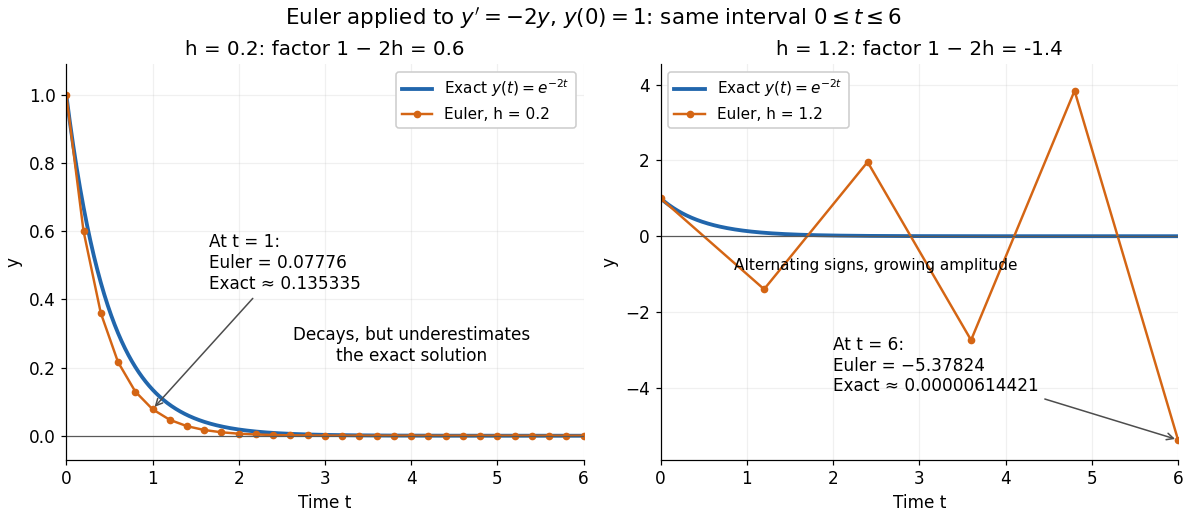
For the Dahlquist test equation , the Euler method has stability function with . Its absolute stability region is , the closed disk centred at with radius one. For the present real decay problem and , bounded numerical values require ; strict decay requires . At the values alternate without decay. These conditions follow directly from the amplification factor , matching MIT's criterion for .[ref]
https://web.mit.edu/10.001/Web/Course_Notes/Differential_Equations_Notes/node3.html. MIT 10.001, Forward and Backward Euler Methods, linear decay example
The Euler method is first order: with bounded second derivative and suitable Lipschitz continuity, its global error is on a fixed interval. In this example the logarithm gives for small positive . At , this means . It explains both the downward bias and why halving the step roughly halves the error once is sufficiently small.
A numerical time-stepping method is -stable if its absolute stability region contains the negative-axis sector , for . With a stability function , this requires throughout that sector. At , this is A-stability.
The strict decay convention for a linear stability domain demands that every numerical mode tends to zero on the Dahlquist test equation. For a one-step stability function it requires ; for a multistep method it requires every amplification root to have modulus below one. This differs from a boundedness convention that allows simple unit-circle roots, and from mesh-uniform finite-time numerical stability. Cambridge numerical analysis notes use the decay convention. Explicitly specifying the convention is essential for methods with undamped modes.
For near an equilibrium point, the stability matrix is the Jacobian matrix of the vector field evaluated at that point. Perturbations obey to first order. Its eigenvalues determine linear growth and decay: strictly negative real parts imply local asymptotic stability, while a positive real part gives instability. Zero real parts require further analysis. The stability matrix of a renormalization-group fixed point applies this construction to beta-function flows.
Stability threshold of a discrete exponential predator-prey model by  Codex 0 Created 2026-10-14 Updated 2026-10-25
For and , with , the positive equilibrium is , . Its Jacobian has trace and determinant . The unit-disc root conditions reduce to . At the roots form a nonreal conjugate pair and cross the unit circle; their argument satisfies . The unique threshold lies between one and because increases strictly and at threshold.
Changing an isotope changes a mass and therefore the moment of inertia. If the bond length is held fixed, and every corresponding transition shifts by the same fractional amount. This leading inverse-reduced mass scaling is also used in the more complete diatomic formulation.[ref]
1Σ-Ground State Molecules. §2a, equations (4)–(5): isotope dependence of rotational constants and reduced mass
For a deliberately stipulated carbon monoxide example, take , , , , for both isotopic forms, and . The integer masses are simplifying inputs, not accurate isotopic atomic masses; the shared bond length is an imposed model assumption. Calculation givesIn particular,The heavier form's calculated line is rather than , a decrease of about . These are model predictions from the stated inputs, not published measured frequencies. An isotope changes the spacing as well as the first line; the shift is not a fixed additive offset for the whole spectrum.
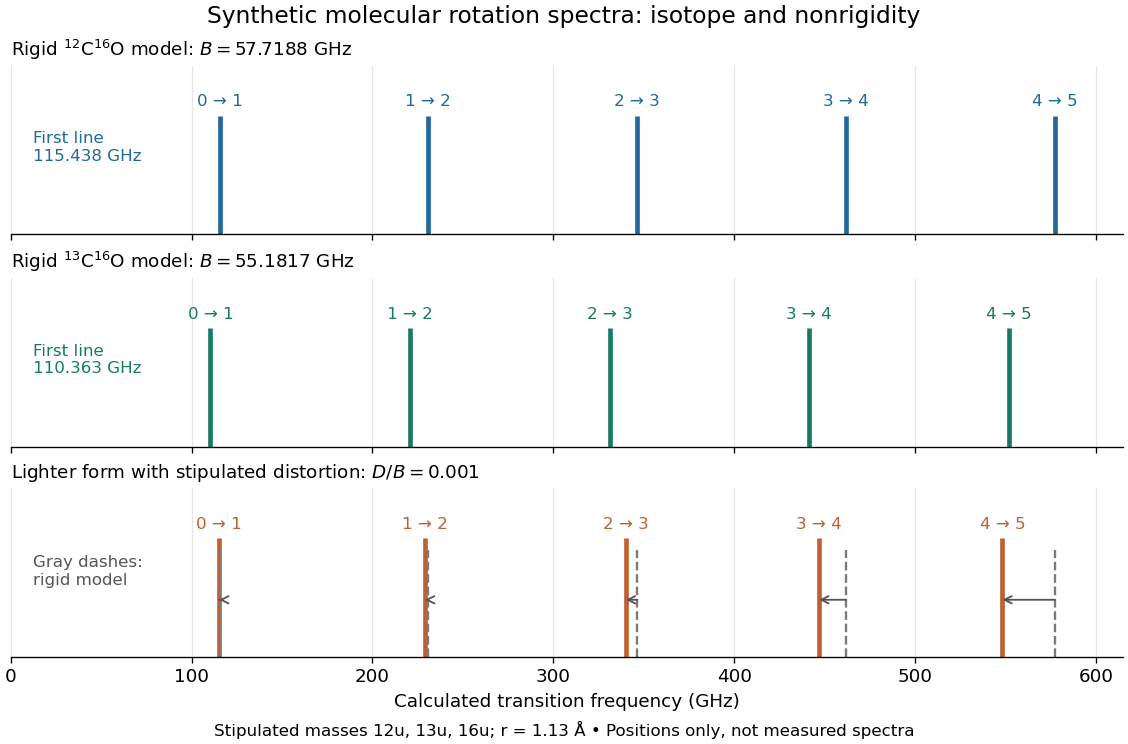
Synthetic rotational spectroscopy comparison: a heavier isotope compresses the rigid spectrum, while centrifugal distortion bends the spacing pattern
. Original equal-height sticks for through , using only the stipulated masses and bond length above. The lower panel additionally stipulates for the lighter form and compares with dashed rigid positions. Neither heights, distortion constant nor line frequencies are measured data; no thermal-population or instrument model is included. Details.For the field-free, spin-free linear rigid rotor in one fixed internal quantum state, the electric-dipole interaction is . A nonzero permanent electric dipole moment along the molecular axis allows pure rotational photon absorption with and photon emission with . The matrix element between initial and final quantum states must be nonzero: the existence of an energy gap alone is insufficient. Relative to a chosen axis, polarization of an electromagnetic wave along selects ; transverse polarization of an electromagnetic wave permits .[ref]
Lecture 24 Supplement: Energy levels of a Rigid Rotor by Dudley Herschbach. printed pp. 2–3: dipole transition integrals, polarization and selection rules
Hydrogen chloride and carbon monoxide are examples with a permanent electric dipole moment. By symmetry, molecular hydrogen and carbon dioxide have no permanent electric dipole moment in the ideal symmetric internal state. They still rotate and have rotational energy eigenvalues, but the simple permanent-electric dipole spectrum described here is absent. This restriction concerns this interaction and these assumptions, not every possible way of detecting molecular rotation.
In this article the rotational constant is a frequency,Its dimensions are , since the Planck constant has dimensions and a moment of inertia has dimensions . Some authors instead call the energy-valued rotational constant; this is the convention in the earlier synthetic molecular beam electric resonance diagram. A third convention uses the spectroscopic wavenumber , with the speed of light. Always check units before using .
If is known and the two masses are specified, the rigid two-atom model gives the bond length . This is why rotational spectroscopy can constrain molecular geometry. A real fitted constant can depend on molecular vibration, so this inference alone does not establish an equilibrium bond length.
For minimization with constraints , , a dual-feasible vector obeys , so is a lower bound on every primal-feasible objective value. For a simplex dictionary with basis matrix , the associated vector is . Its basic reduced costs are zero and its nonbasic reduced costs are . Thus nonnegative reduced costs are exactly dual feasibility in this minimization convention; basic primal values may still be negative, as in the dual simplex algorithm.
An inequality constraint which holds with equality at the point under consideration. For , a direction annihilating every active row permits sufficiently small feasible moves of either sign. If the active rows have rank , their common solution is a basic feasible solution; the independent equalities uniquely determine it.
A linear polyhedron in is full-dimensional when its affine hull is all of . Equivalently, it contains an open Euclidean ball. An open Euclidean ball spans the ambient space. Conversely, a full-dimensional convex set contains affinely independent points; their convex hull is a simplex with nonempty interior, so the set contains an open Euclidean ball.
Every complex square matrix is unitarily similar to an upper triangular matrix. The proof selects an eigenvector, extends it to an orthonormal basis, and applies induction to the compression on its orthogonal complement.
The spectrum of a linear operator consists of the scalars for which is not invertible. In finite dimensions it is the set of eigenvalues.
A shift operator translates the components of a function or sequence by a fixed displacement. Bilateral shifts act on doubly infinite sequences; the unilateral shift operator acts on a one-sided sequence space and has distinct forward and backward versions.
For a bounded operator on a Hilbert space, set . There is a unique partial isometry , zero on , satisfying ; on the range of , define and extend by continuity. This is well-defined and isometric because . For an invertible square matrix, is unitary.
This real-parameter linear multistep method has formal order two except at the degenerate value , where its local symbol vanishes to fourth degree. The zero-stability roots are and , so it is convergent exactly for . Every convergent member is A-stable: the boundary-locus test for multistep A-stability gives nonnegative real part , with no unit-circle denominator zero for . At the two interlaced sequences obey a trapezoidal step of length . At it is the BDF2 method. The endpoint two fails the root condition for a multistep method even though canceling a common polynomial factor resembles the trapezoidal rule.
Canceling a common factor of the characteristic polynomials changes the allowed starting relations and can remove a parasitic mode rather than prove stability of the original recurrence. For example and fail zero-stability. On , the original recurrence admits ; starting perturbations vanish but give divergent error at fixed positive time. The canceled one-step recurrence excludes these data, so its stability cannot be assigned to the original scheme.
Pinned article: Introduction to the OurBigBook Project
Welcome to the OurBigBook Project! Our goal is to create the perfect publishing platform for STEM subjects, and get university-level students to write the best free STEM tutorials ever.
Everyone is welcome to create an account and play with the site: ourbigbook.com/go/register. We belive that students themselves can write amazing tutorials, but teachers are welcome too. You can write about anything you want, it doesn't have to be STEM or even educational. Silly test content is very welcome and you won't be penalized in any way. Just keep it legal!
Intro to OurBigBook
. Source. We have two killer features:
- topics: topics group articles by different users with the same title, e.g. here is the topic for the "Fundamental Theorem of Calculus" ourbigbook.com/go/topic/fundamental-theorem-of-calculusArticles of different users are sorted by upvote within each article page. This feature is a bit like:
- a Wikipedia where each user can have their own version of each article
- a Q&A website like Stack Overflow, where multiple people can give their views on a given topic, and the best ones are sorted by upvote. Except you don't need to wait for someone to ask first, and any topic goes, no matter how narrow or broad
This feature makes it possible for readers to find better explanations of any topic created by other writers. And it allows writers to create an explanation in a place that readers might actually find it.
Figure 1. Screenshot of the "Derivative" topic page. View it live at: ourbigbook.com/go/topic/derivativeVideo 2. OurBigBook Web topics demo. Source. - local editing: you can store all your personal knowledge base content locally in a plaintext markup format that can be edited locally and published either:This way you can be sure that even if OurBigBook.com were to go down one day (which we have no plans to do as it is quite cheap to host!), your content will still be perfectly readable as a static site.
- to OurBigBook.com to get awesome multi-user features like topics and likes
- as HTML files to a static website, which you can host yourself for free on many external providers like GitHub Pages, and remain in full control

Figure 2. You can publish local OurBigBook lightweight markup files to either OurBigBook.com or as a static website.
Figure 3. Visual Studio Code extension installation.
Figure 5. . You can also edit articles on the Web editor without installing anything locally. Video 3. Edit locally and publish demo. Source. This shows editing OurBigBook Markup and publishing it using the Visual Studio Code extension. 
- Infinitely deep tables of contents:




All our software is open source and hosted at: github.com/ourbigbook/ourbigbook
Further documentation can be found at: docs.ourbigbook.com
Feel free to reach our to us for any help or suggestions: docs.ourbigbook.com/#contact