Topics (384k) Articles (398k) Users (410) Discussions (242) Comments (383) Files (13k) New article

Neuronal polarity is the structural and molecular differentiation of a neuron into compartments such as an axon and dendrites. Different distributions of proteins, transport machinery and synapses support different roles in receiving and sending signals. This organization does not require every electrical event to travel in only one direction: action potentials can propagate back into dendrites.
In 1988, Carlos G. Dotti, Christopher A. Sullivan and Gary A. Banker followed individual embryonic rat hippocampus neurons in culture using repeated photography and time-lapse imaging. Several initially similar neurites preceded rapid growth of one future axon; staining for microtubule-associated protein 2 helped distinguish later dendrites. Following the same biological cells over time directly tested the developmental sequence, which a collection of mature shapes could only suggest.[ref]
The establishment of polarity by hippocampal neurons in culture by Carlos G. Dotti and others. Abstract; developmental observations, pp. 1454–1468
Neuroimaging measures structural or functional properties of the nervous system. Different methods record different physical signals, so anatomical images and activity-sensitive measurements support different inferences.
For example, electroencephalography records electrical potential differences, while many functional vascular measurements depend on neurovascular coupling. Spatial overlap in an image is not by itself proof that one location implements a complete psychological process.
Reproductive success is an organism's contribution of offspring, or later descendants, under a stated measurement convention. Counting eggs laid, offspring surviving to maturity and descendants that themselves reproduce gives different outcomes. The relevant interval must therefore be explicit.
Biological fitness often compares expected reproductive contributions among inherited types in a specified environment. A realized count from one individual also includes chance: two individuals with the same underlying expected contribution can leave different numbers of descendants. Survival is one contributor to reproductive success, rather than a complete substitute for it.
Consider an explicitly idealized haploid population with two inherited types , one allele per individual at the tracked genetic locus, and discrete, nonoverlapping generations. Assume faithful type transmission, no mutation or gene flow, a constant environment, and reproductive contributions independent of type frequency. Let the expected values of offspring surviving to the next census be , with relative genotype fitness .
For frequency , expected offspring contributions are proportional to and . Normalizing gives the deterministic large-population mathematical modelThe denominator is mean relative genotype fitness. For and , . Equivalently, 200 and 800 parents with contribute expected counts 240 and 800. Fractional per-parent expected values are averages, not literal fractional offspring. The ratio of these expectations is a deterministic approximation, not generally the expectation of a random ratio.
The odds multiply particularly simply:Thus : repeated modest advantage can substantially change composition. For and , . The deterministic boundary remains unchanged: natural selection needs existing variation.
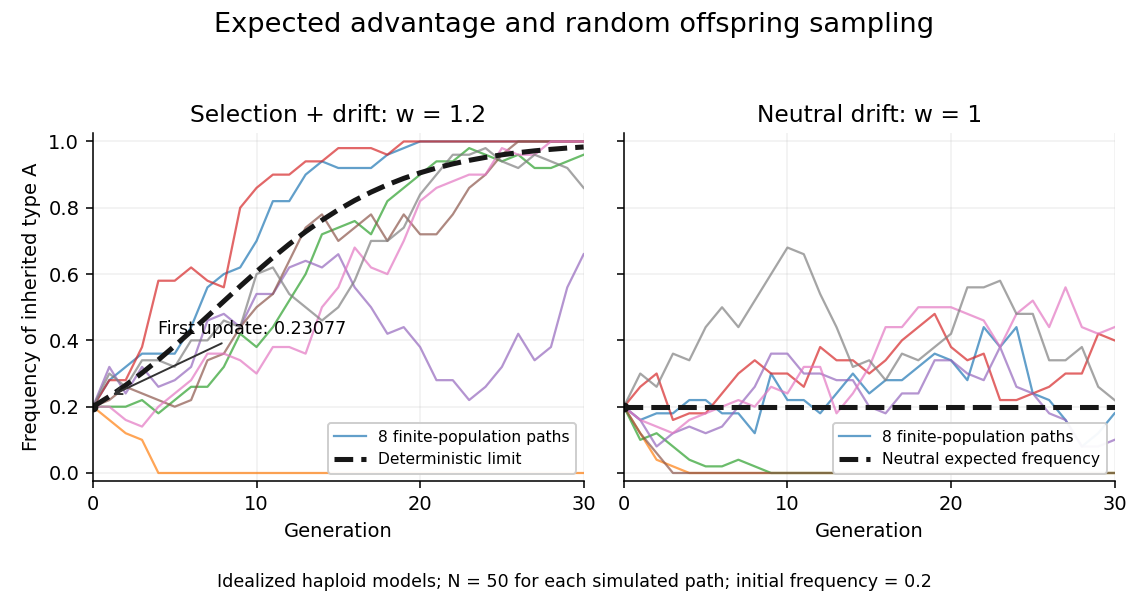
A distinct stochastic extension fixes offspring and samples their types independently using a binomial distribution: , where , then . Its conditional expected value is and conditional variance is . With , the conditional expected value remains , yet realized frequencies wander through genetic drift. With , genetic drift can still lower or lose entirely. Over several generations, the deterministic curve need not equal the mean stochastic trajectory, because the recurrence is nonlinear.
A mutation rate measures the frequency of mutation events per specified unit, such as per chromosome segment per generation. Its units and the population-size convention must be specified. If time is measured in generations and , each ancestral lineage has mutation intensity per unit of coalescent time.
A gene deletion removes a chosen gene sequence from a genome. An experimental gene deletion tests the consequences of that removal in a specified genetic background and environment; lack of an observed phenotype does not prove that the gene has no function under other conditions.
Developmental integration here means coordination of cellular growth, organization and function into a developing whole. It describes what the parts do together, whereas clonal development describes how they descend from founders. Interactions through signal transduction can help coordinate cell differentiation; see the Alberts et al. development chapter cited under multicellular organism.
Clonal development builds a group through successive divisions of founding biological cells, rather than by gathering previously separate lineages. In snowflake yeast, daughter biological cells remain attached after budding. Common ancestry does not imply that every descendant remains genetically identical forever: new mutations can arise. See the 2015 study cited under multicellular organism.
Ethene, also called ethylene, is , the simplest alkene. Its two carbons and four hydrogens form a planar framework around a carbon-carbon double bond.
In addition polymerization, opening that double bond connects successive ethene-derived units into polyethylene. Each consumed monomer contributes two carbon atoms, whereas the smallest constitutional repeating unit of the ideal chain contains only one carbon.[ref]
An individual molecule capable of contributing structural units through polymerization. See IUPAC: monomer molecule.
Pinned article: Introduction to the OurBigBook Project
Welcome to the OurBigBook Project! Our goal is to create the perfect publishing platform for STEM subjects, and get university-level students to write the best free STEM tutorials ever.
Everyone is welcome to create an account and play with the site: ourbigbook.com/go/register. We belive that students themselves can write amazing tutorials, but teachers are welcome too. You can write about anything you want, it doesn't have to be STEM or even educational. Silly test content is very welcome and you won't be penalized in any way. Just keep it legal!
Intro to OurBigBook
. Source. We have two killer features:
- topics: topics group articles by different users with the same title, e.g. here is the topic for the "Fundamental Theorem of Calculus" ourbigbook.com/go/topic/fundamental-theorem-of-calculusArticles of different users are sorted by upvote within each article page. This feature is a bit like:
- a Wikipedia where each user can have their own version of each article
- a Q&A website like Stack Overflow, where multiple people can give their views on a given topic, and the best ones are sorted by upvote. Except you don't need to wait for someone to ask first, and any topic goes, no matter how narrow or broad
This feature makes it possible for readers to find better explanations of any topic created by other writers. And it allows writers to create an explanation in a place that readers might actually find it.
Figure 1. Screenshot of the "Derivative" topic page. View it live at: ourbigbook.com/go/topic/derivativeVideo 2. OurBigBook Web topics demo. Source. - local editing: you can store all your personal knowledge base content locally in a plaintext markup format that can be edited locally and published either:This way you can be sure that even if OurBigBook.com were to go down one day (which we have no plans to do as it is quite cheap to host!), your content will still be perfectly readable as a static site.
- to OurBigBook.com to get awesome multi-user features like topics and likes
- as HTML files to a static website, which you can host yourself for free on many external providers like GitHub Pages, and remain in full control

Figure 2. You can publish local OurBigBook lightweight markup files to either OurBigBook.com or as a static website.
Figure 3. Visual Studio Code extension installation.
Figure 5. . You can also edit articles on the Web editor without installing anything locally. Video 3. Edit locally and publish demo. Source. This shows editing OurBigBook Markup and publishing it using the Visual Studio Code extension. 
- Infinitely deep tables of contents:



All our software is open source and hosted at: github.com/ourbigbook/ourbigbook
Further documentation can be found at: docs.ourbigbook.com
Feel free to reach our to us for any help or suggestions: docs.ourbigbook.com/#contact