Topics (384k) Articles (398k) Users (410) Discussions (242) Comments (383) Files (13k) New article

The chemical element with atomic number eighteen. Argon is a colourless noble gas. It can provide a protective atmosphere around hot, reactive materials, for example in welding, where excluding oxygen limits oxidation. Commercial production separates it by distillation of liquid air.[ref]
Argon — Element information, properties and uses. Periodic Table by Royal Society of Chemistry; Fact box, Uses and Natural abundance: atomic number, group, protective atmosphere and liquid-air distillation
Its discovery shows why a small disagreement can matter more than a reassuringly repeatable result. Two preparations can each give consistent measurements while producing different mixtures. The Rayleigh-Ramsay argon density experiment investigated just such a discrepancy. Gas density links the weighing to a mean molar mass; a separate separation process tests which component accounts for it.
The chemical element with atomic number seventeen.
The chemical element with atomic number sixteen.
The chemical element with atomic number fifteen.
The chemical element with atomic number thirteen.
The chemical element with atomic number nine.
The chemical element with atomic number five.
The periodic table arranges chemical elements in increasing atomic number, across successive periodic table periods. Its columns are periodic groups, numbered 1–18. The layout places recurring outer electron configurations above one another, making similarities in chemical bonds and chemical reactions easier to recognize. Ordering is by proton count, not by mass; the mass number of a particular isotope does not determine its box. See the official IUPAC periodic table and numbering conventions.
For the first eighteen neutral chemical atoms in their ground states, a compact description counts electrons in successive electron shells. Thus carbon has , meaning two electrons in the first electron shell and four in the second; the sum agrees with its atomic number. Sodium has , whose sum is . These are occupancy counts, not circular trajectories of electrons.
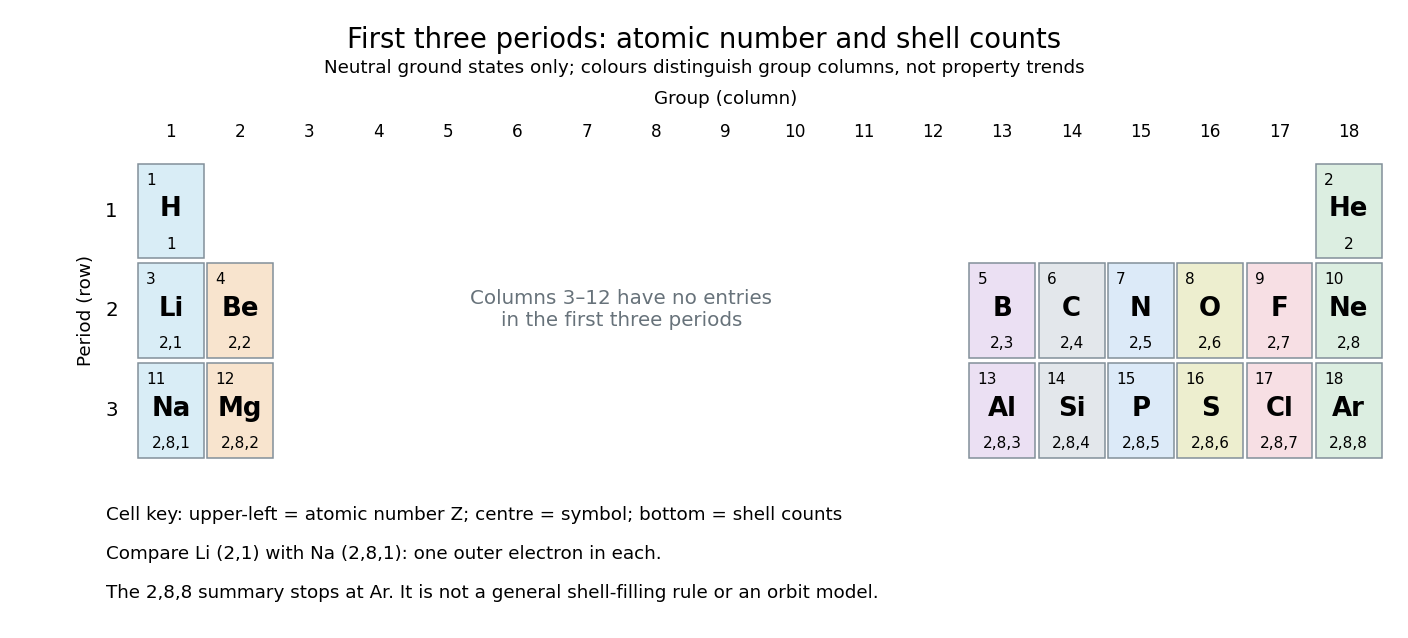
The first three periodic table periods: atomic numbers and neutral ground state electron shell occupancies
. Colours distinguish periodic group columns only, without encoding numerical property trends. The spaces in columns 3–12 preserve the eighteen-column periodic table layout: no chemical elements occupy those positions in these three periodic table periods. Each cell gives a chemical element's symbol, atomic number, and electron shell counts. Details.Reading each row from left to right gives:
The counting outline is short: the occupied electron subshells in this range are , , , , and , filled in that order for these neutral ground states. Each electron subshell holds up to two electrons and each electron subshell up to six, giving , , and along these three rows. This summary applies only through argon; it is not a general rule that each electron shell fills completely before the next begins, nor a claim that the third electron shell can hold only eight electrons. See Flowers et al., Chemistry 2e, electronic structure and electron configurations.
The recurring outer counts make the arrangement useful. Lithium and sodium each have one valence electron, whereas fluorine and chlorine each have seven valence electrons. Such similarities help anticipate chemical reactions, without making all properties identical throughout a periodic group. Helium is an instructive exception to an eight-electron shortcut: its two electrons complete the first electron shell, so it belongs above neon and argon in periodic group 18. Hydrogen shares column 1 with lithium and sodium but has its own distinct chemistry. See Flowers et al., Chemistry 2e, periodic-table organization.
Copper is the chemical element with atomic number 29 and symbol . It is a transition metal. Its high electrical conductivity supports wiring, and and are common oxidation states. Copper-containing alloys include brass and bronze, whose properties differ from those of the pure metal.[ref]
Zinc is the chemical element with atomic number 30 and symbol . It is a metal. Its common ion is . Coating iron with zinc protects it through both a surface barrier and preferential zinc oxidation; zinc in an enzyme instead has a coordinated ionic role rather than behaving as a bulk metallic coating.[ref]
Platinum is the chemical element with atomic number 78 and symbol . It is a transition metal. It resists many corrosive environments but can be highly active at its surface as a catalyst. This contrast shows that bulk chemical persistence and catalytic surface activity are compatible properties.[ref]
Mercury is the chemical element with atomic number 80 and symbol . It is a metal. It is liquid near ordinary room temperature, making it a familiar exception to the usual solid state of metals. Mercury(I) commonly contains the dimeric cation , while mercury(II) has different chemistry.[ref]
Tungsten is the chemical element with atomic number 74 and symbol . It is a transition metal. Its very high melting point supports high-temperature applications. Electron emission from a heated tungsten filament connects thermal energy with the escape of electrons from a metal surface.[ref]
Tin is the chemical element with atomic number 50 and symbol . It is a metal. Both and oxidation states are common. Its different solid allotropes have different structures, and tin-containing solders illustrate how alloy composition can change melting and mechanical properties.[ref]
Nicotinamide adenine dinucleotide phosphate is a cofactor used in metabolism. Its oxidized and reduced forms, NADP+ and NADPH, carry electrons between coupled chemical reactions. In oxygenic photosynthesis, light-dependent reactions produce NADPH for the Calvin cycle, which returns NADP+ for reuse. [ref].
2-Mercaptoethanol is the chemical compound ; see the NIST Chemistry WebBook, 2-mercaptoethanol: structure and names. In the ribonuclease A refolding experiment, it breaks protein disulfide bonds, while the peptide bonds of the protein backbone remain intact. This separates a change in crosslinks from cutting the polypeptide chain.
Urea is the chemical compound with molecular formula and structure . See the NIST Chemistry WebBook, urea: formula and structure. Concentrated urea is used to promote protein denaturation in the ribonuclease A refolding experiment.
An isocyanate bears an group. A molecule bearing two such groups can react with a diol to form polyurethane connections.
A diol has two hydroxy groups. Its two groups can serve as joining ends in polyaddition; the rest of its molecule can already be a long chain.
Ellman's reagent is 5,5'-dithiobis(2-nitrobenzoic acid), abbreviated DTNB, a disulfide used to quantify accessible thiols. Reaction releases the colored TNB species measured by absorbance at wavelength . The disulfide bond experiment above explains why a thiol measurement can become an indirect bridge count only after controlled reduction. [ref]
https://assets.thermofisher.com/TFS-Assets/LSG/manuals/MAN0011216_Ellmans_Reag_UG.pdf. Pierce Biotechnology: identity and use of Ellman's reagent
Pinned article: Introduction to the OurBigBook Project
Welcome to the OurBigBook Project! Our goal is to create the perfect publishing platform for STEM subjects, and get university-level students to write the best free STEM tutorials ever.
Everyone is welcome to create an account and play with the site: ourbigbook.com/go/register. We belive that students themselves can write amazing tutorials, but teachers are welcome too. You can write about anything you want, it doesn't have to be STEM or even educational. Silly test content is very welcome and you won't be penalized in any way. Just keep it legal!
Intro to OurBigBook
. Source. We have two killer features:
- topics: topics group articles by different users with the same title, e.g. here is the topic for the "Fundamental Theorem of Calculus" ourbigbook.com/go/topic/fundamental-theorem-of-calculusArticles of different users are sorted by upvote within each article page. This feature is a bit like:
- a Wikipedia where each user can have their own version of each article
- a Q&A website like Stack Overflow, where multiple people can give their views on a given topic, and the best ones are sorted by upvote. Except you don't need to wait for someone to ask first, and any topic goes, no matter how narrow or broad
This feature makes it possible for readers to find better explanations of any topic created by other writers. And it allows writers to create an explanation in a place that readers might actually find it.
Figure 1. Screenshot of the "Derivative" topic page. View it live at: ourbigbook.com/go/topic/derivativeVideo 2. OurBigBook Web topics demo. Source. - local editing: you can store all your personal knowledge base content locally in a plaintext markup format that can be edited locally and published either:This way you can be sure that even if OurBigBook.com were to go down one day (which we have no plans to do as it is quite cheap to host!), your content will still be perfectly readable as a static site.
- to OurBigBook.com to get awesome multi-user features like topics and likes
- as HTML files to a static website, which you can host yourself for free on many external providers like GitHub Pages, and remain in full control

Figure 2. You can publish local OurBigBook lightweight markup files to either OurBigBook.com or as a static website.
Figure 3. Visual Studio Code extension installation.
Figure 5. . You can also edit articles on the Web editor without installing anything locally. Video 3. Edit locally and publish demo. Source. This shows editing OurBigBook Markup and publishing it using the Visual Studio Code extension. 
- Infinitely deep tables of contents:



All our software is open source and hosted at: github.com/ourbigbook/ourbigbook
Further documentation can be found at: docs.ourbigbook.com
Feel free to reach our to us for any help or suggestions: docs.ourbigbook.com/#contact