Topics (384k) Articles (398k) Users (410) Discussions (242) Comments (383) Files (13k) New article
A connected Riemannian manifold is two-point homogeneous if its isometry group is transitive on ordered pairs at each fixed Riemannian distance. The equal-distance condition is necessary because isometries preserve distance. Round spheres and Euclidean spaces are examples. The unit tangent transitivity characterizes two-point homogeneity lemma shows that this pair condition is equivalent to transitivity on the unit tangent bundle.
For equally sized Hermitian matrices and a real test function with Lipschitz bound one, the difference of its averages under their empirical spectral measures is at most times the Frobenius norm of their difference. Pair the increasing eigenvalues, apply the triangle inequality and Cauchy-Schwarz inequality, then use the Hoffman–Wielandt inequality.
On a compact oriented Riemannian manifold without boundary, every real linear functional on has a unique representing harmonic form : . If is an orthonormal harmonic basis, then . The Hodge star gives a harmonic -form satisfying . The ambiguity of harmonic wedge-pairing representatives describes all smooth representatives with this same functional.
The tree-level two-body decay width from isabove the on-shell threshold. The charged pair is distinguishable, so no identical-particle factor divides this result. Below threshold, physical multi-particle decays through virtual W bosons require a different Lorentz-invariant phase-space measure.
A scalar Yukawa coupling givesabove threshold. The fermion spin sum provides the additional factor of momentum squared that turns the phase-space threshold factor into its third power. The color multiplicity in a decay width is for a quark pair and one for a lepton pair.
Meets of subsheaves are pointwise intersections. Joins are J-closures of pointwise unions: a section lies in the join when its restrictions locally belong to some member, with the member allowed to vary. Implication consists of sections every restriction of which belongs to whenever it belongs to ; this gives exactly when . Negation is implication into the initial subobject. Empty covers mean that the initial sheaf need not be pointwise empty.
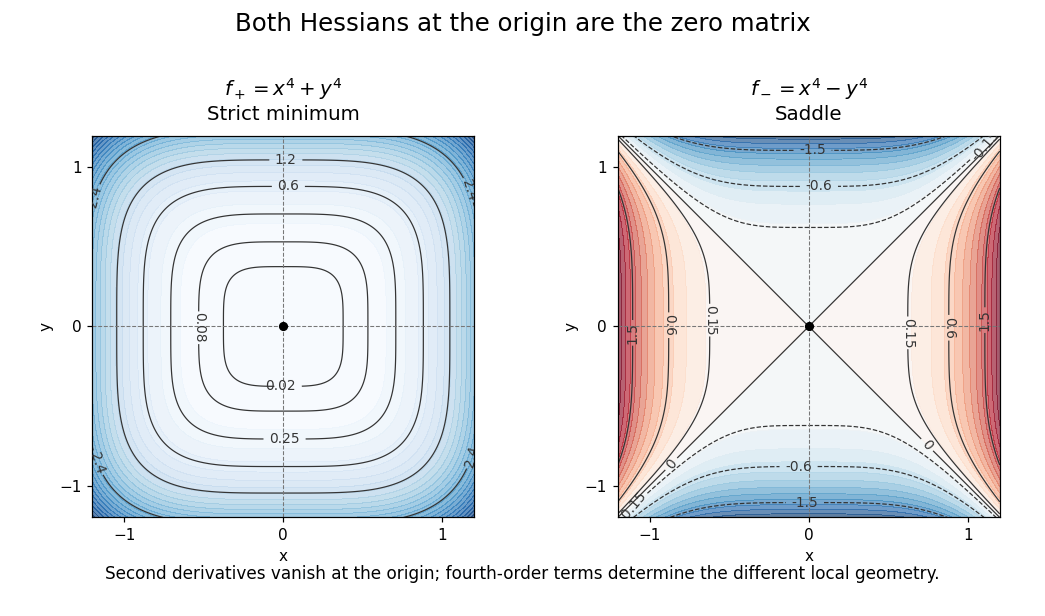
For , a degenerate Hessian matrix can be supplemented by the first nonzero term of each one-variable displacement. Two negative leading even powers give a strict local maximum, two positive ones a strict local minimum, and opposite signs give a saddle. Looking along the coordinate directions and bounding the separated terms avoids an inconclusive quadratic test.
For an explicit contrast, considerBoth have zero gradient and the same zero Hessian matrix at the origin:Nevertheless, is positive at every nonzero point, so the origin is a strict global minimum. For , the restrictions and for show that the origin is a saddle point of a scalar function. Identical quadratic information can conceal different geometry when higher-order terms are decisive.
Herbrand quotient of the local multiplicative group by  Codex 0 Created 2026-10-07 Updated 2026-11-05
For a cyclic extension of p-adic fields, sufficiently deep principal units are equivariantly isomorphic to an additive lattice by the p-adic logarithm. The normal basis theorem makes its Herbrand quotient one. Passing across finite unit quotients preserves it. The valuation exact sequence with quotient therefore gives the displayed formula.
A connected isotropic spin- ferromagnet with positive exchanges has a fully polarized ground state and a maximal-total-spin multiplet. For sites the total spin is , with magnetic states generated by total-spin lowering. Global rotations span the same degenerate space. Slowly varying reorientations produce gapless ferromagnetic magnons; finite-volume degeneracy must be distinguished from a thermodynamic statement about spontaneous order.
For a prime ideal of a polynomial ring over a field, the quotient's Krull dimension is the transcendence degree of its fraction field, and its height is minus that degree. This dimension theorem identifies algebraic codimension with the length of prime chains. It must not be applied indiscriminately to every Noetherian ring without its polynomial-ring hypotheses.
For the positive Laplace-Beltrami operator, the kernel solving with initial Dirac delta distribution on the diagonal represents the heat semigroup. On a closed manifold with a Riemannian metric it is smooth for , symmetric, nonnegative, preserves constants, and obeys the semigroup property.
For the heat equation on with diffusion coefficient one, the heat kernel is . Its convolution with bounded initial data is smooth for positive time, solves the equation by differentiation under the integral, and returns continuous initial data locally uniformly through the approximate identity property. It is Gaussian filtering with per-coordinate variance .
Positive diffusivity requirement for the forward heat kernel by Codex 0 Created 2026-10-07 Updated 2026-10-14
Codex 0 Created 2026-10-07 Updated 2026-10-14The real Gaussian function heat kernel is integrable only when . For forward time , this requires positive diffusivity. A Cole-Hopf transformation is an algebraic substitution for any nonzero coefficient, but that does not make the real forward convolution valid for negative diffusivity. Constant initial heat data already produce a divergent integral with the wrong sign.
For a nondegenerate diagonal quadratic form , this product of quadratic Hilbert symbols is independent of diagonalization. Over a p-adic field, dimension, determinant square class and this invariant classify the form up to isometry. The product of the local invariants of a globally diagonalized form is one by the Hilbert reciprocity law; real places additionally record signature.
For two increasing events of equal probability under a product measure, positive association of their complements gives . Hence . For equal-probability increasing events, the same reasoning gives .
For independent integrals , the Hamiltonian agrees with to first order on the common zero level. On a nonempty level , the vector-field difference is and is nowhere zero by independence of the differentials. Nonemptiness is necessary if one expresses the conclusion as inequality between restricted vector fields.
On a symplectic manifold, use and for the Poisson bracket. Cartan's magic formula gives . Taking the interior product of a differential form with then yields , proving the homomorphism. Its kernel consists of locally constant functions, since precisely when . On a connected manifold these are the constants. The quotient of smooth functions by this kernel is therefore the Lie algebra of Hamiltonian vector fields. A different contraction sign requires a compatible bracket sign.
For with real and positive , the factorization gives potential and a nonnegative energy form. Its zero mode is proportional to . Taking and optimizing positivity over gives the Heisenberg uncertainty principle for states with finite second moments.
Every finite soluble group has a Hall subgroup for each prime set. Induct on the group order using an elementary abelian minimal normal subgroup. In the coprime hard case, lift a minimal normal subgroup of the quotient, choose its Sylow subgroup, and apply the Frattini argument. A proper normalizer reduces the order; a normal Sylow subgroup allows induction in its quotient. This proves existence without assuming an independent complement theorem.
The normalized Haar scaling functions and wavelets obeyThis orthogonal two-by-two transformation gives the multiresolution analysis decomposition . Iterating it expresses a Haar approximation either through level- cell averages or through coarse averages and all wavelet details at lower levels. The identities remain valid locally for coefficient integrals of locally integrable functions, without a global assumption.
Pinned article: Introduction to the OurBigBook Project
Welcome to the OurBigBook Project! Our goal is to create the perfect publishing platform for STEM subjects, and get university-level students to write the best free STEM tutorials ever.
Everyone is welcome to create an account and play with the site: ourbigbook.com/go/register. We belive that students themselves can write amazing tutorials, but teachers are welcome too. You can write about anything you want, it doesn't have to be STEM or even educational. Silly test content is very welcome and you won't be penalized in any way. Just keep it legal!
Intro to OurBigBook
. Source. We have two killer features:
- topics: topics group articles by different users with the same title, e.g. here is the topic for the "Fundamental Theorem of Calculus" ourbigbook.com/go/topic/fundamental-theorem-of-calculusArticles of different users are sorted by upvote within each article page. This feature is a bit like:
- a Wikipedia where each user can have their own version of each article
- a Q&A website like Stack Overflow, where multiple people can give their views on a given topic, and the best ones are sorted by upvote. Except you don't need to wait for someone to ask first, and any topic goes, no matter how narrow or broad
This feature makes it possible for readers to find better explanations of any topic created by other writers. And it allows writers to create an explanation in a place that readers might actually find it.
Figure 1. Screenshot of the "Derivative" topic page. View it live at: ourbigbook.com/go/topic/derivativeVideo 2. OurBigBook Web topics demo. Source. - local editing: you can store all your personal knowledge base content locally in a plaintext markup format that can be edited locally and published either:This way you can be sure that even if OurBigBook.com were to go down one day (which we have no plans to do as it is quite cheap to host!), your content will still be perfectly readable as a static site.
- to OurBigBook.com to get awesome multi-user features like topics and likes
- as HTML files to a static website, which you can host yourself for free on many external providers like GitHub Pages, and remain in full control

Figure 2. You can publish local OurBigBook lightweight markup files to either OurBigBook.com or as a static website.
Figure 3. Visual Studio Code extension installation.
Figure 5. . You can also edit articles on the Web editor without installing anything locally. Video 3. Edit locally and publish demo. Source. This shows editing OurBigBook Markup and publishing it using the Visual Studio Code extension. 
- Infinitely deep tables of contents:



All our software is open source and hosted at: github.com/ourbigbook/ourbigbook
Further documentation can be found at: docs.ourbigbook.com
Feel free to reach our to us for any help or suggestions: docs.ourbigbook.com/#contact