Topics (384k) Articles (398k) Users (410) Discussions (242) Comments (383) Files (13k) New article
A thermally activated phase slip is a noise-driven crossing between adjacent phase-locked wells. In the mobility-one Langevin equation has the units of the phase potential . A barrier of height is rarely crossed when .
For a smooth nondegenerate minimum and neighboring saddle , the overdamped Kramers escape rate is asymptoticallyThe mean waiting time is approximately , whereas local relaxation within the well occurs on the scale . An intrawell phase autocorrelation approximation is useful only on timescales where escape remains rare; the barrier height alone does not specify this hierarchy.
For the Adler phase equation, the activation barriers of the Adler phase equation differ by in the two winding directions, while the leading curvature prefactors agree. Their rate ratio is therefore in the low-noise approximation. The barrier-crossing description fails at the deterministic locking threshold, where the minimum and saddle merge and the assumed nonzero curvatures vanish.
A pure thermodynamic phase is an extremal equilibrium Gibbs state rather than a probabilistic mixture of distinct macroscopic phases. On an ordered Ising branch, taking the thermodynamic limit before removing a selecting conjugate field gives a nonzero magnetization. A symmetric mixture can instead have zero mean but a nondecaying two-point contribution. The connected correlation function and correlation length describing ordinary critical fluctuations should be evaluated in a chosen pure phase when this distinction matters.
Suppose a finite group acts freely on and trivially on its integral cohomology. The Borel construction gives a sphere fibration over whose total space is homotopy equivalent to the -dimensional quotient. Its Serre spectral sequence has just two rows with trivial local coefficients. Transgressing the fibre generator gives ; the sole differential is multiplication by it up to sign. For , both the source and target terms have total degrees above , so their surviving kernel and cokernel must vanish. Hence multiplication by gives period in positive-degree cohomology over any field.
The alternating resolution maps and for a cyclic group become zero after applying homomorphisms to its trivial prime field module. Thus there is one class in every degree. A two-step shift of the resolution represents a degree-two periodicity class . For odd , a degree-one class squares to zero by graded commutativity, andOne can take for the Bockstein homomorphism. For the two maps agree over , so a one-step shift gives with . The Künneth theorem then gives dimension in degree for , obstructing periodic group cohomology and hence such a free sphere action.
A triangular wave is a continuous piecewise-linear periodic function with successive rising and falling segments. For , the even -periodic extension of from isIt has troughs of height zero at , peaks of height at , and slopes and between the corners. The function is continuous at the corners but lacks a derivative there.
Its Fourier cosine series contains a constant term and odd modes with coefficients proportional to the inverse square of the mode number. The Fourier cosine series of a triangular wave computes this for another normalization. Even periodic extensions also encode reflection in problems with Neumann boundary conditions.
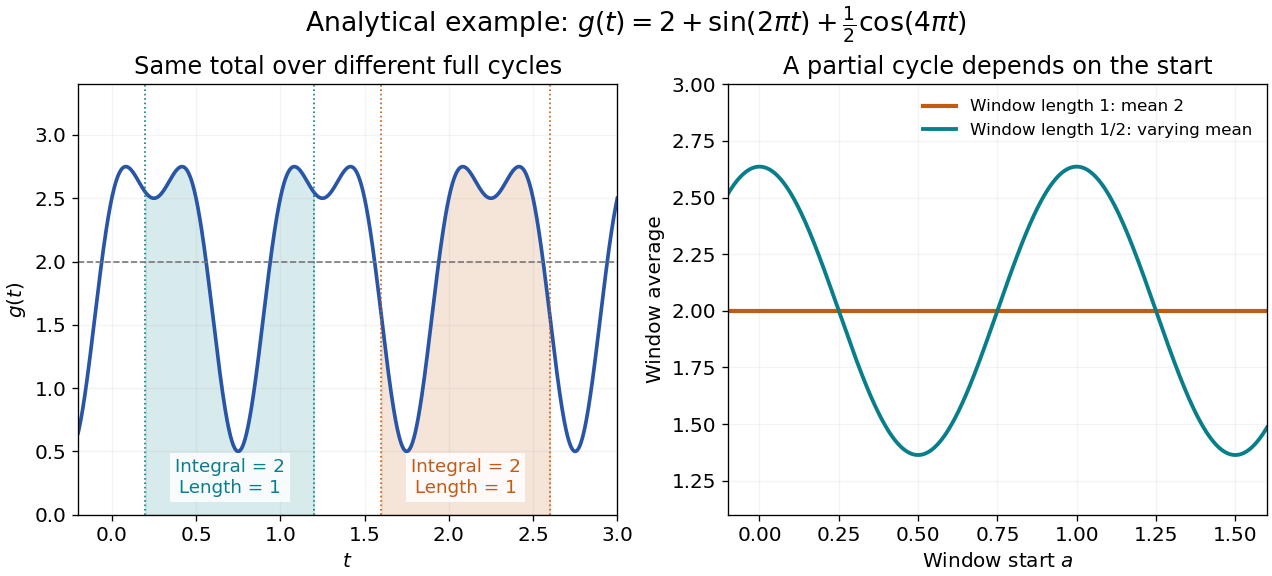
The period average extracts the reference level of an integrable function that repeats. For a real- or complex-valued periodic function with positive period of a function , assume is Lebesgue integrable on every bounded interval. Its average isThe answer is independent of the starting point . Splitting a shifted interval at the old endpoint and using moves its extra piece back into the missing piece. The interval length must be a period; an arbitrary window can give a different average.
For , every length-one window has average : both oscillating integrals vanish over that window. A half-unit window instead has average , which depends on its start. Thus a short sample of an oscillation can bias an estimate of its reference level even when the full-cycle average is known exactly.
In the complex Fourier series convention with basis , the zero-frequency Fourier coefficient is . This assertion defines the coefficient even when an additional convergence theorem is needed to reconstruct from its series. Strang's §4.1 explicitly identifies that constant coefficient with the average.[ref]
Fourier Series for Periodic Functions. §4.1; pp. 317
Averaging a square measures something different from averaging its original function. For the illustrated , orthogonality of the trigonometric terms gives , whereas . Its root mean square is therefore . Similarly, the period average of is . A zero mean need not imply a zero mean square.
Admissible data for a periodic convolution inverse by  Codex 0 Created 2026-10-06 Updated 2026-10-31
When all multipliers are nonzero, the Moore–Penrose inverse of an operator acts by dividing each Fourier coefficient by . Its data domain is precisely the square-summability condition displayed. The dense range need not be closed, and writing the formal inverse series does not establish the Picard criterion.
For independent site percolation or bond percolation on a rooted locally finite graph, is right continuous on . Finite-radius connection events have polynomial probabilities in and decrease to infinite connection. Thus is their infimum by continuity from above of a measure. This infimum of continuous functions is upper semicontinuous; parameter monotonicity from the monotone coupling of Bernoulli percolation then gives right continuity.
Suppose a planar bond percolation model has critical one-arm probability at most with , and a finite-radius connection event depends on edges. The finite-box comparison for percolation parameters gives . Balancing at gives . For the square lattice use and the polynomial critical one-arm upper bound.
independent bond percolation on the square lattice satisfies , where is its connective constant. If , closed dual graph cycles have a summable large-length tail: their counts are bounded by a polynomial factor times the count of self-avoiding walks. Conditioning a sufficiently large finite box to be open excludes short enclosing graph cycles without changing the law of the remaining edges. With positive conditional probability no enclosing closed dual graph cycle remains, so the origin belongs to an infinite percolation cluster.
If , the best unrestricted derivative-norm bounds are and . Continuous concentrated bumps approach the first constant, and continuous approximations to approach the second. For the three-point asymmetric second-derivative formula, these constants are and .
A dyadic partition of at level consists of equal cells of length . Each cell splits into two cells at the next level. Use left-closed, right-open cells, adding the endpoint to the final cell when a pointwise representative is needed. These nested partitions underlie the Haar scaling functions and Haar wavelets.
A differential poset is a locally finite graded partially ordered set with a unique minimum, finite ranks, and up and down cover operators satisfying for a fixed positive integer . The Young lattice has : distinct equal-rank diagrams have equally many common upper and lower covers, and each diagram has one more upper cover than lower cover.
A subset of a partially ordered set on which the inherited order is total. The upper-bound hypothesis in Zorn lemma concerns all such subsets, not just countable increasing sequences.
A partial order in which the strict predecessors of each node form a well-order. The height of a node is the order type of its predecessors; nodes of a common height form a level. This order-theoretic meaning is distinct from a graph-theoretic tree.
For , the partial transpose of its pure state projector is , where is the swap operator. Expand in matrix units: becomes .
A partial unary operation on a set is a partial function with specified domain of a function and values in . For example, is a partial unary operation on the real numbers with .
A function preserving partial unary operations and must send each into and satisfy . It need not reflect definedness: a point outside can still map into . Preservation therefore requires both a domain of a partial function condition and a value equality.
Integrating a Stokeslet distribution along a straight slender filament explains the leading drag anisotropy. Axial motion samples the tensor component , while transverse motion samples . Integrating on both sides from radius to cutoff gives and . End effects and nonlocal hydrodynamic interactions supply the corrections retained by slender-body theory.
Lubrication resistance integrals for a nearly occluding sphere by Codex 0 Created 2026-10-06 Updated 2026-10-14
Codex 0 Created 2026-10-06 Updated 2026-10-14A sphere almost filling a tube has local parabolic lubrication gap . The resistance integrals are , and , obtained with and . Moving-boundary lubrication flux weights shear-driven and pressure-driven transport by different powers of the gap, explaining the three distinct divergence rates.
The graph of a pants decomposition has one vertex per pair of pants and one edge per glued cuff. It is a connected trivalent multigraph, possibly with loops. A closed surface of genus gives vertices and edges, so its first Betti number is . The graph records a decomposition rather than the homeomorphism class alone, and omits cuff lengths and twists.
Pinned article: Introduction to the OurBigBook Project
Welcome to the OurBigBook Project! Our goal is to create the perfect publishing platform for STEM subjects, and get university-level students to write the best free STEM tutorials ever.
Everyone is welcome to create an account and play with the site: ourbigbook.com/go/register. We belive that students themselves can write amazing tutorials, but teachers are welcome too. You can write about anything you want, it doesn't have to be STEM or even educational. Silly test content is very welcome and you won't be penalized in any way. Just keep it legal!
Intro to OurBigBook
. Source. We have two killer features:
- topics: topics group articles by different users with the same title, e.g. here is the topic for the "Fundamental Theorem of Calculus" ourbigbook.com/go/topic/fundamental-theorem-of-calculusArticles of different users are sorted by upvote within each article page. This feature is a bit like:
- a Wikipedia where each user can have their own version of each article
- a Q&A website like Stack Overflow, where multiple people can give their views on a given topic, and the best ones are sorted by upvote. Except you don't need to wait for someone to ask first, and any topic goes, no matter how narrow or broad
This feature makes it possible for readers to find better explanations of any topic created by other writers. And it allows writers to create an explanation in a place that readers might actually find it.
Figure 1. Screenshot of the "Derivative" topic page. View it live at: ourbigbook.com/go/topic/derivativeVideo 2. OurBigBook Web topics demo. Source. - local editing: you can store all your personal knowledge base content locally in a plaintext markup format that can be edited locally and published either:This way you can be sure that even if OurBigBook.com were to go down one day (which we have no plans to do as it is quite cheap to host!), your content will still be perfectly readable as a static site.
- to OurBigBook.com to get awesome multi-user features like topics and likes
- as HTML files to a static website, which you can host yourself for free on many external providers like GitHub Pages, and remain in full control

Figure 2. You can publish local OurBigBook lightweight markup files to either OurBigBook.com or as a static website.
Figure 3. Visual Studio Code extension installation.
Figure 5. . You can also edit articles on the Web editor without installing anything locally. Video 3. Edit locally and publish demo. Source. This shows editing OurBigBook Markup and publishing it using the Visual Studio Code extension. 
- Infinitely deep tables of contents:



All our software is open source and hosted at: github.com/ourbigbook/ourbigbook
Further documentation can be found at: docs.ourbigbook.com
Feel free to reach our to us for any help or suggestions: docs.ourbigbook.com/#contact