Topics (384k) Articles (398k) Users (410) Discussions (242) Comments (383) Files (13k) New article
A Borel set of Lebesgue measure zero. Every Lebesgue-null set is contained in a Borel null set, by outer regularity; consequently testing all Borel null sets suffices in the definition of a Sierpiński set.
Past null infinity is the ideal boundary from which incoming null geodesics arrive in an asymptotically flat spacetime. In the Minkowski conformal compactification it is , with the retarded coordinate tending to and the advanced coordinate finite.
Finite-codimensional weak-star dense dual subspace is norming by  Codex 0 Created 2026-10-06 Updated 2026-11-05
Let be a Banach space, and let be a norm-closed linear subspace with finite codimension, dense for the weak-star topology. Then is a norming subspace: some satisfiesPut . Finite codimension makes finite-dimensional, while density for the weak-star topology gives . The canonical embedding into the bidual has closed image , whose unit sphere has positive distance from : otherwise bounded approximants in have a convergent subsequence with a nonzero limit in both spaces. The Hahn-Banach theorem identifies the norm of evaluation restricted to with , proving the bound. Completeness of is needed for this closedness argument.
Finite truncations of the sign or phase sequence of belong to and attain increasing partial sums of . Thus the space of sequences converging to zero is 1-norming for the absolutely summable sequence space. Its codimension in is infinite: indicators of pairwise disjoint infinite subsets have linearly independent classes modulo . Norming does not require finite codimension.
For a nonnegative normalized velocity density , is a positive norm-one projection on phase-space . Normalization gives . Its range consists of fields . This Banach-space projection need not be an orthogonal projection in unweighted ; no such assertion is needed for the collision estimates.
Integrable Volterra solution for normalized velocity relaxation by Codex 0 Created 2026-10-06 Updated 2026-10-07
Codex 0 Created 2026-10-06 Updated 2026-10-07For , let . The factorial bound for a Volterra iterate is . Thus the Neumann series converges in for every finite and solves . The same estimate applied to a difference proves uniqueness among locally time-bounded integral solutions. The whole collision term remains inside this undamped integral, rather than absorbing loss into the free propagator.
A normal-ordered product of free-field oscillator operators places all creation operators to the left of all annihilation operators, including the fermionic sign required to reorder fermions. Its vacuum expectation vanishes if any nontrivial oscillator factors remain. The Wick theorem expresses a free-field time-ordered product through these products and all Wick contractions.
For the quantum harmonic oscillator , its normal symbol is . The Weyl ordering symbol of is , so . Switching from adjacent-label coherent-state time slicing to a midpoint phase-space path integral must retain this ordering correction. Both correctly normalized constructions give the thermal partition function of a quantum harmonic oscillator ; retaining the normal-symbol constant after switching prescriptions would count the zero-point shift twice.
An eigenfrequency is the natural frequency associated with a free normal mode. Always specify whether it means the angular frequency or the frequency in hertz. For a uniform fixed-end wave equation on a string, and ; the amplitude does not change either within the linear model. In a generalized eigenvalue problem for small oscillations, the eigenvalue is , rather than itself.
For a first-order system , a real eigenvalue of instead gives a signed eigenfrequency in . A positive imaginary part of gives exponential decay with this sign convention. Thus a complex damped eigenfrequency encodes both oscillation and decay; it is not just the number of cycles per second.
If a normal matrix satisfies , then . Indeed, is normal and . Since , also . This identity proves orthogonality of distinct eigenspaces and gives spectral restrictions for Hermitian matrices, skew-Hermitian matrices and unitary matrices.
A two-factor normal linear model describes independent responses with factor-specific means and common normal error variance. The additive mean assumes no interaction term; the full mean permits the first factor effect to vary with the second. Constraints or treatment coding identify the parameters. In a balanced two-by-five design the full model has ten free cell means.
For a centered normal random variable , and . This converts squared normal increments into exact variance calculations, including the degenerate case .
For independent standard normal random variables , the maximum of has scale . A union bound and the Gaussian tail bound give the upper scale. Integrating the normal density over gives a lower tail bound , implying .
The standard normal distribution has probability density function . Its rapid decay explains both concentration at one location and the growth scale of a Gaussian maximum over many locations.
The block mixed norm sums the norm of each block, for . Its dual norm is , where for and for . Apply Holder inequality blockwise and choose a norming block to attain equality. Absolute values are essential for signed components.
A dual norm measures how strongly a bounded linear functional can respond to a unit-sized input. If is a bounded linear functional on a normed vector space , write and defineIt is the operator norm of when its scalar output is measured by absolute value. On , represent using a coefficient vector . The unit ball is symmetric, so maximizing gives the same value as maximizing : negate an input whenever its output is negative.[ref]
Convex Optimization by Stephen Boyd and Lieven Vandenberghe. §A.1.6, printed p. 636: dual norm and scalar operator-norm interpretation
For an original two-coordinate example, fix , so . The input norm changes the allowable unit ball and hence the dual norm:Under the L1 norm, , and attains the bound. Under the Euclidean norm, the Cauchy-Schwarz inequality gives , with equality at the displayed normalized vector. Under the maximum norm, each coordinate can reach unit absolute value, so ; attains it. Thus the dual norms of these three vector norms are respectively the maximum norm, the Euclidean norm, and the L1 norm. For , Lp norms on a finite coordinate space pair with their Holder conjugate exponents.[ref]
Convex Optimization by Stephen Boyd and Lieven Vandenberghe. §A.1.6, printed p. 637: Euclidean self-duality and one-, infinity- and p-norm duality; the numerical vector and maximizing points here are independent examples
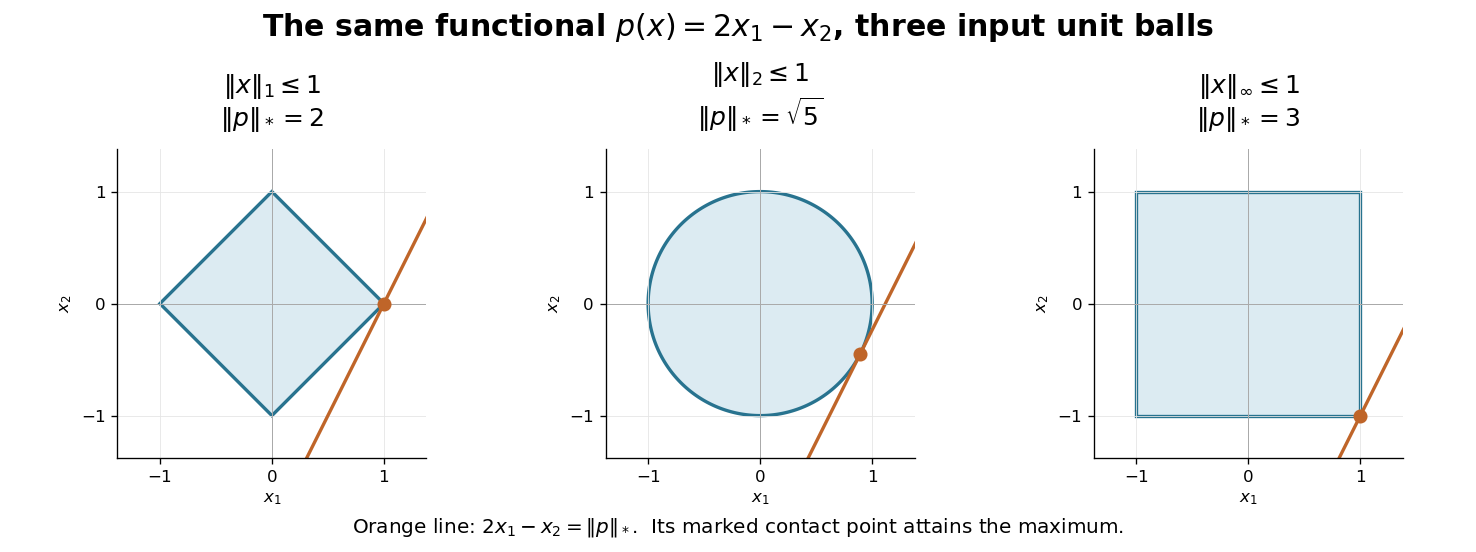
This geometry explains the usefulness of a dual norm: it translates a bound on inputs into the sharp bound on a linear output. The support function of the unit ball gives its value in the coefficient direction . Changing the input budget changes the set of possible inputs; the three different answers do not conflict. In finite dimensions a closed unit ball is compact, so a continuous linear functional achieves its maximum absolute value. In an infinite-dimensional normed vector space, the supremum remains the definition and need not be achieved.
A quasi-norm on a vector space is nonnegative, vanishes only at zero, is absolutely homogeneous, and satisfies a triangle inequality with one constant factor . For , on an Lp space is a quasi-norm: gives a quasi-triangle inequality. Measure-preserving composition preserves this quantity even though the Minkowski inequality is unavailable below exponent one.
An extension's vertexwise split arrow matrices are . Scaling the subobject by multiplies by . Nonzero preserves the middle isomorphism class; gives . For a nonsplit extension, the split orbit is distinct and lies in the smaller-dimensional boundary of the middle orbit closure.
A smoothing parameter controls the amount of averaging or regularization in a fitted function. Increasing the penalty multiplier in a cubic smoothing spline discourages curvature and generally reduces effective degrees of freedom. Increasing a smoothing bandwidth enlarges local averaging neighbourhoods. Software may use a monotone transformed parameter such as
spar, so its numerical value should not be confused with the raw penalty multiplier.In , the damping coefficient depends on the displacement. The oscillator energy satisfies . Positive dissipates energy and negative supplies it; a changing sign can select a stable amplitude. The averaged amplitude for position-dependent damping measures the net effect over an oscillation.
Pinned article: Introduction to the OurBigBook Project
Welcome to the OurBigBook Project! Our goal is to create the perfect publishing platform for STEM subjects, and get university-level students to write the best free STEM tutorials ever.
Everyone is welcome to create an account and play with the site: ourbigbook.com/go/register. We belive that students themselves can write amazing tutorials, but teachers are welcome too. You can write about anything you want, it doesn't have to be STEM or even educational. Silly test content is very welcome and you won't be penalized in any way. Just keep it legal!
Intro to OurBigBook
. Source. We have two killer features:
- topics: topics group articles by different users with the same title, e.g. here is the topic for the "Fundamental Theorem of Calculus" ourbigbook.com/go/topic/fundamental-theorem-of-calculusArticles of different users are sorted by upvote within each article page. This feature is a bit like:
- a Wikipedia where each user can have their own version of each article
- a Q&A website like Stack Overflow, where multiple people can give their views on a given topic, and the best ones are sorted by upvote. Except you don't need to wait for someone to ask first, and any topic goes, no matter how narrow or broad
This feature makes it possible for readers to find better explanations of any topic created by other writers. And it allows writers to create an explanation in a place that readers might actually find it.
Figure 1. Screenshot of the "Derivative" topic page. View it live at: ourbigbook.com/go/topic/derivativeVideo 2. OurBigBook Web topics demo. Source. - local editing: you can store all your personal knowledge base content locally in a plaintext markup format that can be edited locally and published either:This way you can be sure that even if OurBigBook.com were to go down one day (which we have no plans to do as it is quite cheap to host!), your content will still be perfectly readable as a static site.
- to OurBigBook.com to get awesome multi-user features like topics and likes
- as HTML files to a static website, which you can host yourself for free on many external providers like GitHub Pages, and remain in full control

Figure 2. You can publish local OurBigBook lightweight markup files to either OurBigBook.com or as a static website.
Figure 3. Visual Studio Code extension installation.
Figure 5. . You can also edit articles on the Web editor without installing anything locally. Video 3. Edit locally and publish demo. Source. This shows editing OurBigBook Markup and publishing it using the Visual Studio Code extension. 
- Infinitely deep tables of contents:



All our software is open source and hosted at: github.com/ourbigbook/ourbigbook
Further documentation can be found at: docs.ourbigbook.com
Feel free to reach our to us for any help or suggestions: docs.ourbigbook.com/#contact