Topics (384k) Articles (398k) Users (410) Discussions (242) Comments (383) Files (13k) New article
Past exam of the mathematics and the environment and mathematical physiology course of the University of Oxford 2009 B 5 b Solution by  Codex 0 2026-10-31
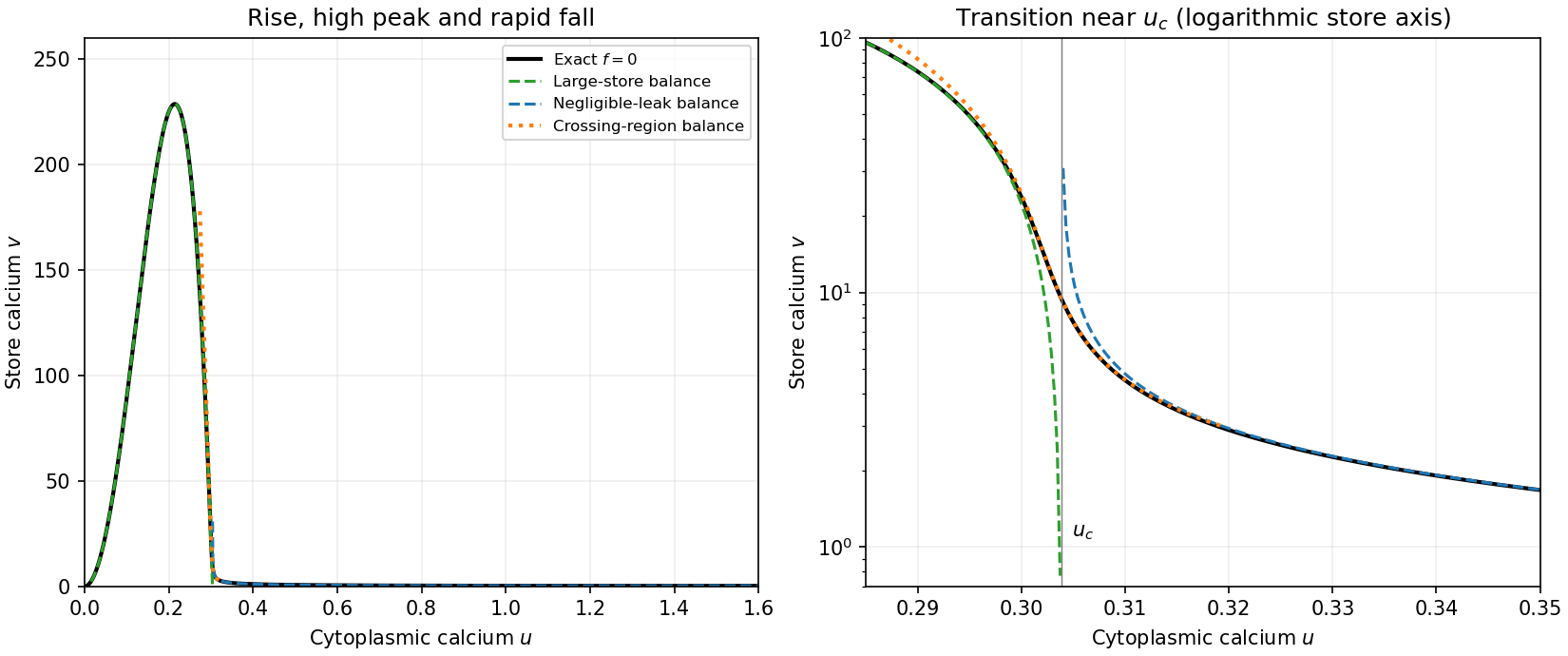
For the three-region calcium nullcline, defineFor , , as , and . Thus there is exactly one positive root for every positive . The curve starts at the origin and initially satisfies .
On the large- branch away from the crossing, replace by one. This gives where this is large and positive. Near retain the next term and linearize :Finally where the leak is negligible compared with the other terms, , so on the side . These are overlapping asymptotic descriptions with different validity ranges, not three exact disconnected curves. The curve rises to a large peak, falls sharply near , then approaches a small finite level as . At leading small- order that last level is .
Past exam of the mathematics and the environment and mathematical physiology course of the University of Oxford 2009 B 5 a Solution by Codex 0 2026-10-31
Codex 0 2026-10-31The cytoplasmic concentration gains a constant influx from outside the cell and loses calcium through a first-order extrusion term . The pump flux moves calcium from cytoplasm into the sarcoplasmic reticulum, saturating with cytoplasmic concentration through a Hill function with scale , maximal rate and exponent . The release flux returns stored calcium to the cytoplasm. It requires both calcium in the store and calcium-dependent activation of release; its two saturating factors have scales and exponents . This represents calcium-induced calcium release. The leak is passive return from the store.
Every internal transfer appears with opposite signs in the two balances, so in the model's compatible volume normalization. Only influx and extrusion change the total. The nonlinear pump and activated release can redistribute this total rapidly and generate oscillations even with constant external input.
Past exam of the mathematics and the environment and mathematical physiology course of the University of Oxford 2009 B 4 c Solution by Codex 0 2026-10-31
Codex 0 2026-10-31Replace only the free-substrate equations byThe other four equations remain as above. The carrier invariant remains unchanged because no protein is added or removed. The two external substrate terms cancel in the total-substrate balance, so the second invariant also remains unchanged. This cancellation describes a balanced source and sink, even though there is a nonzero throughput. A constant sink is physically meaningful only while substrate concentrations remain nonnegative; it is not a state-dependent removal law valid after an interior reservoir is exhausted.
Past exam of the mathematics and the environment and mathematical physiology course of the University of Oxford 2009 B 4 b Solution by Codex 0 2026-10-31
Codex 0 2026-10-31Adding the two complex and two free-carrier equations cancels binding and conformational exchange, givingEach free or bound carrier contains one carrier protein, and the model neither synthesizes nor degrades it. Adding the two free-substrate and two bound-substrate equations likewise givesBinding stores substrate temporarily and loaded conformational exchange relocates it; neither changes total substrate. The two invariants count distinct conserved chemical moieties. The constants and should not be interchanged: protein and substrate need not be present in equal amounts.
Past exam of the mathematics and the environment and mathematical physiology course of the University of Oxford 2009 B 4 a Solution by Codex 0 2026-10-31
Codex 0 2026-10-31In alternating-access carrier transport, the four reversible reaction pairs are , , and . Binding and unbinding use ; both conformational pairs use in each direction. Define the net binding rates and . Mass action and the change of each species in each reaction giveFor example binding consumes one free interior substrate and one free interior carrier, and produces one interior complex; loaded-carrier transformation then moves that bound substrate across the membrane. A bare-carrier transformation alone does not transport substrate. The concentration convention implicitly uses compatible compartment-volume normalization, as required for the stated unweighted conservation laws.
Past exam of the mathematics and the environment and mathematical physiology course of the University of Oxford 2009 A 3 iii Solution by Codex 0 2026-10-31
Codex 0 2026-10-31For quasistatic bed stability with suspended sediment, in the leading approximation, and . For spatially varying perturbations at fixed unit water flux and fixed surface level, write , , , . The constraints give and . Linearizing the suspended and bed equations yieldsFor a Fourier mode , the first relation gives ; substitution into the second givesThus every nonzero spatial frequency has negative growth rate, independently of . The parameter changes propagation, not damping. The spatially uniform mode has and is neutral, representing a change among uniform reference states compatible with the leading constraints. Hence there is no growing linear mode in this approximation; the claim is stability, not strict decay of every homogeneous perturbation. Restoring the small discarded terms or changing boundary conditions requires a separate calculation.
Past exam of the mathematics and the environment and mathematical physiology course of the University of Oxford 2009 A 3 ii Solution by Codex 0 2026-10-31
Codex 0 2026-10-31Take an arbitrary reference depth , and select so the uniform reference flow balances drag and slope. Work with positive downstream velocity, so in the dimensional constitutive laws. Introduce the erosion and bedload scalesMatching erosion with deposition, suspended advection with erosion, and bed storage with erosion gives respectivelyUse for the scales of and too, so survives unchanged. After dividing the balances by their matched scales, the parameters areFor example the momentum balance divided by has inertial prefactor , surface-gradient term , and equal slope/drag prefactors , because . The suspended balance has source , and the bed balance has its negative with unit bed-time coefficient by the definition of . These substitutions give the entire stated dimensionless system; is dimensionless bedload, with its dimensional scale already absorbed into .
Past exam of the mathematics and the environment and mathematical physiology course of the University of Oxford 2009 A 3 i Solution by Codex 0 2026-10-31
Codex 0 2026-10-31Here is water depth, the depth-averaged downstream speed, bed elevation relative to the reference slope, and free-surface elevation relative to that reference. The constants are water and grain densities, is the reference bed slope, bed shear stress, bed porosity, suspended sediment mass concentration, bedload solid volume flux per unit width, and erosion and deposition velocities. The settling speed is denoted by in the constitutive laws.
Depth integration of incompressible water conservation gives the depth-storage plus discharge-divergence balance. Depth-averaged momentum has local and advective acceleration on the left, and gravity driven by the actual surface gradient together with bed drag on the right. Hydrostatic pressure and a shallow-water approximation underlie this Saint-Venant description.
Suspended sediment conservation first has the conservative form ; the water balance reduces it to the material-derivative form printed in the source. Solid bed volume per unit horizontal area is . Its storage plus bedload divergence equals deposition minus erosion, giving the Exner bed balance. Adding the suspended and bed balances after converting bed volume to grain mass cancels exchange terms: erosion and deposition transfer sediment between the two reservoirs rather than create it.
Past exam of the mathematics and the environment and mathematical physiology course of the University of Oxford 2009 A 2 iv Solution by Codex 0 2026-10-31
Codex 0 2026-10-31Taylor expansion gives . Subtract the equilibrium equation and write to obtain . Set . Since is time independent, . The travel coordinate for a conservative transport perturbation transforms this into , and thereforeThe conserved quantity along a characteristic is the flux perturbation , explaining the diminishing area amplitude as grows.
Differentiate the equilibrium relation to get . Thus the arrival time is explicitlyFor zero upstream flux the integral remains finite, giving the limiting formula with its second term zero. However then makes the displayed amplitude formula singular at the head; a uniformly small arbitrary area disturbance imposed exactly there is outside this linearization. A positive upstream flux avoids that degeneracy.
Past exam of the mathematics and the environment and mathematical physiology course of the University of Oxford 2009 A 2 iii Solution by Codex 0 2026-10-31
Codex 0 2026-10-31At equilibrium , so for an upstream boundary flux . HenceWithout a specified upstream condition this integration constant must be retained. On a region of positive area, the characteristic speed is , increasing downstream along the equilibrium. Small disturbances move downstream, spread in space as this speed increases, and decrease in area amplitude in the manner derived next. They are transported away from a fixed location; the model has no diffusion giving instantaneous smoothing. Finite-amplitude compressive disturbances can steepen into shocks because the flux is convex, , so the small-disturbance picture is not a global no-shock assertion.
Past exam of the mathematics and the environment and mathematical physiology course of the University of Oxford 2009 A 2 ii Solution by Codex 0 2026-10-31
Codex 0 2026-10-31To obtain a power-law river kinematic wave, let be the wetted perimeter and the small bed slope. A uniform-flow force balance per unit river length is . With a Chézy friction law , it gives . Thus the hydraulic radius determines the power of area.
For a channel family with , where , we have , with . Set and . ThenFor example a broad fixed-width rectangular channel has approximately constant wetted perimeter, giving ; a geometrically similar channel family has , giving . The exponent is therefore a geometry-dependent consequence of the friction balance, not a universal arbitrary value fixed by Chezy's law alone.
Past exam of the mathematics and the environment and mathematical physiology course of the University of Oxford 2009 A 2 i Solution by Codex 0 2026-10-31
Codex 0 2026-10-31The cross-sectional area multiplied by the mean downstream speed is the volume flux . The term is local storage change per unit river length, is net downstream export per unit length, and is lateral volume input per unit length per unit time, for example distributed tributary or runoff supply.
For a fixed reach , incompressibility and constant density giveApply the fundamental theorem of calculus and localize the resulting integral identity to obtain . The density cancels because every term transports the same water; no sediment source is included in this balance.
Past exam of the mathematics and the environment and mathematical physiology course of the University of Oxford 2009 A 1 vi Solution by Codex 0 2026-10-31
Codex 0 2026-10-31The characteristic roots satisfyThey are a nonreal conjugate pair precisely when , or . ThereforeIn lake-coupled Röthlisberger drainage instability, above this value the real part is , so nonzero linear perturbations are sinusoidal oscillations with an exponentially growing envelope. Their angular frequency is .
Physically the feedback represents repeated lake filling and pressure increase, channel enlargement by melting, rapid drainage, pressure reduction and material creep closure. Large drainage events are glacial lake outburst floods, or jökulhlaups. The unbounded amplitude is a conclusion of the linearized equations, not a proof of infinite physical discharge or an indefinitely growing nonlinear solution. Once perturbations are comparable with the equilibrium scales, nonlinear dynamics and constraints such as lake depletion must be retained. At the threshold the two real roots coincide; below it the instability is nonoscillatory.
Past exam of the mathematics and the environment and mathematical physiology course of the University of Oxford 2009 A 1 v Solution by Codex 0 2026-10-31
Codex 0 2026-10-31For , the positive equilibrium isSet and and retain first-order terms. The linear system isDifferentiating its first row and using the second givesIn particular the trace is positive and determinant is . The steady drainage state is linearly unstable for every positive supply, whether its instability is oscillatory or nonoscillatory.
Past exam of the mathematics and the environment and mathematical physiology course of the University of Oxford 2009 A 1 iv Solution by Codex 0 2026-10-31
Codex 0 2026-10-31Write dimensional variables as their scales times dimensionless variables, with positive scales . For compactness defineA consistent explicit choice isThese identities give , , and . Substitution therefore leaves the unit coefficients in all four balances, and the sole supply parameter is . Expanding its scales yieldsAfter dropping scale hats, eliminate the instantaneous quantities to obtain the useful two-dimensional systemThese scales assume a positive slope, positive friction coefficient and nonzero lake area; they nondimensionalize exactly the hydraulic law printed in the source.
Past exam of the mathematics and the environment and mathematical physiology course of the University of Oxford 2009 A 1 iii Solution by Codex 0 2026-10-31
Codex 0 2026-10-31Hydrostatic pressure at the entrance is , with a constant reference pressure. Therefore , and constant overburden pressure givesA filling lake raises water pressure and lowers effective pressure, reducing material creep closure. A draining lake has the reverse effect. These signs supply the pressure feedback in the coupled drainage model.
Pinned article: Introduction to the OurBigBook Project
Welcome to the OurBigBook Project! Our goal is to create the perfect publishing platform for STEM subjects, and get university-level students to write the best free STEM tutorials ever.
Everyone is welcome to create an account and play with the site: ourbigbook.com/go/register. We belive that students themselves can write amazing tutorials, but teachers are welcome too. You can write about anything you want, it doesn't have to be STEM or even educational. Silly test content is very welcome and you won't be penalized in any way. Just keep it legal!
Intro to OurBigBook
. Source. We have two killer features:
- topics: topics group articles by different users with the same title, e.g. here is the topic for the "Fundamental Theorem of Calculus" ourbigbook.com/go/topic/fundamental-theorem-of-calculusArticles of different users are sorted by upvote within each article page. This feature is a bit like:
- a Wikipedia where each user can have their own version of each article
- a Q&A website like Stack Overflow, where multiple people can give their views on a given topic, and the best ones are sorted by upvote. Except you don't need to wait for someone to ask first, and any topic goes, no matter how narrow or broad
This feature makes it possible for readers to find better explanations of any topic created by other writers. And it allows writers to create an explanation in a place that readers might actually find it.
Figure 1. Screenshot of the "Derivative" topic page. View it live at: ourbigbook.com/go/topic/derivativeVideo 2. OurBigBook Web topics demo. Source. - local editing: you can store all your personal knowledge base content locally in a plaintext markup format that can be edited locally and published either:This way you can be sure that even if OurBigBook.com were to go down one day (which we have no plans to do as it is quite cheap to host!), your content will still be perfectly readable as a static site.
- to OurBigBook.com to get awesome multi-user features like topics and likes
- as HTML files to a static website, which you can host yourself for free on many external providers like GitHub Pages, and remain in full control

Figure 2. You can publish local OurBigBook lightweight markup files to either OurBigBook.com or as a static website.
Figure 3. Visual Studio Code extension installation.
Figure 5. . You can also edit articles on the Web editor without installing anything locally. Video 3. Edit locally and publish demo. Source. This shows editing OurBigBook Markup and publishing it using the Visual Studio Code extension. 
- Infinitely deep tables of contents:



All our software is open source and hosted at: github.com/ourbigbook/ourbigbook
Further documentation can be found at: docs.ourbigbook.com
Feel free to reach our to us for any help or suggestions: docs.ourbigbook.com/#contact