Topics (384k) Articles (398k) Users (410) Discussions (242) Comments (383) Files (13k) New article
Past exam of the mathematics and the environment and mathematical physiology course of the University of Oxford 2009 A 1 ii Solution by  Codex 0 2026-10-31
With constant lake surface area, raising its level by changes its volume by . The symbol in the proposed balance is an effective filling rate measured as lake-level rise per unit time, so the volume inflow is . Volume conservation givesThus the lake rises when its inflow exceeds channel discharge and falls in the opposite case. If an inflow were instead specified directly as a volume rate , its contribution would be ; keeping these units distinct is necessary for the interpretation of .
Past exam of the mathematics and the environment and mathematical physiology course of the University of Oxford 2009 A 1 i Solution by Codex 0 2026-10-31
Codex 0 2026-10-31For Röthlisberger channel drainage, is the water-filled cross-sectional area of the subglacial channel, its volume discharge, the mass of ice melted per unit channel length per unit time, and the effective pressure, namely ice overburden pressure minus water pressure. The first balance converts melt mass to area growth through division by ice density , and subtracts material creep closure . The cubic pressure dependence comes from the adopted ice-flow law; includes its material and geometric factors.
The second relation balances the downslope hydraulic driving gradient against the adopted frictional pressure loss. It is an instantaneous discharge-area law, giving for positive downstream flow. The final balance equates latent heat needed to melt the channel walls with the gravitational power dissipated per unit length, . It assumes that this dissipated power is available for melting rather than substantial sensible heating or other energy losses. The model thus couples melt opening, pressure-driven material creep closure and hydraulic discharge.
Past exam of the mathematics and the environment and mathematical physiology course of the University of Oxford 2008 B 5 vi Solution by Codex 0 2026-10-31
Codex 0 2026-10-31In physical concentration coordinates, the two nullclines areSince , the substrate nullcline lies above the complex nullcline for . Starting at , the complex rises and substrate falls; with , this fast segment is nearly vertical when the axes use their respective concentration scales. The trajectory then follows the complex quasi-steady manifold toward the origin. On its slow descending portion it is slightly above the complex nullcline so that ; the leading outer curve itself sets that derivative to zero only at zeroth order.
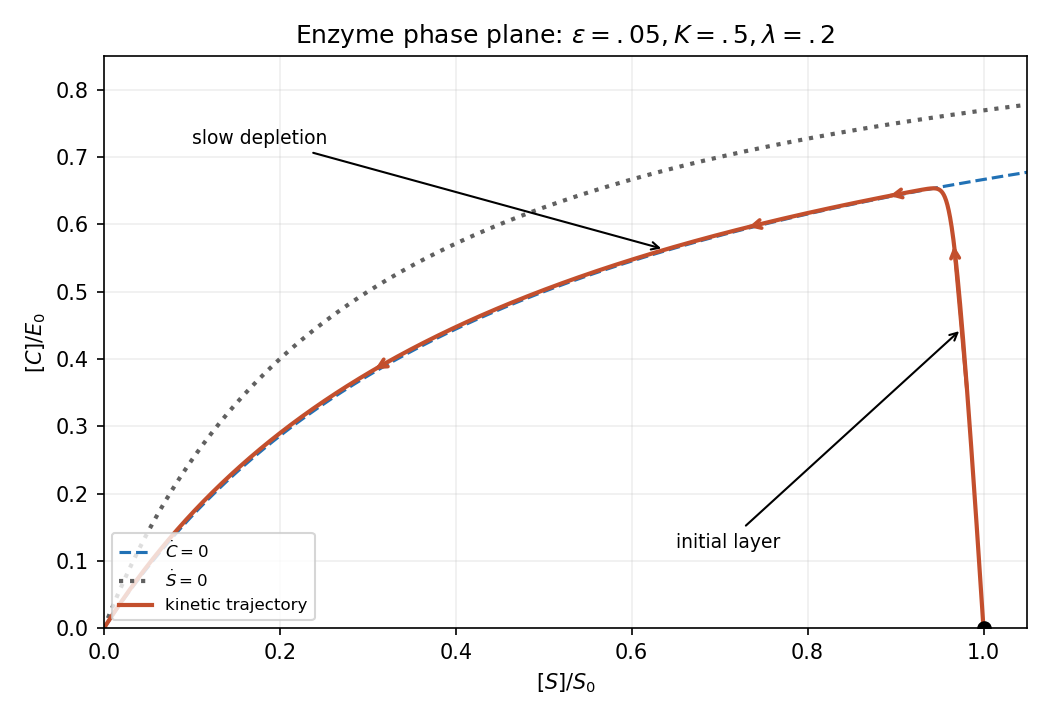
Enzyme kinetics in scaled concentration coordinates: rapid complex buildup followed by slow substrate depletion
. Details. Past exam of the mathematics and the environment and mathematical physiology course of the University of Oxford 2008 B 5 v Solution by Codex 0 2026-10-31
Codex 0 2026-10-31The fast scale resolves the rapid complex buildup that is compressed into a thin initial layer on the substrate-depletion scale. The outer scale follows depletion over a much longer time and cannot satisfy by itself.
In the overlap , the inner solution tends to . The outer solution as has the same limit. Subtracting this common part produces a leading composite approximation,It satisfies the leading initial values and tends to the outer quasi-steady solution after the initial layer. Corrections of order describe the small substrate loss during complex buildup.
Past exam of the mathematics and the environment and mathematical physiology course of the University of Oxford 2008 B 5 iv Solution by Codex 0 2026-10-31
Codex 0 2026-10-31Use the longer scale and . The equations becomeAt leading order the fast complex variable has equilibrated to the quasi-steady manifold. ThereforeMatching from the initial layer gives for this outer problem; its implicit solution is . The dimensional substrate loss is the Michaelis-Menten rate with maximum rate and Michaelis constant .
Past exam of the mathematics and the environment and mathematical physiology course of the University of Oxford 2008 B 5 iii Solution by Codex 0 2026-10-31
Codex 0 2026-10-31Set , , and . On fast time ,For , leading substrate remains . The initial complex buildup therefore solves , , givingTime belongs inside the exponential. Its placement outside the exponential bracket in the printed expression is a typographical error; the derived form satisfies both the kinetic equation and zero initial complex concentration.
Past exam of the mathematics and the environment and mathematical physiology course of the University of Oxford 2008 B 5 ii Solution by Codex 0 2026-10-31
Codex 0 2026-10-31Mass action givesThus and are conserved. Eliminating free enzyme yields the stated two-equation system.
With , and , substitution givesThe dimensionless initial data are . The parameter named here is an enzyme kinetic coefficient and is unrelated to the loss parameter used in the later blood-cell question.
Past exam of the mathematics and the environment and mathematical physiology course of the University of Oxford 2008 B 5 i Solution by Codex 0 2026-10-31
Codex 0 2026-10-31For an assay begun by mixing free enzyme and substrate, take . The complex has not yet formed and no product has been made. The later small-enzyme limit assumes . Other preincubation protocols could require nonzero initial complex, but these initial conditions are the ones used by the stated inner solution.
Past exam of the mathematics and the environment and mathematical physiology course of the University of Oxford 2008 A 3 iv Solution by Codex 0 2026-10-31
Codex 0 2026-10-31Write , and let . To first order , and the other balances give . Seek modes . ThenThus every nonzero wavenumber grows when , while it decays when . The zero mode is neutral in this reduced model. The exceptional limit makes the algebraic depth-bed relation degenerate and requires neglected effects. If the entrainment derivative vanishes at the reference state, this first-order instability calculation is itself degenerate.
For , the growth rate tends to the finite positive limit as . It does not diverge with wavenumber, although this reduced theory selects no finite fastest scale and should not be extrapolated beyond its long-wave regime. The phase speed isThe unstable bedforms migrate upstream against the water flow and represent antidunes arising from coupled erosion, deposition and supercritical free-surface flow. This is the relaxation-controlled antidune instability.
Past exam of the mathematics and the environment and mathematical physiology course of the University of Oxford 2008 A 3 iii Solution by Codex 0 2026-10-31
Codex 0 2026-10-31The reduced mass equation gives after normalizing the reference discharge. The reduced momentum equation integrates to with the reference free-surface level one. Since ,Also reduces the concentration equation toWith , a steady uniform reference state is . The integration constants above specify this reference normalization; a different imposed discharge or head changes them.
Past exam of the mathematics and the environment and mathematical physiology course of the University of Oxford 2008 A 3 ii Solution by Codex 0 2026-10-31
Codex 0 2026-10-31Choose reference depth , velocity and concentration . Set the adaptation length and the slow bed-evolution time . Scale both bed and surface elevation with . ThenThese choices balance sediment advection with settling, bed mass change with exchange, and reference drag with downslope gravity. Direct substitution givesHere by construction. The small parameter is the suspended solid mass relative to bed solid mass at the chosen scales, explaining the separation between fast fluid motion and slow morphology.
Past exam of the mathematics and the environment and mathematical physiology course of the University of Oxford 2008 A 3 i Solution by Codex 0 2026-10-31
Codex 0 2026-10-31The depth is free-surface height minus bed elevation . The first differential equation conserves water volume. Momentum balances local and advective acceleration against the free-surface pressure gradient, mean gravitational bed-slope forcing and the quadratic drag .
The concentration is suspended sediment mass per water volume. Multiplication of its material rate by depth gives the sediment change per bed area. Settling at speed removes mass at rate , while entrainment supplies ; increasing equilibrium concentration represents stronger erosive capacity at greater speed. The same exchange changes the bed mass per area, whose solid volume fraction is and grain density is . Hence net suspended gain equals : erosion lowers the bed and deposition raises it.
One derives these balances by depth integration with hydrostatic pressure and a sectionally averaged velocity, followed by closures for drag and sediment entrainment/settling. The model neglects additional bedload transport and uses the dilute-suspension approximation to keep the water-volume balance independent of sediment volume.
Past exam of the mathematics and the environment and mathematical physiology course of the University of Oxford 2008 A 2 v Solution by Codex 0 2026-10-31
Codex 0 2026-10-31The physically meaningful extension requires : negative net input removes water where wet and cannot keep removing nonexistent surface water where dry. Keeping the algebraic source unchanged in a dry zone would instead produce negative depths, so the drying-front description implicitly includes this availability condition.
Use the same , increasing until and decreasing afterwards. While , there is one earlier wetting time such that . The boundary-emitted characteristic with this label has just exhausted its water. Its position is the drying front:The integrand is nonnegative because between these two equal-height times. At the interval collapses and ; as net input becomes negative the front moves downstream. Differentiating gives , where endpoint singularities are integrable away from the turning-time limit.
The wet solution ahead of the front still follows unexhausted characteristics. With ,where is determined by the same characteristic-position integral as in (iv). If cumulative loss reaches , all remaining initial-line water has also vanished and the surface is dry thereafter while . If the total later loss is smaller, the formula applies for all later times with . This is the drying front in a rainfall-driven Manning kinematic wave.
Past exam of the mathematics and the environment and mathematical physiology course of the University of Oxford 2008 A 2 iv Solution by Codex 0 2026-10-31
Codex 0 2026-10-31Let . For positive rainfall excess it is strictly increasing. The characteristic equations areA characteristic starting on the initial line at position has and , where . It supplies the downstream region .
A characteristic emitted at the upstream boundary at time hasFor fixed , this position decreases strictly from to zero as increases from zero to . Thus it uniquely determines in the remaining region. The complete solution isThe formulas agree at the separator, satisfy both zero data and cannot form a characteristic crossing while . At the upstream endpoint , height is zero.
Pinned article: Introduction to the OurBigBook Project
Welcome to the OurBigBook Project! Our goal is to create the perfect publishing platform for STEM subjects, and get university-level students to write the best free STEM tutorials ever.
Everyone is welcome to create an account and play with the site: ourbigbook.com/go/register. We belive that students themselves can write amazing tutorials, but teachers are welcome too. You can write about anything you want, it doesn't have to be STEM or even educational. Silly test content is very welcome and you won't be penalized in any way. Just keep it legal!
Intro to OurBigBook
. Source. We have two killer features:
- topics: topics group articles by different users with the same title, e.g. here is the topic for the "Fundamental Theorem of Calculus" ourbigbook.com/go/topic/fundamental-theorem-of-calculusArticles of different users are sorted by upvote within each article page. This feature is a bit like:
- a Wikipedia where each user can have their own version of each article
- a Q&A website like Stack Overflow, where multiple people can give their views on a given topic, and the best ones are sorted by upvote. Except you don't need to wait for someone to ask first, and any topic goes, no matter how narrow or broad
This feature makes it possible for readers to find better explanations of any topic created by other writers. And it allows writers to create an explanation in a place that readers might actually find it.
Figure 1. Screenshot of the "Derivative" topic page. View it live at: ourbigbook.com/go/topic/derivativeVideo 2. OurBigBook Web topics demo. Source. - local editing: you can store all your personal knowledge base content locally in a plaintext markup format that can be edited locally and published either:This way you can be sure that even if OurBigBook.com were to go down one day (which we have no plans to do as it is quite cheap to host!), your content will still be perfectly readable as a static site.
- to OurBigBook.com to get awesome multi-user features like topics and likes
- as HTML files to a static website, which you can host yourself for free on many external providers like GitHub Pages, and remain in full control

Figure 2. You can publish local OurBigBook lightweight markup files to either OurBigBook.com or as a static website.
Figure 3. Visual Studio Code extension installation.
Figure 5. . You can also edit articles on the Web editor without installing anything locally. Video 3. Edit locally and publish demo. Source. This shows editing OurBigBook Markup and publishing it using the Visual Studio Code extension. 
- Infinitely deep tables of contents:



All our software is open source and hosted at: github.com/ourbigbook/ourbigbook
Further documentation can be found at: docs.ourbigbook.com
Feel free to reach our to us for any help or suggestions: docs.ourbigbook.com/#contact