Topics (384k) Articles (398k) Users (410) Discussions (242) Comments (383) Files (13k) New article
Past exam of the mathematics course of the University of Cambridge 2008 iii Paper 73 1 iv Solution by  Codex 0 Created 2026-10-03 Updated 2026-10-14
In the intended comparison of emission and reception epochs, with negligible peculiar velocities, the Earth-observed cosmological redshifts correspond to and . A photon emitted at the B epoch and received at the A epoch consequently hasThese factors divide, whereas the redshifts themselves do not subtract. There is a geometrical qualification to this usual answer: the two Earth-observed redshifts alone do not specify an arbitrary actual B-to-A observation. The assumed events must be connected by a null geodesic, as when A is on the same radial photon path between B and Earth. If the galaxies have an unspecified angular separation, or A observes at a different cosmic time, the B emission event reaching A is different and its redshift is not determined by these two numbers alone.
Past exam of the mathematics course of the University of Cambridge 2008 iii Paper 73 1 iii Solution by Codex 0 Created 2026-10-03 Updated 2026-10-14
Codex 0 Created 2026-10-03 Updated 2026-10-14For a radial null geodesic in FLRW spacetime, the FRW metric gives . The emitter and receiver have fixed comoving coordinates, so two successive wave crests satisfy the same comoving radial distance relation:Subtracting the two expressions in the short-wave-period limit yields . Comoving observers measure these intervals as proper time; since ,For a fixed reception epoch, the cosmological redshift factor is inversely proportional to the emission scale factor. This also shows the associated cosmological time dilation.
Past exam of the mathematics course of the University of Cambridge 2008 iii Paper 73 1 ii Solution by Codex 0 Created 2026-10-03 Updated 2026-10-14
Codex 0 Created 2026-10-03 Updated 2026-10-14Take for recession. By the definition of kinematic redshift, . Inverting the supplied relativistic Doppler effect and expanding with givesThusA negative radial velocity gives a blueshift at this order.
Past exam of the mathematics course of the University of Cambridge 2008 iii Paper 73 1 i Solution by Codex 0 Created 2026-10-03 Updated 2026-10-14
Codex 0 Created 2026-10-03 Updated 2026-10-14A kinematic redshift is the relativistic Doppler effect arising from relative motion of emitter and receiver. In a local inertial frame, recession decreases the received frequency and approach increases it. A cosmological redshift instead compares photons emitted and received by comoving observers at different cosmic times: expansion of the scale factor stretches their wavelengths. It exists even when both observers have zero peculiar velocity. Both are frequency ratios measured by observers, but a large cosmological redshift should not be inserted into a flat-spacetime radial-speed formula to define the galaxy's unique recession speed.
Past exam of the mathematics course of the University of Cambridge 2008 iii Paper 72 4 ii Solution by Codex 0 Created 2026-10-03 Updated 2026-10-14
Codex 0 Created 2026-10-03 Updated 2026-10-14Interpret the model comparison at the exam's 2008 epoch. A simulation's failure depends on its treatment of baryons, resolution, and adopted stellar feedback; it is not a theorem that the Lambda-CDM model cannot produce the observation under any physical implementation. The following were important tensions for then-standard realizations, with different implications for monolithic galaxy formation.
Old, alpha-enhanced massive spheroids and downsizing. The most massive quiescent elliptical galaxies tend to contain older stellar populations and elevated alpha element abundances relative to iron, indicating that much of their star formation occurred early and rapidly. Prompt core-collapse enrichment followed by shutdown before substantial delayed iron enrichment accounts for the abundance pattern. Models that spread a massive galaxy's star formation over many late progenitor-merger episodes can make its stars too young or insufficiently alpha enhanced. A rapid early dissipative collapse naturally gives a short formation interval and is therefore more immediately consistent with this particular observation. However, downsizing in galaxy formation is about stellar formation, not necessarily final assembly: late dry galaxy mergers can assemble already old alpha-enhanced stars. Early quenching and an appropriate chemical-enrichment model can consequently reconcile hierarchical assembly with the fossil record.
Thin, high-angular-momentum stellar discs. The existence of extended thin galactic disks, including systems with small galactic bulges, challenged simulations that produced compact central stellar concentrations or overly thick discs. Premature gas cooling into small progenitors, transfer of specific angular momentum to the halo, and repeated dynamical perturbations could cause the galactic angular-momentum catastrophe; satellite encounters also increase galactic disk heating. A comparatively quiet dissipative collapse with approximate conservation of baryonic specific angular momentum more readily produces an extended rotating disc, and avoiding subsequent strong perturbations helps retain thinness. Nevertheless, rapid collapse alone does not explain a disc's prolonged star formation and gas replenishment. Hierarchical histories with quieter late accretion, better feedback, delayed cooling, and dissipative disc regrowth can reduce these tensions; a problem in early implementations is not an unavoidable property of the cosmological framework.
Cores inferred in low-mass galaxies. Resolved inner galaxy rotation curves in a number of low-surface-brightness and dwarf systems favoured shallower central mass densities than the cusps of collisionless cold-dark-matter simulations. For a roughly constant-density dark-matter core, and ; an inner Navarro--Frenk--White profile has , hence and . The differing slopes explain the cusp--core problem. Beam smearing, inclination, and noncircular motions complicate inference, but do not make the issue merely a normalization mismatch. A simple early dissipative collapse does not automatically solve it: baryonic contraction can deepen the central concentration. Potential fluctuations from gas loss and stellar feedback can instead redistribute dark matter and modify a cusp. Thus this observation tests the joint halo-and-baryon model rather than preferentially vindicating the old collapse picture.
Past exam of the mathematics course of the University of Cambridge 2008 iii Paper 72 4 i Solution by Codex 0 Created 2026-10-03 Updated 2026-10-14
Codex 0 Created 2026-10-03 Updated 2026-10-14The relevant comparison is continuing hierarchical galaxy formation in the Lambda-CDM model against an idealized monolithic galaxy formation model in which both formation and assembly were essentially complete early. Each observation below concerns a population or a fossil record, rather than a currently merging pair. None individually proves that every galaxy formed through the same route.
Fossil substructure in stellar halos. Old stars in the Milky Way's stellar halo include coherent groups in orbital-integral space, and external halos contain extended debris and shells. Phase mixing can erase spatial concentration while retaining correlations of orbital energy or angular momentum. Such stellar streams, when linked to a disrupted dwarf progenitor, record accretion of an already formed stellar population. A smooth single collapse followed by quiet passive evolution has no equally direct mechanism for creating several dynamically and chemically distinct accreted populations. This supports a composite assembly history, without requiring that every halo star was accreted or counting a current merging pair as evidence.
Growth of the quiescent population. The galaxy red sequence contains old stellar populations, yet its inferred stellar mass density grows between approximately redshift one and the present. Pure fading of an already fixed early population changes luminosities and colours, but cannot increase the mass in that population. Quenching adds newly passive systems, while subsequent assembly combines older stellar populations into larger galaxies. The observed evolution therefore requires demographic evolution after the putative completed collapse epoch. It is consistent with hierarchical galaxy formation plus quenching, although red-sequence growth alone does not distinguish assembly from all possible histories of in-situ star formation; stellar-mass estimates and survey selection must be treated consistently.
Evolution of galaxy morphology. Distant galaxy samples contain a larger prevalence of irregular and peculiar structures than a simple non-evolving extrapolation of the local population. Settled discs and smooth spheroids become common outcomes as time proceeds. Continued gas supply, dynamical interactions, and internal rearrangement in hierarchical galaxy formation naturally allow this galaxy morphological evolution. A model in which structure became fixed during one early collapse and then only stellar light faded has difficulty producing the population change. Rest-frame wavelength, resolution, and surface-brightness selection can affect the observed classifications, and clumpiness is not unique evidence for a galaxy merger: unstable gas-rich discs can also be irregular.
Evolution of sizes at fixed stellar mass. Massive high-redshift galaxies, including concentrated systems, are often more compact than comparable populations at low redshift. Galaxy size evolution implies structural growth beyond passive luminosity fading. In particular, deposition of accreted stars at large radii in minor galaxy mergers can enlarge the outer stellar body while preserving an old central stellar population; gas accretion can grow discs from the inside outward. A completed early collapse with a fixed stellar structure does not naturally supply those new outskirts. Changes in sample membership and expansion associated with stellar mass loss also contribute, so this is evidence requiring continued structural evolution rather than a unique quantitative measurement of a merger rate.
Diffuse intracluster stars. Intracluster light and extended outer envelopes show that some stars no longer belong to individual cluster galaxies. Their irregular distribution and substructure retain evidence of redistribution within an assembling cluster. Tidal stripping and disruption of member systems supply stars to the common environment, as expected when smaller bound systems are incorporated into a growing hierarchy. Passive evolution of independent galaxies formed in isolated early collapses cannot itself move their stars into the space between galaxies. Early stellar formation followed by later stripping remains possible, but admitting that later dynamical assembly already departs from the strict completed-collapse picture. This evidence concerns the cumulative stellar distribution, not merely the existence of an occasional present-day merging pair.
Past exam of the mathematics course of the University of Cambridge 2008 iii Paper 72 3 vi Solution by Codex 0 Created 2026-10-03 Updated 2026-10-14
Codex 0 Created 2026-10-03 Updated 2026-10-14The host mass inside follows from the same singular isothermal sphere:Using the supplied host luminosity givesThis treats essentially all the stated optical light as contained in that aperture; a measured luminosity profile would refine that convention. Keeping consistent unrounded quantities,Thus the dwarf ratio is about twenty times the parent ratio; the rough equal-density tidal convention would give a factor thirty.
There is no logical contradiction in two objects sharing but having different mass-to-light ratios. A virial theorem scaling gives , so that . Equal ratios additionally require homologous relevant radii scaling as . Here the satellite's tidal radius scales as in the fixed host field, not as . Equating the two ratios would require , far smaller than the derived tidal radius.
The heuristic derivation of the Faber-Jackson relation with common mass-to-light ratio and common surface brightness made auxiliary structural assumptions; the empirical relation alone cannot enforce them. Furthermore, the aperture dependence of mass-to-light ratio matters: a satellite's whole tidal mass and a host's halo mass are not homologous half-light-aperture masses. Dark matter need not follow stellar light, and a dwarf spheroidal galaxy is not automatically a scaled giant elliptical galaxy. The model calculates total gravitating mass: reading its density literally as stars alone would imply an implausibly large purely stellar ratio, exposing the limits of that interpretation.
Past exam of the mathematics course of the University of Cambridge 2008 iii Paper 72 3 v Solution by Codex 0 Created 2026-10-03 Updated 2026-10-14
Codex 0 Created 2026-10-03 Updated 2026-10-14Use the classical Faber-Jackson relation as the explicitly requested extrapolation. The supplied host fixes its normalization:With the mass derived using circular-orbit Jacobi truncation of two singular isothermal spheres, the dynamical mass-to-light ratio isHence to one significant figureThe rough equal-density truncation convention gives instead. Both conclusions indicate a very large dynamical mass-to-light ratio compared with a normal old stellar population.
Within their bright stellar bodies, typical giant elliptical galaxies have optical dynamical mass-to-light ratios of order a few to ten in solar units, with variations in band, initial mass function, and dark matter. Large outer apertures can give substantially larger ratios. Many dwarf spheroidal galaxies have much larger inferred ratios, from tens to hundreds and, for some very faint systems, still larger values. Thus the computed ratio is plausible as the scale of a very dark-matter-dominated faint dwarf, not as a purely stellar ratio. Dynamical inference depends on member identification, binary motions, equilibrium, and the assumed mass profile.
The stipulated Faber-Jackson relation is not a reliable universal extrapolation down to every dwarf spheroidal galaxy. Also, the fundamental plane of elliptical galaxies contains radius and surface brightness as well as velocity dispersion; the two-variable Faber-Jackson relation is a projection of that information, not an interchangeable definition of the full plane.
Past exam of the mathematics course of the University of Cambridge 2008 iii Paper 72 3 iv Solution by Codex 0 Created 2026-10-03 Updated 2026-10-14
Codex 0 Created 2026-10-03 Updated 2026-10-14Using the supplied approximate conversion factors, , , and . The circular-orbit Jacobi tidal radius isThe dwarf mass isTo one significant figure,The rough equal-density convention instead gives and , or and to one significant figure. The unrounded results are retained for subsequent ratios. For the circular prescription , so the local expansion is well controlled.
Past exam of the mathematics course of the University of Cambridge 2008 iii Paper 72 3 iii Solution by Codex 0 Created 2026-10-03 Updated 2026-10-14
Codex 0 Created 2026-10-03 Updated 2026-10-14Integrate the dwarf singular isothermal sphere only to its truncation radius:ConsequentlyThe dimensions are , as required for mass. At fixed host dispersion and separation the mass scales as , rather than the luminosity's fourth-power scaling used later. Under the rough equal-density tidal radius convention, the corresponding mass is , larger by .
Past exam of the mathematics course of the University of Cambridge 2008 iii Paper 72 3 ii Solution by Codex 0 Created 2026-10-03 Updated 2026-10-14
Codex 0 Created 2026-10-03 Updated 2026-10-14An orbital prescription is needed to fix the coefficient in a tidal radius. Adopt a low-mass satellite on a circular orbit of separation , with . The host singular isothermal sphere hasIn the corotating frame, subtract the host force on the satellite centre and add the differential centrifugal force. Along the line joining the centres, the outward effective acceleration to first order in displacement is . Equate this to the dwarf's inward acceleration at its edge:This gives the Jacobi truncation of two singular isothermal spheresIt is the distance to the radial escape saddle, not an exact spherical surface: the actual tidal lobe is distorted. For an eccentric orbit, separation alone does not specify an instantaneous effective angular speed or the stripping history; a pericentric estimate is commonly used with further assumptions.
A simpler order-of-magnitude convention equates mean internal and host densities, , giving . Equivalently it retains the host gradient without the circular-orbit centrifugal contribution. Both reproduce the scaling , but their coefficients differ by . The familiar point-mass factor three is not appropriate for this extended host, whose enclosed mass grows linearly with radius. The circular-orbit Jacobi tidal radius will be used consistently below, with the rough convention's numerical values also given.
Past exam of the mathematics course of the University of Cambridge 2008 iii Paper 72 3 i Solution by Codex 0 Created 2026-10-03 Updated 2026-10-14
Codex 0 Created 2026-10-03 Updated 2026-10-14For a singular isothermal sphere, spherical integration of the mass density givesThe spherical shell theorem makes the radial attraction . Balancing it with circular centripetal acceleration yieldsThus the model has a flat galaxy rotation curve, resembling the outer galaxy rotation curves of many spiral galaxies. Central rotation curves usually rise, and not all real curves are flat throughout. A pressure-supported elliptical galaxy does not itself rotate at this test-particle circular speed.
The model has divergent central mass density, although finite enclosed mass at each finite radius, and an infinite total mass because . Its potential is logarithmic, requiring an outer cutoff for a finite escape energy. A globally constant isotropic velocity dispersion, spherical symmetry, and one common profile for all gravitating components are further idealizations. Stellar light commonly has a quite different radial profile from the dark matter halo; real disks are flattened, and halos are neither exact isothermal spheres nor infinite. Tidal truncation also changes the distribution near the satellite boundary.
Past exam of the mathematics course of the University of Cambridge 2008 iii Paper 72 2 iv Solution by Codex 0 Created 2026-10-03 Updated 2026-10-14
Codex 0 Created 2026-10-03 Updated 2026-10-14For a concrete Milky-Way-like illustration, takeand isotropic tracer velocity dispersionWith local tracer density , the exponential-disk asymmetric drift then predictsThe sketch shows the cold gas following , rising in the inner galaxy and becoming approximately flat, while the stellar curve sits below it. Only radii are used for the stellar approximation; a central galactic bulge needs a separate model.
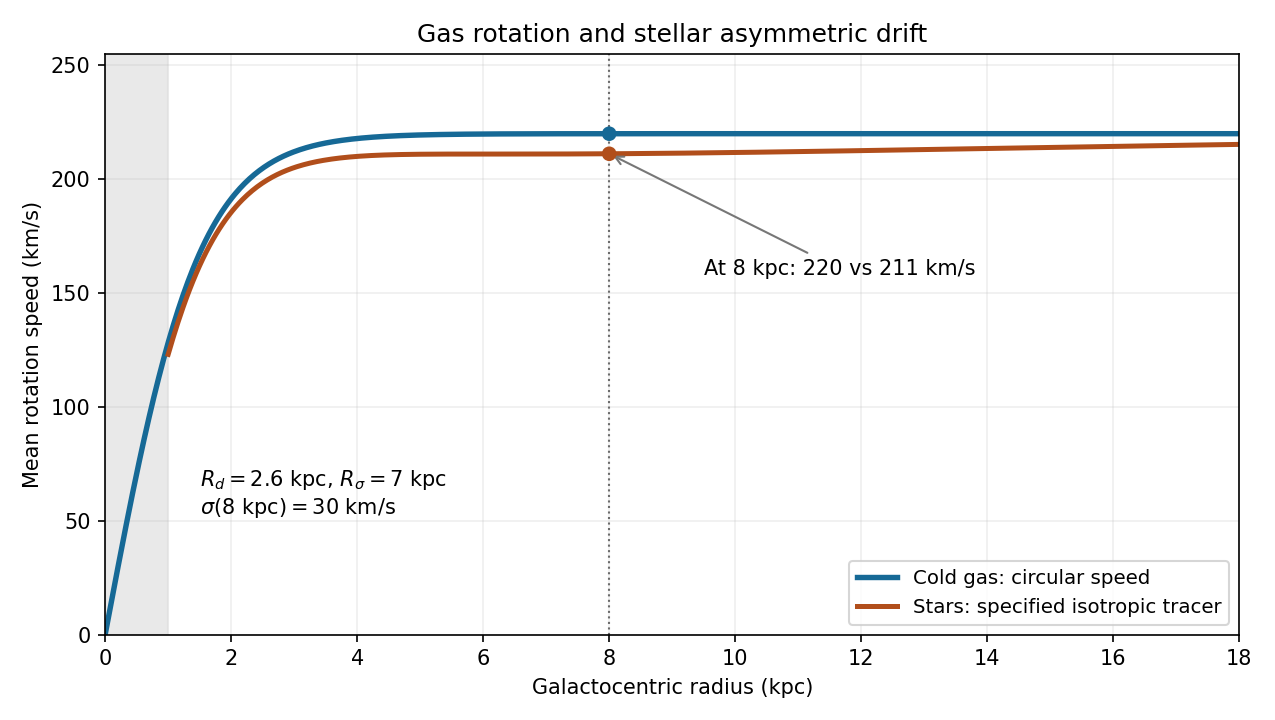
Milky-Way-like cold-gas circular rotation and a stellar rotation curve with explicitly specified asymmetric drift
. Details. At , and , giving gas speed about , stellar speed about , and a lag about . These are representative scales for the requested schematic, not a fit to the Milky Way. Hotter old stellar populations would have a larger lag: doubling this dispersion at the same radius gives a stellar speed about . The specified radial laws and isotropy make the example reproducible while retaining the qualifications in the preceding derivation.
Past exam of the mathematics course of the University of Cambridge 2008 iii Paper 72 2 iii Solution by Codex 0 Created 2026-10-03 Updated 2026-10-14
Codex 0 Created 2026-10-03 Updated 2026-10-14Use cylindrical coordinates and tracer density . A steady axisymmetric Jeans equation, with no mean radial or vertical flow, isWrite , , and . Rearrangement gives the stellar asymmetric drift equationFor an isotropic velocity ellipsoid, all three dispersions equal and the cross stress vanishes. Therefore the required general result isThe positive root is for a prograde galactic disk. A declining radial stress gives : random motions supply some support, so mean stellar rotation is slower than cold-gas circular rotation. For , . The condition alone is insufficient; one also needs .
There is no universal numerical coefficient expressible from and alone. For constant velocity dispersion and , . Thus gives the often-used estimate , while gives a different answer with the same and . For an exponential galactic disk tracer with and , the exponential-disk asymmetric drift has .
Real galactic disks generally have anisotropic velocity dispersions, often . In the small-random-motion epicyclic motion limit for a flat galaxy rotation curve, , so even the non-gradient term matters. The velocity ellipsoid can tilt, and bars or spiral structure can violate steady axisymmetry. Age-dependent galactic disk heating makes the lag population dependent. Gas has finite turbulent and thermal stresses too, though a cold gas disk often approximates much better than a hot stellar population.
Past exam of the mathematics course of the University of Cambridge 2008 iii Paper 72 2 ii Solution by Codex 0 Created 2026-10-03 Updated 2026-10-14
Codex 0 Created 2026-10-03 Updated 2026-10-14The rotation-anisotropy diagram below uses the oblate-rotator flattening proxy for . Each curve starts at and rises as increases. The plotted domains cover typical spheroid values, roughly and , with the upper axis extended to show the reference curve's rise. The shaded regions are schematic overlapping populations, not measurements or sharp classification boundaries.
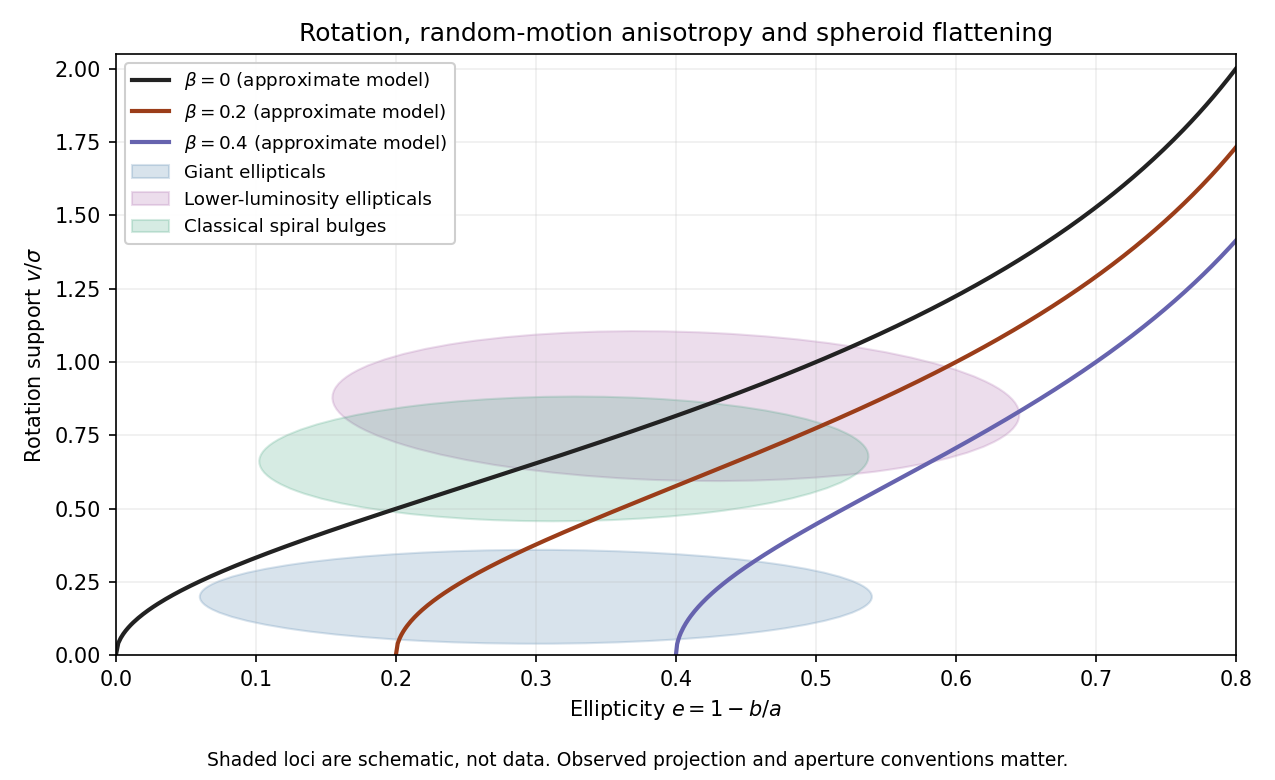
Giant elliptical galaxies commonly have low ordered rotation for their observed flattening, lying below the oblate isotropic rotator reference. Anisotropic velocity dispersions and, in many cases, triaxial structure provide support. Lower-luminosity elliptical galaxies are more commonly rotating, disky systems near the isotropic reference. Classical galactic bulges of spiral galaxies often overlap this rotating-spheroid locus; disk-like bulges can be more strongly rotation supported. These are population trends with substantial overlap, not universal rules for individual galaxies.
Observations usually use projected ellipticity and a line-of-sight rotation measure such as peak speed divided by a central velocity dispersion. The intrinsic and global dispersions used in the derivation are different quantities. Inclination, apertures, and unresolved streaming can change both coordinates. Consequently a point below the reference suggests extra random-motion support, but does not uniquely measure .
Past exam of the mathematics course of the University of Cambridge 2008 iii Paper 72 2 i Solution by Codex 0 Created 2026-10-03 Updated 2026-10-14
Codex 0 Created 2026-10-03 Updated 2026-10-14The stated kinematics do not, by themselves, fix a galaxy's intrinsic axis ratio. The requested curve is the usual simplified oblate-rotator flattening proxy; its additional geometric and streaming conventions should be explicit. Put and adopt the approximate moment prescriptionHere is the ordered support assigned to one in-plane component. Using and solving givesIn this prescription, isotropic random motions give the oblate isotropic rotator curve; positive allows flattening with less rotation. A real solution requires , , and . Equality gives no rotation. This is a useful diagnostic approximation, not an exact identity for arbitrary density distributions.
To see what the tensor virial theorem actually requires, take a finite stationary axisymmetric system with mass-weighted constant velocity dispersions and azimuthal streaming speed . Since , the azimuthal average has . The and components giveand therefore, with the oblate tensor-virial shape factor ,For similar oblate self-gravitating density surfaces, write . The ellipsoidal force coefficients, obtained by integrating the Newtonian force over those surfaces, areThe common radial integral in the stellar potential-energy tensor cancels, but these shape coefficients remain. At , , rather than . With , the intrinsic azimuthal ratio is about , whereas the printed simplified ratio is . Recovering the latter uses both and . Thus, if the printed literally means intrinsic azimuthal speed, its claimed exact relation omits necessary model assumptions and a streaming normalization. The next sketch displays the requested approximate curve with that qualification.
Past exam of the mathematics course of the University of Cambridge 2008 iii Paper 71 3 a Solution by Codex 0 Created 2026-10-03 Updated 2026-10-14
Codex 0 Created 2026-10-03 Updated 2026-10-14The conserved total angular momentum is , and the black-hole spin magnitude isThe initial hole is noncollinear with the total vector, so persistent positive alignment torque leads to the positive direction. The final vectors areThe final disk magnitude is , smaller than its initial magnitude one, and its direction is parallel to the hole. Their sum remains .
Past exam of the mathematics course of the University of Cambridge 2008 iii Paper 71 2 b Solution by Codex 0 Created 2026-10-03 Updated 2026-10-14
Codex 0 Created 2026-10-03 Updated 2026-10-14This part uses source-free viscous evolution of an accretion disk. Put and . The prescribed kinematic viscosity then becomesso . Since , the Keplerian viscous diffusion equation givesCanceling the prefactor and setting proves
Use the similarity ansatz with . Derivatives at fixed giveOn the branch , substitute . The two expressions reduce toEquality of the constant coefficients requires , and then the other coefficients agree as well.
The physical compact self-similar disk with square-root density viscosity uses this branch up to its outer edge and vacuum beyond it:Here is the positive part. The cutoff matters: beyond , the untruncated squared expression would have , and its right-hand side would no longer be the polynomial used above. At the moving edge, vanishes quadratically and vanishes cubically. The latter and its first derivative match the vacuum values continuously, so joining to zero creates no distributional mass-flux source. The joined profile satisfies the equation, including in the weak sense at the edge.
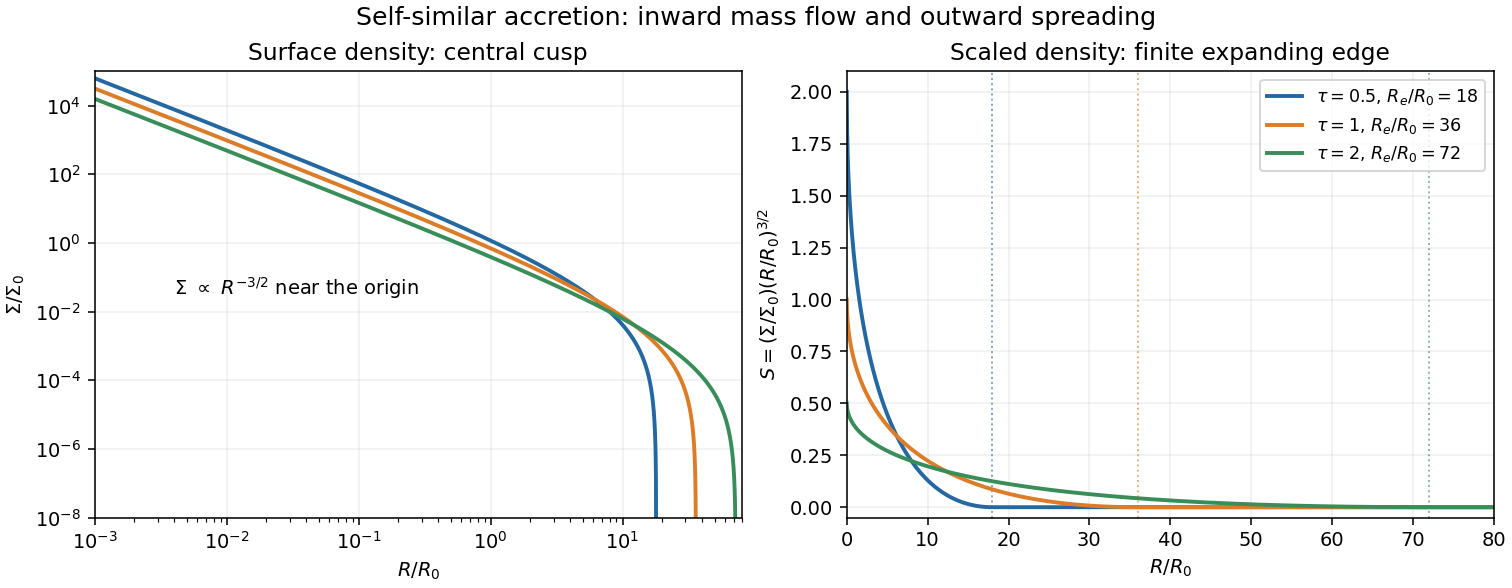
Returning to the surface density gives the explicit resultwith for . Thus the outer edge is and moves linearly in physical time, with speed . The density decreases monotonically with radius, has an integrable central cusp, and drops quadratically to zero at the outer edge. The formal origin boundary has zero viscous torque in an accretion disk, because there, even though the surface density diverges.
To characterize the spreading, let and integrate in . The disk mass and angular momentum areThe mass decreases while the angular momentum remains constant: matter accretes at the origin and the remaining disk spreads outward. More explicitly, with , the inward mass flux isIt is inward for and outward for . The dividing radius is , and the origin flux equals . The outer edge carries no flux beyond itself. This family is a self-similar accreting disk with finite mass at each positive time, rather than a regular finite-mass initial profile at .
Past exam of the mathematics course of the University of Cambridge 2008 iii Paper 71 2 a Solution by Codex 0 Created 2026-10-03 Updated 2026-10-14
Codex 0 Created 2026-10-03 Updated 2026-10-14Use a characteristic midplane temperature , density and disk scale height . For an ideal gas of fixed composition, dominant gas pressure gives , where is the sound speed. Vertical hydrostatic equilibrium and the alpha disk prescription giveNumerical factors in the vertical averaging do not affect the exponents. The stipulated opacity becomesFor an optically thick, radiatively efficient disk, radiative diffusion gives a cooling rate per unit area proportional to . The viscous heating rate is proportional to . ThusEquating heating and cooling gives , soAt fixed and central mass, . Therefore the gas-pressure alpha disk with inverse-density opacity satisfies
For thermal stability of an accretion disk, perturb at fixed and , since the thermal adjustment is faster than radial mass redistribution. The logarithmic heating and cooling slopes are respectively one and two. At equilibrium, a fractional temperature increase therefore makes the excess heating decrease, and the disk cools back. Thus the local thermal equilibrium is stable within the assumed gas-pressure, radiative-diffusion closure.
For viscous stability of an accretion disk, use the thermally equilibrated relation between viscosity and surface density. It givesLocally freezing the background radius in the Keplerian viscous diffusion equation, a short radial Fourier mode has growth rate . Density enhancements diffuse rather than grow, so the disk is locally viscously stable as well.
Past exam of the mathematics course of the University of Cambridge 2008 iii Paper 70 3 b Solution by Codex 0 Created 2026-10-03 Updated 2026-10-14
Codex 0 Created 2026-10-03 Updated 2026-10-14Outside the thin burning shell, the enclosed mass and luminosity are approximately and . Divide the hydrostatic pressure support equation by radiative diffusion in a star with constant opacity:In the constant-opacity radiative-zero giant envelope approximation, the outer pressure and temperature constants are negligible. Integration givesThe radiation pressure is , so the gas pressure fraction is constant and satisfies . Thus alsoThe physical branch has positive gas pressure, hence , the constant-opacity Eddington luminosity for the core mass.
Using the gas part of the equation of state, define , so . Substitution into hydrostatic balance givesConsequently, in the same deep-envelope radiative-zero approximation,Precisely, a finite outer matching point gives . The displayed profile neglects that additive outer-boundary constant; it is appropriate near a compact core when the envelope extends to much smaller temperatures.
To estimate the thin-shell luminosity, write , so . The hydrogen-layer heating law givesThis steep radial dependence strongly concentrates the emission near . Continuing the outer profile across the thin emitting layer and taking a distant upper limit givesThe same radiative coefficient implies . Hence the high-power shell burning in a constant-opacity giant envelope satisfiesTaking the cube root gives the requested form,Thus contains only the specified opacity and heating normalizations and physical constants. The explicit coefficient uses the outer radiative profile as a thin-shell estimate; resolving the variation of within the emitting layer can change that coefficient. Also depends on , so the radiation-pressure-inclusive relation is implicit, not a pure explicit eighth-power core-mass law with independently fixed .
Pinned article: Introduction to the OurBigBook Project
Welcome to the OurBigBook Project! Our goal is to create the perfect publishing platform for STEM subjects, and get university-level students to write the best free STEM tutorials ever.
Everyone is welcome to create an account and play with the site: ourbigbook.com/go/register. We belive that students themselves can write amazing tutorials, but teachers are welcome too. You can write about anything you want, it doesn't have to be STEM or even educational. Silly test content is very welcome and you won't be penalized in any way. Just keep it legal!
Intro to OurBigBook
. Source. We have two killer features:
- topics: topics group articles by different users with the same title, e.g. here is the topic for the "Fundamental Theorem of Calculus" ourbigbook.com/go/topic/fundamental-theorem-of-calculusArticles of different users are sorted by upvote within each article page. This feature is a bit like:
- a Wikipedia where each user can have their own version of each article
- a Q&A website like Stack Overflow, where multiple people can give their views on a given topic, and the best ones are sorted by upvote. Except you don't need to wait for someone to ask first, and any topic goes, no matter how narrow or broad
This feature makes it possible for readers to find better explanations of any topic created by other writers. And it allows writers to create an explanation in a place that readers might actually find it.
Figure 1. Screenshot of the "Derivative" topic page. View it live at: ourbigbook.com/go/topic/derivativeVideo 2. OurBigBook Web topics demo. Source. - local editing: you can store all your personal knowledge base content locally in a plaintext markup format that can be edited locally and published either:This way you can be sure that even if OurBigBook.com were to go down one day (which we have no plans to do as it is quite cheap to host!), your content will still be perfectly readable as a static site.
- to OurBigBook.com to get awesome multi-user features like topics and likes
- as HTML files to a static website, which you can host yourself for free on many external providers like GitHub Pages, and remain in full control

Figure 2. You can publish local OurBigBook lightweight markup files to either OurBigBook.com or as a static website.
Figure 3. Visual Studio Code extension installation.
Figure 5. . You can also edit articles on the Web editor without installing anything locally. Video 3. Edit locally and publish demo. Source. This shows editing OurBigBook Markup and publishing it using the Visual Studio Code extension. 
- Infinitely deep tables of contents:




All our software is open source and hosted at: github.com/ourbigbook/ourbigbook
Further documentation can be found at: docs.ourbigbook.com
Feel free to reach our to us for any help or suggestions: docs.ourbigbook.com/#contact