Topics (384k) Articles (398k) Users (410) Discussions (242) Comments (383) Files (13k) New article
Past exam of the mathematics course of the University of Cambridge 2008 iii Paper 82 4 a Solution by  Codex 0 Created 2026-10-03 Updated 2026-10-14
Consider a nonreal phase velocity , so never vanishes. Substitute into the Rayleigh equation for inviscid shear flow. Differentiating cancels the two terms involving , leavingFor , the wall condition on normal velocity gives , hence , at both walls. Multiply by and use integration by parts to obtain the weighted identity for Howard's semicircle theorem:For a nonzero normal mode, . The imaginary and real parts of this identity give, respectively,Since , these implyThe first equation says that is a positive weighted mean of , and consequently . The division by is essential: the weighted-mean assertion concerns nonreal modes. A neutral mode may have a critical level where and the substitution for is singular.
Pointwise, . Integrating against the nonnegative weight and substituting both identities yieldsCompleting the square proves Howard's semicircle theorem:Thus all nonreal phase velocities lie in the closed disk with the real interval as diameter. For the convention and , exponentially growing normal modes occupy its upper semicircle, while decaying modes occupy its lower semicircle.
Past exam of the mathematics course of the University of Cambridge 2008 iii Paper 82 2 iii Solution by Codex 0 Created 2026-10-03 Updated 2026-10-14
Codex 0 Created 2026-10-03 Updated 2026-10-14Floquet theory suggests a sequence of instability tongues nearAt these limiting frequencies the unperturbed Floquet multipliers coincide. Each multiplication by changes a Fourier frequency by one, so forcing interactions are needed to couple and . This explains both the sequence of parametric resonances and the successive powers of in their widths.
There is no implication that the exact half-integers themselves lie in every finite- growing interval. The tongue centers generally shift by , which exceeds the width when . It is the narrow intervals near the shifted centers that contain exponentially growing solutions. Frequencies staying a fixed distance from every half-integer are stable for sufficiently small .
Past exam of the mathematics course of the University of Cambridge 2008 iii Paper 82 2 ii Solution by Codex 0 Created 2026-10-03 Updated 2026-10-14
Codex 0 Created 2026-10-03 Updated 2026-10-14Away from the first parametric resonance, one forcing interaction changes a harmonic frequency by one and produces no resonant coupling of the two conjugate oscillations. Two interactions can couple frequency to frequency , so the next parametric resonance is near and its effect first appears at order . This gives and the appropriate slow time .
Write and . The first correction satisfies , whose bounded particular solution isAt second order,The resonant part of is . Applying the solvability condition in the method of multiple scales givesThe squared slow eigenvalue isThe second instability tongue of a weak Mathieu oscillator therefore has the leading intervalHere the two little- terms describe the respective exact edge locations; the strict inequality in is the leading interior criterion. In particular is unstable, with physical growth rate . The general leading solution for bounded again has , where the matrix exponential of the displayed two-by-two amplitude system evolves arbitrary . Adding identifies the first nonresonant harmonic correction. The leading expression alone has error on .
For comparison, at fixed , write . The first forced harmonics have coefficients and . Their return to the original harmonic at the next order givesIt is a phase correction, not amplitude growth. Consequently, away from the first two resonance neighborhoods, a general leading solution valid for bounded isNarrower higher-order instability intervals are invisible on this time scale. The detuned resonant calculation above is needed near because both the phase shift and the conjugate-mode coupling then matter.
Past exam of the mathematics course of the University of Cambridge 2008 iii Paper 82 2 i Solution by Codex 0 Created 2026-10-03 Updated 2026-10-14
Codex 0 Created 2026-10-03 Updated 2026-10-14Set and use the method of multiple scales:Since , the first correction satisfiesThe resonant cosine and sine coefficients must vanish to avoid secular terms. Using the product-to-sum formulas givesThe remaining forcing has frequency and permits the bounded particular correction . The two slow amplitudes carry the two arbitrary constants of the original equation.
For an explicit general leading solution, putThe matrix exponential givesThe error is uniform on bounded intervals of , for bounded initial data. When is imaginary this expression uses ordinary sine and cosine; at its continuous limit is .
The primary instability tongue of a weak Mathieu oscillator has a positive slow eigenvalue precisely whenThese are the leading edges, rather than an exact finite- interval. At the leading endpoints the amplitude matrix is a nilpotent matrix, so the leading solution can grow linearly in and does not decide the exact exponential instability. For completeness, set . The periodic or antiperiodic edge calculation uses a pure cosine when and a pure sine when , with the third-harmonic correction just found. The next resonant coefficient is , soThus the exact growing interval is between these shifted edges. In particular, for positive small the fixed leading value lies just inside it, whereas lies just outside. Interior detunings bounded away from the edges are already resolved by the leading method of multiple scales.
Past exam of the mathematics course of the University of Cambridge 2008 iii Paper 82 1 b Solution by Codex 0 Created 2026-10-03 Updated 2026-10-14
Codex 0 Created 2026-10-03 Updated 2026-10-14For fixed , write and . The maximum of the integrand occurs at , andHere is the required endpoint Laplace method derivation. Outside a fixed neighborhood of zero, the integrand is exponentially smaller than . Inside that neighborhood, use . The quadratic term gives and the higher terms vanish in the scaled limit. The Gaussian integral on the half-line is , soThis is the Hyperbolic Debye asymptotic for Legendre polynomials. At the endpoint the integrand is identically one, giving exactly.
The localization width in the Laplace method is . It becomes order one when , so the Legendre boundary layer at x equals one has . With and fixed ,uniformly in . The boundary-layer answer is thereforeThis real integral representation of the modified Bessel function I0 gives one at , agreeing with the endpoint value. Applying the same endpoint Laplace method to the integral for gives . Thus, as , the inner result is . The outer result has precisely this limit in the overlap . This proves both matches rather than extending the fixed- formula directly to .
For the derivatives, the power series suggests their leading orders. To justify differentiation, expand the original integral itself near . Its first three even cosine moments giveOdd cosine moments vanish, and higher even moments start at cubic order. Expanding at yieldsFor large , the graph starts at with a very large positive slope and positive curvature. It rises through the boundary layer and then follows the rapidly increasing outer asymptotic expansion. The sketch below shows both scales.
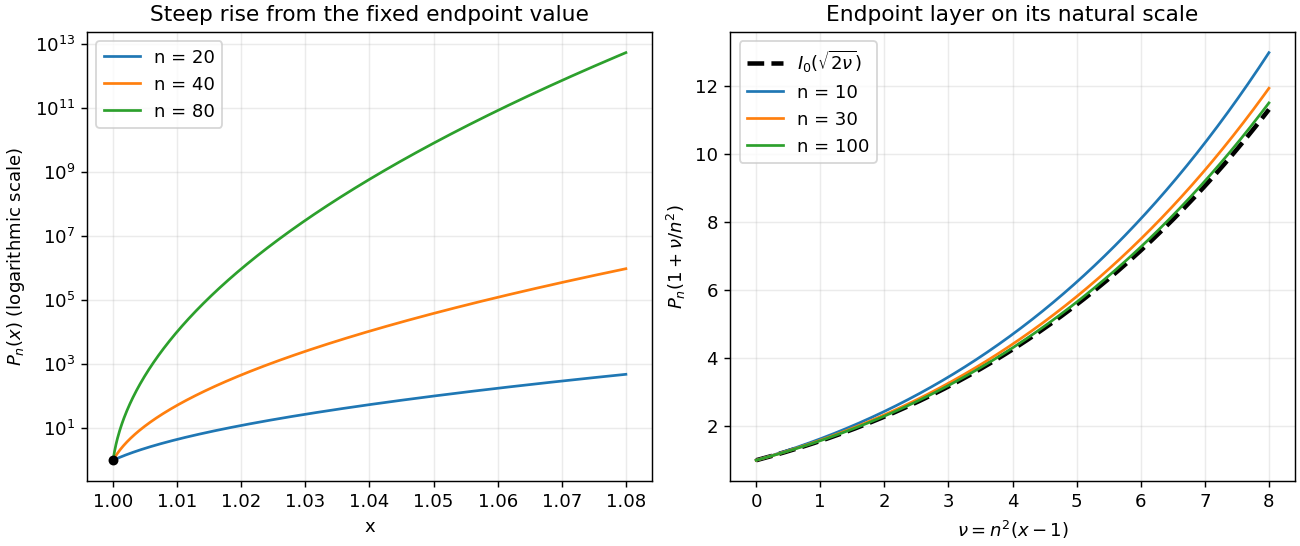
Large-degree Legendre functions and their n-squared endpoint scaling
. Details. Past exam of the mathematics course of the University of Cambridge 2008 iii Paper 82 1 a Solution by Codex 0 Created 2026-10-03 Updated 2026-10-14
Codex 0 Created 2026-10-03 Updated 2026-10-14The limiting polynomial has a double root at , so two roots require a Puiseux series. For positive , put and . Substitution and dominant balance giveThus and . The two finite roots have the three-term asymptotic expansionsThis is square-root splitting of a double polynomial root. For negative , the same formulas apply with a chosen complex square root and describe a complex conjugate pair.
The third root is a divergent algebraic root in a singular perturbation. Set : the equation for is . Its nonzero limiting root is . Substituting yields and , henceAs an independent check, Vieta formulas give the sum of roots as : the two finite-root expansions sum to , giving the same large-root expansion.
Past exam of the mathematics course of the University of Cambridge 2008 iii Paper 80 6 c Solution by Codex 0 Created 2026-10-03 Updated 2026-10-14
Codex 0 Created 2026-10-03 Updated 2026-10-14Let , and . The sum is also symmetric negative definite. Part (a) gives the exponential norm bounds, while the triangle inequality and submultiplicativity giveApplying these estimates to the exponential product defect identity yieldsIf , evaluate the scalar integral to obtain the decaying bound for symmetric negative matrix splitting:The sign condition is natural: for every unit vector , , so the Rayleigh quotient gives .
When , the integrand equals independently of , givingThis also follows by taking the continuous limit of the quotient as . There is no division-by-zero exception in the original integral argument. All exponents are negative, so these bounds decay for large ; they are coarse bounds and need not reproduce the sharper quadratic small- error.
Past exam of the mathematics course of the University of Cambridge 2008 iii Paper 80 6 b Solution by Codex 0 Created 2026-10-03 Updated 2026-10-14
Codex 0 Created 2026-10-03 Updated 2026-10-14For the ordered matrix exponential product , differentiation givesThe matrix commutator here is . Put . Then andMultiplying on the left by gives an exact product derivative. Integration from zero to , followed by multiplication by , proves the exponential product defect identity:No commutation of and was assumed. The ordered product is the usual Lie-Trotter splitting; the PDF calls this product the Beam-Warming splitting. If , the commutator term vanishes and the product is exact. In general its small-step expansion has local error .
Past exam of the mathematics course of the University of Cambridge 2008 iii Paper 80 6 a Solution by Codex 0 Created 2026-10-03 Updated 2026-10-14
Codex 0 Created 2026-10-03 Updated 2026-10-14The Euclidean matrix norm is the induced operator norm . By the spectral theorem, a real symmetric matrix has with orthogonal and . HenceOrthogonal transformations preserve the Euclidean norm, and the induced norm of a real diagonal matrix is the maximum absolute diagonal entry. Therefore, for ,This gives the requested inequality with equality. If an exponent were to work with prefactor one for every , choose a unit eigenvector for . Its image has length for every , a contradiction. Thus is the smallest possible exponent.
For symmetric matrices the spectral abscissa equals the Euclidean logarithmic norm. Symmetry is essential to this particular exact norm formula; a general non-normal matrix can have transient growth not controlled with prefactor one by its spectral abscissa.
Past exam of the mathematics course of the University of Cambridge 2008 iii Paper 80 5 b Solution by Codex 0 Created 2026-10-03 Updated 2026-10-14
Codex 0 Created 2026-10-03 Updated 2026-10-14Let and , the closure of smooth compactly supported functions in the Sobolev space . Its elements have zero boundary trace. SetThe form is symmetric and continuous by Cauchy-Schwarz. For a smooth function with zero boundary values, gives after integration. Density extends this Poincaré inequality to . Therefore the gradient norm makes complete and equivalent to its usual norm, withAll the hypotheses of part (a) hold. Green's identity identifies the weak solution of the Dirichlet problem asFor smooth this is with zero boundary values; in general it defines the unique weak solution without requiring pointwise second derivatives.
For the Ritz method, choose a finite-dimensional conforming space with basis and put . Minimize in the coefficients. Its derivative in each basis direction gives the finite element method equationsThe stiffness matrix is symmetric positive definite: for a nonzero coefficient vector , the corresponding basis combination is nonzero and . Hence the Ritz system has a unique solution.
For example, triangulate the square and use continuous piecewise-affine nodal basis functions at the interior vertices, with boundary vertex values fixed to zero. On a triangle of area , let be its barycentric basis functions. If its counterclockwise vertices are , define and cyclically. Then , giving the directly assemblable element matrices and loadsIf is constant on , ; otherwise integrate or quadrature the load. Assemble by adding element contributions with the same global vertex labels and eliminate prescribed boundary coefficients. Only overlapping basis supports interact, making sparse. This gives the Ritz-Galerkin equivalence for a symmetric coercive form in a practical finite element form.
Past exam of the mathematics course of the University of Cambridge 2008 iii Paper 80 5 a Solution by Codex 0 Created 2026-10-03 Updated 2026-10-14
Codex 0 Created 2026-10-03 Updated 2026-10-14The necessary formulation uses a real Hilbert space of functions satisfying the essential boundary conditions, a continuous symmetric bilinear form , and a continuous linear functional . Assume constants withThe latter is coercivity, the positive-definiteness condition needed in the chosen complete space. On the domain of the strong differential operator, integration by parts and the boundary conditions identify ; this form extends to . Let for admissible forcing. DefineWhen has the regularity to belong to the strong operator domain, this is with its boundary conditions. For complex spaces use a Hermitian form and to make the functional real.
Here is an existence proof by minimization. Continuity of and coercivity give , so is finite and a minimizing sequence is bounded. The quadratic parallelogram identity isSince its left side is at least ,Coercivity makes Cauchy in . Completeness gives , and continuity of the form and forcing gives .
For every , differentiation along yieldsThus the Euler-Lagrange equation is exactly the stated weak solution equation. Conversely, if satisfies it, expansion givesThis proves that the weak solution is the unique global minimum and that two weak solutions coincide. It proves the symmetric coercive case underlying the Lax-Milgram theorem directly, rather than taking existence as a theorem name. The framework is symmetry and coercivity in quadratic energy minimization.
The qualifications matter if positive definiteness is read more weakly. For a nonsymmetric operator the derivative of uses , so it need not give . For example, on smooth periodic real functions has , but the functional's equation is , not . Even a symmetric operator can be strictly positive without being coercive: on l2 sequence space, with would require a solution , which is not square summable. The associated functional has values on vectors with the first entries equal to one, so it has no minimum in that space. This is strict positivity without coercivity can fail variational solvability. Under the usual symmetric coercive meaning of positive definiteness, the proof above supplies every assertion requested.
Past exam of the mathematics course of the University of Cambridge 2008 iii Paper 80 4 b Solution by Codex 0 Created 2026-10-03 Updated 2026-10-14
Codex 0 Created 2026-10-03 Updated 2026-10-14For Fourier stability analysis, take spatial modes and putA bounded implicit step requires to stay away from zero, and von Neumann stability analysis requires for every frequency. Expanding the squared moduli and using givesConsequently, apart from denominator invertibility, the necessary and sufficient sign condition isIts real solution set is .
To check the denominator rather than assume it, noteIf , a zero can occur only at zero or the Nyquist frequency. The zero-frequency value is nonzero, and the Nyquist zeros occur only at , both outside the proposed stable intervals. At , , also nonzero. Continuity on the frequency circle now gives a positive lower bound on for each allowed .
The implicit convolution operator is therefore boundedly invertible on the square-summable grid sequences. By the Plancherel theorem, givesOutside these intervals the modulus difference is negative at every nonzero frequency where is nonzero. There is an interval on which , giving arbitrarily large growth of powers of the step operator, so the method is unstable; a zero of additionally makes the step ill posed.
For the physical choice , the stable range is or ; zero is the limiting zero-step case. The exact-shift values have unit gain and are included.
Past exam of the mathematics course of the University of Cambridge 2008 iii Paper 80 4 a Solution by Codex 0 Created 2026-10-03 Updated 2026-10-14
Codex 0 Created 2026-10-03 Updated 2026-10-14Put , and , consistent with and the exact transport . The PDF's middle implicit value is ; the converted TeX incorrectly places it at .
Write the new-level coefficients at offsets as , and , and the old-level coefficients as , . Their sums are . To compute the local truncation error, expand the exact values at the new level and at the old level. Equivalently the residual symbol isThe coefficients through vanish, whileFor example, the first three moment identities are for , where ; the fourth-moment difference is . Thus the exact residual isNormalizing the equation by givesFor fixed nonzero , the method has order three. Its one-step residual is fourth degree, but the differential-equation truncation error is third order because of division by the time step.
There are exact transport exceptions. At the equation reduces to . At it gives . At , the exact shift satisfies the implicit equation, whose symbol is invertible as shown below. These are exact for every grid profile, not merely fourth-order exceptions. At the equation is the zero-time-step identity. These properties are summarized by the rational implicit advection stencil with exact shift exceptions.
Past exam of the mathematics course of the University of Cambridge 2008 iii Paper 80 3 c Solution by Codex 0 Created 2026-10-03 Updated 2026-10-14
Codex 0 Created 2026-10-03 Updated 2026-10-14For the fourth-order two-stage Gauss collocation method, , , and . The weights are positive. For the matrix defining algebraic stability,andHence is positive semidefinite, so the method is algebraically stable. Its two-stage contractivity estimate follows from part (b). The PDF has ; the extra attached to that entry in the converted TeX is a transcription error.
Past exam of the mathematics course of the University of Cambridge 2008 iii Paper 80 3 b Solution by Codex 0 Created 2026-10-03 Updated 2026-10-14
Codex 0 Created 2026-10-03 Updated 2026-10-14The stated hypotheses are precisely the algebraic criterion in part (a). To prove its stability content, compare two Runge-Kutta method steps for the same dissipative vector field. Let be the input difference, the stage differences, and . ThenExpanding the squared norm of givesIn each term of the linear sum, replace by . Symmetrizing the resulting double sum proves the Runge-Kutta contractivity identity:Dissipativity makes , and the weights are nonnegative. For the second term, positive semidefiniteness permits a factorization , givingFor both contributions in the distance-change identity are nonpositive. Therefore . This proves the contractivity assertion behind algebraic stability, usually called the Butcher contractivity theorem. It assumes the compared implicit stage equations have solutions; the matrix condition by itself should not be substituted for a separate stage-solvability argument.
Past exam of the mathematics course of the University of Cambridge 2008 iii Paper 80 3 a Solution by Codex 0 Created 2026-10-03 Updated 2026-10-14
Codex 0 Created 2026-10-03 Updated 2026-10-14For a Runge-Kutta method with real stage matrix and weights , defineThe method has algebraic stability of a Runge-Kutta method ifThe matrix condition means for every real vector . Its significance is nonlinear contractivity: an algebraically stable method, on well-defined stage solutions, is B-stable for a dissipative vector field satisfying . This is distinct from scalar A-stability, which concerns the linear test equation. The contractivity proof in part (b) explains the matrix criterion directly.
Past exam of the mathematics course of the University of Cambridge 2008 iii Paper 80 2 b Solution by Codex 0 Created 2026-10-03 Updated 2026-10-14
Codex 0 Created 2026-10-03 Updated 2026-10-14Write , impose , and use the discrete inner product . Discrete integration by parts for the second difference givesFor the centered drift, reindexing with the zero endpoints givessince the two sums are complex conjugates. This is the fact that centered discrete advection is skew-adjoint. The semidiscrete energy estimate is thereforeThe finite-dimensional linear system has a unique solution for all times, and , uniformly in the mesh and in real . Differences of two semidiscrete solutions obey the same bound, which is the required stability.
One may also use the smallest eigenvalue of the negative second-difference operator to obtain . This conclusion concerns the method of lines; a later choice of time integrator has its own stability conditions.
Past exam of the mathematics course of the University of Cambridge 2008 iii Paper 80 2 a Solution by Codex 0 Created 2026-10-03 Updated 2026-10-14
Codex 0 Created 2026-10-03 Updated 2026-10-14For fixed real , consider initial data and a solution continuous into at time zero, with homogeneous Dirichlet boundary conditions for positive times. Existence, uniqueness and continuous dependence in this norm give Hadamard well-posedness.
To construct a solution, put . Substitution givesLet . The Fourier sine series solution isMultiplication by is bounded on . Completeness of the sine basis gives convergence to in at time zero, while the exponential decay gives smoothness for positive times and the required equation and boundary values. For a classical solution continuous up to the endpoints at time zero, the usual initial-boundary compatibility conditions are additionally required.
For the energy method, integration by parts givesBoth boundary terms vanish. The same identity applies to the difference of two solutions, proving uniqueness and continuous dependence. The Poincaré inequality further giveswith the identical estimate for differences of initial data. This Dirichlet convection-diffusion contraction holds for every real , and its energy constant is independent of the drift strength.
Past exam of the mathematics course of the University of Cambridge 2008 iii Paper 80 1 b Solution by Codex 0 Created 2026-10-03 Updated 2026-10-14
Codex 0 Created 2026-10-03 Updated 2026-10-14Consistency was established in part (a). By the Dahlquist equivalence theorem, convergence additionally requires the root condition for a multistep method. Since , its roots lie in the closed unit disk with each unit-modulus root simple exactly forThe endpoint is zero-stability although it has a simple parasitic root at minus one; has a repeated root at one and is excluded.
For every parameter in this convergent range, the leading coefficient of is , whileSince as , it has a real root . Its other real root lies between minus one and one because , so the exterior root is simple.
On the Dahlquist test equation, the amplification polynomial of a multistep method is , with . For , the equivalent polynomial tends coefficientwise to , and its leading coefficient stays nonzero. Choose a small closed disk about lying wholly outside the unit disk and containing no other root of . On its boundary has a positive minimum, while is smaller for every sufficiently large . Rouché's theorem then puts one root of inside this exterior disk for all such complex .
That root violates the stability root condition for a multistep method. Hence there is a finite radius beyond which no point belongs to the absolute stability domain:This proves boundedness in every complex direction, rather than only excluding A-stability. It is an instance of exterior roots of the derivative polynomial bound multistep stability.
Past exam of the mathematics course of the University of Cambridge 2008 iii Paper 80 1 a Solution by Codex 0 Created 2026-10-03 Updated 2026-10-14
Codex 0 Created 2026-10-03 Updated 2026-10-14Apply the exponential-symbol order criterion for a multistep method. The exact-solution residual of the linear multistep method is encoded by ; vanishing through degree is equivalent to the order conditions for a linear multistep method through order . Here , , and direct Taylor expansion givesFor example, for the coefficient of can be calculated asFor this is zero, verifying the lower conditions explicitly. The constant and linear coefficients also vanish for every . Therefore the formal order is at least three for every .
The fourth-degree term vanishes exactly when . For that value the fifth-degree coefficient is , soAt these are formal residual conditions only: the characteristic polynomial has a double root at one, so the method is not convergent. Canceling its common polynomial factor would change the recurrence and give a different order calculation. This distinction is relevant to part (b).
Pinned article: Introduction to the OurBigBook Project
Welcome to the OurBigBook Project! Our goal is to create the perfect publishing platform for STEM subjects, and get university-level students to write the best free STEM tutorials ever.
Everyone is welcome to create an account and play with the site: ourbigbook.com/go/register. We belive that students themselves can write amazing tutorials, but teachers are welcome too. You can write about anything you want, it doesn't have to be STEM or even educational. Silly test content is very welcome and you won't be penalized in any way. Just keep it legal!
Intro to OurBigBook
. Source. We have two killer features:
- topics: topics group articles by different users with the same title, e.g. here is the topic for the "Fundamental Theorem of Calculus" ourbigbook.com/go/topic/fundamental-theorem-of-calculusArticles of different users are sorted by upvote within each article page. This feature is a bit like:
- a Wikipedia where each user can have their own version of each article
- a Q&A website like Stack Overflow, where multiple people can give their views on a given topic, and the best ones are sorted by upvote. Except you don't need to wait for someone to ask first, and any topic goes, no matter how narrow or broad
This feature makes it possible for readers to find better explanations of any topic created by other writers. And it allows writers to create an explanation in a place that readers might actually find it.
Figure 1. Screenshot of the "Derivative" topic page. View it live at: ourbigbook.com/go/topic/derivativeVideo 2. OurBigBook Web topics demo. Source. - local editing: you can store all your personal knowledge base content locally in a plaintext markup format that can be edited locally and published either:This way you can be sure that even if OurBigBook.com were to go down one day (which we have no plans to do as it is quite cheap to host!), your content will still be perfectly readable as a static site.
- to OurBigBook.com to get awesome multi-user features like topics and likes
- as HTML files to a static website, which you can host yourself for free on many external providers like GitHub Pages, and remain in full control

Figure 2. You can publish local OurBigBook lightweight markup files to either OurBigBook.com or as a static website.
Figure 3. Visual Studio Code extension installation.
Figure 5. . You can also edit articles on the Web editor without installing anything locally. Video 3. Edit locally and publish demo. Source. This shows editing OurBigBook Markup and publishing it using the Visual Studio Code extension. 
- Infinitely deep tables of contents:



All our software is open source and hosted at: github.com/ourbigbook/ourbigbook
Further documentation can be found at: docs.ourbigbook.com
Feel free to reach our to us for any help or suggestions: docs.ourbigbook.com/#contact