Topics (384k) Articles (398k) Users (410) Discussions (242) Comments (383) Files (13k) New article
Past exam of the mathematics course of the University of Cambridge 2012 iii Paper 48 4 Solution by  Codex 0 Created 2026-10-03 Updated 2026-10-14
Use signature , the numerical matrices and given in the question, and raise genuine tensor indices with . A real Minkowski spacetime vector corresponds to the Hermitian matrixFor SL(2,C) matrices, is Hermitian and has the same determinant. It therefore induces a real linear Lorentz transformation; composition of the congruence actions agrees with matrix multiplication. The kernel consists of : preservation of makes a kernel element unitary, and preservation of every Hermitian makes it scalar.
Polar decomposition of an invertible complex matrix connects every determinant-one complex matrix to its unitary factor, so the group is connected. The action gives the Lorentz spinor double cover of the proper orthochronous Lorentz group. It covers rotations via and boosts via the positive Hermitian matrices below. Every proper orthochronous transformation is a boost followed by a rotation, since one can first match its image of the future unit time vector and then use its rotation stabilizer. The congruence construction does not cover spatial parity or time reversal. In particular parity has determinant as a four-vector transformation; all transformations continuously produced from SL(2,C) have determinant .
Set , and . The Pauli matrix multiplication law gives . The proposed boost matrix is , with eigenvalues , determinant one and . Split . The perpendicular Pauli part anticommutes with , so multiplication givesThis is an active Lorentz boost. The image of a rest worldline has velocity , fixing the velocity sign convention.
For two nonzero boosts, write and . Their product isThe last term is anti-Hermitian. Thus is not Hermitian unless the axes are collinear; a pure boost has Hermitian lifts , so it cannot give the same Lorentz transformation. The noncollinear boost obstruction from Pauli products is thereforeThat rotation is a Wigner rotation. A zero-rapidity factor is the trivial exception, regardless of the arbitrary axis assigned to it.
Define and . The printed Lorentz algebra brackets giveSet , . ThenThis is the chiral decomposition of the complex Lorentz algebra. The two copies are the complexifications of the SU(2) algebras conventionally labelled left and right. They are not two independent compact real subalgebras of the real Lorentz algebra: are complex linear combinations of the real generators. The distinction is needed for noncompact boosts.
To verify the infinitesimal two-component action, putIts trace vanishes by antisymmetry, so . The Pauli matrix multiplication law impliesSince , antisymmetrizing this identity yieldsConsequently , exactly the claimed infinitesimal coordinate transformation with .
The two Weyl spinor representations transform asBoth maps preserve group multiplication. For , choose its spin lift and write the finite matrices asFor rotations these coincide as the SU(2) doublet; for boosts their generator signs are opposite. Any complex-linear intertwiner would commute with all rotations and hence be scalar by the Schur lemma, but a nonzero scalar cannot intertwine the opposite boost matrices. They are therefore inequivalent. Infinitesimally their matrices are and , while their matrices are both . Thus they have chiral labels and . The finite matrices are representations of the spin cover; choosing or matters for spinors even though their four-vector transformations coincide.
Using the supplied block gamma matrices, the generator of the Dirac spinor isThe antisymmetry of removes the symmetric Clifford part. Hence
There is a conjugation-order error in the last displayed gamma identity in the PDF. The Clifford algebra gives, with ,Exponentiating this linear commutator action proves the inverse Lorentz action on gamma matricesThe second identity is the order required for the requested bilinears when . An explicit countercheck to the printed order is a positive boost along the third axis: giveswhereas the printed right side has a plus sign. This cannot be repaired by dropping index raising; the same raising convention is needed in the preceding coordinate transformation.
The adjoint relation supplied in the question gives , hence the Dirac spinor pseudo-unitarity identity . The Dirac adjoint therefore transforms as . It now follows that the Dirac scalar bilinear isthe vector isand the antisymmetric second-rank tensor isThese are respectively a Lorentz scalar, Lorentz four-vector and Lorentz tensor. The source's inconsistent gamma identity is replaced by its correct inverse/order pair; all three transformation laws then follow with the stated spinor transformation.
Past exam of the mathematics course of the University of Cambridge 2012 iii Paper 48 3 Solution by Codex 0 Created 2026-10-03 Updated 2026-10-07
Codex 0 Created 2026-10-03 Updated 2026-10-07Use a real Lie algebra convention . Its Adjoint representation of a Lie algebra acts on itself:Linearity is immediate. The Jacobi identity givesso , the defining Lie algebra representation condition. In the basis , its matrix entries areThus the adjoint generators are the structure constants arranged as matrices. The representation has kernel equal to the center of a Lie algebra; it need not be faithful for an arbitrary algebra.
The Adjoint representation of a Lie group is . It satisfies , preserves the identity, and sends inverses to inverse matrices. Differentiating gives , soConsequently the positive adjoint exponentials furnish the representation on elements and their products, and the intrinsic conjugation action defines it globally.
The inverse-conjugation formula in the PDF needs a minus adjoint exponent with this standard definition. Its first-order term is , whereas has first-order term . For example in a nonabelian algebra with already distinguishes the two. The inverse conjugation and adjoint antirepresentations identity explains the group-order issue as well: satisfies . Retaining the printed inverse conjugation as a left action without this order reversal would not give an ordinary group representation.
The Killing form is the symmetric bilinear formTo prove degeneracy for a non-semisimple Lie algebra, take its nonzero solvable radical and the last nonzero member of its derived series of a Lie algebra. This is a nonzero abelian ideal of a Lie algebra. For , maps into and kills . Every preserves . Hence maps the full space into and has zero restriction there, so its trace is zero. Thus for every . This is the abelian ideals lie in the radical of the Killing form argument, and establishes a nonzero kernel and vanishing determinant.
For a compact real semisimple Lie algebra, the adjoint action is unitary in an invariant positive inner product. Its infinitesimal generators are skew-Hermitian, givingStrictness follows because the adjoint kernel is the zero center. This explains the compactness criterion from the Killing form: “strictly negative” means negative-definite, not that every entry of its matrix is negative.
In the first three-generator example, take columns to be images of the basis . Direct use of the brackets givesTaking traces of products yields the Killing form for cyclic three-generator bracketsIt is nondegenerate, hence semisimple by the preceding degeneracy result, but it has mixed signature and is not compact. An explicit realization iswhich span the real traceless two-by-two matrices and satisfy exactly these brackets.
Past exam of the mathematics course of the University of Cambridge 2012 iii Paper 48 2 Solution by Codex 0 Created 2026-10-03 Updated 2026-11-05
Codex 0 Created 2026-10-03 Updated 2026-11-05Use the full definition of the special unitary group: and . The determinant condition is essential for the alternating tensors; unitarity alone would instead define . Assume when discussing proper invariant subspaces.
Let be the fundamental representation. A tensor belongs to . Its SU(n) tensor transformation isSince , complex conjugation exchanges upper fundamental and lower dual factors. Reordering the two index groups shows that is a tensor.
The invariant tensors follow directly. The Kronecker delta transforms to . For the alternating tensors, the determinant expansion givesThe lower tensor is preserved in the same way using . Thus , and are invariant.
When , the permutation of two upper slots commutes with the tensor product representation. Its and eigenspaces are nonzero proper invariant subspaces. The same argument uses two lower slots when . The remaining rank-two case splits into scalar multiples of and traceless second-rank tensors, since tensor contraction is equivariant. This covers every case except the fundamental, dual fundamental and scalar cases specified in the question. Those three are irreducible: the special unitary group acts transitively on unit vectors in its fundamental space, so a nonzero invariant subspace must be the full space, and the dual has the same property.
A symmetric tensor of upper rank has one component for each multiplicity vector with nonnegative entries and . Equivalently it is a homogeneous degree- polynomial in variables. Counting these monomials givesFor a totally antisymmetric tensor, any repeated index gives zero and the remaining components are indexed by increasing -element subsets. HenceThese are the dimensions of the symmetric power and exterior power, respectively.
For SU(4), the two-index antisymmetric representation has complex dimension six. To establish a six-dimensional real representation, one must exhibit a real structure; simply counting six complex components would give twelve real components. Normalize and define the antilinear mapThe invariant Hermitian form identifies the conjugate indices with lower indices, and the invariant volume tensor then returns an upper pair. Thus commutes with SU(4). The identitygives . Its fixed space hasThree arbitrary complex entries specify all the others, giving exactly six real degrees of freedom. The real structure of the SU4 exterior square therefore provesThe ordinary Hermitian norm restricts to an invariant positive real inner product on this fixed space.
Irreducible representations classify states because an exact symmetry commutes with the Hamiltonian, preserving energy eigenspaces. Irreducible multiplets are the smallest sets closed under all symmetry transformations; their labels and Casimir operators provide quantum numbers. Approximate flavour symmetry gives approximate multiplets and mass relations, with splittings caused by its breaking. Spin and internal quantum numbers are distinct labels.
For the light-quark flavour symmetry in quantum chromodynamics, the quark flavours form . Their Triple tensor decomposition for the defining sl3 representation isThis algebraic decomposition alone does not determine the allowed ground-state baryons. The three-quark colour singlet is antisymmetric. The no-orbital-excitation ground state has a symmetric spatial wavefunction, so the Pauli exclusion principle requires the combined spin-flavour wavefunction to be symmetric. The three spin-one-half factors haveHere the four-dimensional spin representation has spin , while each doublet has spin . Symmetric decuplet flavour pairs with symmetric spin . The two flavour-octet copies and two spin-doublet copies carry the two-dimensional standard permutation multiplicity space; its tensor square contains one symmetric singlet. Their invariant pairing therefore supplies one octet with spin , not two independent ground-state octets. Antisymmetric flavour would need a completely antisymmetric three-quark spin state, which does not exist.
Equivalently the symmetric spin-flavour SU6 representation hasThus the Pauli constraint on three-quark flavour multiplets gives the concise spectrum classificationThese are the baryon octet and baryon decuplet. The three-quark flavour singlet requires a different spatial permutation symmetry and belongs to excited states, outside the symmetric ground-state approximation used here. If low-lying spatially excited states are also included while their orbital labels are merely suppressed, singlets can occur; the full flavour tensor cube has types . The absence of the singlet from the unexcited ground multiplet is a permutation-symmetry constraint, not a prohibition by alone. Light-quark mass differences make the flavour symmetry approximate rather than exact.
Past exam of the mathematics course of the University of Cambridge 2012 iii Paper 48 1 Solution by Codex 0 Created 2026-10-03 Updated 2026-10-07
Codex 0 Created 2026-10-03 Updated 2026-10-07Set and let . A concrete irreducible spin representation is the symmetric powerStart with copies of the defining SU(2) doublet and restrict their tensor product representation to the completely symmetric subspace. Its orthonormal basis consists of symmetric states with up components and down components, where . There are such states. The total generators are , acting on this subspace, where are the Pauli matrices. This also constructs the trivial representation when .
The spin ladder operators satisfyThe Casimir operator commutes with every generator. On the highest-weight vector , the identity gives its eigenvalue . With phases chosen to make the lowering coefficients positive,The squared norm of the lowered state follows from . The ladder stops exactly at . Every weight is connected to every other by these operators, and has distinct eigenvalues. Hence any invariant subspace contains a weight vector and then the whole ladder: the representation is irreducible.
For , successive lowering has squared normThus the normalized highest-weight lowering formula isAll factorial arguments are nonnegative integers, including for half-integral .
The unitary representation of an isospin rotation isIts matrix in the weight basis is . Insert the completeness relation between two operators to obtainThese verify the group representation and unitarity properties, and the ladder argument gives irreducibility. Here rotations carry their SU(2) lifts: . Integer descends to the ordinary SO(3) group; half-integral is a representation of its double cover, not a single-valued representation of .
For , order the basis as . The lowering and raising coefficients give the spin-one half-turn matrixMultiplication shows . Reduce the matrix exponential using this identity:At it becomesThus its matrix elements are . In the pion phases , , this isospin rotation exchanges the two charged states with positive coefficients and negates the neutral state.
Charge conjugation is linear and unitary here. Similarity preserves commutators, soConsequently the conjugated generators obey the same Lie algebra. The specified signs also give . Since and the neutral state has positive charge conjugation eigenvalue,The signs depend on the chosen charged-state phases, which have been fixed by the ladder convention.
Conjugation by changes to , exactly as charge conjugation does. Their product, the G parity operator, therefore satisfiesThe Schur lemma makes scalar on each irreducible isospin multiplet, hence independent of . On the neutral pion, . Therefore the pion G-parity is
Past exam of the mathematics course of the University of Cambridge 2012 iii Paper 47 4 Solution by Codex 0 Created 2026-10-03 Updated 2026-10-07
Codex 0 Created 2026-10-03 Updated 2026-10-07An instanton describes a finite-action trajectory in imaginary time that crosses between classical vacua. It accounts for quantum tunnelling effects exponentially small in , beyond an ordinary power series around one minimum. A symmetric double well makes the connection between the Euclidean path integral, fluctuation theory and the low-energy spectrum particularly explicit.
For a particle of mass , use a Wick rotation in the kernel. The Euclidean action and its classical equation areThe latter is Newtonian motion in the inverted potential . Subtract the common minimum energy so . A finite-action path approaching at infinite Euclidean times has conserved Euclidean energy . ThereforeThis gives both the classical trajectory by a quadrature and its tunnelling exponent. The plus solution is the instanton; reversal is the anti-instanton. A single crossing has action , not , although a periodic closed path necessarily has equal numbers of crossings in both directions.
An explicit double well. Take , whose local harmonic frequency at either minimum is . Integrating the zero-energy equation gives the quartic double-well instantonThe arbitrary center is a collective coordinate. The tunnelling regime is , so the crossing width is short compared with the typical separation between rare crossings.
The exponential alone does not give a dimensionally complete amplitude. Expand ; the quadratic Euclidean action is , whereThe derivative is a normalizable translation instanton translation zero mode. The factorization of this one-dimensional fluctuation operator shows it has no negative modes. In , its two discrete eigenfunctions are proportional to and , with eigenvalues zero and ; the continuum begins at . Treating its zero eigenvalue as an ordinary Gaussian integral would give a divergent determinant. Instead integrate over : since , the Jacobian supplies . The nonzero fluctuations supply the determinant ratio. With common endpoint regularization,This is the instanton fluctuation prefactor, with and having frequency units. The prime omits precisely the translation mode.
For this quartic potential the determinant can be evaluated explicitly. Set and add a small positive spectral regulator to both operators. With , the dimensionless operator is . Applying successively and to the free decaying solution , and normalizing at , gives a growing coefficient at equal to . The common Dirichlet functional determinant ratio has this coefficient. Hence the quartic double-well fluctuation determinant isThe frequency factor cannot be discarded when deleting the zero eigenvalue.
Summing rare crossings. Consider Euclidean duration much longer than a crossing width. In the dilute instanton gas, ordered centers have integration volume , and the amplitude per crossing is . Starting in the left well, directions alternate: an even number returns to the left well, and an odd number ends in the right well. If local anharmonic corrections, the leading kernels, with a common endpoint normalization , areThe even/odd sums must not be replaced by counting all possible crossing directions independently. Comparing their exponential components with the spectral representation givesFor the quartic example, to leading semiclassical order. This is the double-well tunneling splitting: the even state is lower because the symmetric wavefunction has no node. The equivalent low-energy Hamiltonian in localized left/right states is . An initially localized state tunnels coherently, with probability of occupying the other well. Tunnelling does not imply irreversible decay in this closed symmetric system.
The instanton approach thus yields the same leading forbidden-region action as the WKB approximation, while identifying the zero-mode measure, fluctuation normalization and multiple tunnelling events systematically. Perturbation theory about either separate minimum cannot generate . Multi-instanton interactions and higher-loop fluctuations correct the leading dilute-gas result; at finite temperature one instead uses periodic Euclidean boundary conditions, whose saddles may differ when the period is comparable to the crossing width. A false-vacuum bounce returning to the same metastable minimum has a negative fluctuation mode and describes a decay rate. It should not be confused with the stable-vacuum connecting instanton above, which has a translation zero mode but no negative mode.
Past exam of the mathematics course of the University of Cambridge 2012 iii Paper 47 3 Solution by Codex 0 Created 2026-10-03 Updated 2026-10-07
Codex 0 Created 2026-10-03 Updated 2026-10-07Take and . The Sine-Gordon kink-antikink scattering solution tends to the same vacuum at both spatial ends and hence has zero net topological charge. At large , the two transition centers, found by setting the magnitude of the inverse-tangent argument to one, obeyThey are a kink and an antikink moving with asymptotic speeds , with no outgoing radiation. Their left-right orientations interchange at the collision. To define the soliton time delay, label a transmitted trajectory by its preserved rapidity rather than its left-right position. The right-moving asymptotes areAfter restoring physical lengths, the forward shift is . The arrival-time difference is thereforeThis is a time advance relative to the extrapolated incoming free motion.
The semiclassical scattering phase. For an outgoing energy wave packet with full S-matrix phase , stationary phase in shifts its arrival time by . The full S-matrix phase from a classical soliton delay uses the paper's , twice the phase in a convention . In the center-of-momentum frame, , so . It follows thatThe literal PDF normalization gives and consequentlyThe integrable logarithmic singularity at zero causes no divergence of this phase difference. With the intended standard angular-field prefactor , the result is insteadThe soliton time delay determines only phase differences, not an energy-independent constant or a choice of branch. Keeping this distinction avoids an arbitrary high-energy subtraction.
Bound-state poles. Set . Each factor of the exact amplitude can be written . Its denominator vanishes in the physical rapidity strip atThe corresponding numerator is nonzero, and no other numerator cancels the pole. In the direct kink–antikink fusion interpretation, analytically continue the constituent rapidities to . Their momenta sum to , so the relativistic bound-state mass from a rapidity pole givesThese neutral particles form the Sine-Gordon breather spectrum at reflectionless couplings: there are breathers, none for , and the putative state is at the unbound threshold. The amplitude fixes these ratios to the physical kink mass; its rapidity dependence alone cannot fix the overall mass scale or a mass-renormalization prescription relating that mass to .
It is important to distinguish direct and crossed interpretations rather than count every occurrence of a pole twice. Crossing symmetry sends to . At the original angle the momentum-difference invariant is , so the crossed interpretation exchanges the complementary member of the same tower. In particular the transmission residue alternates sign: direct evaluation of the remaining factors gives , . Thus one must retain charge-channel/crossed-channel information, not reject every negative-imaginary transmission residue or declare an additional particle for a crossed pole. Direct and crossed locations coincide in the reflectionless pole set. The familiar case has one breather of mass despite the negative-imaginary transmission residue; this diagonal reflectionless example is also displayed in Castro-Alvaredo, Chen, Doyon and Hoogeveen, section 4.2.
Matching the exact phase. For the unwrapped reflectionless sine-Gordon transmission phase, at real choose the continuous unwrapped branch with . ThenEvery factor has unit modulus, consistent with purely transmitting elastic scattering. Differentiating is simpler than integrating its complex logarithm:For fixed the sum becomes a Riemann sum, and the elementary integral yieldsSince and , replacing by changes this only at subleading order. The leading phase difference agrees with the standard semiclassical result. The derivative approximation is not uniform as at fixed ; integrating its logarithm gives a finite leading phase difference nevertheless. A compatible constant is the given branch , whose choice is supplied by the exact amplitude rather than the classical trajectory.
As a useful endpoint check, , obtained by expanding the two logarithms . Thus the leading phase with coefficient tends to . The exact unwrapped endpoints arewhere the extra is subleading. Neither should be replaced by zero by an unannounced branch convention. Finally, the literal action gives a phase derivative of order , whereas the printed exact amplitude gives order . The requested exact/semiclassical matching requires correcting the overall action normalization to . This is an actual inconsistency between pages 2 and 4, not a change to the sine-Gordon equation or the classical scattering field.
Past exam of the mathematics course of the University of Cambridge 2012 iii Paper 47 2 Solution by Codex 0 Created 2026-10-03 Updated 2026-10-07
Codex 0 Created 2026-10-03 Updated 2026-10-07Take and use the complex sine-Gordon theory reduced density , with physical lengths and times . Physical rest energy is , and the dimensionless Noether charge is obtained from the reduced action. Put , , , so . Initially take , avoiding the singular target-space boundary.
The canonical Hamiltonian density isHere , , and . Since , the kinetic contribution is simply . ConsequentlyTo fix the charge sign, take the Noether current directly from , :Thus positive internal rotation has positive charge in this convention. With and the supplied integral,Reversing the definition of the generator would reverse all charge labels but not any mass. The limit is the vacuum with zero mass and charge. At the field reaches at its center and the current's coordinate expression becomes singular. The mass still has the finite limiting value , butThe displayed local density does not assign a unique endpoint charge merely by substituting .
The four collective parameters. Translation, a Lorentz boost of rapidity , and the global phase symmetry produceThe independent real parameters are , with periodic modulo . A further time translation is absorbed into these parameters. The energy and momentum are and , while is invariant. The internal angle is the collective coordinate whose canonical momentum is this Noether charge.
Semiclassical quantization. For one rest-frame internal rotation, the period in dimensionless time is . The action around the orbit isEquivalently this is , where is the reduced rest energy. Bohr-Sommerfeld quantization with gives . Because the internal orbit is a cyclic angle, not a one-dimensional oscillator between turning points, there is no half-integer Maslov index shift. HenceOn the nonsingular branch . The elementary charge-one mass approaches at weak coupling. For positive with , , where , . Thus : the charge- soliton cannot fragment into smaller like-charge particles. For a general charge-conserving partition, a constituent with already has mass at least ; if every , the decreasing ratio gives , strictly for nontrivial fragmentation. Thus opposite-charge constituents cannot open a lower-energy decay either. This is charged rather than topological stability, and the semiclassical spectrum is reliable at weak coupling.
Counting states and the endpoint. Write . If is not an integer, the regular branch givesIf is an integer, the local nonsingular calculation gives only regular states. The formal closed-branch list has charge labels, but its last two labels are limits of the same singular static solution. Counting them needs a global completion; it cannot be decided from a regular current integral at .
In the additional integer-level completion, at leading semiclassical order and charges are identified modulo integer . There are then nonzero charge sectors. For odd , positive and negative labels are distinct; for even , the endpoint labels describe one self-conjugate state. This supplies states when , rather than endpoint labels. This global interpretation, and the distinction between classical and renormalized couplings, are discussed in Dorey and Hollowood, section 2. A generic classical does not automatically define an integer or specify this quantum completion.
Past exam of the mathematics course of the University of Cambridge 2012 iii Paper 47 1 Solution by Codex 0 Created 2026-10-03 Updated 2026-10-07
Codex 0 Created 2026-10-03 Updated 2026-10-07Use in the field-theory calculations. Work with signature and . Since and , , , and the Sine-Gordon equation is . Introduce and . The specified Sine-Gordon Bäcklund transformation becomes , . Its compatibility givesAdding and subtracting these equations establishesThus a compatible transformed field satisfies the same Sine-Gordon equation. Smoothness is needed to interchange mixed derivatives. The statement cannot literally include , since one defining equation contains .
Generating the kink. With zero seed, the two first-order equations give and . On a nonconstant branch put ; then , . Integration givesFor , this is the Sine-Gordon kink, after absorbing in the center position. Its speed and Lorentz factor obeyChanging the sign of or of the exponential coefficient selects the corresponding antikink orientation; whenever is finite and nonzero. Constant vacuum branches, omitted by division by , can be added separately.
The continuously parametrized Bäcklund transformation does more than produce this one solution. Successive compatible transformations and Bianchi permutability for sine-Gordon Bäcklund transformations construct multisoliton solutions; expansion of the generating relations gives the local conserved-charge hierarchy of sine-Gordon theory. Together with its Lax pair and inverse scattering transform, this is the structure behind classical integrability, elastic scattering and the absence of generic radiative energy loss in soliton collisions. Existence of a transformation alone is not a proof that every generated conserved charge is independent and in involution; those are additional properties of the integrable system.
Transforming the static kink at . The seed obeys , , . Adding and subtracting the two Sine-Gordon Bäcklund transformation equations yieldsAgain set . These simplify to , . The first gives , and the second gives . ThereforeContinuous inverse-tangent branches may be chosen without creating artificial jumps. At spatial infinity the field approaches the same vacuum, so its net topological charge is zero. For large there are two well-separated transitions near , with speeds tending to zero. The two transitions exchange their kink/antikink orientations as they pass through the collision, while the field remains smooth.
This is the Sine-Gordon threshold kink-antikink solution, a separatrix between finite-speed scattering and the bounded Sine-Gordon breather motion, rather than a finite-period breather. In fact it is the limit of the scattering field in question 3. At , and , so the reduced energy is , exactly twice the reduced single-kink energy .
For mass comparisons below, the original PDF really prints . Restoring physical coordinates , gives the angular-field action and literal kink mass , for . The usual Sine-Gordon theory instead has prefactor and mass . The equation of motion and every field above are unchanged by this overall normalization; the quantum scattering comparison in question 3 is not.
Past exam of the mathematics course of the University of Cambridge 2012 iii Paper 46 4 Solution by Codex 0 Created 2026-10-03 Updated 2026-10-14
Codex 0 Created 2026-10-03 Updated 2026-10-14Take the muon mass to be , and use the quantum electrodynamics convention with . Let be the incoming muon and antimuon momenta and the outgoing photon momenta, so . External particles are on shell: and . The two tree-level Feynman diagrams are the two orders in which the photon legs attach to the muon line. There is no three-photon QED vertex, and therefore no single-photon annihilation diagram into two photons at this order.
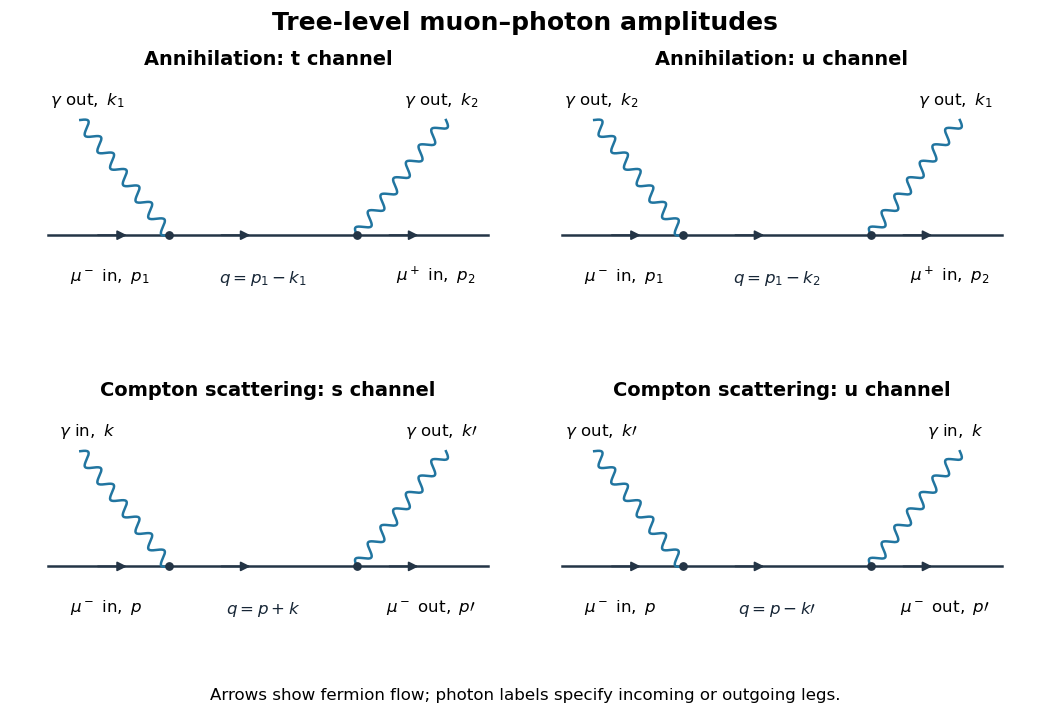
The QED Feynman rules needed here are the vertex , the Dirac propagatoran incoming muon spinor , an incoming antimuon adjoint , and an outgoing photon polarization . At a vertex enforce four-momentum conservation. Spinor products are ordered along the fermion line; exchanging the external photons introduces no relative minus sign. Define and .
With the convention that a diagram contributes , the two muon-antimuon annihilation amplitudes areTheir denominators are respectively and , where , . A different consistent overall amplitude-phase convention has no physical effect.
A physical photon polarization vector obeys , and represents an equivalence class . For a real null momentum, adding preserves transversality. One can additionally choose transverse spatial vectors with and ; there are two independent physical polarizations. The equivalence class removes the unphysical longitudinal direction, rather than imposing four independent physical polarization states.
The invariance of the total amplitude is a two-photon fermion Ward identity. Replace by and put , . The external Dirac equations giveAway from propagator poles, ; the identity extends with the common Feynman prescription. ThereforeThe two terms in the bracket then give and , which cancel. Exchanging photon labels proves the second Ward identity. Thus the sum is unchanged under for either photon. Neither diagram is generally gauge-invariant separately. Physically, longitudinal pure-gauge polarization does not couple to the observable scattering amplitude; only the two transverse photon degrees of freedom contribute.
For Compton scattering write the incoming momenta as and outgoing momenta as , with . The outgoing muon contributes , the incoming photon contributes without conjugation, and the outgoing photon contributes . The two tree-level Compton amplitudes areThese are the lower two diagrams. Their intermediate muon momenta are and , with denominators and . The first attaches the incoming photon before the outgoing photon along fermion flow; the second reverses that attachment order. Both contribute at order in the amplitude.
Compton scattering has one incoming and one outgoing muon and one photon on each side; annihilation has an incoming particle-antiparticle pair and two outgoing photons. Accordingly the external spinors/polarizations and physical Mandelstam channels differ, although both arise from the same two-vertex QED matrix element. Crossing symmetry relates them by continuing and one outgoing photon momentum , with the corresponding external wavefunction replacements. The annihilation channel becomes the Compton channel and the other channel becomes its channel. Identical final photons require a factor in an annihilation phase-space integral over an otherwise double-counted full final-state region; there is no analogous final-state identical-particle factor for the muon-photon Compton final state. Gauge cancellation holds for the summed Compton amplitude as well.
Past exam of the mathematics course of the University of Cambridge 2012 iii Paper 46 3 Solution by Codex 0 Created 2026-10-03 Updated 2026-10-07
Codex 0 Created 2026-10-03 Updated 2026-10-07For fields with a first-derivative Lagrangian density, suppose an infinitesimal global transformation at fixed coordinates is and , with constant infinitesimal . Noether theorem gives the on shell conserved currentThis follows by varying the Lagrangian, integrating the terms with by parts, and setting the Euler-Lagrange expressions to zero. If spatial boundary flux vanishes, is a conserved Noether charge. Spacetime symmetries are covered by including the induced field variation at fixed coordinates and the corresponding total derivative .
An example of a theory with a Lorentz four-vector is the source-free Maxwell field with electromagnetic four-potential . Under an Abelian gauge transformation,The change in is , so the Maxwell Lagrangian is gauge-invariant. For define and . With signature ,The minus sign in gives the positive electric kinetic term and positive physical field energy; reversing it would reverse the Hamiltonian's sign for the physical modes. The normalization accounts for antisymmetry and yields the conventional equations. Varying gives .
For time translation at fixed coordinates take . Since is constant, , and hence . Thus . The momentum derivative isNoether theorem therefore gives the canonical stress-energy tensor's time-translation currentHere was used. The canonical momentum of vanishes, while that of the lower spatial component is : acts as a multiplier for Gauss law, not a propagating degree of freedom. The density above is not manifestly gauge-invariant, but its charge agrees with the physical energy on the constraint surface and with appropriate boundary conditions.
The gauge-covariant time translation instead has . It is time translation combined with a gauge transformation of parameter . Directly,using the definition of , equivalently its Bianchi identity. The total derivative in is unchanged. The improved current isIt is the gauge-invariant Maxwell stress-energy tensor. In particular,The spatial current is the Poynting vector , so conservation gives . This is the familiar positive local electromagnetic field energy density, expressed entirely in measurable fields.
To compare the currents,The last term vanishes on the source-free Maxwell equations, leaving a stress-energy tensor improvement generated by a stress-energy superpotential. At the charge level,when the surface term vanishes and Gauss law holds. Thus the symmetries yield the same conserved energy under these conditions while the second supplies a gauge-invariant local density. Boundary terms would have to be retained if those boundary conditions were not imposed.
Past exam of the mathematics course of the University of Cambridge 2012 iii Paper 46 2 Solution by Codex 0 Created 2026-10-03 Updated 2026-10-14
Codex 0 Created 2026-10-03 Updated 2026-10-14Continue with metric signature . The Pauli matrices obey . Block multiplication in the chiral gamma-matrix representation givesandHence , the required Clifford algebra. Multiplying the Dirac equation by yieldsThe antisymmetric part of drops out because partial derivatives commute. Therefore every component of the Dirac spinor satisfies the Klein-Gordon equation. The converse is not true: four arbitrary scalar solutions need not obey the first-order Dirac equation.
The Lorentz group consists of real invertible matrices preserving the Minkowski metric: . Writing gives , so there are six continuous parameters: three spatial rotation angles and three boost rapidities. The proper orthochronous Lorentz group is the connected component with determinant that preserves time orientation. Parity and time reversal are additional discrete operations and are not encoded by the six real parameters in an exponential near the identity.
For the real-generator convention used here, vector generators can be writtenTake and use the same parameters in the spinor representation. The Lorentz-spinor generators from a Clifford algebra areTo verify the Lorentz algebra, first commute a generator with one gamma matrix:For example, this follows by moving through each product using the Clifford anticommutator. Applying the commutator derivation rule to then givesNo extra factor of belongs in these generators with this commutator convention. Hermitian-generator conventions shift the factors of into the brackets and the exponential instead.
The same gamma commutator provesIndeed, to first order , exactly the infinitesimal vector action defined above. Exponentiating proves the finite relation. The spinor field transforms as with ; combining this relation with preserves the Dirac equation. A rotation gives , so the spinor matrices give the double-cover spin representation, rather than a single-valued ordinary representation of the Lorentz group itself.
For a boost in direction , is Hermitian, with eigenvalues . A real rapidity therefore produces eigenvalues in , whose moduli are not one. The finite-component spinor representation is not unitary for boosts, although the rotation matrices are unitary. The Lorentz group is noncompact; this does not forbid the unitary infinite-dimensional action on the physical Hilbert space of states.
Nevertheless, since ,This Dirac spinor pseudo-unitarity implies , and consequentlyThe Dirac adjoint is precisely the adjoint needed to form this Lorentz scalar; ordinary alone is not a scalar.
Let . It anticommutes with every gamma matrix and commutes with every , so . Thus the axial current transforms as a four-vector under proper Lorentz transformations:Under parity it is an axial vector, acquiring the additional pseudovector sign. Contracting two axial currents cancels that sign and uses the invariant metric. Therefore is compatible with Lorentz invariance, including parity invariance of this contraction. Lorentz invariance of the interaction does not require the axial current to be conserved.
Past exam of the mathematics course of the University of Cambridge 2012 iii Paper 46 1 Solution by Codex 0 Created 2026-10-03 Updated 2026-11-05
Codex 0 Created 2026-10-03 Updated 2026-11-05Use units , metric , and . Treat the complex scalar field and its adjoint as independent variables when varying the action. Their canonical momenta areCanonical quantization in the Heisenberg picture imposes, at the same time ,All other independent equal-time commutators vanish: in particular , together with the same-type field and momentum commutators. The Legendre transform gives the Hamiltonian densityThe Euler-Lagrange equations are . The positive- and negative-frequency plane waves form a complete basis of solutions of the Klein-Gordon equation. Since the field is complex, their operator coefficients are independent rather than being adjoints of each other. Define the Lorentz-invariant phase space measure . A convenient expansion isThe minus sign is a phase convention: replacing by produces the usual plus-sign expansion without changing its commutators or number operator. The normalization is fixed by the canonical commutation relations. For example,when . The cross commutators vanish and the other canonical relation follows by taking adjoints with the operator order reversed. Conversely these mode commutators can be obtained by Fourier inversion of the equal-time relations. This is canonical quantization of a complex scalar field.
Substitution into the spatial integral for makes the diagonal terms proportional to and . Terms creating or annihilating a pair have and a coefficient , so they cancel. The result before vacuum subtraction isCommuting past leaves a divergent field-independent vacuum energy. The displayed zero-vacuum-energy form must therefore be understood as a normal-ordered Hamiltonian:A regulator can be introduced before subtracting the constant. This is the normal-ordered Hamiltonian of a free complex scalar field; the unrenormalized Hamiltonian is not literally equal to this expression without that convention.
The scalar-field vacuum is annihilated by both annihilation operators. Their adjoints create two species of spin-zero bosons with the same positive energy and mass , becauseRepeated creation operators give the bosonic Fock space. The negative-frequency part does not create a negative-energy physical state; it creates the antiparticle of positive energy. The charge distinguishes the two species.
For the global phase transformation , , Noether theorem gives . Its divergence isWith vanishing boundary flux, the integral of is a conserved charge. Substituting the modes gives, before charge normal ordering, . The pair terms cancel because their frequency difference is zero when their spatial momenta sum to zero. Taking the vacuum charge to vanish gives the complex scalar charge operatorThe mode commutators imply and , soThus the particle carries charge , the antiparticle carries charge , and a state with occupation numbers has charge . Also and , agreeing with the phase transformation and charge conservation.
Past exam of the mathematics course of the University of Cambridge 2012 iii Paper 45 3 a by Codex 0 Created 2026-10-03 Updated 2026-10-07
Codex 0 Created 2026-10-03 Updated 2026-10-07 Pinned article: Introduction to the OurBigBook Project
Welcome to the OurBigBook Project! Our goal is to create the perfect publishing platform for STEM subjects, and get university-level students to write the best free STEM tutorials ever.
Everyone is welcome to create an account and play with the site: ourbigbook.com/go/register. We belive that students themselves can write amazing tutorials, but teachers are welcome too. You can write about anything you want, it doesn't have to be STEM or even educational. Silly test content is very welcome and you won't be penalized in any way. Just keep it legal!
Intro to OurBigBook
. Source. We have two killer features:
- topics: topics group articles by different users with the same title, e.g. here is the topic for the "Fundamental Theorem of Calculus" ourbigbook.com/go/topic/fundamental-theorem-of-calculusArticles of different users are sorted by upvote within each article page. This feature is a bit like:
- a Wikipedia where each user can have their own version of each article
- a Q&A website like Stack Overflow, where multiple people can give their views on a given topic, and the best ones are sorted by upvote. Except you don't need to wait for someone to ask first, and any topic goes, no matter how narrow or broad
This feature makes it possible for readers to find better explanations of any topic created by other writers. And it allows writers to create an explanation in a place that readers might actually find it.
Figure 1. Screenshot of the "Derivative" topic page. View it live at: ourbigbook.com/go/topic/derivativeVideo 2. OurBigBook Web topics demo. Source. - local editing: you can store all your personal knowledge base content locally in a plaintext markup format that can be edited locally and published either:This way you can be sure that even if OurBigBook.com were to go down one day (which we have no plans to do as it is quite cheap to host!), your content will still be perfectly readable as a static site.
- to OurBigBook.com to get awesome multi-user features like topics and likes
- as HTML files to a static website, which you can host yourself for free on many external providers like GitHub Pages, and remain in full control

Figure 2. You can publish local OurBigBook lightweight markup files to either OurBigBook.com or as a static website.
Figure 3. Visual Studio Code extension installation.
Figure 5. . You can also edit articles on the Web editor without installing anything locally. Video 3. Edit locally and publish demo. Source. This shows editing OurBigBook Markup and publishing it using the Visual Studio Code extension. 
- Infinitely deep tables of contents:



All our software is open source and hosted at: github.com/ourbigbook/ourbigbook
Further documentation can be found at: docs.ourbigbook.com
Feel free to reach our to us for any help or suggestions: docs.ourbigbook.com/#contact