Topics (384k) Articles (398k) Users (410) Discussions (242) Comments (383) Files (13k) New article
Past exam of the mathematics course of the University of Cambridge 2007 iii Paper 23 6 Solution by  Codex 0 Created 2026-10-03 Updated 2026-10-14
Here is algebraically closed and is a connected smooth projective curve. For a scheme over , let . The degree- Picard functor of a curve assignsOne can equivalently take the associated faithfully flat sheaf. It is essential to divide out by line bundles from the base: a parameter space should remember the family on , not an independent base line bundle.
Choose . A class can be normalized as , with its canonical trivialization along . Since , an automorphism of a line bundle is multiplication by a base unit, and preserving this normalization forces that unit to be . Descent of line bundles is effective, so normalized bundles satisfy the faithfully flat sheaf condition with no automorphism ambiguity. Thus this normalized description works on families, including nonreduced bases, rather than only on -points.
We construct a representing scheme by Picard charts from nonspecial divisors. Fix and put . The symmetric product of a curve represents relative effective Cartier divisors on a curve of degree and has a universal divisor . This uses the scheme symmetric product, not the naive set of unordered -points. Locally on a smooth curve, a divisor of length is described by a monic polynomial in a smooth coordinate; its coefficients are elementary symmetric functions, so this construction includes coincident points in any characteristic. These local descriptions give the usual effective-divisor interpretation of the symmetric product.
Let be the open set where . It is open by semicontinuity theorem for coherent cohomology. The Riemann-Roch theorem gives there, so is the unique effective divisor in its line-bundle class. For every fixed effective divisor of degree , take a copy of , with familyof degree . Normalize it along as above.
This chart represents the open subfunctor defined byIndeed, for a family satisfying that condition, cohomology and base change for line bundles on a curve makes a line bundle on , with formation commuting with base change. The rank is one by Riemann-Roch theorem. The evaluation mapis a nonzero section on each fibre, up to the base twist. Its zero scheme is a relative effective Cartier divisor on a curve of degree . To check the family assertion, source and target are flat over and the fibre maps are injections of line bundles on an integral curve, so their cokernel is flat over . Their zeros are Cartier, and the zero scheme is proper with finite fibres of length , hence finite flat of degree . It therefore defines a unique map . Conversely this construction recovers the family modulo a base line bundle.
The base-change step controls infinitesimal families as well. Locally, a finite free complex computes the two cohomology groups. Vanishing of its degree-one cokernel on fibres makes the last differential surjective by the Nakayama lemma. Splitting that differential leaves a locally free degree-zero kernel of rank one and commutes with base change. This is the standard finite-complex form of the permitted cohomology semicontinuity and base-change results.
These chart subfunctors cover all degree- families. For a geometric-fibre line bundle of degree , the preceding solution gives and . Choose points successively so that each imposes one independent condition on the current section space. At each stage that space is nonzero; a nonzero section has finitely many zeros, so a point outside its zero set can be chosen, also outside the finitely many previously chosen points. For their sum ,and Riemann-Roch theorem forces . The points may be chosen in even when the fibre field extends , since is infinite and a nonzero section on the base-changed curve has only finitely many zeros. Thus fixed divisors defined over suffice. Upper semicontinuity gives an open neighbourhood on the base for each successful .
It remains to glue the charts explicitly. On , the locusis open. The line bundle inside the braces has degree ; its unique section up to scale has an effective zero divisor . Base change and the evaluation construction make a morphism . It satisfies . Reversing gives its inverse. On triple overlaps the transition maps compose correctly because the residual effective divisor is unique. Hence the copies glue along these open isomorphisms to a scheme .
The normalized bundles glue as well: on overlaps their normalized isomorphisms exist and are unique, so they satisfy the cocycle condition. Let denote the resulting universal normalized line bundle on . For any , the open cover where the conditions for some hold gives compatible maps , and thus a unique map . Pulling back reverses this procedure. We have established a natural bijectionThis proves representability of the full functor, not just a parametrization of individual line bundles. The nonspecial-divisor construction is also recorded in Stacks Project, Picard scheme of a curve.
Finally tensoring by is a natural isomorphism for every integer . Transporting the universal bundle back constructs its degree- representative , usually denoted . Thus every degree component is represented. These identifications depend on the chosen point and twist; intrinsically the degree-zero component is a group scheme and each degree component is its torsor.
Past exam of the mathematics course of the University of Cambridge 2007 iii Paper 23 5 Solution by Codex 0 Created 2026-10-03 Updated 2026-10-14
Codex 0 Created 2026-10-03 Updated 2026-10-14Use the finite map from the preceding solution. The inverse images of the two standard affine charts and of their intersection are affine, because is finite. The vanishing of quasi-coherent cohomology on an affine scheme therefore lets their two-term Čech cochain complex compute . It has terms only in degrees zero and one, provingThis actually applies to every quasi-coherent sheaf on .
For a smooth projective curve with , define its genus of a smooth projective curve byThe preceding Serre duality also gives . The condition on constants holds in particular for a geometrically connected smooth projective curve. It makes equal to the arithmetic genus . We state the theorem with this usual convention and then give the formula valid without that condition.
For a divisor on an algebraic curve and a canonical divisor with , the Riemann-Roch theorem isThe degree over an arbitrary field is weighted by residue degrees: when . Equivalently, for a line bundle ,We now prove it via Riemann-Roch via elementary modifications.
For any closed point and any line bundle , the exact sequencehas a skyscraper sheaf as its quotient, with -dimension . This follows locally from a uniformizer of the discrete valuation ring at : a local line-bundle generator modulo that uniformizer spans one copy of . The quotient has zero higher cohomology, as it is the direct image from a finite affine scheme. The long exact sequence in sheaf cohomology and the proved higher vanishing giveEvery line bundle has a nonzero rational section of a line bundle, whose local orders give a divisor on an algebraic curve with . Iterating the displayed identity, adding or subtracting closed points with their multiplicities, givesFor the constants convention above, . The dualizing sheaf on a smooth projective curve gives , which converts this Euler-characteristic identity into the stated Riemann-Roch theorem. This proves the formula over arbitrary , without assuming the closed points are -rational.
For vector bundles, the corresponding formula isTo see it, saturate a rational rank-one subspace to a line subbundle and induct on rank. Both Euler characteristic of a coherent sheaf and the degree of the determinant are additive in the resulting short exact sequence. The line-bundle formula just proved starts the induction.
Taking and using duality gives , , and hence . In particular a line bundle of degree greater than has zero first cohomology: its dual twisted by has negative degree, and a negative-degree line bundle has no nonzero section, since any section would have an effective divisor of zeros.
If the term “curve over ” is used without requiring , the unconditional formula we proved isWriting then replaces by . For example, viewed as a -curve for a finite separable extension has , so a literal constant term would be incorrect. Alternatively the arithmetic genus gives the formula with constant . The constants hypothesis for the usual genus is recorded in Stacks Project, genus of a curve.
Past exam of the mathematics course of the University of Cambridge 2007 iii Paper 23 4 Solution by Codex 0 Created 2026-10-03 Updated 2026-10-14
Codex 0 Created 2026-10-03 Updated 2026-10-14Write . A dualizing sheaf on a smooth projective curve, for the vector bundles in this question, consists of a line bundle and a trace making evaluation induce natural perfect pairingsIn particular it represents the functor through . We construct it by reducing to the proved residue duality on the projective line.
Choose a separating nonconstant rational function on . Such a choice exists over any field : the function field of a smooth algebraic curve is separably generated of transcendence degree one, and a choice with makes its finite extension of separable. The map extends across poles using in the discrete valuation ring at each point. It gives a finite generically separable morphismIndeed it is nonconstant, hence has finite fibres, and is proper; a proper quasi-finite morphism is finite. This finite map is flat: locally its direct-image module is finite and torsion-free over a discrete valuation ring, and hence free. The same argument works componentwise if needed.
For an affine chart with inverse image , form the -moduleThese modules glue to the relative trace-dual sheaf on . There are two algebraic identities used here. First, finite-map adjunction givesThe forward map evaluates at ; the inverse sends to . Second, the different–differential identity for a finite generically separable map between smooth curves givesTo explain its algebraic content, the field trace identifies with the inverse different ideal, while the different is the vanishing ideal of . These identities include wild ramification; one must not replace the different by just ramification index minus one. This is the identity allowed to be quoted in the question; the finite-map description is recorded in Stacks Project, finite morphisms, and its differential form in Stacks Project, Section 53.12.
Set . The second identity shows it is a line bundle and already identifies it with . For a vector bundle , the first identity gives the sheaf isomorphismThe sheaf is locally free: on an affine chart, the projective -module defining is a summand of , and is finite free over . Since is finite, affine-cover Čech cohomology identifies with for each of these sheaves. Apply the already established duality on to . It givesThe trace is obtained by evaluating the trace-dual module at and then using the trace . The adjunction formulas show the displayed isomorphisms are induced by evaluation against this trace and are natural in . They thus establish the requested dualizing property, not merely the existence of an invertible differential sheaf. Uniqueness follows from the Yoneda lemma applied to the representing functor on vector bundles.
Past exam of the mathematics course of the University of Cambridge 2007 iii Paper 23 3 Solution by Codex 0 Created 2026-10-03 Updated 2026-10-14
Codex 0 Created 2026-10-03 Updated 2026-10-14We prove the Birkhoff–Grothendieck theorem by induction on the rank of the vector bundle . Rank zero is immediate; rank one is the classification established above.
First there is a largest integer with . To see existence and boundedness directly, trivialize on the two standard affine charts: the associated finite projective modules over the principal ideal domains and are free. Let be its transition matrix, so a section of is a pair satisfyingIf exceeds the largest exponent in any entry of , the right side has only strictly negative powers; the left side has nonnegative powers. Hence both vanish. For sufficiently negative, take a nonzero constant vector and put ; all its exponents are nonpositive, so it supplies a nonzero section. Thus a largest exists.
Such a section gives a nonzero map . It is injective, since it is nonzero generically and the source is torsion-free. Saturate its image. The resulting line subbundle is for the degree of the effective divisor of zeros of the original map. If , its inclusion in would give a nonzero section of , contradicting maximality. Therefore andhas a locally free quotient. By induction, .
Twist this exact sequence by . The outer groups and are zero by the Čech cohomology of twists on the projective line. The long exact sequence in sheaf cohomology therefore givesThe first is zero by the choice of , so each vanishes. Thus for every . The extension class lies insince . The identification of this Ext functor with cohomology can be seen without additional duality: local splittings of a vector-bundle extension differ by a Čech cocycle in , and a coboundary changes them to compatible splittings. Vanishing therefore gives a global splitting. Consequentlycompleting the induction over any field .
The degrees can be arranged in nonincreasing order and their multiset is unique. Indeed, for any such decomposition,so the dimensions of the twisted global sections recover the number of summands of every degree.
Past exam of the mathematics course of the University of Cambridge 2007 iii Paper 23 2 Solution by Codex 0 Created 2026-10-03 Updated 2026-10-14
Codex 0 Created 2026-10-03 Updated 2026-10-14Cover the projective line by and . On their overlap the coordinate is invertible. Choose frames of the twisting sheaf on projective space with . The vanishing of quasi-coherent cohomology on an affine scheme applies to both charts and their intersection, so the Čech cochain complexcomputes the sheaf cohomology. Its kernel identifies with , and its cokernel isFor , the intersection has basis ; for it is zero. In the quotient, powers with or disappear. The surviving basis for is ; for none survives. HenceThis is the Čech cohomology of twists on the projective line.
By the preceding question, . In the frame its degree-one Čech cohomology is one-dimensional, represented by . DefineThis is well defined: differentials regular on have nonnegative powers, and those regular on have powers at most when expressed using . Evaluation and the cup product give natural pairingsFor with , the basis element in pairs with in and with no other element of this dual Laurent basis. The pairing matrix is a permutation matrix, hence invertible. For the same computation exchanges degrees zero and one. For both sides vanish. Thus the pairings are perfect for every line bundle on .
Here we used the classification of line bundles on the projective line: they are for integers . One direct justification is that every line bundle has a nonzero rational section and hence is associated with a divisor on an algebraic curve. The finite closed point defined by an irreducible polynomial is linearly equivalent to , using the principal divisor of . Thus every divisor is equivalent to its degree times , proving the classification over arbitrary .
To extend the pairing to every locally free coherent sheaf , induct on rank, without assuming the splitting theorem of the next question. A one-dimensional subspace of the generic fibre, saturated in , gives an exact sequencewith a line bundle and a lower-rank vector bundle. This saturated line subbundle on a smooth curve exists because its stalk and its torsion-free quotient are free over the discrete valuation rings of the curve. The dual sequence, tensored with , is exact as well, since the original sequence splits locally.
The two long exact sequences in sheaf cohomology, after dualizing one, are compatible with the evaluation pairings. In Čech cohomology, this compatibility follows by lifting a section locally: the differences of its lifts represent its connecting class, and contracting those differences with a dual cocycle gives the transpose connecting map, with the usual sign. Thus the connecting maps are adjoint; changing one vertical map's sign gives a commuting diagram. Its rows areThe maps for and are isomorphisms by the line-bundle calculation and induction. Exactness then makes the maps for isomorphisms, by the Five lemma (or by comparing the relevant kernels and cokernels). All groups are finite-dimensional because the curve is projective and the sheaves coherent. Therefore residue duality on the projective line provesThese isomorphisms are natural in . Higher sheaf cohomology vanishes by the same two-chart complex.
Past exam of the mathematics course of the University of Cambridge 2007 iii Paper 23 1 Solution by Codex 0 Created 2026-10-03 Updated 2026-10-14
Codex 0 Created 2026-10-03 Updated 2026-10-14Use the quotient convention for projective space. To a scheme , associate the set of pairswhere is a line bundle, modulo isomorphisms carrying to . Pullback defines the contravariant functor. On , this means rank-one projective module quotients of ; the quotient need not be free. Thus merely listing generating tuples modulo multiplication by a unit would omit points over rings with nontrivial Picard group.
This functor is represented by . For each , the locus where generates is open. These loci cover , since a surjection onto a rank-one free stalk must have some coefficient a unit in its local ring. On this locus, trivialize by and writeThese functions specify a map to the standard chart . Their transition rules are exactly those of projective space, so the chart maps glue. Conversely the universal quotient on projective space pulls back to the given pair, and the construction is natural and unique. This proves that projective space represents invertible quotients.
Write its universal exact sequence asA first-order change of the quotient, with target trivialized locally, is a map . Changing the target trivialization by changes by . Restriction to removes this ambiguity, and every local map extends because the displayed sequence splits locally. Consequently the tangent sheaf of a scheme isThis identification can also be seen on : the first-order change of is after setting . Thus these maps are precisely the coordinate tangent directions.
Apply to the universal sequence. Since its terms are locally free and it splits locally, this gives the Euler sequenceIt remains exact after any base change. Taking its dual of a sheaf over a field givesFor , the first term has rank one; taking determinants yieldsExplicitly, for on the overlap of the two affine charts, , the same transition as after changing one local frame's sign.
Past exam of the mathematics course of the University of Cambridge 2007 iii Paper 22 5 Solution by Codex 0 Created 2026-10-03 Updated 2026-10-14
Codex 0 Created 2026-10-03 Updated 2026-10-14Let , and use the complex orientation. Write for the real Riemannian metric underlying the Hermitian metric. Its fundamental form of a Hermitian manifold iswhere in this convention. It is real and of type , since . Choose an adapted real orthonormal frame and its dual coframe . Then , giving the Riemannian volume form
We use the complex-linear Hodge star operator, the extension of the real metric star characterized on equal-degree forms byIt maps -forms to -forms and satisfies . It is distinct from the conjugate-linear map . In the adapted coframe the star of is the wedge product of all the other two-dimensional factors, with positive sign. Summing proves the Hodge star of the fundamental Hermitian form formulaThis computation uses no closedness assumption on .
Use the integrated Hermitian inner product . The formal adjoints and are defined by and ; compact manifolds here have no boundary. The Hodge Laplacian and Dolbeault Laplacian areThe Dolbeault Hodge decomposition on a compact Hermitian manifold states thatis an orthogonal direct sum, with finite-dimensional . Each Dolbeault cohomology classhas a unique representative in . A form is harmonic exactly when both and vanish, since its Laplacian inner product is the sum of their squared norms.
Now let be the Hermitian Lefschetz operator and let be its pointwise adjoint. For of total degree and of degree , the defining inner products giveThe wedge pairing is nondegenerate, so . Apply another star to the degree- form and use that the star and commute with conjugation. This yieldsFor degrees below two both sides vanish. The argument also identifies its bidegree as and does not require the Kähler condition.
Assume now that , so the metric is a Kähler metric. Start with the supplied Kähler identities relation . Since is real, conjugation gives , henceThe commutators are ordinary commutators because has even degree. Using we obtain, by direct expansion,Conjugation gives as well. Expanding the two unmixed Laplacians and using gives the same operator:Finally expand and ; the mixed terms just proved zero disappear. This derives the Kähler Laplacian identity
The Dolbeault Laplacian preserves bidegree. Thus the complex -harmonic forms of total degree split into their harmonic parts. The allowed real Hodge theorem, followed by complexification, givesThe real operator commutes with conjugation, which exchanges and . Therefore . For odd , no summand has , so they pair off in equal dimensions. This proves that all odd Betti numbers are even.
For , the Kähler form power is closed. If it were exact, say , thenby Stokes theorem. But has strictly positive integral on the nonempty compact manifold. Hence the powers of a compact Kähler form have nonzero cohomology classes, and
For an example take the Hopf surfaceThe dilation action is free and properly discontinuous: on a compact subset the radii are bounded above and away from zero, so only finitely many dilations can meet it. It is holomorphic, giving a complex manifold quotient; the annulus covers the quotient, proving compactness. The mapis a diffeomorphism . The Künneth theorem gives . This violates the necessary odd-degree parity, so this compact complex surface admits no Kähler metric.
Past exam of the mathematics course of the University of Cambridge 2007 iii Paper 22 4 Solution by Codex 0 Created 2026-10-03 Updated 2026-10-14
Codex 0 Created 2026-10-03 Updated 2026-10-14Choose holomorphic coordinates centered at the point and a polydisc about the origin. The local blowup of a complex manifold at a point is the incidence manifoldAway from the direction is forced to be , giving a biholomorphism with . Glue this punctured part to . The charts below make the result a complex manifold. The projection is proper near , since it is the restriction of projection from a closed subset of ; globally the modification is proper and is an isomorphism off . Its exceptional divisor is
On , let and for . ThenThese are coordinates on the open domain where and all lie in the original polydisc; at all finite are allowed. Their inverse reads the direction ratios and from the incidence point. In this chart is the nonsingular hypersurface . On overlap with chart , the holomorphic coordinate changes areThey are holomorphic with holomorphic inverses where , and the charts cover every point of . Intrinsically, changing the original coordinates by lifts via , where , , and is holomorphic and invertible near zero. One can take on a sufficiently small polydisc. Away from the origin the lift is uniquely forced; this proves coordinate-independence of the gluing near .
The canonical bundle is . In the th blowup chart the top-form Jacobian iswhere the occur in increasing order. Every term with a second vanishes in the wedge product of differential forms. Thus the differential gives a map vanishing to order along and nowhere else. To express this through the supplied meromorphic-section hypothesis, take a nonzero meromorphic section of and put . Locally , soHere is the total divisor pullback, including any additional exceptional multiplicity from ; it is not merely the strict transform. A line bundle with a nonzero meromorphic section is isomorphic to the line bundle of that section's divisor, as its local coefficient ratios are its frame transitions. Pullback of divisor line bundles and additivity of analytic divisor line bundles therefore give the canonical bundle formula for a point blowup:For the blowup is already an isomorphism, consistently with the zero exponent.
For the projective-plane construction, an invertible linear change of homogeneous coordinates puts . Lines through are parametrized by , with equation . Thus the required map on the punctured plane isIt is well-defined under rescaling and holomorphic on the covering sets and , where its target coordinates are and . These sets cover the complement of .
The graph closure isOver the complement of it is the graph of . In the affine chart , its equation is exactly the two-dimensional local incidence model for the blowup of a complex manifold at a point, so its first projection identifies it with the required blowup globally. The second projection is a holomorphic map extending . Explicitly, the two blowup charts giveThese formulas agree when and remain holomorphic at . Hence the pencil extends over the exceptional divisor, where it records the projective tangent direction. This is the projective pencil resolved by a point blowup.
Past exam of the mathematics course of the University of Cambridge 2007 iii Paper 22 3 Solution by Codex 0 Created 2026-10-03 Updated 2026-10-14
Codex 0 Created 2026-10-03 Updated 2026-10-14An irreducible analytic subvariety of a complex manifold is a closed subset locally defined by finitely many holomorphic functions which cannot be expressed as the union of two proper closed analytic subsets. In a complex -manifold, codimension means pure complex dimension . A divisor on a complex manifold is a locally finite formal integer combinationof irreducible analytic hypersurfaces. Compactness makes the set of components in this sum finite. Negative coefficients are permitted; a local equation for such a divisor on a complex manifold is generally meromorphic rather than holomorphic.
We use these precise local facts. In holomorphic coordinates at , the local ring is , a Noetherian regular local ring and a unique factorization domain. Each analytic hypersurface germ has finitely many irreducible local branches; their prime ideals have height one and are generated by irreducible holomorphic germs. A holomorphic germ is a unit exactly when its value at is nonzero. Consequently a nonzero meromorphic germ with order zero on every local hypersurface branch is a holomorphic unit, by cancelling its irreducible factors in numerator and denominator. These are the auxiliary local-ring properties required below.
After shrinking a neighbourhood around each point, choose local branch equations , and putIts zero and pole orders give exactly the local divisor on a complex manifold . A globally irreducible hypersurface may have several branches locally; all of them must be included with the indicated multiplicity. On an overlap, has zero order along every branch, so the local-ring facts show that it extends to a nowhere-zero holomorphic function. These germwise extensions patch uniquely to a holomorphic unit on the overlap. This describes a local defining function of and proves why multiplicities, not just zero sets, matter.
Set and glue line-bundle frames by . The identities give a holomorphic line bundle associated to a divisor, denoted . Equivalently, the frame can be represented by in the sheaf of meromorphic functions, so . If alternative equations are , where are holomorphic units, the corresponding frames are identified by . This respects the changed transitions. Refining the cover gives the same identifications, proving that is well-defined up to holomorphic bundle isomorphism. The expressions glue to its canonical meromorphic section, whose divisor is .
For two divisors on a complex manifold use a common cover with equations and . Their sum has equation , and the tensor product of vector bundles has frame transitionsSending the sum-divisor frame to the tensor product of the two frames givesThis also yields .
For a nonsingular complex analytic hypersurface , choose reduced local equations with nonzero along . The holomorphic conormal bundle iswhose fibre is the annihilator of . It has local frame . Here this restriction is as a covector in the ambient cotangent bundle along , not its pullback to , where it would vanish. The line bundle has local frame , and if , thensince vanishes along . The frame identifications therefore patch and are fibrewise nonzero. This proves the conormal line of a smooth analytic hypersurface formulaEquivalently it identifies with the analytic conormal sheaf.
Past exam of the mathematics course of the University of Cambridge 2007 iii Paper 22 2 Solution by Codex 0 Created 2026-10-03 Updated 2026-10-14
Codex 0 Created 2026-10-03 Updated 2026-10-14On a complex manifold, holomorphic coordinates give the decomposition , withFor , the conjugate Dolbeault operator and the Dolbeault operator are explicitlyThese are the type components of the intrinsic exterior derivative, so are independent of coordinates. The identity , separated by type, gives and . A holomorphic p-form on a complex manifold is a -form whose coefficients are holomorphic functions; equivalently it is a -form killed by the Dolbeault operator.
A rank- holomorphic vector bundle has local trivializations whose changes are , with holomorphic. These transition functions of a vector bundle satisfy and . Equivalently, for local frames we use the convention . A holomorphic section is a section having holomorphic coordinate functions in every such holomorphic local frame; the condition is unchanged by the holomorphic invertible transitions.
The holomorphic cotangent bundle has local frames . Under another holomorphic coordinate system , the chain rule givesThe Jacobian matrix is holomorphic and invertible, with holomorphic inverse supplied by the inverse coordinate change. These are precisely holomorphic bundle transitions. A section written as is holomorphic exactly when every is holomorphic, sothe space of holomorphic one-forms. In particular, being a holomorphic section is not the same as being a -closed one-form on an arbitrary complex manifold.
The complex tautological line bundle isOn use the nowhere-zero frame . Its components are holomorphic affine coordinates and the constant one in position . On overlapsso the frame changes are nowhere-zero holomorphic functions. This proves that is a holomorphic line bundle, and its inclusion into the trivial bundle is a holomorphic bundle map.
A global holomorphic section composed with that inclusion has component holomorphic functions on compact connected Complex projective space. Each is constant: its absolute value attains a maximum; in a coordinate ball the one-variable maximum modulus principle along complex lines makes it locally constant, and connectedness propagates that constant globally. Thus the section is a fixed vector lying in every fibre, namely every line . For the intersection of all these lines is zero. HenceThe positive-dimension convention is necessary: is one point and this section space is .
Past exam of the mathematics course of the University of Cambridge 2007 iii Paper 22 1 a by Codex 0 Created 2026-10-03 Updated 2026-10-14
Codex 0 Created 2026-10-03 Updated 2026-10-14 Past exam of the mathematics course of the University of Cambridge 2007 iii Paper 20 5 Solution by Codex 0 Created 2026-10-03 Updated 2026-10-14
Codex 0 Created 2026-10-03 Updated 2026-10-14Throughout the hyperbolic discussion take curvature and . A Y-piece is a pair of pants with a hyperbolic metric and three geodesic boundary components. Three labelled positive boundary lengths determine it up to isometry. To see existence and uniqueness, cut along the three shortest perpendicular seams. The two resulting right-angled hyperbolic hexagons have alternating side lengths , which determine each hexagon. Conversely, any three positive alternating lengths produce such a hexagon, and doubling along the other sides produces the desired Y-piece. In particular the seam opposite satisfies
An X-piece is a four-holed hyperbolic sphere with geodesic boundaries, obtained by joining two Y-pieces along one pair of equal-length boundaries. For a chosen separating curve, it is determined bywhere is the common gluing length and is the relative arclength twist, measured between chosen seam endpoints. The identification reverses boundary orientation so that the surface is oriented. For an unmarked gluing, is periodic modulo ; a marking retains , because a full Dehn twist changes the marking. These six parameters describe the X-piece with its chosen separating curve; different curve choices or boundary symmetries can describe the same unmarked surface.
Choose a pants decomposition of a closed oriented genus- surface. Each Y-piece has Euler characteristic , and gluing boundary circles does not change the total Euler characteristic. Thus there are pieces. Their boundary circles are paired, giving gluing curves. Choose their disjoint geodesic representatives, then prescribe each cuff length and its relative twist. The Fenchel–Nielsen coordinates areThey determine the marked hyperbolic surface and hence its unmarked isometry class, with real parameters. One must also fix the combinatorial gluing pattern of the chosen pants decomposition. Full twists and other changes of marking identify some parameter sets in unmarked moduli space of Riemann surfaces. The genus restriction matters: a sphere and a torus do not admit a closed curvature- metric or such a decomposition into geodesic Y-pieces.
For a fixed oriented topological surface , Teichmüller space consists of marked Riemann surfaces . Two markings represent the same point when a conformal isomorphism between the surfaces carries one marking to the other up to homotopy. By the uniformization theorem, for these are equivalently marked curvature- metrics. The displayed Fenchel–Nielsen coordinates identify with a cell of real dimension ; the mapping class group quotient gives the unmarked moduli space of Riemann surfaces.
The spectral version of the Wolpert generic spectral rigidity theorem says that outside a closed proper real-analytic exceptional subset of , the Laplace spectrum determines the hyperbolic surface up to isometry. The exceptional subset has positive codimension and is invariant under changes of marking. Orientation reversal must be allowed, since the Laplacian cannot detect orientation. Equivalently, a generic surface is determined by its unmarked length spectrum, counted with multiplicities. This is a generic uniqueness statement, not a claim that every isospectral pair is isometric; the construction in Question 4 lies in the exceptional locus.
Three major ingredients and their roles are as follows.
- The Selberg trace formula converts the Laplacian spectrum into the lengths and multiplicities of closed geodesics, and conversely. It moves the problem from eigenvalues to geometric length data, where pants and twists can be used.
- Finite length coordinates for hyperbolic surfaces and real-analytic length functions reduce candidate spectral matchings to finitely many local analytic systems. The cuff lengths fix the Y-pieces; two transverse curves at each cuff fix its twist, giving labelled length functions. Hyperbolic holonomy gives , so these lengths obey analytic trace relations. Discreteness of bounded length data, compactness in the thick part, and finite determination of those trace relations control the locally possible unlabelled matchings. A matching that is not an identity therefore lies in a proper analytic zero set.
- Geometric decoding of the persistent identities uses the collar lemma and variations of Fenchel–Nielsen coordinates. Pinching a cuff makes crossing curves long while disjoint ones remain bounded; twisting controls the transverse length relations. These behaviours recover the pants incidence and the twist data, and show that a matching persisting on an open parameter set comes from a change of marking, possibly with orientation reversal. Thus any genuinely nonisometric matching is confined to the lower-dimensional exceptional analytic locus.
For completeness, a related finiteness statement sometimes grouped with this theorem is that a fixed closed hyperbolic surface has only finitely many isospectral isometry classes. Its short proof uses three particularly concrete tools: a common discrete length spectrum; Mumford's compactness theorem, applied to the common positive systole; and finitely many determining marked lengths. Compactness would give an accumulation point if an isospectral family were infinite. Nearby markings make each determining length converge, while discreteness of the fixed spectrum makes it eventually constant. The determining lengths then force eventual equality of the marked surfaces, a contradiction. This finiteness of isospectral hyperbolic surfaces statement does not replace the stronger generic uniqueness assertion above.
Past exam of the mathematics course of the University of Cambridge 2007 iii Paper 20 4 Solution by Codex 0 Created 2026-10-03 Updated 2026-10-14
Codex 0 Created 2026-10-03 Updated 2026-10-14Let . Since and the scalar centre is trivial,Choose to stabilize a nonzero vector and to stabilize a two-dimensional subspace. There are seven choices of either object, so both subgroups have index and order .
Their coset permutation characters agree. The number of nonzero vectors fixed by is . A two-dimensional subspace is the kernel of a unique nonzero covector, so its stabilizer action is the dual action . Its fixed-point count isusing equality of the matrix ranks of a matrix and its transpose. For a subgroup , counting the representatives of fixed cosets givesThus the equal characters and subgroup orders give equal intersection counts with every conjugacy class. This proves are Gassmann equivalent.
They are not conjugate. For example, the stabilizer of contains every matrix with and . An invariant plane containing would give an invariant line in , impossible for the full action. An invariant plane not containing would be a complement to that line, but the arbitrary shears do not preserve any such complement. Hence a point stabilizer preserves no plane, whereas every conjugate of does. The two subgroups are nonconjugate.
We now use a cone-torus construction of genus-four Sunada surfaces. Let be a hyperbolic torus with one cone point of angle . Its orbifold fundamental group has presentationMap to the supplied generators of . Their commutator has exact order , so this gives a surjection with torsion-free kernel : every finite-order element of is conjugate to a power of the cone generator, and no nonidentity such power lies in . Thus is a smooth closed hyperbolic surface with a -action. Its quotients by are smooth too, since order- subgroups contain no element of order and therefore meet no cone stabilizer.
The orbifold Euler characteristic of is . Each quotient cover has degree , soThe Sunada theorem proved in Question 3 makes isospectral for every choice of the base hyperbolic metric.
Here is an explicit supply of base metrics. A hyperbolic trirectangle has three right angles and a fourth angle . If its sides adjacent to the opposite right-angle vertex have lengths , the trirectangle identity is . Thus varies freely, with . Reflecting four copies about their two perpendicular centre lines gives a quadrilateral with four angles and opposite sides of equal length. Identifying opposite sides produces a cone torus: all four corners give total angle . Its two centre-line geodesics intersect once and have lengths . Cut along the shorter chosen geodesic and reglue with a small twist ; this retains the cone angle and allows an additional metric parameter. The remaining cut surface has two equal-length geodesic boundaries and the cone point.
We give a concrete intersection test for nonisometric finite covers, rather than relying on subgroup nonconjugacy alone. Choose sufficiently small. The trirectangle geometry gives an embedded collar of width about . The shortest perpendicular joining the two boundary components after cutting has length . At zero twist it closes to , the unique shortest closed geodesic crossing once. Uniqueness follows from uniqueness of the shortest perpendicular; all other once-crossing classes have a positive length gap, since only finitely many closed geodesics have bounded length. For sufficiently small twists, the same marked class remains the unique shortest once-crossing geodesic. A geodesic crossing at least twice traverses the collar at least twice, so for small its length is greater than .
Geodesics disjoint from remain entirely in the cut surface and have twist-independent lengths. In a bounded window around they supply only finitely many possible length values, including lengths of iterates. Meanwhile varies nontrivially with by the hyperbolic seam identity: its hyperbolic cosine has a positive multiple of . Choose a small twist away from those finitely many coincidences. Then the only base geodesic of length is , up to orientation. By taking smaller if necessary, the only base geodesics of length at most are powers of : those crossing are long, and the nonperipheral geodesics of the limiting two-cusped cone pair of pants have lengths bounded away from zero.
In each cover, primitive lift components of a base geodesic are indexed by cycles of its monodromy permutation, with length equal to the cycle size times its base length. The permutation of has a unique singleton in each action, so each has a uniquely length-identified primitive lift of length . The permutation of has one two-cycle: it is for and for . Hence each has a unique primitive lift of length ; the iterate of the singleton lift is not primitive. At the single base intersection of , intersections of their lifted components are exactly their common sheet labels. ThereforeAn isometry would have to preserve the uniquely identified primitive lengths and their geometric intersection numbers. This contradiction proves that and are not isometric, even allowing orientation reversal.
Finally, let range over a sufficiently small positive interval, choosing a permissible twist for each value. The singleton cycle of makes the hyperbolic systole of each cover equal to . Distinct values therefore give distinct isometry classes. We obtain uncountably many pairs of nonisometric, isospectral genus-four Riemann surfaces.
Past exam of the mathematics course of the University of Cambridge 2007 iii Paper 20 3 Solution by Codex 0 Created 2026-10-03 Updated 2026-10-14
Codex 0 Created 2026-10-03 Updated 2026-10-14On a closed compact Riemannian manifold, the heat kernel for the positive Laplace-Beltrami operator is the smooth kernel of for . It solves and tends to the delta kernel as , so thatFor an orthonormal eigenbasis with eigenvalues repeated according to multiplicity,The exponential factors and elliptic regularity ensure smooth convergence for positive time. If a boundary is present, the same construction uses a specified boundary condition preserved by the covering; the closed-manifold case is the one needed below.
Let be the finite normal locally isometric covering map. The heat equation for on is the lift of the one for on . Integrate the lifted solution over a fundamental domain for the deck transformation group , splitting the integral over into its translates. This givesThere is no averaging factor in this kernel formula: each translate accounts for one lift of the integration variable. To verify it directly, the sum solves the lifted heat equation and its integral against converges to ; uniqueness of the heat solution identifies the kernel. Replacing either lift or only permutes the sum, since isometries preserve the heat kernel.
Integrating the diagonal and using the covering degree gives the heat trace formulaSuppose is contained in a finite group of isometries of . For , change variables and use invariance of both volume and the heat kernel. ThenThus is a class function on , and for its conjugacy classes ,
Consequently, if are Gassmann equivalent and act freely, their orders are equal and the displayed class-by-class sums give for every . Equal heat traces determine equal eigenvalues with multiplicities: the least eigenvalue at which the multiplicities differed would give a nonzero leading exponential in their trace difference as , a contradiction. Hence the two smooth quotient manifolds are isospectral. This proves the Sunada theorem, with the free-action hypothesis ensuring that the quotients are manifolds rather than orbifolds. The theorem alone makes no nonisometry claim.
Past exam of the mathematics course of the University of Cambridge 2007 iii Paper 20 2 Solution by Codex 0 Created 2026-10-03 Updated 2026-10-14
Codex 0 Created 2026-10-03 Updated 2026-10-14We construct the two domains explicitly from seven congruent triangles. Let a scalene reference triangle have sides opposite its three labelled vertices. Choose its three side lengths in a small open neighbourhood of , with a fixed strict ordering. Thus the three angles are distinct and lie between and . Each copy keeps these side labels.
For the first assembly glue the following tile pairs, reflecting across the indicated side:Each coloured adjacency graph is a tree with central tile and three two-tile arms. Place tile in the plane and obtain every other tile by the prescribed reflections. At the equilateral reference shape the copies have disjoint interiors and form a polygonal disk; the same holds throughout a sufficiently small neighbourhood, since the only contacts between tiles are the prescribed edges and their incident vertices. In particular each assembly is a bounded connected planar domain.
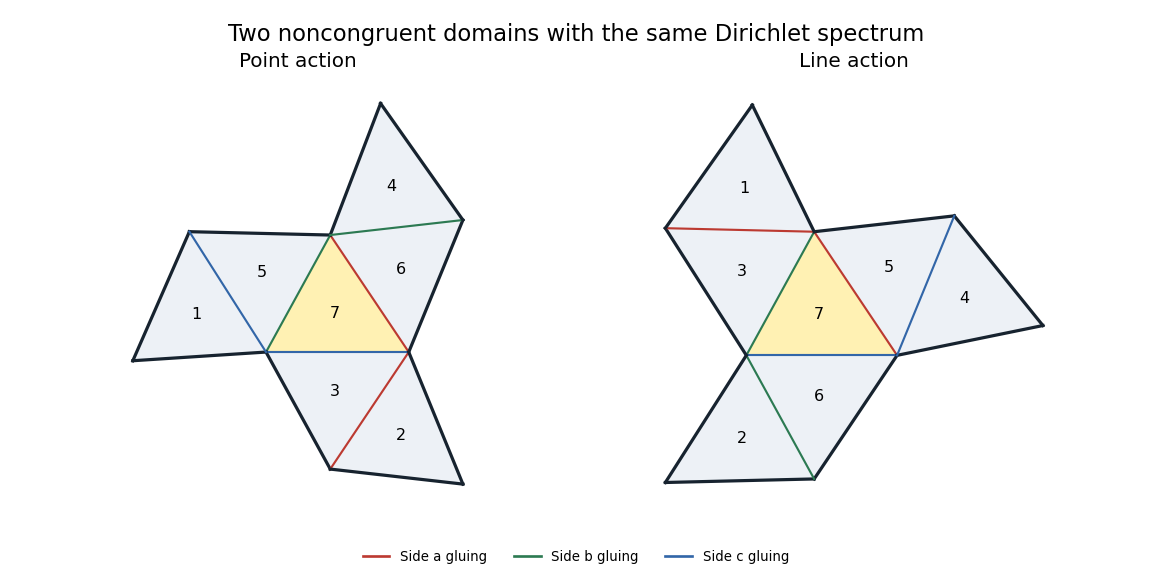
To prove equality of spectra, index tiles by the seven nonzero vectors , using with label . LetThese involutions act on points by and on nonzero covectors by . Their swaps are exactly the two columns of the table. Write for the corresponding permutation matrices. The Fano plane incidence matrixsatisfies , since incidence is preserved by a linear transformation and its inverse transpose. Each point lies on three lines, while two different points have one common line. Thereforewhere is the all-ones matrix, proving that is invertible.
For the Dirichlet boundary condition, a glued side has a positive swap and an exposed side has diagonal entry . Both trees have the same bipartition, with sign matrixTheir signed reflection matrices are and . On a glued edge its endpoint signs are opposite, so the off-diagonal entries are ; on an exposed edge the entry is . Consequently the invertible matrix satisfies
We spell out why this gives isospectrality. Pull each function back from the seven tiles to the reference triangle. Its seven boundary values along side form a vector satisfying : this imposes equal values at glued edges and zero values at exposed edges. Outward normal derivatives of a smooth eigenfunction satisfy , giving opposite normal derivatives on glued edges. The identities above preserve both conditions under . Since is constant, it also commutes with the scalar Laplacian on each triangle.
One can include all weak eigenfunctions without any corner regularity issue by orthogonalization of a transplantation matrix. The matrix commutes with the symmetric , so is orthogonal and still intertwines . On the disjoint tiles, preserves the norm and the sum of the Dirichlet energies; it maps the trace-matching form domain bijectively to . Thus it is a unitary equivalence of the Dirichlet Laplacians, proving equality of every eigenvalue with its multiplicity.
Finally, the only reentrant vertices of either polygon are the three vertices of tile , with interior angles four times the corresponding reference-triangle angles. All other boundary angles are less than . These three distinct angles force any hypothetical isometry to map each labelled central vertex to its counterpart. An isometry between connected open planar domains is a restriction of a rigid motion: its derivative is orthogonal, and preservation of the flat Levi-Civita connection makes that derivative constant. After aligning the two central triangles, this rigid motion fixes three noncollinear points and is the identity. But the two domains do not coincide: the tile beyond side of the central triangle has its next attachment along in the point assembly and along in the line assembly. These occupy different open regions. This contradiction proves nonisometry.
Therefore the three freely varying side lengths give a three-parameter family of nonisometric Dirichlet-isospectral bounded planar domains. The parameters include scale; no congruence normalization removes it.
Past exam of the mathematics course of the University of Cambridge 2007 iii Paper 20 1 Solution by Codex 0 Created 2026-10-03 Updated 2026-10-14
Codex 0 Created 2026-10-03 Updated 2026-10-14Use the nonnegative convention for the Laplace-Beltrami operator. For a smooth function on a Riemannian manifold , three intrinsic definitions areHere is the exterior derivative, its formal adjoint for the Riemannian volume density, the Riemannian gradient, and the Levi-Civita connection. The bilinear form is the Riemannian Hessian. The equally common nonpositive convention negates all three definitions simultaneously.
In local coordinates let be the inverse metric matrix and . By the defining relation ,The divergence of a Riemannian vector field can be defined by . Differentiating the coordinate volume density gives . Thus the second definition becomesFor compactly supported smooth , coordinate integration by parts showsSince this holds for every such , the first and second definitions agree. This argument also works on a nonorientable Riemannian manifold, using its volume density; no global orientation is needed.
For the third definition,The Christoffel symbols satisfy . This follows by tracing their formula and using . Metric compatibility givesSubstitute both identities into the coordinate divergence expression to obtainThis proves all three definitions equivalent. In geodesic normal coordinates at a point , the common value is . Finally, on a closed manifold,confirming the chosen positive Laplace-Beltrami operator sign convention.
Pinned article: Introduction to the OurBigBook Project
Welcome to the OurBigBook Project! Our goal is to create the perfect publishing platform for STEM subjects, and get university-level students to write the best free STEM tutorials ever.
Everyone is welcome to create an account and play with the site: ourbigbook.com/go/register. We belive that students themselves can write amazing tutorials, but teachers are welcome too. You can write about anything you want, it doesn't have to be STEM or even educational. Silly test content is very welcome and you won't be penalized in any way. Just keep it legal!
Intro to OurBigBook
. Source. We have two killer features:
- topics: topics group articles by different users with the same title, e.g. here is the topic for the "Fundamental Theorem of Calculus" ourbigbook.com/go/topic/fundamental-theorem-of-calculusArticles of different users are sorted by upvote within each article page. This feature is a bit like:
- a Wikipedia where each user can have their own version of each article
- a Q&A website like Stack Overflow, where multiple people can give their views on a given topic, and the best ones are sorted by upvote. Except you don't need to wait for someone to ask first, and any topic goes, no matter how narrow or broad
This feature makes it possible for readers to find better explanations of any topic created by other writers. And it allows writers to create an explanation in a place that readers might actually find it.
Figure 1. Screenshot of the "Derivative" topic page. View it live at: ourbigbook.com/go/topic/derivativeVideo 2. OurBigBook Web topics demo. Source. - local editing: you can store all your personal knowledge base content locally in a plaintext markup format that can be edited locally and published either:This way you can be sure that even if OurBigBook.com were to go down one day (which we have no plans to do as it is quite cheap to host!), your content will still be perfectly readable as a static site.
- to OurBigBook.com to get awesome multi-user features like topics and likes
- as HTML files to a static website, which you can host yourself for free on many external providers like GitHub Pages, and remain in full control

Figure 2. You can publish local OurBigBook lightweight markup files to either OurBigBook.com or as a static website.
Figure 3. Visual Studio Code extension installation.
Figure 5. . You can also edit articles on the Web editor without installing anything locally. Video 3. Edit locally and publish demo. Source. This shows editing OurBigBook Markup and publishing it using the Visual Studio Code extension. 
- Infinitely deep tables of contents:



All our software is open source and hosted at: github.com/ourbigbook/ourbigbook
Further documentation can be found at: docs.ourbigbook.com
Feel free to reach our to us for any help or suggestions: docs.ourbigbook.com/#contact