Topics (384k) Articles (398k) Users (410) Discussions (242) Comments (383) Files (13k) New article

The generalized second law states that the sum of Bekenstein-Hawking entropy and the entropy of matter and radiation outside black holes does not decrease.
The third law of black-hole mechanics says that no finite physical process can reduce the surface gravity of a regular black-hole horizon to zero.
The zeroth law states that the surface gravity is constant over a stationary Killing horizon under the standard field-equation and energy assumptions.
The laws of black-hole mechanics relate surface gravity, horizon area, mass, angular momentum, and charge in close analogy with the laws of thermodynamics. Quantum theory identifies the analogy physically through Hawking temperature and Bekenstein-Hawking entropy.
Black-hole energy extraction transfers part of a black hole's mass, charge, or rotational energy to its exterior. A reversible limiting process preserves the horizon area and saturates the maximum extraction permitted by the First law of black-hole mechanics and Hawking's area theorem.
A radiatively inefficient accretion flow carries a substantial fraction of locally generated energy with the gas instead of radiating it before accretion. It can occur at low density because emission is weak or at high optical depth because photons are trapped.
The inflow time is the characteristic time for accreting matter to move radially by its current radius, .
An accelerating binary mass quadrupole emits gravitational waves. The resulting energy and angular-momentum loss shrinks and circularizes a detached compact binary, with the evolution accelerating sharply as its separation decreases.
A cataclysmic variable is a close binary in which a Roche-lobe-filling low-mass star transfers matter to a white dwarf. Angular-momentum loss drives long-term transfer, while unstable burning of accumulated hydrogen produces classical novae.
Wind mass transfer occurs when one star accretes part of a companion's stellar wind without the donor necessarily filling its Roche lobe.
A recycled pulsar is a neutron star spun up by accretion from a binary companion. Accreted angular momentum can reduce its spin period to milliseconds, while donor-envelope removal often leaves a white-dwarf companion.
A binary mass function combines the observed orbital period and radial velocity semi-amplitude of a visible member of a spectroscopic binary. For a circular Kepler orbit, , where is the visible star's orbital semimajor axis about the centre of mass and the orbital inclination. The centre of mass relation and Kepler's third law eliminate the unobserved separation:It has units of mass. The right side is at most , so is a strict observational lower bound on the unseen companion's mass within this model. If is independently estimated, setting and solving the equation gives a stronger minimum companion mass. An unknown orbital inclination generally prevents a unique pair of stellar masses from being inferred from one velocity curve alone.
For an eccentric Kepler orbit with measured orbital eccentricity , the radial-velocity semi-amplitude is , so the observable expression becomes . A fitted semi-amplitude, rather than an arbitrary instantaneous radial velocity, is required. This is why an unseen companion can be constrained dynamically even when its own spectral lines are absent.
A dyadic decomposition partitions a positive range into intervals . It reduces a variable-length sum to sums in which every variable has a fixed order of magnitude.
When two species share the same local settling velocity, their total particle volume fraction supports a nonlinear kinematic wave, while their relative composition is transported as a contact-like wave at the common particle speed.
An empirical Bayes method estimates prior hyperparameters from the marginal distribution of the observed data and then uses the resulting fitted prior in Bayesian inference.
A credible interval is an interval containing a prescribed amount of posterior probability for an unknown scalar statistical parameter . For a continuous posterior distribution with posterior density , its endpoints satisfyThe conditioning includes the chosen statistical model and prior distribution. For a discrete posterior distribution, exact equality may be impossible because of its probability masses; an interval can instead be required to contain at least the requested posterior probability. An interval compresses the full posterior distribution into a range whose uncertainty can be communicated in the parameter's own units. See MIT 18.05, Class 16: probability intervals.
For the eight-head, two-tail example in Bayesian statistics, the posterior density is on . Its cumulative distribution function, obtained by integration of this polynomial, isSolving and by the bisection method givesThese are numerical approximations to the exact quantiles defined by those equations; the endpoints were computed from the cumulative distribution function, rather than read off a plot. The resulting equal-tailed credible interval leaves 2.5% posterior probability on each side. Its shaded area is 95% of the total area under the posterior density.
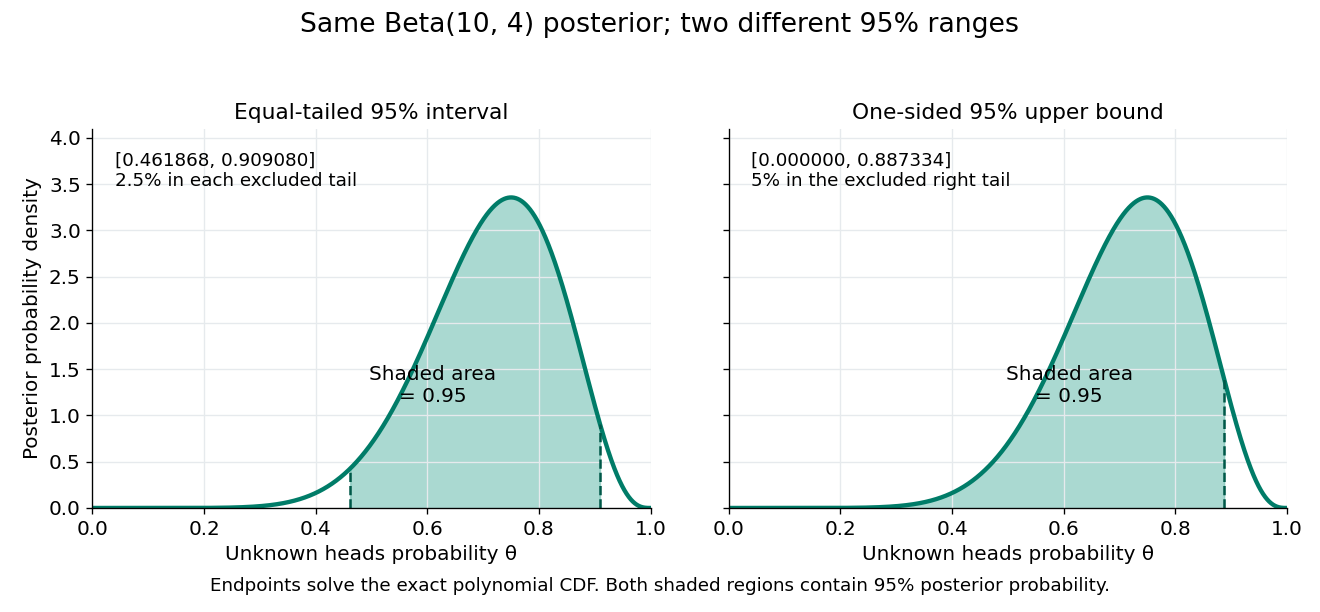
Credible intervals are not unique. The one-sided credible interval also has 95% posterior probability, but leaves all 5% outside it on the right. A highest density region instead selects points above a density threshold; it need not be an equal-tailed credible interval, and when the posterior density has separated peaks it need not be one interval at all. Thus a reported credible interval should specify its construction.
A 95% credible interval makes a statement about the statistical parameter conditional on these observed data and the Bayesian model. A 95% confidence interval instead refers to the coverage probability of a procedure under repeated sampling at a fixed parameter value. These are different conditioning statements: 95% posterior probability does not by itself imply 95% coverage probability for every fixed parameter. The confidence interval article develops that sampling interpretation.
Pinned article: Introduction to the OurBigBook Project
Welcome to the OurBigBook Project! Our goal is to create the perfect publishing platform for STEM subjects, and get university-level students to write the best free STEM tutorials ever.
Everyone is welcome to create an account and play with the site: ourbigbook.com/go/register. We belive that students themselves can write amazing tutorials, but teachers are welcome too. You can write about anything you want, it doesn't have to be STEM or even educational. Silly test content is very welcome and you won't be penalized in any way. Just keep it legal!
Intro to OurBigBook
. Source. We have two killer features:
- topics: topics group articles by different users with the same title, e.g. here is the topic for the "Fundamental Theorem of Calculus" ourbigbook.com/go/topic/fundamental-theorem-of-calculusArticles of different users are sorted by upvote within each article page. This feature is a bit like:
- a Wikipedia where each user can have their own version of each article
- a Q&A website like Stack Overflow, where multiple people can give their views on a given topic, and the best ones are sorted by upvote. Except you don't need to wait for someone to ask first, and any topic goes, no matter how narrow or broad
This feature makes it possible for readers to find better explanations of any topic created by other writers. And it allows writers to create an explanation in a place that readers might actually find it.
Figure 1. Screenshot of the "Derivative" topic page. View it live at: ourbigbook.com/go/topic/derivativeVideo 2. OurBigBook Web topics demo. Source. - local editing: you can store all your personal knowledge base content locally in a plaintext markup format that can be edited locally and published either:This way you can be sure that even if OurBigBook.com were to go down one day (which we have no plans to do as it is quite cheap to host!), your content will still be perfectly readable as a static site.
- to OurBigBook.com to get awesome multi-user features like topics and likes
- as HTML files to a static website, which you can host yourself for free on many external providers like GitHub Pages, and remain in full control

Figure 2. You can publish local OurBigBook lightweight markup files to either OurBigBook.com or as a static website.
Figure 3. Visual Studio Code extension installation.
Figure 5. . You can also edit articles on the Web editor without installing anything locally. Video 3. Edit locally and publish demo. Source. This shows editing OurBigBook Markup and publishing it using the Visual Studio Code extension. 
- Infinitely deep tables of contents:



All our software is open source and hosted at: github.com/ourbigbook/ourbigbook
Further documentation can be found at: docs.ourbigbook.com
Feel free to reach our to us for any help or suggestions: docs.ourbigbook.com/#contact